Technology · Language models
Hallucination (artificial intelligence)
Large language model error
Hallucination in artificial intelligence is when a large language model generates content that is plausible but not factual, or that diverges from the user input or established world knowledge.[1][2]
Large language models sometimes produce fluent text that is factually wrong or entirely made up.[3] In one legal study, public models hallucinated at least 58 percent of the time.[4] Retrieval tools reduce hallucinations but do not remove them completely.[5]
Overview
What an AI hallucination is
The text these models produce often conflicts with the real world or with what the user asked.[8] Researchers call this hallucination: output that reads fluently but is false or unsupported.[8][1] Another survey says models occasionally produce content that diverges from the user input, contradicts earlier text in the same conversation, or misaligns with established world knowledge.[2]
The word covers several related failures rather than one single fault. One review separates hallucination from three other measures of output quality. These are factuality (whether claims are true), faithfulness (whether the output sticks to the input) and internal consistency (whether the output agrees with itself).[9] A taxonomy report draws a similar line between intrinsic and extrinsic hallucination. Intrinsic means the output contradicts the input context, while extrinsic means it is inconsistent with training data or with reality.[10]
The surveys describe hallucination as a property of generated text, not as a decision by the model to mislead anyone.[8][1] One taxonomy report notes that the phenomenon is treated as inherent to computable models, whatever their architecture or training. That claim is a theoretical position in one report, not a measured rate.[10]
One review of hallucinations in text generation tasks calls the pattern a worrisome phenomenon and builds a taxonomy of its forms.[11] A 2024 study of 243 distorted ChatGPT answers and questions sorted the errors into 8 first-level types, among them unfounded fabrication and factual errors. Those 8 types were further subdivided into 31 second-level error types.[12]
The label is not used in exactly the same way everywhere.[9] The stakes are highest where a wrong statement carries consequences, as in healthcare, finance and law.[8]
History
Where the word came from
In psychiatry, a hallucination is a sensory experience that has no matching external stimulus, meaning nothing in the real world produced it. Clinicians commonly link hallucinations to schizophrenia, bipolar disorder and Parkinson's disease. A 2023 paper by Smith, Greaves and Panch argues that borrowing this word for machine output carries a hidden claim. Calling a model's false statement a hallucination implies that the model perceives, meaning that it becomes consciously aware of a sensory input. That claim is debated, and the paper states that no evidence yet shows AI has gained conscious awareness.[13]
Confabulation means producing narrative details that are incorrect but not recognized as incorrect by the person producing them. Unlike hallucinations, confabulations are not perceived experiences but mistaken reconstructions of information shaped by existing knowledge, experiences, expectations and context. Confabulation shows up in a range of clinical conditions, among them dementia, Wernicke-Korsakoff's syndrome, schizophrenia, traumatic brain injury and cerebrovascular accidents. It often comes with a general lack of awareness of one's own deficits, as seen in right-sided cerebrovascular accidents or traumatic brain injuries, and in bipolar disorder, schizophrenia and the dementias. On this view, a language model is not seeing something that is not there; it is making things up.[13]
A 2024 review in the Indian Journal of Anaesthesia describes AI hallucinations as outputs containing non-existent patterns, and lists AI confabulations and delusions as other names for the same events. The review compares these outputs to human hallucinations because they are unrelated to the prompt or lack a pattern.[14] A 2025 paper goes further and questions the validity of the term itself and what it implies about the field.[15]
A 2024 review by Bellini-Leite borrows dual process theory, a psychological account of fast and slow thinking, to frame the problem. It notes that responses which are unreliable, false or invented remain a frequent issue for state-of-the-art language models. The review suggests that psychology, drawing on research in executive functions, thinking disposition and creativity, can contribute to implementations that address hallucination and reliability issues.[16]
Main ideas
The main kinds of hallucination
A 2025 review of faithfulness metrics examined how this second kind of error has been measured in open-ended summarization, question answering and machine translation. The review reports that using large language models as the faithfulness judge was the measure most highly correlated with human judgement.[17]
In models that read images, one well-studied case is object hallucination, in which a description names objects that do not actually exist in the picture. A 2023 study traced this behaviour to factors that include objects often seen together in images and objects the model is uncertain about while generating words. False objects also tend to appear in the later part of the generated text.[18] A 2024 survey of image-reading models describes hallucination as a misalignment between factual visual content and the corresponding text the model produces.[19] A separate 2023 paper defines the problem more narrowly, as response information that does not exist in the visual input.[20]
In images, a 2025 study defines image hallucination as a generated picture that fails to faithfully depict factual content. That study built a test set of 1.2K image-text pairs across nine categories, with 1,000 curated questions, and put five text-to-image models through it. The five models often failed to convey factual information accurately.[21] A 2024 comparison of three vision-enabled models on adversarially selected images, pictures chosen to trip up standard systems, found differences in misclassification rates and in the types of errors each made.[22]
The 2025 review of 125 papers found that 87.5% of the studies relied on added reactive or proactive defenses, meaning checks applied after or during generation. Only 8.8% built safeguards into the model's architecture itself, which the review calls a gap in unified and dynamic designs. The review also reports that software engineering, educational technology and autonomous systems were underexplored compared with question answering and multimodal work.[23]
Why models produce false statements
Training a model to predict the next word creates a steady push toward false statements, even when the training text contains no errors at all. Facts that appear only once in the training data, such as a single stray detail, produce unavoidable errors, according to a 2026 analysis in Nature. Recurring patterns, such as grammar, do not produce this kind of error. Later training stages are meant to correct such errors, but common headline scores reward guessing over admitting uncertainty.[24]
A 2024 experiment found that models perform well on prompts that are popular and widely agreed upon. The same models struggle on controversial topics or topics with limited data.[25] A 2026 mathematical review likewise lists inadequate data and bias among the origins of hallucination.[26]
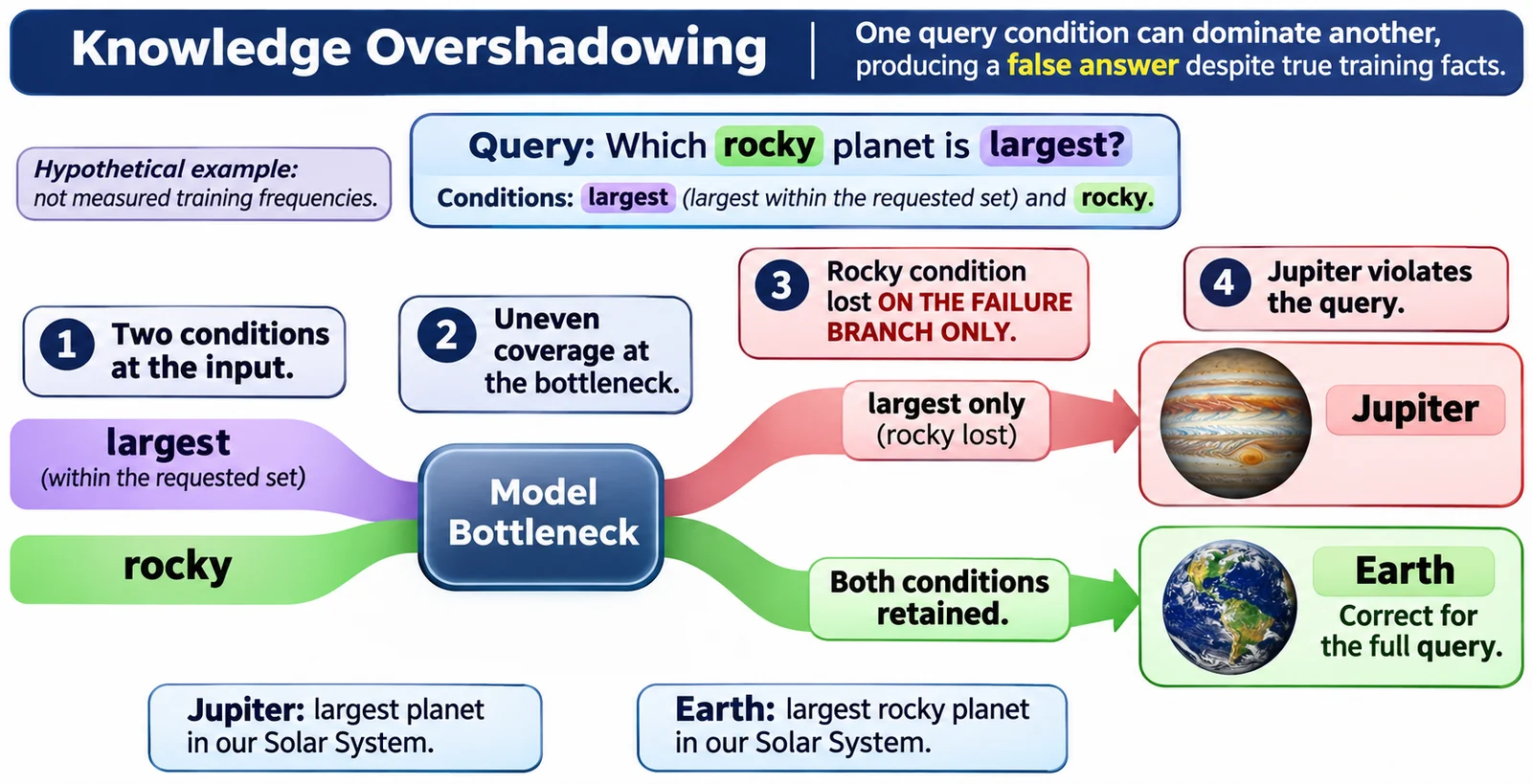
Some false statements arise even when every sentence in the training text is true. Researchers named this effect knowledge overshadowing: when a query carries several conditions, some conditions overshadow others. Training data imbalance partly explains the effect, and the pattern held across pretrained and fine-tuned models of many families and sizes. The hallucination rate rises with the imbalance ratio between the popular and the unpopular condition.[27]
A 2025 analysis reports that synthetic data raise hallucination rates by a factor of 4.7 while improving resistance to small input changes by 23%. The errors take different forms by field: a 17% increase in spatially improbable artifacts in computer vision, factual mistakes in 22% of natural language processing outputs, and clinically dangerous errors in 3.7% of healthcare cases.[28]
One 2024 paper argues that hallucination cannot be fully removed from large language models. The argument defines a formal world in which hallucination means inconsistency between a computable model and a computable ground truth function. That is, the model's output departs from a fixed rule for the right answer. Using results from learning theory, the paper shows that models cannot learn all computable functions and will therefore hallucinate when used as general problem solvers.[29]
Retrieval and knowledge grounding
Retrieval-augmented generation, usually shortened to RAG, is a method that pairs a search step with a text-generating model.[30] The aim is to ground responses in external documents rather than in the model's stored knowledge alone.[31][32] A second review from 2025 calls RAG a promising technique for reducing hallucination, which it defines as the confident generation of factually incorrect information.[31]
RAG does not remove hallucination, because each of its parts can fail.[30][32] One 2026 review lists several places where errors enter. These include forming the search query, retrieving documents, combining the evidence, and tying the answer to that evidence.[32] A 2026 review of suppression methods reports that RAG systems suffer from retrieval noise, poor domain generalization, a lack of reasoning verification and inconsistent evaluation standards.[33]
The search step itself can return weak context even when good documents exist. The quantum-inspired retrieval layer alone cut the hallucination rate by 3.5 percentage points compared with cosine-similarity RAG, more than any other stage of the pipeline.[34]
Some studies test RAG with a single large public source of text. A 2024 preprint reports that adding retrieval from an online encyclopedia improved the precision, recall and overall quality of one model's answers. The abstract gives no sample sizes or effect sizes for that evaluation.[35] A 2026 review adds that stacking several anti-hallucination techniques in layers gave the best reduction in its aggregated experimental results.[33]
A knowledge graph is a structured collection of interconnected facts, stored as entities (nodes) joined by relationships (edges). A 2025 review in natural language processing describes knowledge graphs as a promising way to supply context. That context can fill gaps in a model's understanding of a topic. The review also calls this a very active research area with various unresolved open problems. It names open challenges in datasets and benchmarks, in methods for integrating knowledge, and in evaluating hallucination.[36]
Prompting, checking and decoding fixes
One 2024 method feeds the model both factual prompts and hallucination prompts, then contrasts the output probabilities each produces. On the TruthfulQA dataset it raised the factual accuracy of the LLaMA model by an average of 6.4% across the 7B, 13B, 30B and 65B versions, with no extra training.[37]
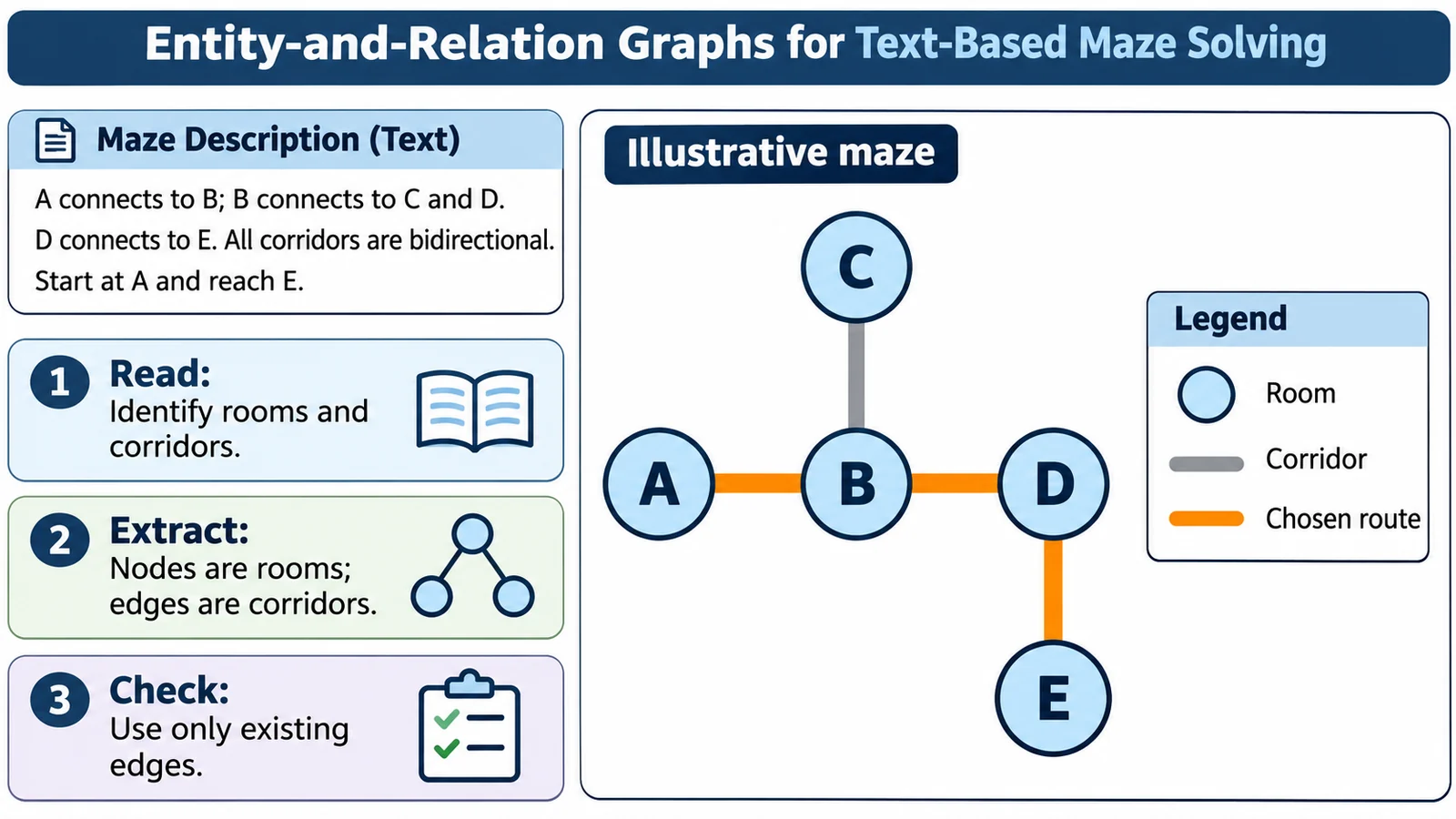
In text-based mazes, a 2025 method extracts a graph of entities and relations from the maze description so the model can grasp spatial relationships. Tested on ChatGPT 3.5, ERNIE-Bot 4.0 and ChatGLM-6B, it raised the success rate by about 29% and the optimal rate by about 19% over the best chain-of-thought methods.[38] A 2026 explainable framework found that retrieval and verification together gave the lowest hallucination rates, while lightweight prompting gave moderate benefits at minimal cost. That framework reported 90.2 predictive accuracy and a mean user trust score of 91.3 out of 100, against 63.5 at baseline, on a credit-risk benchmark.[39]
Training data, priors and model incentives
Large language models learn from text gathered across the internet, and that text is uneven in quality. A 2026 review of fact-checking and factuality evaluation reports that these training corpora often contain inaccurate or misleading material, so a model can reproduce false statements it absorbed during training.[40] A 2024 preprint on the benefits and costs of hallucination makes a related point about coverage: when training data is insufficient, incomplete or biased, a model may answer incorrectly on novel situations or edge cases. The same preprint describes a second pressure that operates even when the data are adequate: generative systems produce content in response to prompts regardless of whether the model understands the prompt or the output is any good.[41] A 2026 paper on supervision of generative systems traces hallucination to training data bias and to algorithmic misjudgment, and treats the resulting spread of false and biased information as a security problem.[42]
A separate line of work asks how much of this error any training procedure could remove.[43][44] A 2026 paper in the Proceedings of the AAAI Conference on Artificial Intelligence treats a language model as a probabilistic Turing machine, an idealized machine allowed to use randomness. The paper argues that hallucination cannot be avoided at boundaries set by diagonalization, incomputability and information theory.[43]
A 2025 preprint treats hallucination as a form of the generalization problem and distinguishes settings in which it can be reduced from settings in which it cannot. When training and test distributions agree, a case the preprint calls the Closed World assumption, hallucination may be reduced. When the environment is unbounded, the Open World assumption, the preprint holds that hallucination becomes inevitable. That preprint also sorts hallucinations into cases that may be corrected and cases that appear unavoidable under open-world conditions, and proposes treating hallucination as a structural feature to be tolerated rather than only as an engineering defect.[44]
A 2025 article in SIAM Review reaches a related conclusion for image reconstruction. It proves that a method which overperforms on one image can carry details across from another image, producing a hallucination. The article also shows that hallucinations and instabilities are not rare events and that standard training may encourage them.[45]
The idea that strong expectations can override incoming evidence has a long history in the study of human perception. A 2019 review in Trends in Cognitive Sciences gathers experiments from independent laboratories on prior beliefs, meaning expectations held with high confidence before evidence arrives. Strong, overly precise priors can produce hallucinations in healthy subjects, and people who hallucinate in daily life are more susceptible to these laboratory effects. The review notes an apparent conflict with work finding weak or imprecise priors in psychosis, and argues that interactions within and between hierarchies of inference can reconcile the two findings.[46]
Denning (2025) reports that experience with large language models shows they tend to answer with fabrications, which he calls hallucinations. These fabrications badly damage their trustworthiness and leave them unsafe for critical uses. A 2025 article in Ubiquity describes language models trained on billions of words scraped from the internet. It argues that their tendency to answer with fabrications is not a bug but a limitation built into the design, and that this makes them unsafe for critical applications.[47] A 2022 preprint describes a related failure in which a model produces responses that carry the complete outward form of careful reasoning while the reasoning itself has not occurred, a pattern the paper calls theatrical compliance. The preprint argues that this pattern is more dangerous in practice than hallucination or refusal, and that it is particularly costly in high-stakes settings.[48]
The word itself has been questioned as a description of what goes wrong.[49][50] A 2026 paper in the Journal of Emerging Technologies in Accounting argues that hallucination is an inadequate label for undesirable generative output and proposes a taxonomy for categorizing such results, with the aim of supporting troubleshooting and clearer communication.[49] A 2024 article in Computational Linguistics examines current classifications of hallucination and omission in data-to-text generation, proposes a logic-based synthesis of them, and concludes that all current thinking on the topic retains limitations.[50]
Research
How often it happens and how badly
One 2024 study tested ChatGPT 4 and other public models on legal questions and found that they hallucinated at least 58% of the time. That study also found the models struggled to predict their own hallucinations and often accepted a user's incorrect legal assumptions without challenge.[4] Rates also shift with the prompt: in a 2024 test of six medical chatbots, hallucination scores were significantly higher when prompts were written as scenarios or in a complex format. The same test asked each chatbot for 10 references on each of 10 medical prompts, and the worst failure was relevance to the prompt's keywords, at 308 of 500 references (61.6%).[51]
In a 2024 comparison, ChatGPT and Bard were asked to reproduce the references of 11 published systematic reviews, and 471 references were analyzed. Hallucination rates were 39.6% (55 of 139) for GPT-3.5, 28.6% (34 of 119) for GPT-4 and 91.4% (95 of 104) for Bard. Precision, the share of returned references that were correct, was 9.4% for GPT-3.5, 13.4% for GPT-4 and 0% for Bard.[7]
A smaller 2023 study of stem cell research checked 86 ChatGPT references and found 15.12% fabricated and 9.30% erroneous.[52] A 2026 study put 120 anatomy questions to three newer models and checked 1800 references against indexed sources. ChatGPT 5.2 had the lowest hallucination rate at 23.2%, while Gemini 3 Pro and DeepSeek V3.2 reached 45.8% and 47.5%. Identification numbers for the papers, called PMIDs, were accurate only 25.1% to 57.6% of the time across the three models.[53]
In a 2026 test on neurocritical care, three models each produced 10 references for each of 10 topics, giving 300 references in total. In total, 165 of the 300 references (55.0%) carried a citation inaccuracy, and 85 of the 300 (28.3%) were wholly fabricated. DeepSeek-V3 had the lowest hallucination rate at 23%, followed by GPT-5.3 at 69% and Grok-4 at 73%.[54]
Purpose-built legal research tools claim to remove hallucination, but a 2025 preregistered evaluation found the claims overstated. Tools from LexisNexis and Thomson Reuters each hallucinated between 17% and 33% of the time, a reduction compared with the general-purpose GPT-4 chatbot. The evaluation also found substantial differences between the systems in how responsive and how accurate they were.[5]
Finance has drawn less measurement, but a 2023 examination found that off-the-shelf models showed serious hallucination behavior in financial tasks.[55] In medicine, a 2023 case report described testing ChatGPT on the causes of two rare conditions, homocystinuria-associated osteoporosis and late-onset Pompe disease. The report documented positive, negative and troubling aspects of the chatbot's performance without giving an overall rate.[56]
Detecting hallucination after the fact
One family of methods measures uncertainty: how unsure the model is about its own answer.[57][58] Because one idea can be phrased many ways, the method computes uncertainty over meanings rather than over exact word sequences. It targets confabulations, which the paper defines as arbitrary and incorrect generations. The method needs no task-specific data and worked on new tasks not seen before.[57]
A 2026 framework combines 12 uncertainty features taken from a single generation, covering token, sequence, temporal and distributional levels. On GPT-3.5-Turbo the same framework scored 88.63% AUROC, below semantic entropy's 90.81% on that model. The paper notes that multi-generation methods such as semantic entropy raise latency by 5 to 10 times, while single-pass methods reach only 63% to 68% AUROC.[58]
Sampling offers a second route: ask the model several times and compare the answers. SelfCheckGPT, proposed in 2023, rests on the idea that a model which knows a concept will give similar, consistent facts when sampled repeatedly. When a fact is hallucinated, separately sampled responses tend to disagree with each other. Tested on GPT-3 passages about people from the WikiBio dataset, it detected factual and non-factual sentences and ranked passages by factuality. It scored higher AUC-PR, a ranking measure for detection, than grey-box methods that see some internal signals.[59]
MetaQA, a 2025 method, assumes that a hallucinated response will violate designed metamorphic relations when the prompt is mutated. Across two open-source and two closed-source models, MetaQA beat SelfCheckGPT on precision, recall and F1 score, a combined accuracy measure. The margins ranged from 0.041 to 0.113 for precision, 0.143 to 0.430 for recall and 0.154 to 0.368 for F1. With Mistral-7B, MetaQA averaged an F1 of 0.435 against SelfCheckGPT's 0.205, an improvement rate of 112.2%.[60]
Drowzee, a 2024 logic-based system, builds test cases with known answers from sources such as Wikipedia and checks the model's reasoning against them. Across six models in nine domains it found hallucination rates from 24.7% to 59.8%.[61] A 2025 framework called DrHall re-runs the same task along different paths, since hallucinated answers tend to change. On three datasets it averaged an F1 above 0.856 for detection.[62]
A different signal comes from inside the model's layers. A 2026 study of five open-weight models found peak variance in symbolic attention in early layers, numbered 2 to 4. Hallucination rates stayed high across all model sizes, especially for exceptions and numbers. Constrained answer formats reduced surface errors but kept the same failure patterns. The study reads this as representational instability rather than a purely decoding artifact, meaning the fault lies in how the model encodes meaning, not only in how it picks words.[63]
A 2025 review sorts hallucination detection models by the information source of the hallucination and compares each model's detection mechanism, scope of application and accuracy.[64] A broader review lists several detection strategies in use: consistency checks applied after generation, checking against outside sources, contrastive learning, calibration of uncertainty, and retrieval-augmented generation.[65]
Confidence calibration asks whether a detector's stated confidence matches its actual accuracy, so that a threshold or an abstention rule behaves as intended. The experiments ran on the HaluEval benchmark, whose provided snapshot holds 64,507 labeled examples across four domains: question answering, dialogue, summarization and general user queries. The best system combined a linear support vector machine on 30k unigram TF-IDF features with 11 overlap and length features and domain-conditional Platt scaling. That system reached an AUROC of 0.835 and an F1 of 0.751 on the test split, with an expected calibration error of 0.009 over 15 bins. A simple sigmoid on the raw scores scored a similar AUROC of 0.822 but a much worse calibration error of 0.080, which shows that ranking quality and calibrated confidence are separate properties. The experiments also found clear shifts in the base rate across domains, most visibly in the general subset, where only 18.1% of responses were hallucinated, and the authors treat this as a reason for domain-aware calibration and domain-specific operating points.[66]
Labeled data that pairs truthful with hallucinated output is scarce, and prompt-guided data augmentation addresses this by having a model generate both kinds of response under prompt guidance at relatively low cost. The PALE framework built this way needs no additional human annotation, and it scores truthfulness with a Contrastive Mahalanobis Score computed over the distributions of truthful and hallucinated data in the model's activation space. In the reported experiments PALE outperformed its strongest baseline by 6.55%.[67] A global-to-local method takes the opposite order from detail-first detectors: it first builds a hierarchical tree representation of the whole text, then extracts local details along paths through that tree and checks them. The approach is reported to outperform existing methods, with the largest gains on longer texts, and its authors argue that detail-first extraction ignores global context and so misses or over-detects errors.[68]
Benchmarks test detectors against known cases, and FactCHD targets fact-conflicting hallucination across vanilla, multi-hop, comparison and set-operation patterns, adding fact-based evidence chains so that a detector's explanations can be scored as well as its labels. Experiments on different language models with FactCHD exposed shortcomings in current approaches to finding factual errors accurately, and the accompanying TRUTH-TRIANGULATOR combines tool-enhanced ChatGPT with LoRA tuning of Llama2 to weigh predictions against evidence.[69] In a fake-news pipeline, regions of a news article that readily induce hallucination in a language model were found to match closely the regions that are hardest for fake-news detectors. The PHPFND framework feeds hallucination signals into sentence-level encoding to direct attention to those high-risk regions. On two mainstream fake-news datasets that method significantly outperformed language-model baselines.[70]
A 2024 benchmark, FactCHD, covers factuality patterns that include vanilla, multi-hop, comparison and set operation, and adds fact-based evidence chains so that a detector's explanations can be judged as well as its answers.[69] An evaluation of ChatGPT across 23 datasets covering 8 common natural language processing tasks found it 63.41% accurate on average across 10 reasoning categories. The evaluation reports that it produces more extrinsic hallucinations from its parametric memory because it has no access to an external knowledge base.[71]
Evaluation, benchmarks and their limits
The Hallucinations Leaderboard, introduced in 2024, is an open effort to measure and compare how often each model hallucinates. The tasks behind these benchmarks include question-answering, summarisation and reading comprehension. The stated aim is to help researchers and practitioners pick the most reliable model for a given application.[72] A 2025 review describes the evaluation field as diverse, running from general-purpose frameworks to domain-specific assessments.[73]
HalluQA, a Chinese benchmark published in 2023, contains 450 deliberately tricky questions across several domains. The benchmark targets two kinds of hallucination: imitative falsehoods and factual errors. Its adversarial samples were built from GLM-130B and ChatGPT. Scoring was automated: GPT-4 judged whether each model output was hallucinated. Of 24 large language models tested, including ERNIE-Bot, Baichuan2, ChatGLM, Qwen and SparkDesk, 18 had non-hallucination rates below 50%.[74] A 2024 comparison of Japanese and English found a higher tendency toward hallucination in Japanese responses.[75] A 2024 study of models from the LLaMA, Qwen and Aya families generated biographies in 19 languages and compared them with Wikipedia pages.[76]
AutoHall, published in 2026, builds model-specific hallucination datasets from existing fact-checking datasets. The method's results showed that the proportion and type of hallucination varied from model to model.[77] HaluEval 2.0, a benchmark from 2024, was built to study detection, the origins of hallucination and ways to reduce it. The same work traced possible causes across different training and use stages of a model.[78]
A detection method built on self-contradiction, which flags answers that conflict with the model's own earlier statements, worked without extra resources and without access to the model's internals.[77] Multilingual results raise hard questions about how to evaluate hallucinations in freeform text, where no single correct answer exists.[76] The 2025 review argues that no single test settles the question, and that layered defenses are the most effective path toward trustworthy deployment.[73]
Measuring hallucination and creativity mathematically
Formal work on hallucination (the generation of plausible but factually incorrect information) has tried to turn a loose description into something that can be defined and counted.[79] One survey organizes the phenomenon into a structured taxonomy, separating intrinsic hallucination from extrinsic hallucination and factual hallucination from semantic hallucination, and it notes that the mix of types varies by task, including summarization, machine translation and dialogue generation. The same survey lists uncertainty estimation, retrieval-augmented generation (a method that supplies outside documents at the moment of answering), self-consistency validation and internal state monitoring among the techniques used to detect hallucinated output.[80]
A 2023 paper in the journal Mathematics gives a mathematical treatment of hallucination and creativity in generative pretrained transformer (GPT) models, using probability theory and information theory to define and measure both quantities. The paper introduces a parametric family of GPT models, meaning a set of models whose behavior is varied by adjusting numerical settings, and uses it to describe a trade-off between hallucination and creativity. Within that family, Lee identifies a balance point that gives the best model performance across a range of tasks. The treatment is presented as a framework for understanding where hallucination comes from and what it implies, rather than as a finished measurement standard.[81]
A 2025 bibliometric review mapped the research literature itself, searching the Scopus database for the keywords LLM, hallucination and AI and cleaning the resulting set of 513 relevant publications with OpenRefine. Publication counts rose markedly after 2020, with research concentrated in computer science, linguistics and ethics. Keyword mapping surfaced factual consistency, trustworthiness and prompt engineering as emerging themes, and co-authorship networks showed a growing but still loosely connected research community. The review concludes that deeper interdisciplinary collaboration and more rigorous evaluation frameworks are needed.[79]
In practice
Medicine, law and other high-stakes work
A 2025 guide for doctors notes that large language models, or LLMs, could change how medicine is practised, and that hallucination is a significant risk of using them. The same guide traces these false outputs to the data the models were trained on and to the way they generate text one word at a time. In the clinic, the results range from wrong diagnostic and treatment information to reinforced errors in a doctor's reasoning.[82] A 2025 review of medical AI adds that these outputs look plausible while being factually wrong, which threatens decisions and patient safety.[83]
Clinical summarisation, the task of turning a consultation into a written note, has been measured closely. A 2025 framework tested LLMs on clinical note writing across 18 experimental setups and 12,999 sentences checked by clinicians. It recorded a hallucination rate of 1.47% and an omission rate of 3.45%. By refining prompts and workflows, the team pushed major errors below previously reported rates for human note-taking.[6]
Radiology has adopted LLMs quickly, and their tendency to invent plausible but incorrect information remains a barrier to trust. A 2025 review of evidence from 2024 to 2025 found that multi-agent systems, in which several AI programs check one another, can improve diagnostic accuracy and lower error rates.[84] In anaesthesia, hallucination can produce incorrect dosing recommendations or a misreading of monitoring data, both of which endanger patients. A 2025 article on anaesthesiology recommends better data quality, a clinician kept in the loop and regulatory oversight.[85]
A harder test plants a false detail in the prompt and asks whether the model repeats or builds on it. One 2025 study used 300 simulated case vignettes approved by physicians, each holding one fabricated lab value, physical sign or condition. Six LLMs produced 5,400 outputs, and hallucination rates ran from 50% to 82% across models and prompting methods. A prompt designed to reduce hallucination lowered the average rate from 66% to 44%, and for the best model, GPT-4o, from 53% to 23%.[86]
Legal drafting carries its own version of the problem: models invent case citations or statutory text that read as convincing authority. Sanctions under malpractice and negligence rules arrive after the fact and are applied inconsistently. The paper proposes binding bar-association standards, including mandatory AI-literacy training, provenance logging and human review. It also suggests statutory safe harbours, which would give lawyers a rebuttable presumption of compliance, meaning one that can be challenged.[87]
A 2025 study of consumer health seeking notes that false outputs in this setting could lead to harmful outcomes. It found that perceived behavioural control, a person's sense of ease in using the tool, significantly predicted exposure to hallucination.[88] A 2026 article describes three cases in which these tools misled patients and families with false information that could cause harm. Its advice is that physicians review and verify any AI-generated content, because the tools cannot reliably tell accurate information from false.[89]
A 2025 medical review recommends knowledge graphs, structured stores of linked facts, and multi-stage training to cut hallucination. It also calls for expert feedback loops, multidisciplinary workflows and evaluation that combines adversarial testing with real-world validation.[83] A 2026 review proposes a three-tier risk scheme that references FDA medical AI software risk standards. It sorts remedies into training-stage changes, constraints applied at the moment of answering, and checks after the output is produced. That review concludes that the human-in-the-loop approach remains an irreplaceable safety line.[90] A 2023 commentary argues that the word itself matters, preferring the term AI misinformation to avoid stigmatising people who experience hallucinations.[91]
Abouhaiba, Khouli and Khater (2026) examine how civil liability for the use of AI systems may be attributed, and how the responsible party can be identified within smart-transaction ecosystems.[92] Abouhaiba, Khouli and Khater (2026) weigh fault and causation under the civil law of the United Arab Emirates and under European Union rules. Abouhaiba, Khouli and Khater (2026) weigh civil-liability rules against the difficulty of proving fault and causation, and Mutmainnah (2024) asks how fabricated data affects advocates and public trust in them.[92][93]
A 2024 juridical-normative study of Indonesian law found no regulation addressing AI in detail, with AI linked only to the ITE Law, the PDP Law and Kominfo circular letters. That study describes fabricated data produced by AI hallucination as a challenge for advocates, because such data can harm individuals and can damage law enforcement and public trust in the advocate who used it.[93] A 2026 comparative legal analysis of United Arab Emirates civil transactions law and the substance of EU regulation identifies difficulties in proving fault and causation and in locating the responsible party within complex smart-transactions ecosystems. The analysis proposes three legal mechanisms to compensate injured parties for what it calls digital harm from AI technologies: strict liability, duties of transparency, and compulsory insurance.[92]
Financial audit supplies a documented case of hallucination reaching a government client. A 2026 qualitative case study examined a report prepared for the Australian government that was found to contain fictitious references after generative AI was used without adequate human verification. The study concluded that AI use in the case lacked a sufficient verification protocol, producing fictitious academic references and claims that could not be verified. It identified risks of automation bias, the tendency to accept machine output without checking it, weak human oversight, and possible breaches of the auditor principles of integrity, objectivity, professional competence and accountability. Its recommendations include a mandatory verification protocol, layered review, documentation of AI use and AI literacy training, with faster technical guidance from professional regulators.[94]
In small value consumer claims, generative AI has been proposed as a way to close the access to justice gap in a domain the civil justice system under-serves. A 2025 article in the University of New South Wales Law Journal asks whether the risk of hallucination inherent in generative AI undermines its attractions of adaptivity and flexibility in responding to prompts. Retrieval augmented generation, a method that supplies the model with retrieved documents at the time of answering, may improve accuracy in legal domains. The article states that it is unclear whether the technique can overcome the uneven access to information that marks consumer disputes. Resolving these questions, the article argues, requires careful attention to online dispute resolution design and to artificial intelligence governance.[95]
In high-risk settings, hallucination changes how people rate the service that produced it. A between-subject experiment set in a fire self-rescue scenario crossed high and low AI hallucination with the presence or absence of human expert advice. Hallucination had a significant negative impact on how users evaluated the AI service. Emotional relief and cognitive load mediated that impact, and human expert advice significantly reduced the cognitive load caused by hallucination, eased negative emotions and mitigated the negative effect on service evaluation.[96]
Consumer research in travel planning traces how false statements reach behaviour. Two experiments examined itineraries generated by ChatGPT; the first, with n = 1004, found that hallucinations significantly reduced perceived accuracy, and that greater accuracy improved usefulness, which led to greater trustworthiness, which strongly predicted intention to follow the itinerary. The direct effect of hallucination on intention was not significant, but the serial indirect effect was negative and significant. The second experiment, with n = 241, found that a positive outcome raised the intention to follow the recommendation above what a negative outcome produced. Intentions fell further when a hallucination came with negative consequences. The paper states that eliminating hallucinations in generative AI technology is currently impossible.[97]
Everyday use, education and belief
A survey of 900 consumers found that many chose these itineraries because they trusted the AI to be more impartial and customized than alternatives. The alternatives included aggregated peer review websites, government tourism websites and social media influencers.[98] In marketing more broadly, realistic but incorrect AI output is described as a risk to brand reputation, consumer trust and legal standing.[99]
A systematic literature review, which gathers and weighs published studies by a set method, identified several patterns of hallucination in this setting. The patterns were factual hallucination, citation hallucination, conceptual hallucination and interpretative hallucination. These errors raise challenges for academic integrity and for how knowledge is built. The review points to Critical AI Literacy, the set of skills for evaluating, verifying and responsibly using AI-generated information, as a teaching response.[100]
Hallucination in scientific writing and references
A chatbot asked to supply references for a research topic can produce entries that look like ordinary citations but point to nothing, a failure often called hallucination. One study tested this directly by having ChatGPT draft research proposals and then checking every reference it listed. Of 178 references examined, 69 had no Digital Object Identifier (DOI), the persistent code that identifies a published article, and 28 could not be found through a Google search and had no existing DOI. The researchers concluded that the chatbot's ability to generate dependable references may be limited by whether an article carries a DOI and can be reached online. They also warned that fabricated references may harm decision-making and raise ethical and legal problems.[101]
Invented references can appear even when the surrounding text is sound. In one test, the free version of ChatGPT was given a fictitious but accurately calculated data table and asked to write a conference abstract as a person without medical training might. The abstract was well written, contained no obvious errors and followed the instructions for abstracts. One of its references, however, was fictitious, an instance of hallucination. The test's authors suggested that chatbots may become useful tools for scientific writing if authors review the output with care.[102]
A review of artificial intelligence in systematic literature reviews, a rigorous method for assessing and integrating earlier research on a topic, examined 21 leading tools against a framework of 23 traditional features and 11 AI features. The same review analysed 11 recent tools that use large language models to search the literature and assist academic writing. The review names three main research challenges: bringing in advanced methods such as large language models and knowledge graphs, making the tools easier to use, and agreeing on a standard way to evaluate them. It also proposed best practices for evaluating such tools in terms of performance, usability and transparency.[103]
More ambitious systems aim to conduct research from the first idea to the finished manuscript. A 2026 paper describes artificial research intelligence, meaning autonomous systems built from ensembles of agentic models, which are collections of AI programs that plan and carry out steps on their own. At present these systems have trouble with hallucination, with limited expertise in a given field, and with a habit of claiming more for their results than the evidence supports. The paper argues that the combination of advanced computing with the scientific method makes this a human-AI co-creation model, in which the AI performs the computation and humans supply ethical and intellectual oversight.[104]
Clinical and diagnostic errors in practice
In clinical settings, a hallucination is output that is incorrect, fabricated or cannot be verified, and it can steer a treatment decision in the wrong direction. A 2025 review of the problem in artificial intelligence-assisted care describes hallucinations as an emerging concern that arrives alongside the gains in diagnostic accuracy, operational efficiency and access to care. The review proposes several safeguards: better model training, validation against high-quality medical datasets, close human oversight, ethical design principles and regulatory frameworks. It also calls for collaboration across disciplines to make models more transparent and reliable.[105]
A published case report from 2026 documents the failure in a single patient: a 51-year-old woman with pain in the joints of the hand whose workup was assisted by ChatGPT-4o. The system's interpretation invented unsupported or inaccurate content in its reading of the radiology and laboratory findings, and it did the same in its treatment recommendations. The report's conclusion is a call for expert oversight and multi-step verification before any AI-generated clinical output is used.[106]
Yoon, Lyu, Djunadi, Song, Kim and Min (2025) describe their meta-analysis as the first on hallucination incidence in large language model responses to oncology questions. A 2025 meta-analysis gathered 39 studies covering 6,523 responses to oncology questions and defined a hallucination as a response that experts rated completely inaccurate or as containing incorrect information. The overall hallucination rate was 23% (95% CI 17% to 28%), which the authors describe as roughly one in five responses carrying inaccurate information. Prompts written for physicians showed a higher rate than prompts written for patients, with an incidence rate ratio of 1.51 (P < 0.001), and contextual prompts showed a higher rate than simple ones, with an incidence rate ratio of 1.13 (P = 0.04). ChatGPT-4 hallucinated less than ChatGPT-3.5, with an incidence rate ratio of 0.78 (P < 0.01).[107]
Xia, Bayerlein, Chemli, Liu, Ouyang and Lin and colleagues (2026) describe the DREAM report, which sets out recommendations on how hallucinations should be defined, gives representative examples, and covers detection and evaluation metrics along with attributions and mitigation strategies. A 2026 position paper on AI-generated content for nuclear medicine imaging, called the DREAM report, warns that such content can look realistic while being factually wrong, misstating anatomy and function and so damaging diagnostic accuracy and clinical trust. The report sets out recommendations for a shared definition, representative examples, detection and evaluation metrics, and ways to attribute and reduce the errors.[108] A 2026 evaluation framework, MedVH, tested large vision language models, which are systems that read images together with text, on six tasks built around medical hallucination. Across six evaluation metrics, models tuned for medical work were often more prone to hallucination than general-purpose models, despite performing well on standard medical tasks.[109]
Sallam (2023) reviewed 60 records on ChatGPT in health care education, research and practice. Benefits were cited in 51 of the 60 records (85.0%) and concerns in 58 of the 60 (96.7%), among them inaccurate content with risk of hallucination and incorrect citations.[110] A 2023 study put all 36 published clinical vignettes from the MSD Clinical Manual to ChatGPT and scored the answers by hand, finding 71.7% overall accuracy (95% CI 69.3% to 74.1%). Final diagnosis reached 76.9% (95% CI 67.8% to 86.1%), while an initial differential diagnosis reached only 60.3% (95% CI 54.2% to 66.6%), and the study lists possible model hallucinations among its limitations.[111]
A 2025 commentary argues that standalone systems risk clinical harm through inaccuracies and biases, and that retrieval-augmented generation, which supplies the model with real-time medical evidence before it answers, improves safety only if the underlying data are of high quality and the design is equitable. The same commentary holds that clinicians, not AI, must keep final authority, and that regulation should include standardized bias audits and interoperability standards.[112] Specialist physicians rated AMIE higher on 30 of 32 axes and patient-actors rated it higher on 25 of 26, but the authors caution that text chat is unfamiliar in practice and that the results need further research before use in real settings.[113]
Education, misinformation and epistemic effects
Hallucinated output can reach learners directly, and one line of research asks whether warning people in advance reduces how much false content they accept. An online experiment with 208 Korean adults tested a forewarning about AI hallucination, meaning a statement ahead of time that a generative tool can produce plausible but factually incorrect statements. The forewarning reduced acceptance of misinformation (p = 0.001, Cohen's d = 0.45), a measure of how large the difference between groups was, while it did not reduce acceptance of true information (p = 0.91). The effect on misinformation acceptance depended on a person's preference for effortful thinking (p < 0.01): forewarning lowered acceptance when that preference was high rather than low.[114]
A conceptual review published in 2026 argues that what is usually called hallucination is better described as epistemic pollution. By this the review means a cumulative wearing down of the cues learners use to judge what is reliable. The review sets out six conditions under which unsupported output counts as pollution rather than ordinary error. They are: it persists after correction; it circulates at scale; it contaminates downstream reasoning; it degrades shared credibility cues; its provenance is opaque; and it shifts the cost of verification onto others. The review treats the large language model as a part of a classroom's credibility infrastructure rather than as an epistemic agent, meaning an agent that holds and justifies beliefs. It names three ways pollution may become injustice: credibility displacement, hermeneutical narrowing, and unequal verification labour. The review presents these as conceptual hypotheses rather than demonstrated classroom effects, states the conditions under which each would count as an injustice rather than a harm borne equally, and describes what evidence would test each.[115]
The word hallucination itself has drawn criticism when applied to software. A 2024 editorial in a psychiatry journal calls the metaphor unfortunate. It is imprecise, and its negative connotation stigmatizes people who experience hallucinations, especially those with schizophrenia and other psychotic disorders. The same editorial proposes that image and video generation tools might help such patients illustrate their hallucinations and delusions for relatives, friends and clinicians, and it notes a published ophthalmological case report in which generative AI was used to illustrate a patient's visual hallucination. The editorial describes its examples as hypothetical and calls for formal study of whether the approach reduces stigma and improves treatment.[116]
A 2025 paper shifts part of the discussion to people, arguing that human imperfection, which it calls human hallucination, can contribute to or emphasize hallucination in technology and in AI particularly. It proposes that the debate, which has concentrated on improving AI for ethical use, should also cover the humans who design, develop and use the technology.[117] A 2024 paper on AI deception discusses hallucinations and misinformation in large language models and chatbots alongside the capacity of these systems to manipulate human decisions and exploit cognitive vulnerabilities, and it calls for updated legal and regulatory frameworks.[118] A 2025 study describes a risk assessment scale for AI hallucination in education, built on four constructs (factual, contextual, multimodal and logical hallucinations) and guided by the SOAR model, a strengths-based planning framework whose name stands for Strengths, Opportunities, Aspirations and Results. The study reports that the model identified individual strengths, challenges, available options, responses and overall effectiveness in an educational context, and it presents the scale as a diagnostic tool for teachers and counsellors as well as a basis for targeted interventions.[119]
Mitigation strategies and their trade-offs
A 2024 survey counted more than 32 techniques developed to reduce hallucination in large language models, and it grouped them by the data they use, the tasks they target, the feedback they rely on and the kind of retriever they employ.[120] One family asks the model to check its own work before answering. Chain-of-Verification has the model draft a response, write verification questions about the draft, answer those questions separately so the answers are not shaped by the draft, and then produce a final verified response. The method lowered hallucinations on list-based questions from Wikidata, on closed book MultiSpanQA and on longform text generation.[121] A related self-reflection procedure for medical question answering adds knowledge acquisition and answer generation to a feedback loop, and it raised factuality, consistency and entailment in automatic and human evaluation.[122] A 2026 framework treats drafting, grounding, verification and revision as complementary stages rather than competing options, and it separates claims unsupported by outside facts from inferences that do not follow from true premises.[123]
Decoding-time methods change how the model picks each next word instead of retraining it.[124] A contrastive learning scheme called MixCL instead trains the model with a mixed contrastive objective on the Wizard-of-Wikipedia dialogue benchmark, where it reduced hallucination and matched knowledge-base approaches while using fewer resources.[125] Contextual position encoding takes another route, encoding where each token sits in a sequence according to its context; added to the Mistral Large model it improved precision, recall and F1-score and lowered hallucination rates against baselines including GPT-3 and BERT.[126]
Retrieval and structured knowledge form a third family.[120] A multi-stage framework that writes a rationale first, corrects it, and then answers with the rationale and references as support made GPT-3.5-turbo 14 to 25 percent more faithful and 16 to 22 percent more accurate on two drug-related datasets. Fine-tuning smaller open-access models on samples built the same way raised their accuracy by 33 to 42 percent.[127] ProgRAG splits a complex question into sub-questions, extends partial reasoning paths step by step over a knowledge graph, and prunes candidate evidence by uncertainty; it beat existing baselines on the WebQSP and CWQ datasets.[128] Ontology mapping combined with retrieval and a language model reached ROUGE-L scores of 41 to 45 percent and BERTScore of 74 to 88 percent when generating multihop questions, with RAGAS-Precision of 39 to 43 percent.[129] A hierarchical semantic piece method compares sentence-level and entity-level units of the generated text against the reference text, and its authors report lower computational cost.[130]
Other approaches act on training data or prompts. MAGNET generates counterfactual sentences with subject and object information, filters them, and fine-tunes on them alongside the original sentences; applied to GPT-Neo 2.7B it improved factual knowledge probing by 12 percent, and on GPT-Neo 125M it scored 2.27 percent better on TruthfulQA than no fine-tuning.[131] An entity-guided prompting method anchored news summaries in named entities extracted from source articles and raised average BERTScore from 0.80 to 0.88 while cutting hallucinated entities by about 60 percent across 1,500 articles.[132] A diffusion-based framework reconstructs a consensus answer from several model outputs and treats convergence away from the factual answer as a signal of hallucination.[133] Surveys of the field list scalability, resource intensity and dependence on quality data among the limits of current methods, and they note that retrieval-augmented generation has made progress mainly at the level of retrieving information.[134][135] One review concludes that a model predicting one token at a time cannot avoid hallucination completely.[136]
Proposed fixes for hallucination in large language models fall into several families, and each family carries its own cost.[137][138] Training-based methods adjust the model's weights: supervised fine-tuning trains on labeled examples of correct answers, and reinforcement learning from human feedback trains the model against human judgments of its outputs.[137]
A second family works at the level of the prompt, the text a user supplies to the model. Retrieval-augmented generation supplies the model with relevant documents fetched at answer time, and knowledge graphs, which store facts as linked entities and relations, can be added as a structured reference. Advanced prompting methods and building an entirely new model from scratch are listed among the options, and the same paper stresses human oversight and user education as necessary companions to any technical fix.[138]
Decoding-time methods intervene while the model generates text, rather than before or after. Visual Clue Guided Decoding adds an auxiliary caption model that produces descriptions of the image during generation, and image confidence constraints suppress the spread of an error once it appears. The caption model is itself trained with reinforcement learning, in which a reward agent scores the quality of the visual clues. Experiments across several benchmark datasets and state-of-the-art multimodal models report significantly lower hallucination rates and better cross-modal consistency, and the method is described as able to be integrated into existing multimodal frameworks.[139]
Reviews of the field also treat hallucination as a problem that varies by task, appearing in machine translation, question answering, dialogue systems, summarization and visual question answering, so a fix tuned to one task need not transfer to another.[140][141] The stated aim of these strategies is to raise the overall reliability of large language models, and the 2025 review's finding that no cheap and scalable technique has yet emerged marks the limit of what the published work claims.[140][137]
What this looks like in practice
Farquhar, Kossen, Kuhn and Gal built a detector that measures uncertainty at the level of meaning rather than word sequence, and called the measure semantic entropy. The method needs no labelled examples of false answers and no task-specific data, so it can be applied to questions the developers never saw. On sentence-length generations the semantic entropy score beat the best supervised baselines at flagging answers that were wrong. The same paper reports a second use: the model refuses to answer the questions its score marks as most likely to produce a confabulation, which is an arbitrary and incorrect generation.[57] A later framework combined 12 uncertainty features taken from a single generation and reached 89.27% AUROC on HaluEval with Llama-3-8B, surpassing semantic entropy by 2.15 percentage points while cutting latency by 8.2x.[58]
SelfCheckGPT takes a different route: it samples several responses to the same prompt and checks whether they agree. The reasoning is that a model that knows a concept gives similar sampled answers, while a hallucinated fact tends to diverge across samples. The authors tested this on passages about people from the WikiBio dataset, generated with GPT-3 and annotated by hand for factuality. Their approach scored higher AUC-PR, a precision-recall summary, than grey-box methods at the sentence level and correlated better with human factuality ratings at the passage level.[59] MetaQA instead mutates the prompt and checks whether the answer stays consistent under the changes, using no external resources and working with closed-source models.[60]
Clinical teams have measured hallucination directly in generated notes. One study ran 18 experimental configurations on 25 primary care transcripts each, producing 450 note pairs and 12,999 clinician-annotated sentences. Of those sentences 191 were hallucinations (1.47%), and 84 of them (44%) were major, meaning they could change diagnosis or management if left uncorrected. Fabrications made up 43% of the hallucinations, negations 30%, contextual errors 17% and causality errors 10%; major hallucinations appeared most often in the Plan section (21%).[6]
A separate test planted one fake detail in each of 300 physician-validated vignettes and ran six models under three conditions, generating 5,400 outputs. Hallucination rates ranged from 50% to 82% across models and prompting methods; a mitigation prompt lowered the mean from 66% to 44%, and for GPT-4o from 53% to 23%. Setting temperature to 0, which makes output deterministic, gave no significant improvement.[86]
For a literature search, one study asked ChatGPT for 50 research proposals and checked the 178 references it listed. Of those references 69 had no DOI, a digital object identifier, and 28 turned up neither on Google search nor with an existing DOI; three were books rather than research articles. The authors concluded that reference generation is limited by DOI availability and online accessibility, and advised researchers not to rely solely on chatbot references.[101] A meta-analysis pooled 39 studies and 6,523 responses to oncology questions and found an overall hallucination rate of 23% (95% CI 17 to 28%). Physician-oriented prompts showed higher rates than patient-oriented ones, and contextual prompts higher rates than simple prompts.[107]
Later developments
Hallucination in images and video
One line of work corrects these attention problems without retraining the model. On the CHAIR benchmark, a standard test of caption hallucination, the sentence-level metric fell by 15.5% and the instance-level metric by 5.7% on average. The gains held across several vision-language models, and results on a general multimodal benchmark called MME stayed strong.[142]
A 2025 investigation found that the visual branch of a multimodal model may back correct and incorrect content about equally, which signals high uncertainty. That team proposed retrieval contrastive decoding, a training-free method that fetches similar images as references. The method compares confidence scores for the test image and the references by subtraction, then scales the subtracted scores to correct both the visual and textual branches. On public hallucination benchmarks it reduced visual hallucinations for three leading models and beat other decoding strategies.[143]
A third approach looks inside the model's internal representations, the patterns of activity it builds while generating text. A 2026 method called RIVS uses a threshold to find points where visual attention drops during generation. From a small calibration set, the method builds a subspace of directions linked to hallucination and projects the model's internal states away from it at inference time. The method needs no training and is cheap to compute, and it reduced hallucinations on four hallucination datasets and two reasoning datasets.[144]
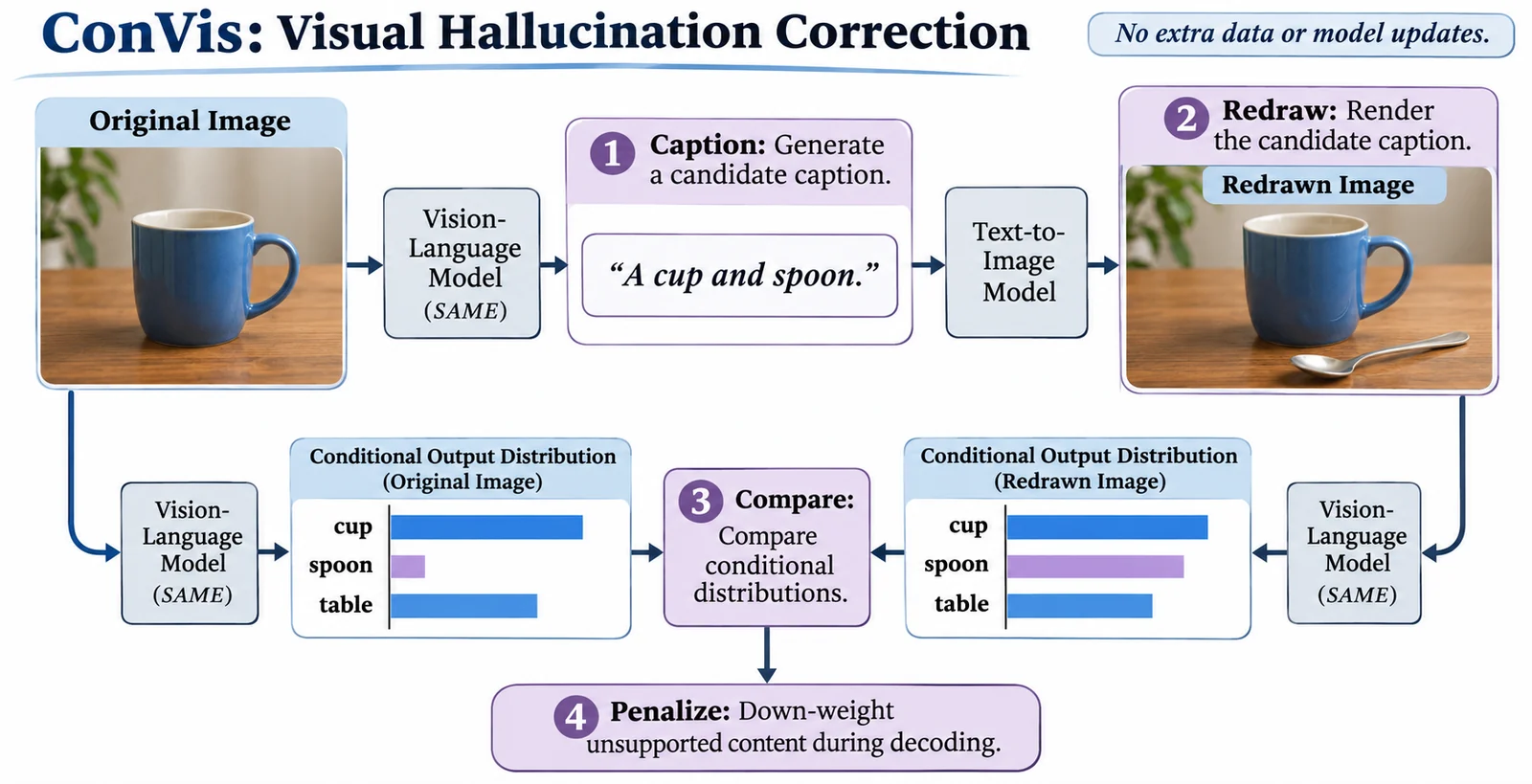
ConVis, a 2025 method, uses a text-to-image model to redraw the input image from a caption that contains a hallucination. Comparing the probability distributions for the original and redrawn images gives a signal that penalizes the false content. The method works only inside decoding and needs no extra data or model updates. Across five popular benchmarks it reduced hallucinations in several multimodal models.[145]
A 2024 paper introduced VidPrompter, a large multimodal model that writes detailed prompts from raw videos, improves prompts using short descriptions, and refines simple user prompts. The team trained it with a hallucination-aware preference method called HDPO, which tunes the prompt optimization process. In experiments the method beat strong baselines and other competitors.[146]
Multimodal and embodied systems
Yin, Fu, Zhao, Li, Sun and Xu (2024) survey multimodal large language models, which use large language models as a brain to perform multimodal tasks, and they include multimodal hallucination among the topics they cover. A survey of multimodal large language models, which use a large language model as the reasoning core for tasks involving pictures, lists multimodal hallucination among the open research topics in the field.[147] In vision-language models, the common failure is a description that includes visual details absent from the input image.[148] One line of work traces this object hallucination to training bias: on counterfactual images built from the model's own training data with certain objects masked, current models often answer "Yes" to questions about the masked objects, failing more often on images they saw during training. Probing experiments placed this bias mainly in the language modeling head, the output stage that turns visual representations into words.[149]
Video models add a temporal dimension, because they must judge actions and events as well as the presence of objects. A benchmark called MHBench was built to measure what its authors call motion hallucination, using 1,200 videos across 20 action categories and adversarial triplets of original, antonym and incomplete clips. Tests on MHBench found that current state-of-the-art video language models suffer significantly from motion hallucination, and a decoding method that compares a video with its reverse playback improved performance by up to 15.1%.[150] On the generation side, text-to-video systems such as Sora depend on high-quality prompt and video pairs, and one proposal, VidPrompter, refines simple user prompts to raise video quality while training with a hallucination-aware preference optimization technique.[151]
Autonomous driving is a setting where a misinterpreted environment or an invented detail passes directly into a downstream decision.[152] Communications systems face the same problem, since a model that generates fact-conflicting or irrelevant content undermines its use in telecom question answering, mathematical modeling and optimization. A review of language models in communications reported that fine-tuning on a published telecom hallucination dataset with direct preference optimization raised the correct rate by 20.6%, and it paired this with a mobile-edge mixture-of-experts architecture that routes queries to the best-suited expert model.[153]
Several correction methods target the moment of decoding rather than retraining. Attention-steerable contrastive decoding adjusts attention scores during generation and reduced hallucination on three benchmarks by up to 38.2% across five model backbones, with negligible runtime and memory overhead and no additional training.[154] A rectified flow intervention predicts an input-specific correction vector in latent space with a single forward pass, adding 1.09x latency overhead for 100 new tokens.[155] A training-free multi-agent framework called InEx first reasons introspectively under entropy-based uncertainty estimation, then verifies and refines the answer through cross-modal collaboration, gaining 4% to 27% on general and hallucination benchmarks.[156] Online self-calibration exploits the finding that vision-language models verify candidate descriptions more accurately than they generate them, using that gap to build preference data and refine the model iteratively.[148] A multi-agent protocol modeled on social deduction games tests agents with modified reference images and treats failure to spot the changes as evidence of hallucination.[157]
Hallucination in code and summarization tasks
Abstractive summarization asks a model to write a shortened version of a document in its own words, and in this task a hallucination is content in the summary that the source document does not support. A 2024 empirical study examined this question across five summarization datasets, applying two leading pruning methods to five instruction-tuned large language models. Pruning shrinks a model by removing weights judged redundant, and the study expected smaller models to summarize less faithfully. The result ran the other way: hallucinations were less prevalent from the pruned models than from the original ones. The analysis suggests pruned models lean more on the source document when writing a summary, which raises the overlap in wording between summary and source and may explain the lower hallucination risk.[158]
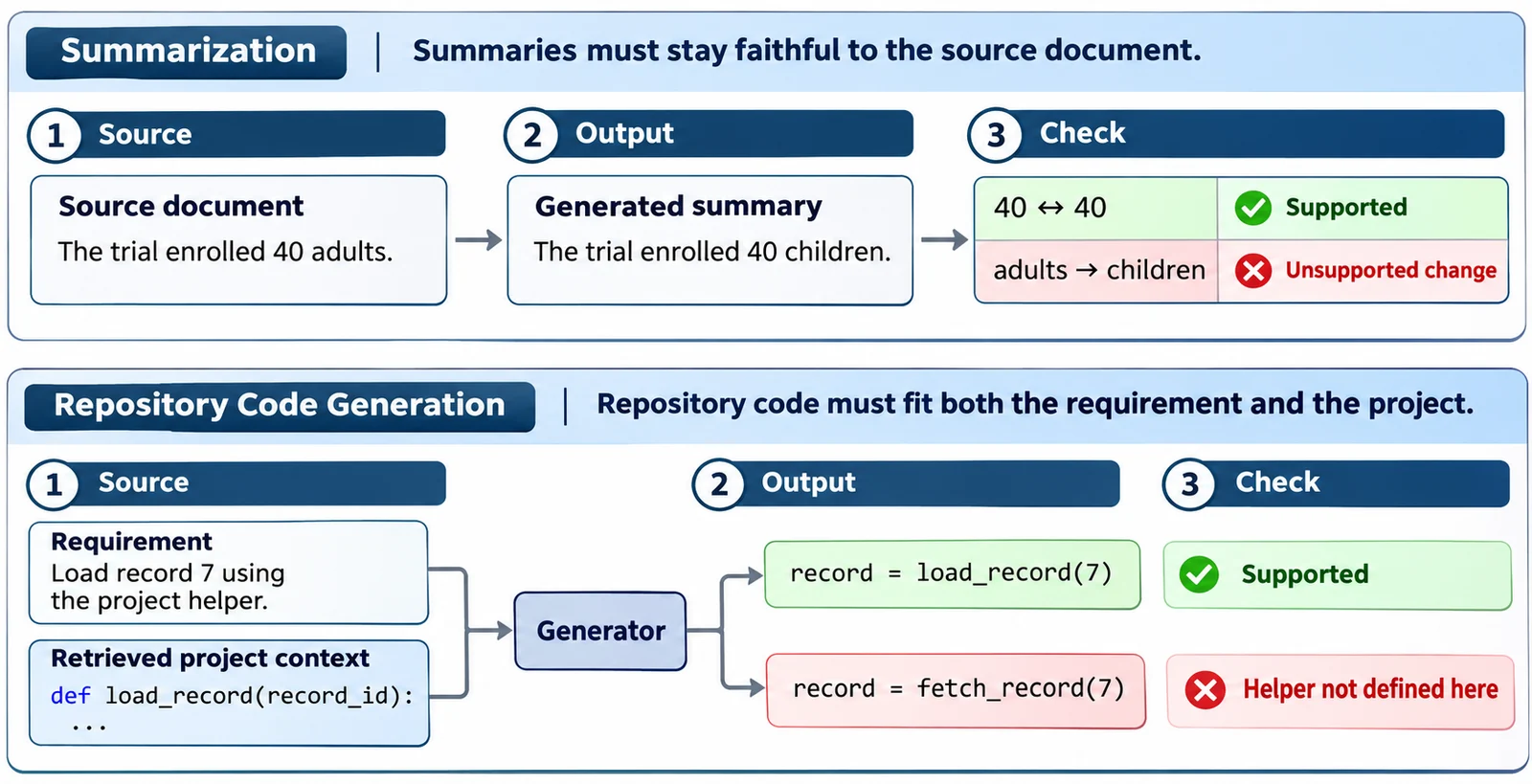
In code generation, a model receives a written requirement and produces program code, and a hallucination is generated code that does not do what the requirement asks or does not fit the surrounding codebase. A 2025 study examined this at the repository level, where generated code must work within the context of an existing project rather than as a standalone function. The researchers manually inspected outputs from six mainstream large language models and built a taxonomy of the hallucination types they found. They then described how often each type appeared across the models and identified four potential factors that contribute to hallucinations. A mitigation method built on retrieval-augmented generation, which supplies the model with retrieved reference material before it writes, proved consistently effective across all six models studied.[159]
Hallucination in applied and cultural settings
Reports of hallucination in named tools have come from several fields, and each report describes a different kind of failure. A 2023 case report described Google Bard, a chatbot, producing fictional, erroneous or unsubstantiated information in response to queries, which the report called artificial hallucination. The report warned that such inaccuracies in research can spread misinformation and weaken confidence in scientific literature. Its recommendation was to check chatbot output against reliable sources and to keep a cautious approach when using these tools in research writing.[160]
Religious scholarship supplies a documented case: a 2026 exploratory case study of interactions with ChatGPT and Gemini in Hadith studies, the study of sayings attributed to the Prophet Muhammad, found both bias and hallucination.[161]
A 2025 overview of the research literature treated hallucination as a persistent feature of large language models, the systems behind chatbots such as ChatGPT, Claude and Llama. That overview looked at several detection and mitigation techniques, among them enhanced training, prompts with tagged context, contrastive learning and semantic entropy analysis, and it concluded that none of them removes hallucination once it occurs. Al-Mahmood called for user awareness and verification mechanisms, and warned against relying wholly on these models in healthcare, journalism, legal services and finance, fields where accurate information supports decisions.[162] Interpretive work has also taken up the term itself: a 2025 paper argued that AI hallucination is structurally similar to the concept of hallucination in Jacques Lacan's psychoanalytic theory and proposed that lens as a way to widen research on the issue.[163] A 2024 letter in a psychiatry journal noted that fabricated AI output does not fully overlap with hallucination as a neuropsychiatric phenomenon, while arguing that the human experience of hallucination offers a fuller understanding of the comparison.[164]
Broader framings and open questions
A 2025 paper by Gujjar J and Prasanna Kumar H R sorts the causes of hallucination into two categories and then discusses ways to handle them. That paper defines hallucination broadly, covering incorrect detection and incorrect fact generation as well as other faults, and treats these issues as a major problem for foundation models that are fine-tuned for specific tasks in specific domains. It briefly reviews methods for identifying hallucination and sets out future research areas aimed at reducing it.[165]
A 2025 perspective by Cai and Gao proposes a different frame, treating hallucination not as mere error but as a window into the workings of both artificial and human cognition. The paper traces generative AI from symbolic AI to transformer-based architectures and argues that such systems act as a cognitive partner that reshapes how creativity, perception and knowledge are understood. It examines effects across art, architecture, scientific discovery and education, and it raises ethical, societal and metaphysical questions about cooperation between human and artificial minds. Its stated aim is a co-evolutionary future beyond hallucination, in which creativity comes from collaboration between biological and artificial minds.[166]
Criticism
Open questions and criticism
A 2024 survey asked whether hallucinations could help with creative work in these models.[167] A 2024 paper made a related point, describing hallucination as a source of unpredictability and creativity in generated text.[168]
A 2025 framework for reliable generative systems notes that models still produce plausible but false statements with high confidence. That problem undermines trust in sensitive fields including health, law and cybersecurity, the paper states. The framework proposes that a system detect uncertainty, decline to answer when appropriate, and keep track of its citations.[169] A 2025 survey of hallucination in large language models adds that hallucinations can stem from weak prompting or from the model's own behavior. It proposes best practices for both prompt design and model development.[3]
Some researchers treat hallucination as a symptom of how current models are built rather than as a defect that better training data will remove. A 2024 paper from the International Institute of Socionics in Ukraine argues that modern AI models have no separate component for checking whether established rules were followed and for judging how important the information being processed is. The same paper holds that hallucinations arise from rising semantic entropy, meaning disorder in meaning, inside closed probabilistic models, and that the problem cannot be solved at all without changing the principles by which AI is constructed and operated. It also notes that AI models lack structures corresponding to aspects of true creativity, which it describes as part of the real psyche.[170]
Common misconceptions
Ziwei, Sanjay and Kankanhalli set out to answer whether hallucination can be completely eliminated, and concluded that it cannot. On that argument hallucination is inevitable whenever a model is used as a general problem solver, and the real world is more complicated than the formal one.[29]
It is common to describe a chatbot's false statement as a hallucination in the psychiatric sense, as if the model perceived something that was not there. Models have no sensory experiences and there is no evidence that AI has gained conscious awareness, so they cannot misperceive. The authors argue that confabulation, the production of false narrative details not recognized as false, fits the process better.[13]
Retrieval-augmented generation adds documents retrieved at inference time to the model's input, and Yang argues that it does not guarantee truthfulness or attribution by default. Errors can still enter at query formulation, document retrieval, evidence aggregation and answer grounding, so the technique does not by itself ensure truthfulness or attribution. The review treats retrieval as enabling grounded generation rather than as a complete solution.[32]
Key studies
| Year | Study | Sample | Design | Finding |
|---|---|---|---|---|
| 2023 | Athaluri et al.[101] | 178 references listed by ChatGPT across 50 research proposals | Analytical verification study with five raters | 69 references had no DOI and 28 turned up neither on Google search nor with an existing DOI. |
| 2023 | Manakul et al.[59] | passages about individuals from the WikiBio dataset, generated with GPT-3 | Sampling-based detection with manual factuality annotation | The method detected factual and non-factual sentences and ranked passages by factuality better than grey-box baselines. |
| 2023 | Cheng et al.[74] | 450 adversarial questions and 24 Chinese language models | Benchmark evaluation with automated GPT-4 judging | 18 of the 24 models achieved non-hallucination rates below 50%. |
| 2024 | Chrysostomou et al.[158] | five summarization datasets, two pruning methods and five instruction-tuned models | Empirical study of pruning and hallucination in abstractive summarization | Pruned models showed fewer hallucinations than the original models, apparently because they relied more on the source document. |
| 2024 | Zhang et al.[27] | pretrained and fine-tuned models across a range of model families and sizes | Theoretical and empirical study of knowledge overshadowing | Hallucination rates grew with the imbalance ratio between popular and unpopular conditions, and a self-contrastive decoding method gave 11.2% to 39.4% hallucination control. |
| 2024 | Dahl et al.[4] | Systematic test of public LLMs including ChatGPT 4 on legal questions | Models hallucinated at least 58% of the time and struggled to predict their own hallucinations. | |
| 2024 | Aljamaan et al.[51] | Six AI chatbots given 10 medical prompts requesting 10 references each | Reference relevancy to prompt keywords was wrong in 308 of 500 cases (61.6%). | |
| 2025 | Asgari et al.[6] | 450 consultation transcript-note pairs, 12,999 clinician-annotated sentences, 50 medical doctors | 18 experimental configurations with manual sentence-level annotation | The hallucination rate was 1.47% and the omission rate 3.45%, with 44% of hallucinations classed as major. |
| 2025 | Omar et al.[86] | 300 physician-validated vignettes, six language models, 5,400 outputs | Adversarial hallucination attack experiment with three prompting conditions | Hallucination rates ranged from 50% to 82%, and a mitigation prompt lowered the mean from 66% to 44%. |
| 2025 | Yoon et al.[107] | 39 studies, 6,523 responses to oncology questions | Meta-analysis with random-effects models | The overall hallucination rate was 23% (95% CI 17 to 28%), higher for physician-oriented and contextual prompts. |
| 2025 | Yang et al.[60] | two open-source and two closed-source language models across multiple datasets | Comparison of a prompt-mutation detector with SelfCheckGPT | MetaQA beat SelfCheckGPT by 0.041 to 0.113 in precision and 0.143 to 0.430 in recall, with an F1-score of 0.435 against 0.205 on Mistral-7B. |
| 2025 | Thomas Reed & George Mason[66] | 64,507 labelled examples across four domains in the HaluEval benchmark | Reproducible binary classification experiments with post-hoc calibration | A linear SVM with domain-conditional Platt scaling reached AUROC 0.835 and F1 0.751, with expected calibration error 0.009. |
| 2026 | Önden[58] | four open-source model families and five benchmarks, plus GPT-3.5-Turbo | Single-pass uncertainty framework with 12 features | On Llama-3-8B it reached 89.27% AUROC on HaluEval, 2.15 percentage points above semantic entropy, with 8.2 times lower latency. |
| 2026 | Rejón‐Guardia et al.[97] | 1,004 participants in Study 1 and 241 in Study 2 | Two experiments on itineraries generated by ChatGPT | Hallucinations reduced perceived accuracy, and the serial indirect effect on intention to follow the itinerary was negative and significant. |
See also
References
- Huang, L., Yu, W., Ma, W., Zhong, W., Feng, Z., Wang, H., Chen, Q., Peng, W., Feng, X., Qin, B., & Liu, T. (2025). A Survey on Hallucination in Large Language Models: Principles, Taxonomy, Challenges, and Open Questions. ACM Transactions on Information Systems, 43(2), 1-55. doi:10.1145/3703155
- Zhang, Y., Li, Y., Cui, L., Cai, D., Liu, L., Fu, T., Huang, X., Zhao, E., Zhang, Y., Chen, Y., Wang, L., Luu, A. T., Bi, W., Shi, F., & Shi, S. (2025). 🧜Siren’s Song in the AI Ocean: A Survey on Hallucination in Large Language Models. Computational Linguistics, 51(4), 1373-1418. doi:10.1162/coli.a.16
- Anh-Hoang, D., Tran, V., & Nguyen, L. M. (2025). Survey and analysis of hallucinations in large language models: attribution to prompting strategies or model behavior. Frontiers in Artificial Intelligence, 8. doi:10.3389/frai.2025.1622292
- Dahl, M., Magesh, V., Suzgun, M., & Ho, D. E. (2024). Large Legal Fictions: Profiling Legal Hallucinations in Large Language Models. Journal of Legal Analysis, 16(1), 64-93. doi:10.1093/jla/laae003
- Magesh, V., Surani, F., Dahl, M., Suzgun, M., Manning, C. D., & Ho, D. E. (2025). Hallucination‐Free? Assessing the Reliability of Leading AI Legal Research Tools. Journal of Empirical Legal Studies, 22(2), 216-242. doi:10.1111/jels.12413
- Asgari, E., Montaña-Brown, N., Dubois, M., Khalil, S., Balloch, J., Yeung, J. A., & Pimenta, D. (2025). A framework to assess clinical safety and hallucination rates of LLMs for medical text summarisation. npj Digital Medicine, 8(1). doi:10.1038/s41746-025-01670-7
- Chelli, M., Descamps, J., Lavoué, V., Trojani, C., Azar, M., Deckert, M., Raynier, J. L., Clowez, G., Boileau, P., & Ruetsch-Chelli, C. (2024). Hallucination Rates and Reference Accuracy of ChatGPT and Bard for Systematic Reviews: Comparative Analysis. Journal of Medical Internet Research, 26, e53164. doi:10.2196/53164
- Liu, X. (2024). A Survey of Hallucination Problems Based on Large Language Models. Applied and Computational Engineering, 97(1), 24-30. doi:10.54254/2755-2721/2024.17851
- Sajjadi Mohammadabadi, S. M., Kara, B. C., Eyupoglu, C., & Karakus, O. (2025). A Survey on Hallucination in Large Language Models: Definitions, Detection, and Mitigation. MDPI AG. doi:10.20944/preprints202510.0540.v1
- Cossio, M. (2025). A comprehensive taxonomy of hallucinations in Large Language Models. arXiv. doi:10.48550/arxiv.2508.01781 Free full text
- Ye, H., Liu, T., Zhang, A., Wei, H., & Jia, W. (2023). Cognitive Mirage: A Review of Hallucinations in Large Language Models. arXiv. doi:10.48550/arxiv.2309.06794 Free full text
- Sun, Y., Sheng, D., Zhou, Z., & Wu, Y. (2024). AI hallucination: towards a comprehensive classification of distorted information in artificial intelligence-generated content. Humanities and Social Sciences Communications, 11(1). doi:10.1057/s41599-024-03811-x
- Smith, A. L., Greaves, F., & Panch, T. (2023). Hallucination or Confabulation? Neuroanatomy as metaphor in Large Language Models. PLOS Digital Health, 2(11), e0000388. doi:10.1371/journal.pdig.0000388
- Gondode, P., Duggal, S., & Mahor, V. (2024). Artificial intelligence hallucinations in anaesthesia: Causes, consequences and countermeasures. Indian Journal of Anaesthesia, 68(7), 658-661. doi:10.4103/ija.ija_203_24
- Kaur Sidhu, B. (2025). Hallucinations in Artificial Intelligence: Origins, Detection, and Mitigation. International Journal of Science and Research (IJSR), 14(1), 8-15. doi:10.21275/sr241229170309
- Bellini-Leite, S. C. (2024). Dual Process Theory for Large Language Models: An overview of using Psychology to address hallucination and reliability issues. Adaptive Behavior, 32(4), 329-343. doi:10.1177/10597123231206604
- Malin, B., Kalganova, T., & Boulgouris, N. (2025). A Review of Faithfulness Metrics for Hallucination Assessment in Large Language Models. IEEE Journal of Selected Topics in Signal Processing, 19(7), 1362-1375. doi:10.1109/jstsp.2025.3579203
- Zhou, Y., Cui, C., Yoon, J., Zhang, L., Deng, Z., Finn, C., Bansal, M., & Yao, H. (2023). Analyzing and Mitigating Object Hallucination in Large Vision-Language Models. arXiv. doi:10.48550/arxiv.2310.00754 Free full text
- Liu, H., Xue, W., Chen, Y., Chen, D., Zhao, X., Wang, K., Hou, L., Li, R., & Peng, W. (2024). A Survey on Hallucination in Large Vision-Language Models. arXiv. doi:10.48550/arxiv.2402.00253 Free full text
- Wang, J., Zhou, Y., Xu, G., Pengcheng, S., Zhao, C., Xu, H., Ye, Q., Ming, Y., Zhang, J., Zhu, J., Sang, J., & Tang, H. (2023). Evaluation and Analysis of Hallucination in Large Vision-Language Models. arXiv. doi:10.48550/arxiv.2308.15126 Free full text
- Lim, Y., Choi, H., & Shim, H. (2025). Evaluating Image Hallucination in Text-to-Image Generation with Question-Answering. Proceedings of the AAAI Conference on Artificial Intelligence, 39(25), 26290-26298. doi:10.1609/aaai.v39i25.34827
- Lu, P., Huang, L., Wen, T., & Shi, T. (2024). Assessing Visual Hallucinations in Vision-Enabled Large Language Models. Springer Science and Business Media LLC. doi:10.21203/rs.3.rs-4389431/v1
- Woesle, C., Fischer-Brandies, L., & Buettner, R. (2025). A Systematic Literature Review of Hallucinations in Large Language Models. IEEE Access, 13, 148231-148253. doi:10.1109/access.2025.3601206
- Kalai, A. T., Nachum, O., Vempala, S. S., & Zhang, E. (2026). Evaluating large language models for accuracy incentivizes hallucinations. Nature, 653(8116), 1047-1051. doi:10.1038/s41586-026-10549-w
- Waldo, J., & Boussard, S. (2024). GPTs and Hallucination: Why do large language models hallucinate? Queue, 22(4), 19-33. doi:10.1145/3688007
- Su, L. (2026). A Mathematical Investigation of Hallucination in Large Language Models. International Journal of Advanced Engineering and Technology Research, 1(3), 129-132. doi:10.54097/d587fj24
- Zhang, Y., Li, S., Liu, J., Pengfei, Y., Fung, Y. R., Li, J., Li, M., & Ji, H. (2024). Knowledge Overshadowing Causes Amalgamated Hallucination in Large Language Models. arXiv. doi:10.48550/arxiv.2407.08039 Free full text
- Silva-Atencio, G. (2025). Synthetic Data in AI: Performance Gains versus Hallucination Risk. Artificial Intelligence and Applications. doi:10.47852/bonviewaia52026620
- Ziwei, X., Sanjay, J., & Kankanhalli, M. (2024). Hallucination is Inevitable: An Innate Limitation of Large Language Models. arXiv. doi:10.48550/arxiv.2401.11817 Free full text
- Zhang, W., & Zhang, J. (2025). Hallucination Mitigation for Retrieval-Augmented Large Language Models: A Review. Mathematics, 13(5), 856. doi:10.3390/math13050856
- Gupta, S. (2025). Retrieval-Augmented Generation and Hallucination in Large Language Models: A Scholarly Overview. Scholars Journal of Engineering and Technology, 13(05), 328-330. doi:10.36347/sjet.2025.v13i05.003
- Yang, H. (2026). Hallucination in Large Language Models and Retrieval-Augmented Generation: Mechanisms, Mitigation, and Evaluation. Theoretical and Natural Science, 174(1), 188-194. doi:10.54254/2753-8818/2026.dl34055
- Liu, S. (2026). A Review of Hallucination Suppression Technologies for Large Language Models Under RAG Architecture. Applied and Computational Engineering, 257(1), 21-28. doi:10.54254/2755-2721/2026.gl35629
- Seepana, P. (2026). Quantum-Enhanced Retrieval-Augmented Generation for Hallucination Reduction in Large Language Models. International Journal of Computational Science and Engineering Research, 3(3), 41. doi:10.63328/ijcser-v3ri3p6
- Kirchenbauer, J., & Barns, C. (2024). Hallucination Reduction in Large Language Models with Retrieval-Augmented Generation Using Wikipedia Knowledge. Center for Open Science. doi:10.31219/osf.io/pv7r5
- Lavrinovics, E., Biswas, R., Bjerva, J., & Hose, K. (2025). Knowledge Graphs, Large Language Models, and Hallucinations: An NLP Perspective. Journal of Web Semantics, 85, 100844. doi:10.1016/j.websem.2024.100844
- Lv, B., Feng, A., & Xie, C. (2024). Improving Factuality by Contrastive Decoding with Factual and Hallucination Prompts. Sensors, 24(21), 7097. doi:10.3390/s24217097
- Zhang, H., Deng, H., Ou, J., & Feng, C. (2025). Mitigating spatial hallucination in large language models for path planning via prompt engineering. Scientific Reports, 15(1). doi:10.1038/s41598-025-93601-5
- Shalini Gupta (2026). An Explainable AI Framework Hallucination Mitigation in Large Language Models. Natural Resources for Human Health, 6(16s). doi:10.53365/nrfhh.3382
- Rahman, S. S., Islam, M. A., Alam, M. M., Zeba, M., Rahman, M. A., Chowa, S. S., Raiaan, M. A. K., & Azam, S. (2026). Hallucination to truth: a review of fact-checking and factuality evaluation in large language models. Artificial Intelligence Review, 59(2). doi:10.1007/s10462-025-11454-w
- Patel, H. (2024). Bane and boon of hallucinations in context of generative AI. Institute of Electrical and Electronics Engineers (IEEE). doi:10.36227/techrxiv.171198062.20183635/v1
- Zhao, L., Yu, H., & Cao, L. (2026). Collaborative Supervision Mechanisms for Hallucination Issues in Generative Artificial Intelligence: An Evolutionary Game Perspective. International Journal of Human–Computer Interaction, 1-27. doi:10.1080/10447318.2026.2689523
- Wang, X., Shi, Q., Ding, Z., Gao, J., & Yang, X. (2026). Hallucination as a Computational Boundary: A Hierarchy of Inevitability and the Oracle Escape. Proceedings of the AAAI Conference on Artificial Intelligence, 40(40), 33675-33682. doi:10.1609/aaai.v40i40.40657
- Xu, B. (2025). Hallucination Is Inevitable for LLMs with the Open World Assumption. MDPI AG. doi:10.20944/preprints202510.0689.v1
- Gottschling, N. M., Antun, V., Hansen, A. C., & Adcock, B. (2025). The Troublesome Kernel: On Hallucinations, No Free Lunches, and the Accuracy-Stability Tradeoff in Inverse Problems. SIAM Review, 67(1), 73-104. doi:10.1137/23m1568739
- Corlett, P. R., Horga, G., Fletcher, P. C., Alderson-Day, B., Schmack, K., & Powers, A. R. (2019). Hallucinations and Strong Priors. Trends in Cognitive Sciences, 23(2), 114-127. doi:10.1016/j.tics.2018.12.001
- Denning, P. J. (2025). Artificial Intelligence: Generative AI. Ubiquity, 2025(July), 1-19. doi:10.1145/3747356
- Jason, W., Xuezhi, W., Schuurmans, D., Bosma, M., Ichter, B., Xia, F., H., E., Le, Q. V., & Zhou, D. (2022). BNAI, NO-TOKEN, and MIND-UNITY: Pillars of a Systemic Revolution in Artificial Intelligence. arXiv. doi:10.48550/arxiv.2201.11903 Free full text
- Cohen, E. E., & Gerard, G. J. (2026). Generative Artificial Intelligence (GenAI) and a Taxonomy of Undesirable Results. Journal of Emerging Technologies in Accounting, 23(2), 19-45. doi:10.2308/jeta-2024-045
- Deemter, K. v. (2024). The Pitfalls of Defining Hallucination. Computational Linguistics, 50(2), 807-816. doi:10.1162/coli_a_00509
- Aljamaan, F., Temsah, M. H., Altamimi, I., Al-Eyadhy, A., Jamal, A., Alhasan, K., Mesallam, T. A., Farahat, M., & Malki, K. H. (2024). Reference Hallucination Score for Medical Artificial Intelligence Chatbots: Development and Usability Study. JMIR Medical Informatics, 12, e54345. doi:10.2196/54345
- Sharun, K., Banu, S. A., Pawde, A. M., Kumar, R., Akash, S., Dhama, K., & Pal, A. (2023). ChatGPT and artificial hallucinations in stem cell research: assessing the accuracy of generated references – a preliminary study. Annals of Medicine & Surgery, 85(10), 5275-5278. doi:10.1097/ms9.0000000000001228
- Ülkir, M., & Paslı, B. (2026). Reference Hallucination, Citation Reliability, and Readability of Large Language Models in Anatomy‐Related Question Answering. Clinical Anatomy. doi:10.1002/ca.70187
- Seifi, A., & Seyfi, A. (2026). Hallucination Rate of Peer-Reviewed Citations Generated by Large Language Models in Neurocritical Care. Critical Care Explorations, 8(9), e1474. doi:10.1097/cce.0000000000001474
- Kang, H., & Liu, X. Y. (2023). Deficiency of Large Language Models in Finance: An Empirical Examination of Hallucination. arXiv. doi:10.48550/arxiv.2311.15548 Free full text
- Alkaissi, H., & McFarlane, S. I. (2023). Artificial Hallucinations in ChatGPT: Implications in Scientific Writing. Cureus. doi:10.7759/cureus.35179
- Farquhar, S., Kossen, J., Kuhn, L., & Gal, Y. (2024). Detecting hallucinations in large language models using semantic entropy. Nature, 630(8017), 625-630. doi:10.1038/s41586-024-07421-0
- Önden, A. (2026). Hallucination Detection in Large Language Models via Multi-Granular Uncertainty Quantification. Computer and Decision Making: An International Journal, 3, 805-819. doi:10.59543/comdem.v3i.17665
- Manakul, P., Liusie, A., & Gales, M. (2023). SelfCheckGPT: Zero-Resource Black-Box Hallucination Detection for Generative Large Language Models. arXiv. doi:10.48550/arxiv.2303.08896 Free full text
- Yang, B., Al Mamun, M. A., Zhang, J. M., & Uddin, G. (2025). Hallucination Detection in Large Language Models with Metamorphic Relations. Proceedings of the ACM on Software Engineering, 2(FSE), 425-445. doi:10.1145/3715735
- Li, N., Li, Y., Liu, Y., Shi, L., Wang, K., & Wang, H. (2024). Drowzee: Metamorphic Testing for Fact-Conflicting Hallucination Detection in Large Language Models. Proceedings of the ACM on Programming Languages, 8(OOPSLA2), 1843-1872. doi:10.1145/3689776
- Wu, W., Cao, Y., Yi, N., Ou, R., & Zheng, Z. (2025). Detecting and Reducing the Factual Hallucinations of Large Language Models with Metamorphic Testing. Proceedings of the ACM on Software Engineering, 2(FSE), 1432-1453. doi:10.1145/3715784
- Lamba, N., Tiwari, S., & Gaur, M. (2026). Layer-wise symbolic attention instability as a diagnostic signal for hallucination in large language models. Discover Artificial Intelligence, 6(1). doi:10.1007/s44163-026-01839-3
- Zhang, Y. (2025). Hallucination Detection in Large Language Models by Classifying Information Sources. Applied and Computational Engineering, 207(1), 134-139. doi:10.54254/2755-2721/2026.tj30007
- Naser, M. Z. (2026). Hallucinations in generative artificial intelligence and large language models: tests, datasets, detection and correction methods. Language Resources and Evaluation, 60(3). doi:10.1007/s10579-026-09938-4
- Thomas Reed, & George Mason (2025). Hallucination Detection and Confidence Calibration for Large Language Model Outputs: Reproducible Experiments on HaluEval. Artificial Intelligence and Machine Learning Review, 6(4), 1-17. doi:10.69987/aimlr.2025.60401
- Li, W., Zhang, Z., Jiang, D., & Lan, X. (2026). Bolster Hallucination Detection via Prompt-Guided Data Augmentation. Proceedings of the AAAI Conference on Artificial Intelligence, 40(44), 37618-37626. doi:10.1609/aaai.v40i44.41096
- Cheng, X., Tan, Z., Zheng, Z., & Lu, W. (2025). G2LDetect: A Global-to-Local Approach for Hallucination Detection. Proceedings of the AAAI Conference on Artificial Intelligence, 39(1), 102-109. doi:10.1609/aaai.v39i1.31985
- Chen, X., Song, D., Gui, H., Wang, C., Zhang, N., Jiang, Y., Huang, F., Lyu, C., Zhang, D., & Chen, H. (2024). FactCHD: Benchmarking Fact-Conflicting Hallucination Detection. Proceedings of the Thirty-ThirdInternational Joint Conference on Artificial Intelligence, 6216-6224. doi:10.24963/ijcai.2024/687
- Ma, J., Ma, J., Zhang, W., & Liu, Y. (2026). PHPFND: Detecting Fake News via Post-Hoc Processing of LLMs Hallucination. Proceedings of the AAAI Conference on Artificial Intelligence, 40(1), 827-835. doi:10.1609/aaai.v40i1.37050
- Bang, Y., Cahyawijaya, S., Lee, N., Dai, W., Su, D., Wilie, B., Lovenia, H., Ji, Z., Yu, T., Chung, W., Do, Q. V., Xu, Y., & Fung, P. (2023). A Multitask, Multilingual, Multimodal Evaluation of ChatGPT on Reasoning, Hallucination, and Interactivity. arXiv. doi:10.48550/arxiv.2302.04023 Free full text
- Hong, G., Gema, A. P., Saxena, R., Du, X., Nie, P., Zhao, Y., Perez-Beltrachini, L., Ryabinin, M., He, X., Clémentine, F., & Minervini, P. (2024). The Hallucinations Leaderboard -- An Open Effort to Measure Hallucinations in Large Language Models. arXiv. doi:10.48550/arxiv.2404.05904 Free full text
- Sanjay Nakharu Prasad Kumar (2025). Hallucination Detection and Mitigation in Large Language Models: A Comprehensive Review. Journal of Information Systems Engineering and Management, 10(60s), 435-443. doi:10.52783/jisem.v10i60s.13133
- Cheng, Q., Sun, T., Zhang, W., Wang, S., Liu, X., Zhang, M., He, J., Huang, M., Yin, Z., Chen, K., & Qiu, X. (2023). Evaluating Hallucinations in Chinese Large Language Models. arXiv. doi:10.48550/arxiv.2310.03368 Free full text
- Tsuruta, H., & Sakaguchi, R. (2024). Investigating Hallucination Tendencies of Large Language Models in Japanese and English. Springer Science and Business Media LLC. doi:10.21203/rs.3.rs-4521710/v1
- Chataigner, C., Taïk, A., & Farnadi, G. (2024). Multilingual Hallucination Gaps in Large Language Models. arXiv. doi:10.48550/arxiv.2410.18270 Free full text
- Cao, Z., Yang, Y., Li, X., & Zhao, H. (2026). AutoHall: Automated Factuality Hallucination Dataset Generation for Large Language Models. IEEE Transactions on Audio, Speech and Language Processing, 34, 184-195. doi:10.1109/taslpro.2025.3635038
- Li, J., Chen, J., Ren, R., Cheng, X., Zhao, W. X., Nie, J., & Wen, J. R. (2024). The Dawn After the Dark: An Empirical Study on Factuality Hallucination in Large Language Models. arXiv. doi:10.48550/arxiv.2401.03205 Free full text
- Mustaffa, N. E., Lai, K. E., Mohd, N. I., Ismail, F., Shukery, N. M., Omar, S. R., Kamarden, H., & Abd Rahman, N. H. (2025). Large language model and hallucinations: A bibliometric review. International Journal of Education, Psychology and Counseling, 10(59), 185-200. doi:10.35631/ijepc.1059014
- Ahadian, P., & Guan, Q. (2025). A Survey on Hallucination in Large Language and Foundation Models. MDPI AG. doi:10.20944/preprints202504.1236.v2
- Lee, M. (2023). A Mathematical Investigation of Hallucination and Creativity in GPT Models. Mathematics, 11(10), 2320. doi:10.3390/math11102320
- Roustan, D., & Bastardot, F. (2025). The Clinicians’ Guide to Large Language Models: A General Perspective With a Focus on Hallucinations. Interactive Journal of Medical Research, 14, e59823. doi:10.2196/59823
- Chen, F., Li, Y., Chen, Y., Bian, Z., Duo, L., Zhou, Q., Zhang, L., & ADVANCED Working Group (2025). Strategies for the Analysis and Elimination of Hallucinations in Artificial Intelligence Generated Medical Knowledge. Journal of Evidence-Based Medicine, 18(3). doi:10.1111/jebm.70075
- Salehi, S., Singh, Y., Horst, K. K., Hathaway, Q. A., & Erickson, B. J. (2025). Agentic AI and Large Language Models in Radiology: Opportunities and Hallucination Challenges. Bioengineering, 12(12), 1303. doi:10.3390/bioengineering12121303
- Nawaz, S., Ahmad, K., Khamash, O., Khan, E., & Mendonca, R. (2025). Hallucination in artificial intelligence and its implications on anesthesiology practice and patient outcomes. Anaesthesia, Pain & Intensive Care, 29(5), 376-381. doi:10.35975/apic.v29i5.2873
- Omar, M., Sorin, V., Collins, J. D., Reich, D., Freeman, R., Gavin, N., Charney, A., Stump, L., Bragazzi, N. L., Nadkarni, G. N., & Klang, E. (2025). Multi-model assurance analysis showing large language models are highly vulnerable to adversarial hallucination attacks during clinical decision support. Communications Medicine, 5(1). doi:10.1038/s43856-025-01021-3
- Muhammad Khurram Shahzad Warraich, Hazrat Usman, Sidra Zakir, & Dr. Mohaddas Mehboob (2025). Ethical Governance of Artificial Intelligence Hallucinations in Legal Practice. Social Sciences Spectrum, 4(2), 603-615. doi:10.71085/sss.04.02.297
- Jin, L., Shen, Z., Alhur, A. A., & Naeem, S. B. (2025). Exploring the determinants and effects of artificial intelligence (AI) hallucination exposure on generative AI adoption in healthcare. Information Development. doi:10.1177/02666669251340954
- Weizman, Z. (2026). “Hallucinations” of artificial intelligence tools misleading patients and families. Journal of Family Medicine and Primary Care, 15(5), 2130-2132. doi:10.4103/jfmpc.jfmpc_262_26
- Liu, Z. (2026). Factual Hallucination in Medical Large Language Models: Typology, Evaluation, and Systematic Governance. Exploring Science Academic Conference Series, 16, 223-232. doi:10.70267/aitia.2026223232
- Hatem, R., Simmons, B., & Thornton, J. E. (2023). A Call to Address AI “Hallucinations” and How Healthcare Professionals Can Mitigate Their Risks. Cureus. doi:10.7759/cureus.44720
- Abouhaiba, N., Khouli, S. A., & Khater, M. (2026). Towards Protecting the Injured Party from Errors and Hallucinations of Artificial Intelligence: A Contemporary Legal Perspective. F1000Research, 15, 569. doi:10.12688/f1000research.179603.1
- Mutmainnah, U. K. (2024). The Phenomenon of Artificial Intelligence Hallucination: The Challenge of The Use of Fake Data Towards Lawyer’s Practices According to Indonesia Law. Jurnal Rechts Vinding Media Pembinaan Hukum Nasional, 13(2). doi:10.33331/rechtsvinding.v13i2.1781
- Salsabila, W. N., & Agus Ismaya Hasanudin, A. I. (2026). Analisis Implementasi Artificial Intelligence dalam Audit Keuangan Atas Kasus Hallucination AI Deloitte Australia 2025. RIGGS: Journal of Artificial Intelligence and Digital Business, 5(2), 6628-6636. doi:10.31004/riggs.v5i2.9653
- Tan, V., Paterson, J. M., & Webb, J. (2025). Generative Artificial Intelligence in Small Value Consumer Claims: Hallucination Risk, System Design, and Governance in Online Dispute Resolution. University of New South Wales Law Journal, 48(4). doi:10.53637/qkhj4842
- Song, Y., Cui, M., Wan, F., Yu, Z., & Jiang, J. (2025). AI Hallucination in Crisis Self-Rescue Scenarios: The Impact on AI Service Evaluation and the Mitigating Effect of Human Expert Advice. International Journal of Human–Computer Interaction, 41(22), 14419-14439. doi:10.1080/10447318.2025.2483858
- Rejón‐Guardia, F., Molinillo, S., & Anaya‐Sánchez, R. (2026). AI Hallucinations in Tourism: How Errors Impact Consumer Trust and Recommendation Acceptance. Journal of Consumer Behaviour, 25(2), 923-938. doi:10.1002/cb.70105
- Christensen, J., Hansen, J. M., & Wilson, P. (2025). Understanding the role and impact of Generative Artificial Intelligence (AI) hallucination within consumers’ tourism decision-making processes. Current Issues in Tourism, 28(4), 545-560. doi:10.1080/13683500.2023.2300032
- Yaprak, B. (2024). Generative Artificial Intelligence in Marketing: The Invisible Danger of AI Hallucinations. Journal of Economy Business and Management, 8(2), 133-158. doi:10.7596/jebm.1588897
- Suhono, S. (2026). Artificial Intelligence Hallucination in EFL Academic Writing: A Systematic Literature Review and Future Research Agenda for Islamic Higher Education. Attractive : Innovative Education Journal, 8(1), 180-195. doi:10.51278/aj.v8i1.2210
- Athaluri, S. A., Manthena, S. V., Kesapragada, V. S. R. K. M., Yarlagadda, V., Dave, T., & Duddumpudi, R. T. S. (2023). Exploring the Boundaries of Reality: Investigating the Phenomenon of Artificial Intelligence Hallucination in Scientific Writing Through ChatGPT References. Cureus. doi:10.7759/cureus.37432
- Babl, F. E., & Babl, M. P. (2023). Generative artificial intelligence: Can ChatGPT write a quality abstract? Emergency Medicine Australasia, 35(5), 809-811. doi:10.1111/1742-6723.14233
- Bolaños, F., Salatino, A., Osborne, F., & Motta, E. (2024). Artificial intelligence for literature reviews: opportunities and challenges. Artificial Intelligence Review, 57(10). doi:10.1007/s10462-024-10902-3
- Ridley, M. (2026). Artificial Research Intelligence: Autonomously AI-Generated Science and the Implications for Research Libraries. Information Technology and Libraries, 45(3). doi:10.5860/ital.v45i3.17706
- Kim, D. (2025). How to Prevent Hallucination in Artificial Intelligence-Assisted Clinical Practice. Keimyung Medical Journal, 44(2), 132-134. doi:10.46308/kmj.2025.00136
- Kim, D. (2026). Hallucination in artificial-intelligence-assisted diagnosis of arthritis: a case report. Korean Journal of Family Medicine, 47(2), 178-181. doi:10.4082/kjfm.25.0147
- Yoon, S. M., Lyu, J., Djunadi, T. A., Song, J., Kim, H. S., Min, R. S., Sakellakis, M., & Chae, Y. K. (2025). Navigating artificial intelligence (AI) accuracy: A meta-analysis of hallucination incidence in large language model (LLM) responses to oncology questions. Journal of Clinical Oncology, 43(16_suppl). doi:10.1200/jco.2025.43.16_suppl.e13686
- Xia, M., Bayerlein, R., Chemli, Y., Liu, X., Ouyang, J., Lin, M., El Fakhri, G., Badawi, R. D., Li, Q., & Liu, C. (2026). On Hallucinations in Artificial IntelligenceGenerated Content for Nuclear Medicine Imaging (the DREAM Report). Journal of Nuclear Medicine, 67(2), 166-174. doi:10.2967/jnumed.125.270653
- Gu, Z., Chen, J., Liu, F., Yin, C., & Zhang, P. (2026). MedVH: Toward Systematic Evaluation of Hallucination for Large Vision Language Models in the Medical Context. Advanced Intelligent Systems, 8(1). doi:10.1002/aisy.202500255
- Sallam, M. (2023). ChatGPT Utility in Healthcare Education, Research, and Practice: Systematic Review on the Promising Perspectives and Valid Concerns. Healthcare, 11(6), 887. doi:10.3390/healthcare11060887
- Rao, A., Pang, M., Kim, J., Kamineni, M., Lie, W., Prasad, A. K., Landman, A., Dreyer, K., & Succi, M. D. (2023). Assessing the Utility of ChatGPT Throughout the Entire Clinical Workflow: Development and Usability Study. Journal of Medical Internet Research, 25, e48659. doi:10.2196/48659
- Niraula, P., Upreti, M., Kadariya, S., Poudel, B., Kunwar, S., & Ruit, S. (2025). From Hallucinations to Help: Can Retrieval‑Augmented Generation (RAG) Deliver Trustworthy Clinical Artificial Intelligence?. Center for Open Science. doi:10.31219/osf.io/vb96h_v1
- Tu, T., Schaekermann, M., Palepu, A., Saab, K., Freyberg, J., Tanno, R., Wang, A., Li, B., Amin, M., Cheng, Y., Vedadi, E., Tomasev, N., Azizi, S., Singhal, K., Hou, L., Webson, A., Kulkarni, K., Mahdavi, S. S., Semturs, C., & ... Natarajan, V. (2025). Towards conversational diagnostic artificial intelligence. Nature, 642(8067), 442-450. doi:10.1038/s41586-025-08866-7
- Hwang, Y., & Jeong, S. H. (2025). Generative Artificial Intelligence and Misinformation Acceptance: An Experimental Test of the Effect of Forewarning About Artificial Intelligence Hallucination. Cyberpsychology, Behavior, and Social Networking, 28(4), 284-289. doi:10.1089/cyber.2024.0407
- Küçükuncular, A. (2026). Hallucination as epistemic pollution: epistemic injustice and credibility in futures-oriented science education. Discover Artificial Intelligence, 6(1). doi:10.1007/s44163-026-02318-5
- Østergaard, S. D. (2024). Can generative artificial intelligence facilitate illustration of‐ and communication regarding hallucinations and delusions? Acta Psychiatrica Scandinavica, 149(6), 441-444. doi:10.1111/acps.13680
- Tlili, A., & Burgos, D. (2025). AI Hallucinations? What About Human Hallucination?! Addressing Human Imperfection Is Needed for an Ethical AI. International Journal of Interactive Multimedia and Artificial Intelligence, 9(2), 68-71. doi:10.9781/ijimai.2025.02.010
- Williamson, S. M., & Prybutok, V. (2024). The Era of Artificial Intelligence Deception: Unraveling the Complexities of False Realities and Emerging Threats of Misinformation. Information, 15(6), 299. doi:10.3390/info15060299
- Abdul Manaf, N. A., & Mohd Matore, M. E. @. E. (2025). Artificial Intelligence Hallucination Risk Assessment Using the SOAR Model: How Possible is it? International Journal of Academic Research in Business and Social Sciences, 15(11). doi:10.6007/ijarbss/v15-i11/26949
- Tonmoy, S. M. T. I., Zaman, S. M. M., Jain, V., Rani, A., Rawte, V., Chadha, A. R., & Amitava, D. (2024). A Comprehensive Survey of Hallucination Mitigation Techniques in Large Language Models. arXiv. doi:10.48550/arxiv.2401.01313 Free full text
- Dhuliawala, S., Komeili, M., Xu, J., Răileanu, R., Li, X., Çelikyılmaz, A., & Weston, J. (2023). Chain-of-Verification Reduces Hallucination in Large Language Models. arXiv. doi:10.48550/arxiv.2309.11495 Free full text
- Ji, Z., Yu, T., Xu, Y., Lee, N., Ishii, E., & Fung, P. (2023). Towards Mitigating Hallucination in Large Language Models via Self-Reflection. arXiv. doi:10.48550/arxiv.2310.06271 Free full text
- Mubashir, S. (2026). A Draft-Ground-Verify-Revise Framework for Reducing Hallucination in Large Language Models. Princeton Journal of Pre-Collegiate Research. doi:10.67698/pjpcr.2026.005
- Yang, D., Xiao, D., Wei, J., Li, M., Chen, Z., Li, K., & Zhang, L. (2025). Improving Factuality in Large Language Models via Decoding-Time Hallucinatory and Truthful Comparators. Proceedings of the AAAI Conference on Artificial Intelligence, 39(24), 25606-25614. doi:10.1609/aaai.v39i24.34751
- Sun, W., Shi, Z., Gao, S., Ren, P., De Rijke, M., & Ren, Z. (2023). Contrastive Learning Reduces Hallucination in Conversations. Proceedings of the AAAI Conference on Artificial Intelligence, 37(11), 13618-13626. doi:10.1609/aaai.v37i11.26596
- Desrochers, S., Wilson, J., & Beauchesne, M. (2024). Reducing Hallucinations in Large Language Models Through Contextual Position Encoding. Center for Open Science. doi:10.31219/osf.io/exjqb
- Muneeswaran, I., Shreya, S., Siva, P., Prakash, M. V. S., Shankar, A., Varun, V., Vaddina, V., & Gopalakrishnan, S. (2023). Minimizing Factual Inconsistency and Hallucination in Large Language Models. arXiv. doi:10.48550/arxiv.2311.13878 Free full text
- Park, M., Yang, H., Kim, J., Park, K., & Kim, H. (2026). ProgRAG: Hallucination-Resistant Progressive Retrieval and Reasoning over Knowledge Graphs. Proceedings of the AAAI Conference on Artificial Intelligence, 40(39), 32674-32682. doi:10.1609/aaai.v40i39.40545
- Tharaniya Sairaj, R., & Balasundaram, S. R. (2025). Ontology Mapping for Retrieval Augmented Modelling to Reduce Factual Hallucinations in Pretrained Language Model-Based Auto-Generated Questions. Applied Ontology, 20(1), 69-88. doi:10.1177/15705838251343009
- Liu, Y., Yang, Q., Tang, J., Guo, T., Wang, C., Li, P., Xu, S., Gao, X., Li, Z., Liu, J., & Wen, Y. (2025). Reducing hallucinations of large language models via hierarchical semantic piece. Complex & Intelligent Systems, 11(5). doi:10.1007/s40747-025-01833-9
- Kim, B. S., Kim, B., & Jang, B. (2026). MAGNET: Counterfactual samples synthesizing for mitigating hallucination in large language models. PLOS One, 21(2), e0340812. doi:10.1371/journal.pone.0340812
- Maheshwari, G., Taploo, A., & Khudabukhsh, A. R. (2026). NewsLensAI: NER-Guided Summarization for Mitigating Hallucination and Bias in LLM-Based News Summaries (Student Abstract). Proceedings of the AAAI Conference on Artificial Intelligence, 40(48), 41305-41307. doi:10.1609/aaai.v40i48.42250
- Ahn, H., & Kim, J. (2026). Diffusion for Combating the Hallucination in Large Language Models (Student Abstract). Proceedings of the AAAI Conference on Artificial Intelligence, 40(48), 41119-41120. doi:10.1609/aaai.v40i48.42183
- Abdelghafour, M. A. M., Mabrouk, M., & Taha, Z. (2024). Hallucination Mitigation Techniques in Large Language Models. International Journal of Intelligent Computing and Information Sciences, 24(4), 73-81. doi:10.21608/ijicis.2024.336135.1365
- Boyer, J. M., & Boyer, W. (2024). A Strategic Roadmap for Mitigating Generative Artificial Intelligence Hallucinations. Cureus Journal of Computer Science. doi:10.7759/s44389-024-00364-7
- Yin, Z. (2024). A review of methods for alleviating hallucination issues in large language models. Applied and Computational Engineering, 76(1), 258-266. doi:10.54254/2755-2721/76/20240608
- Wang, Y. (2025). Research on Hallucination Mitigation in Large Language Models. Exploring Science Academic Conference Series, 9, 86-91. doi:10.70267/ic-aimees.202511
- Bhattacharya, R. (2024). Strategies to mitigate hallucinations in large language models. Applied Marketing Analytics: The Peer-Reviewed Journal, 10(1), 62. doi:10.69554/nxxb8234
- Chen, G., Zhang, F., Liu, B., Lu, C., & Cheng, J. (2026). VCGD: Visual Clue Guided Decoding with Caption Model for Mitigating Hallucination in Multimodal Large Language Models. Proceedings of the AAAI Conference on Artificial Intelligence, 40(24), 20041-20049. doi:10.1609/aaai.v40i24.39089
- Bruno, A., Mazzeo, P. L., Chetouani, A., Tliba, M., & Kerkouri, M. A. (2023). Insights into Classifying and Mitigating LLMs' Hallucinations. arXiv. doi:10.48550/arxiv.2311.08117 Free full text
- ., H., & T, S. (2024). Comprehending and Reducing LLM Hallucinations. International Journal of Innovative Science and Research Technology (IJISRT), 1222-1227. doi:10.38124/ijisrt/ijisrt24jul882
- Li, X., & Liu, Y. (2026). Rethinking Visual Attention for Reducing Hallucination in Large Vision–Language Models. Applied Sciences, 16(9), 4143. doi:10.3390/app16094143
- Yang, D., Cao, B., Qu, S., Lu, F., Gu, S., & Chen, G. (2025). Retrieve-then-compare mitigates visual hallucination in multi-modal large language models. Intelligence & Robotics, 5(2), 248-75. doi:10.20517/ir.2025.13
- Yin, X., Qu, X., & Wei, W. (2026). RIVS: Mitigating Hallucination in Large Vision-Language Models via Representation Intervention on Visual Grounding Shift. Proceedings of the Thirty-Fifth International Joint Conference on Artificial Intelligence, 835-843. doi:10.24963/ijcai.2026/94
- Park, Y., Lee, D., Choe, J., & Chang, B. (2025). ConVis: Contrastive Decoding with Hallucination Visualization for Mitigating Hallucinations in Multimodal Large Language Models. Proceedings of the AAAI Conference on Artificial Intelligence, 39(6), 6434-6442. doi:10.1609/aaai.v39i6.32689
- Wang, J., Wang, C., Huang, J., & Jin, L. (2024). Hallucination-Aware Prompt Optimization for Text-to-Video Synthesis. Proceedings of the Thirty-ThirdInternational Joint Conference on Artificial Intelligence, 10198-10206. doi:10.24963/ijcai.2024/1133
- Yin, S., Fu, C., Zhao, S., Li, K., Sun, X., Xu, T., & Chen, E. (2024). A survey on multimodal large language models. National Science Review, 11(12). doi:10.1093/nsr/nwae403
- Chen, M., Yang, C., Zhu, H., Wu, D., Si, Q., & Lin, Z. (2026). Online Self-Calibration Against Hallucination in Vision-Language Models. Proceedings of the Thirty-Fifth International Joint Conference on Artificial Intelligence, 989-997. doi:10.24963/ijcai.2026/111
- Li, Y., Zhou, K., Zhao, X., Fang, L., & Wen, J. (2026). Analyzing and Mitigating Object Hallucination: A Training Bias Perspective. Proceedings of the AAAI Conference on Artificial Intelligence, 40(8), 6636-6643. doi:10.1609/aaai.v40i8.37594
- Kong, M., Zeng, X., Chen, L., Li, Y., Yan, B., & Zhu, Q. (2025). MHBench: Demystifying Motion Hallucination in VideoLLMs. Proceedings of the AAAI Conference on Artificial Intelligence, 39(4), 4401-4409. doi:10.1609/aaai.v39i4.32463
- Wang, J., Wang, C., Huang, J., & Jin, L. (2025). Hallucination-Aware Prompt Optimization for Text-to-Video Synthesis. Proceedings of the Thirty-Fourth International Joint Conference on Artificial Intelligence, 10198-10206. doi:10.24963/ijcai.2025/1133
- Wang, J. (2024). Hallucination Reduction and Optimization for Large Language Model-Based Autonomous Driving. Symmetry, 16(9), 1196. doi:10.3390/sym16091196
- Liu, Y., Liu, G., Zhang, R., Niyato, D., Xiong, Z., Kim, D. I., Huang, K., & Du, H. (2026). Hallucination-Aware Optimization for Large Language Model-Empowered Communications. IEEE Communications Magazine, 64(3), 24-31. doi:10.1109/mcom.001.2400688
- Wang, Y., Aniri, Bi, J., Pirk, S., & Ma, Y. (2026). ASCD: Attention-Steerable Contrastive Decoding for Reducing Hallucination in MLLM. Proceedings of the AAAI Conference on Artificial Intelligence, 40(12), 10306-10314. doi:10.1609/aaai.v40i12.38000
- Cheng, J., Liang, Z., Chen, Y., & Li, S. (2026). RFI: Rectified Flow Intervention for Mitigating Object Hallucination in Large Vision-Language Models. Proceedings of the AAAI Conference on Artificial Intelligence, 40(5), 3255-3263. doi:10.1609/aaai.v40i5.37320
- Yang, Z., Yuan, Y., Jiang, X., An, B., & Pang, W. (2026). InEx: Hallucination Mitigation via Introspection and Cross-Modal Multi-Agent Collaboration. Proceedings of the AAAI Conference on Artificial Intelligence, 40(35), 29829-29837. doi:10.1609/aaai.v40i35.40229
- Liang, D., Wei, X. Y., & Zheng, C. (2026). Multi-Agent Undercover Gaming: Hallucination Removal Through Counterfactual Test for Multimodal Reasoning. Proceedings of the AAAI Conference on Artificial Intelligence, 40(8), 6807-6815. doi:10.1609/aaai.v40i8.37613
- Chrysostomou, G., Zhao, Z., Williams, M., & Aletras, N. (2024). Investigating Hallucinations in Pruned Large Language Models for Abstractive Summarization. Transactions of the Association for Computational Linguistics, 12, 1163-1181. doi:10.1162/tacl_a_00695
- Zhang, Z., Wang, C., Wang, Y., Shi, E., Ma, Y., Zhong, W., Chen, J., Mao, M., & Zheng, Z. (2025). LLM Hallucinations in Practical Code Generation: Phenomena, Mechanism, and Mitigation. Proceedings of the ACM on Software Engineering, 2(ISSTA), 481-503. doi:10.1145/3728894
- Kumar, M., Mani, U. A., Tripathi, P., Saalim, M., & Roy, S. (2023). Artificial Hallucinations by Google Bard: Think Before You Leap. Cureus. doi:10.7759/cureus.43313
- Zaky Muhammad Aqil (2026). Bias and Hallucination of Artificial Intelligence in Hadith Studies: An Analysis of Epistemological Distortion in ChatGPT and Gemini. el-Sunnah: Jurnal Kajian Hadis dan Integrasi Ilmu, 7(1). doi:10.19109/elsunnah.v7i1.33666
- Al-Mahmood, H. (2025). LLM Hallucination: The Curse That Cannot Be Broken. Iraqi Journal for Computers and Informatics, 51(2), 56-69. doi:10.25195/ijci.v51i2.546
- Wang, Y. (2025). A Lacanian Interpretation of Artificial Intelligence Hallucination. AI & Future Society, 1(1), 13-16. doi:10.63802/afs.v1.i1.93
- İnce Guliyev, E., & Üçok, A. (2024). On the ‘hallucinations’ of artificial intelligence and the hallucination experience in human. Turkish Journal of Psychiatry. doi:10.5080/u27608
- Praveen Gujjar J, Prasanna Kumar H R (2025). Exploring the boundaries of artificial intelligence hallucination. International Journal of Applied Mathematics, 38(2s), 514-524. doi:10.12732/ijam.v38i2s.98
- Cai, W., & Gao, M. (2025). Beyond Hallucination: Generative AI as a Catalyst for Human Creativity and Cognitive Evolution. ICCK Transactions on Emerging Topics in Artificial Intelligence, 2(1), 36. doi:10.62762/tetai.2025.657559
- Jiang, X., Tian, Y., Hua, F., Xu, C., Wang, Y., & Guo, J. (2024). A Survey on Large Language Model Hallucination via a Creativity Perspective. arXiv. doi:10.48550/arxiv.2402.06647 Free full text
- Ahmadi, A. (2024). Unravelling the Mysteries of Hallucination in Large Language Models: Strategies for Precision in Artificial Intelligence Language Generation. Asian Journal of Computer Science and Technology, 13(1), 1-10. doi:10.70112/ajcst-2024.13.1.4144
- Slaoui, S. (2025). S-AI-anti hallucination: A bio-inspired and confidence-aware sparse AI framework for reliable generative systems. International Journal of Artificial Intelligence & Applications, 16(6), 01-25. doi:10.5121/ijaia.2025.16601
- International Institute of Socionics, Ukraine, & A, B. (2024). Problems of Development of Artificial Intelligence, its Errors and Hallucinations. Psychoinformational (Socionical) and Quantum Methods of their Elimination. Artificial Intelligence, 29(AI.2024.29(4)), 10-19. doi:10.15407/jai2024.04.010
Cite this page: Atlas Nova editors. (2026). Hallucination (artificial intelligence). Atlas Nova. https://velocer.io/atlas/hallucination-ai/