Technology · AI and adaptive learning
Intelligent tutoring systems
AI teaching software
An intelligent tutoring system is a computer program that uses artificial intelligence techniques to make teaching more personalized and more automatic.[1]
These programs adjust instruction to fit each student's needs.[2] A review of 50 controlled evaluations found a median effect of 0.66 standard deviations.[3] They can give students more practice and explain why correct solutions work.[4]
Evidence from classrooms and at scale
Schools were paired with similar schools. Each pair was assigned at random to one of two options. One was to keep its current algebra curriculum for 2 years. The other was to adopt the tutor. On a test of algebra proficiency, the first year of use produced no effects. The second year did show signs of positive effects.[6]
In an accounting course, students using an intelligent tutoring system improved their transaction analysis much faster. Students using an online homework system improved more slowly.[7] Students who practiced with the tutor learned better than students who used a printed workbook. Students given a graphic visualization plus a text explanation learned better than students given only the visualization.[8]
Reading, language and other school subjects
A 2019 meta-analysis pooled 19 studies from 13 publications. It covered about 10 000 students in kindergarten through twelfth grade and tested systems for reading comprehension. Across those estimates, the overall random effect size of the tutoring systems on reading comprehension was 0.60. The 95% confidence interval ran from 0.36 to 0.85. Against traditional instruction, the picture depended on the test. The effect size was 0.86 on mixed measures and 0.26 on standardized measures alone.[5]
The computer-based tutorial was called the English Preposition Tutor. It used a sentence-picture matching task and split learners into three feedback groups. On the translation test, the diagram group did better than the group given only right-or-wrong feedback. On the cloze test, the three feedback conditions did not differ much.[9] A 2016 project called AG_TUTOR took as its subject the fourth-grade Arabic grammar curriculum of elementary schools in Egypt.[10]
Talking tutors and natural language dialogue
A dialogue system is a computer program. It talks with a human user in everyday language. A 2020 systematic review of the field found 33 such systems built over the previous twenty years. Most of these systems were aimed at university-level science, technology, engineering and mathematics (STEM) subjects. Most used dialogue to help students learn to solve problems by applying rules and laws. The review calls this the apply level of Bloom's taxonomy. The review selected a set of systems. For 90.91% of them it found published evaluations measuring learning gains or tutoring strategies.[2]
Later systems tried to do more. They deepened the dialogue and adapted it to each student. Deep-Tutor was the first intelligent tutoring system built on learning progressions.[11]
EER-Tutor is a system for database design. A study tested whether adapting the dialogue to each student helps. On pre- and post-tests, the experimental group learned significantly more than their peers. There was clear evidence, however, that the control group disliked one thing. They had to work through the entire dialogue before returning to problem solving.[12]
Dialogue tutors have also been built for less structured domains, where no single correct answer can be defined or checked formally. LARGO stands for the Legal ARgument Graph Observer. It lets law students draw diagrams of legal interpretation with hypotheticals as they read transcripts of U.S. Supreme Court oral arguments. A first pilot study used volunteer first-semester law students. It supported the idea that LARGO would beat a text-based alternative. The lesson from the two studies was that graphical representations may still be better than text here. But engagement is essential.[13]
The evaluation used a crossover 2 x 2 factorial design. It had 20 subjects recruited from 4 academic programs. Report writing improved a great deal after one tutoring session. Learning gains rose fourfold under both interfaces. The timing of feedback, immediate or delayed, had no effect on performance gains. In neither condition was there a link between performance and self-assessment.[14]
Motivation, emotion and self-regulation
Emotions can shape learning when students must analyze, reason, draw conclusions, apply knowledge, answer questions, solve tasks, or give explanations.[15] One proposed set of emotional interaction agents would infer a learner's emotional state. They would offer help when needed and mark how emotionally hard each learning unit is.[16]
A careless error is an answer that is wrong. The student still knows the skill needed to get it right. Researchers built a detector that works automatically. It estimates the chance that an error is careless, not a sign of missing knowledge. Carelessness turned out to be common among students who often showed engaged concentration. Students showing confusion or boredom made fewer careless errors. Over time, confused and bored students learned less overall. So their mistakes seemed to come from a real lack of knowledge.[17]
Game elements may raise motivation. They can also pull attention away from the material a tutor is meant to teach. One study compared a reading strategy tutor with a game version of it. It covered 84 high-school students in eight one-hour sessions. Learning was the same in the two versions at pretest, posttest and retention. Enjoyment and motivation were significantly higher with the game-based system.[18]
Math problems can be personalized to a student's out-of-school interests, such as sports or video games. This can be done inside an algebra tutor. Students who engaged little with numbers did best when problems used only surface parts of their interests. Students who engaged a lot with numbers did best when their interests were built deeply into the number structure of the problems.[19]
Special settings: games, virtual worlds and disability
An educational game and an intelligent tutoring system can both teach by having students solve problems. They often do it in different ways. A classroom experiment compared two tools for solving equations. One was DragonBox, a popular commercial game, and the other was Lynnette, a research-based tutoring system. Students who used Lynnette scored much better on a paper and pencil test of equation-solving skill. They took the test before and after. The study concluded that guesses about what works in education can be wrong. Educational technologies therefore need careful testing with real data.[22]
ElectronixTutor combined five smart learning resources: AutoTutor, Dragoon, LearnForm, ASSISTments and BEETLE-II. It added texts and videos to teach electronic circuits. Its student model records performance on a common set of knowledge parts for circuits. It also records thinking and non-thinking traits. A recommender system uses that model to suggest a small set of sensible next steps. A prototype was being tested at the time of the report.[23]
An earlier system for circuit analysis placed the student in a made-up engineering firm. The student was a newly hired engineer solving real-life problems. That system let students choose their own actions. They could also test designs in a virtual lab built into the software.[24]
The PHP Intelligent Tutoring System gives students exercises. It also gives feedback on their solutions. It must recognize many solutions to one exercise that mean the same thing.[25]
A web-based system teaches Java objects. It adjusts to each student's progress as they work and makes up problems on its own. An early evaluation used students in computer science III at Al-Azhar University, Gaza. It showed a positive impact on the evaluators.[26] For SQL, one method checks student queries by automatic testing on real data. It builds parse trees and compares each query with a reference.[27]
What this looks like when you study
In one classroom study, students worked with a tutor that gave feedback on how they asked for help. The feedback made them use hints more carefully, even after it stopped. The same study found no better learning outcomes from that help-seeking feedback. Log data from an earlier geometry tutor showed students clicked through 68 percent of hint levels in under one second. That is too fast to read them. Even after three errors on a step, students asked for a hint only 34 percent of the time.[28]
A study looked at 126 high school students in Quezon City, Philippines. They used a Cognitive Tutor unit on scatterplots for 80 minutes after school.[17] In a pathology tutor study, 20 residents from four academic programs were randomly assigned to get immediate or delayed feedback. They examined slides and wrote reports.[14]
A study with 521 first-year university statistics students tested two kinds of feedback. One was about steps within tasks, the other about performance across tasks. They were tested alone and together. The effects were mixed and depended on what students already knew. There was no overall effect on how students did in the course. Students used the across-task feedback less when they also got detailed within-task feedback. The authors recommend adding feedback types one at a time. Each type should be offered for long periods.[29]
A study of 175 first-semester students gave groups the same academic task in a four-hour university session. The groups had full, light or no scaffolding for using a generative AI tutor. All groups gained significantly in knowledge, critical thinking, and reflective use. The scaffolding conditions did not differ significantly. The authors suggest short-term gains may depend less on how much scaffolding is given. They may depend more on how learners engage with the AI.[30]
Aleven and Koedinger found that students often clicked through hint levels quickly. They did this to reach the bottom-out hint, which gives the answer. In their logs, students looked at 68% of the hint levels before the last one for under 1 second.[28]
Common misconceptions
Many people believe that more detailed interaction makes a tutoring system work better. The believed effect sizes are d = 0.3 for answer-based systems and 1.0 for intelligent tutoring systems. For adult human tutors the figure is 2.0. A review of experiments did not support these beliefs. It found that human tutoring had an effect size of d = 0.79 and intelligent tutoring systems 0.76. The two were nearly equal.[31]
Criticism, ideology and open questions
A second line of criticism asks about the teacher's job. What happens when software takes over instruction? One 2021 essay describes trends that set the stage for interactive AI-driven teaching tools. In that account, standardized curricula and testing do two things. They limit teachers' professional autonomy and make it easier to build pedagogical tools. The same essay points to the growth of adjunct teaching and paraprofessional roles. This lets organizations take on parts of the traditional teacher role. Faculty evaluations and learning outcomes assessment, it adds, weaken the claim that teachers are the sole judges of instructional quality.[32]
A 2025 review combined 58 studies published between 2019 and 2024. They were about predicting performance inside tutoring systems. Yet generalisability and fairness remain key challenges. The review says diverse datasets and fairness-aware modelling are needed.[33]
What the evidence supports so far
Three studies looked at high school students learning algebra. Model-based remediation and plain reteaching both beat no tutoring. But model-based remediation was not clearly better than reteaching. Those studies used human tutors. Their results suggest something about procedural algebra. Classical computer-assisted instruction would work as well as an intelligent tutoring system.[34] A 1992 comparison found that human tutors gave more flexible and more subtle support than model tracing tutors. The two were still more alike than some argue.[35]
Two classroom experiments tested students who explained their steps while practising with a Cognitive Tutor. They understood more than students who did not explain. The explainers also described their solution steps better. They did better on transfer problems, which ask students to use a skill on a new kind of task.[36] One evaluation of an authoring tool found a significant learning gain. The gain came when tutoring used several scaffolding techniques rather than a single one.[37]
One hybrid system combined dialog tutoring with an adaptive mathematics system. The planned comparison between conditions showed no significant difference in learning gains.[38] A quasi-experimental study looked at novice programmers. Students using a flowchart-based tutor improved their problem solving more than a control group. That tutor was especially effective for students with less prior knowledge.[39]
A 2020 review found that smart tutoring systems helped personal learning. Students performed better and managed their time better.[40] A 2024 review looked at math studies from 2003 to 2023. It found most systems added to existing learning rather than changing it. That review also found that most math studies kept teacher involvement to a minimum.[41]
One paper notes that intelligent tutoring systems have worked well in academic studies. Yet the industry has not adopted them widely. Authoring tools have been built to help. But most are aimed at authors with a lot of programming experience.[37] The 2025 review adds that the ethical effects of using artificial intelligence for teaching should be studied.[42]
Some limits come from how well a system can read a student's mind. An algorithm trained on one day of interaction predicted a student's mental state during a 2-second period. It reached 83% accuracy on data from a later day.[43]
What an intelligent tutoring system is
An intelligent tutoring system is a computer program. It uses artificial intelligence methods. These make teaching more personal and more automatic.[1]
A 1987 introduction for non-specialists described the field as one way artificial intelligence is being applied to education. It set out in general terms what such a system consists of.[44] A 2019 survey defines the systems in the same way. They are computer programs that use artificial intelligence to improve and personalize automation in teaching.[1]
The idea grew out of earlier computer-assisted instruction, which began with linear programs that every student worked through in the same order. A 1986 overview traced how computer assisted instruction grew. It went from early linear programs to expert systems used in education and training.[45] A 1991 survey treats intelligent tutoring systems as a later stage of computer-based training. It also treats them as something that grew out of knowledge-based expert systems.[46]
A 2017 paper notes that the environments have grown more sophisticated and easier to implement. This happened as the number of end users has grown.[47] A review of 53 studies published between 2007 and 2017 found that action-condition rule-based reasoning, data mining and Bayesian networks were the most frequent artificial intelligence techniques in the systems it examined.[48] The 1986 overview also pointed out the systems' shortcomings. It named areas where opinion was not settled.[45]
Early systems and the cognitive tutor idea
In 1985, three researchers argued that computer systems could now teach as well as intelligent human tutors. Their claim rested on progress in three areas. These were cognitive psychology, artificial intelligence and computer technology. They had built computer tutors on teaching principles taken from the ACT theory of cognition, a theory of how the mind acquires and uses skills. One tutor taught students to write proofs in geometry. Another taught them to write computer programs in the language LISP.[49]
The LISP tutor was built around a detailed model of the programming skill itself. Students with earlier programming experience transferred that skill only to the extent that the earlier work involved the same productions. Students differed mainly in how well they learned the productions and how well they kept them. Remediation and choices about the content and timing of feedback helped only when they gave students more practice programming or explained why correct solutions work.[4]
In one study, 24 students aged 14 did algebra tasks on the Leeds Modelling System. The interviews revealed misunderstandings the system had missed. These included deep confusion about algebraic notation. They also included a habit of swapping numbers for variables until the equation balanced. Student errors fell into several classes: manipulative, parsing, clerical and random. The rule database was enlarged. After that, the system could diagnose most of the errors seen in the experiment.[50]
A later study of elementary algebra errors in three separate schools found that mal-rules were severely skewed in frequency. Many were rare and few were common. The mal-rules were also very unstable. Students typically used them irregularly. Different wrong rules explained errors best in different schools. Many of the most powerful ones had not been reported before. The diagnosis worked better with students who had more skill. Every mal-rule found was held with high confidence by at least one student. The study argued that slips and mistakes cannot be cleanly separated. Most errors come from features of the knowledge base and the cognitive architecture.[51]
A third strand concerned programming tutors that had to read and repair student code. Student solutions varied greatly in algorithm, data flow and control flow. They also varied in the LISP primitives and identifiers used. This made automatic debugging much harder. Reasoning explicitly about computational semantics, the meaning of the code, during debugging improved performance, and empirical evaluation showed high performance on widely varying solutions to challenging tasks.[52]
An early project at Oregon State University aimed to tutor students. The goal was reading and solving high school algebra word problems. Its model had four sets of production rules. They covered strategies, computations on problem entities, algebraic manipulations and the meaning of the problem statement.[53]
One tutor taught students to write algebraic equations from story problems. It went through four cycles of development, test and revision. This enriched the working models of both students and tutoring techniques.[54]
How a tutor decides what to do next
Researchers call these choice rules tutorial tactics. They are rules for deciding the next action when several actions are available. The learning content was held the same. Even so, different tactics produced different gains in student learning. Earlier reinforcement learning methods for inducing tactics struggled with large problems. So they were run offline on existing data. A genetic-based reinforcement learning approach instead learned a set of rules online. It used no existing dataset. The results supported its ability to produce tutorial tactics.[55]
One proposal gives learners two ways to solve problems and a two-layer model of hints. A learner works in the way that suits them and gets the most suitable hint. That approach was used in a tutor for the Minimax algorithm when this was written. A 2007 analysis looked at support policies in existing tutors. It also set out the problems it found in how those systems gave help.[56]
A partially observable Markov decision process, or POMDP, is a planning method. It models the learner from limited evidence and plans despite uncertainty. Plain POMDPs become too slow when a tutor tracks many learner features. Examples are whether each separate skill is mastered or whether a particular misconception is present. Two compressed representations, state queues and observation chains, let POMDPs represent over 100 independent learner features. A human study with n = 14 gave initial support for building the model. With simulated students, the compressed versions matched lossless versions on teaching effectiveness. This held across a wide range of problems.[57]
The order in which topics arrive is a separate decision, called course sequencing, and it shapes the student's learning path. That order is hard to set early, before the student has interacted at all. One method built a knowledge base from concepts and relationships in an ontology, a formal map of how ideas connect. It added the matching encyclopedia articles. A text mining algorithm then proposed a sequence. Its agreement with domain experts reached a correlation of 0.664, at a confidence level above 99%. Such a sequence can be set before there is any evidence of what a student knows. It can be revised later as the student works with the system.[58]
Knowledge tracing predicts student performance over time. Dynamic knowledge tracing tracks how a student's knowledge state changes. One framework, RL-DKT, pairs that tracker with a reinforcement learning agent. The agent picks tasks and adjusts difficulty in real time. It was tested on three real datasets: ASSISTments, KDD Cup 2010 and Cognitive Tutor. Against baseline models it cut task completion time by 12.5% and dropout rates by 50%. It also raised prediction accuracy by 7.6%.[59]
Building tutors without programmers
A 2018 systematic review searched seven digital libraries for papers published from 2009 to June 2016. It started with 4622 papers and kept 33 that met its inclusion and exclusion criteria. The review found real evidence of benefits for authors who do not program. These were mainly in effectiveness, efficiency, quality of authored artifacts and usability. These benefits appeared especially when authors built learning content. They also appeared when authors built model-tracing or example-tracing tutors.[60]
A later systematic review set out to find real studies of non-programmer authors. It summarized which tutor components and types could be authored. It also covered which technologies were used and what proof of advantage existed.[61]
Authoring tools have concentrated on some parts of a tutor more than others. Model-tracing and example-tracing tutors stand out among the tutor types people have authored. Current tools have features for authoring all four tutor components. They also offer general features, such as viewing learners' statistics and reusing a tutor design. Authoring has mainly happened before students receive instruction. Some work does address authoring during or after instruction, using human or artificial intelligence.[60]
CTAT can support several strategies, so it can describe what students do while solving problems. In one study, students first learned filling-slot material. They then used a CTAT-built tutor on different problems. The study reported that students' understanding of filling-slot questions increased. It proposed CTAT as an alternative learning medium for that material.[62]
One 2009 paper argues that two research fields each hold knowledge that developers should use together. They are agent-oriented software engineering and intelligent tutoring system research. The paper proposes a requirements analysis with two steps. Goal modelling finds the system's main goals and builds a goal hierarchy. Use case modelling creates the use cases needed to reach each lower-level goal. The use case model then guides the design of agent interactions and the definition of tasks. Designers use the goal hierarchy to check whether the results meet all of the system's goals.[63]
A 2001 paper notes that most recent architectures had focused on the tutor or curriculum parts. They paid little attention to planning and smart teamwork between parts. Its design splits the tutor into two parts. One plans tutorial actions, and the other makes multimedia presentations. Planning techniques also make the user interface more flexible. The ideas are meant to be usable in architectures other than the one they build on.[64]
Writing the teaching rules by hand takes a lot of human effort. One 2020 approach uses data mining, the automatic search for patterns in data. It pulls rules from real tutoring sessions. The rules are stored in a web ontology. This is a formal representation that other tutor models can share.[65] A 2025 paper describes a tutoring environment built from linked expert systems. It has a general ontology of a field, course ontologies, student models and tutoring models.[66]
Subject domains beyond mathematics
A tutor for electric circuits takes a different approach. It makes drill problems, solves them itself, and works out where a student's answer went wrong. The Circuit Exerciser then explains how the mistake was made. It shows the circuit on a graphic display.[67]
In chemistry, a prototype tutor for balancing chemical equations works out a full solution. It explains each step for whatever equation a student or teacher types in. It does this without storing the equation in advance. It can answer questions about each step of its own working. The designers hoped this would support students' own self-explanation and question-asking.[68]
A tutor for French as a second language rests on a natural language processor. It is object oriented and unification based, meaning it analyses sentence structure with grammar rules. The parser handled complex structures. These included conjunctions, reflexive binding (matching a pronoun to the right noun phrase), phrase embedding, and missing or extra parts of speech. These structures had blocked earlier computer-assisted language learning programs.[69]
Hepius is a virtual patient simulator with a tutoring part. Students gather history, physical exam and investigation findings in natural language. Then they propose a diagnosis. It gives real-time step-by-step feedback and suggests topics to review. Mean scores rose on the whole test and on 11 core questions (P<.001 for both).[70]
A dental tutor uses Bayesian networks, a statistical method for updating probabilities. It models each student's knowledge and the group's knowledge, and its hints come from those models. Clinical reasoning improved about as much with that system as with human tutors.[71]
In pathology, resident physicians in two academic programs spent four hours using one of two interfaces. The interfaces differed mainly in how the problem was displayed. After a single tutoring session, students showed highly significant learning gains. The learning was still present at one week. The two interfaces did not differ in learning gains, but only the knowledge-focused interface produced significant gains in metacognition, students' awareness of their own thinking. Students also rated the knowledge-focused interface significantly higher.[72]
Tutors have also been built for professional and practical subjects.[73][74] A real estate management tutor is used at Vilnius Gediminas Technical University. It includes audio and video material for 63 modules. Its student model adapts to a learner's needs and knowledge level. A decision support subsystem gives the system's parts different levels of intelligence.[73] A prototype tutor was designed to get students ready for lab work. It was tested in a controlled experiment with 252 students.[74]
Data, tracing and finding misconceptions
A tutor that logs every action builds a record of what a student knows, and several techniques turn those logs into estimates. A 2012 review describes three such techniques in detail. They are knowledge tracing, performance factor analysis and matrix factorization.[75]
The work used EER-Tutor. This system teaches conceptual database design through Enhanced Entity-Relationship data modelling. Each student's constraint history and detailed action logs gave the raw material for the analysis. The project's authors state that this kind of analysis had not been done before. They say the method can extend to other tutors and subjects.[76]
A 2018 paper describes a method with several steps. It first uses rough paths across knowledge components to find key moments worth closer study. Analysts then study those moments more closely, with richer context. The method was applied to data from a classroom study of a Chemistry Virtual Lab tutoring system. It produced interpretable and actionable insights efficiently. The authors argue the method can handle large amounts of rich data recorded at several levels of detail. They also say it applies to many kinds of dataset.[77]
A study looked at tutorial dialogues in EER-Tutor. Advanced students were selective about which parts of the interface they looked at. Beginners wasted time on parts of the screen that did not fit the task. They did not know they needed help with the dialogues. Prior knowledge, problem complexity and the percentage of dialogue prompts answered correctly predicted future errors. The authors suggest such findings could let a tutor act in advance. For example, it could sort students as beginners or advanced in real time.[78]
Collaboration, dialogue and simulated peers
Some intelligent tutoring systems hold a conversation with the student. They do not only pose problems and check answers. AutoTutor was described in a 2005 paper. It acts like a human tutor by talking with the learner in natural language. An animated conversational agent and three-dimensional interactive simulations add to the dialogue. They aim to raise the learner's engagement and the depth of learning. AutoTutor produced learning gains of about 0.8 sigma. That is close to one letter grade. The exact figure varied by learning measure and comparison condition.[79]
A second line of work gives the student simulated partners rather than a single tutor. In the learning companion strategy, a human student works with two simulated partners. One is a tutor and the other is a student. A later proposal is called learning by disturbing. It turns the simulated student into a troublemaker. This student deliberately disturbs the human learner. That signal lets the system plan the troublemaker's interventions more efficiently.[80]
A 2004 paper describes a virtual student model. It was built with fuzzy technologies. It copies human learning behaviour in a basic way. The model was meant to be useful for any intelligent tutoring system. It would provide an optimal learning strategy for fitting the system to each individual student. The paper's experiments focus on the problems of building such a virtual student.[81]
Collaboration between real students can also be built into a tutoring system. The system finds and names student errors. It offers suggestions during problem solving. It gives guidance on how to proceed. It also judges a student's current level of thinking. It then assigns activities that need more attention. In the evaluation, the experimental group scored 81% on the posttest. The control group scored 46%. The control group showed only a very low significant change in learning.[82]
Who uses tutors and who does not
Enjoyment as students saw it had the most influence. It significantly affected both perceived usefulness and perceived ease of use. Self-efficacy and prior experience added only to perceived ease of use. They did not add to how useful people found it. Perceived usefulness and perceived ease of use each predicted behavioural intention positively. Behavioural intention, in turn, had a significant positive path to actual use.[83]
A 2025 study built an intelligent tutoring system with augmented reality content. In augmented reality, virtual images are laid over the physical world. It tested the system with 105 participants, with or without learning disabilities. Learning with the system and its augmented reality content worked well. Reported benefits were higher motivation, easier interaction, better thinking skills, improved short-term memory and more enjoyable lessons. The study also noted that few augmented reality applications are built specifically to help people with learning disabilities learn.[84] A 2021 paper argued that learners with special educational needs such as dyslexia may not progress as far as their peers. They may need support in strategies for grasping concepts.[85]
Gamification, affect and immersive settings
Researchers have grown more interested in applying gamification to intelligent tutoring systems. These systems adapt instruction to what each learner knows.[86] A later design tool let teachers build their own game-like tutors. Teachers reported high acceptance for ease of use and low complexity. With that tool, teachers made their own gamified tutors in under five minutes.[87]
A 2025 review examined 32 theoretical, demonstration and case studies published from 2015 to 2024. They combined tutoring systems with these extended reality technologies. The combined systems offered immersive, realistic and interactive settings. They could track students' performance and preferences. They could also track their motivational, cognitive and psychological states. Students who learned with this combination showed more engagement, motivation, confidence, immersion and enjoyment. They also reported better learning outcomes and academic performance.[88]
A separate review of hard skills training in immersive virtual reality found only seven qualifying solutions. These copied realistic work environments or equipment. Those tutors gave hints that ranged from simple step-by-step tips to remarks during events. Several could answer certain specific questions. One main limit was that none of the seven reports described a real study. None compared how well the training and tutoring solutions worked.[89]
A 2025 study compared 49 students in grades 9 and 10. They used an adaptive algebra program. It had either motivational agents or ordinary instructional prompts. All students showed learning gains, but prior knowledge changed the pattern. Students with less prior knowledge gained most through reflective work on foundational tasks. Students who started with more knowledge often chose strategies that felt natural but led to errors. The motivational agents shaped how students made choices over time. The study treated planned disengagement as a sensible response. It did not treat it as a failure.[90]
Evaluating a tutor fairly
A 1994 study gave college students the same material in different forms. It aimed to isolate key variables and set aside the effect of others. Printed material and a computer-based multimedia program gave no statistically significant difference in scores. Scores differed significantly only when a multimedia modified smart tutoring system was compared with the two original delivery systems.[91]
The algorithms combined a model of student behavior with brain imaging data. They predicted which step a student performed and whether it was correct. Predictions for a student on day 1 came from other students' data patterns. Adding that student's own day 1 data improved predictions on day 5. Successful tracking depended on combining the behavioral model with the imaging analysis, not on either alone.[92]
The problem of one-to-one teaching
Human tutors are not always available everywhere. Computer-based tutoring was developed for that reason. One review calls face-to-face, one-to-one human tutoring the best form of tutoring.[93]
Differentiated instruction is a pedagogical-didactical approach. It gives teachers a starting point for meeting students' diverse learning needs. A systematic review of literature from 2006 to 2016 found only 14 papers. They covered 12 separate studies of within-class differentiated instruction in secondary schools. Most of those studies found small to moderate positive effects on achievement. After one outlier was removed, effect sizes ran from d = +0.509 to +0.741. The review also found severe gaps in knowledge. It called for more research before firm conclusions could be drawn.[94]
Computer tutors were built to give some of that individual attention when a human tutor is not at hand. An intelligent tutoring system is software built to tutor human learners. Its performance is not as good as that of human tutors.[93] A review of experiments compared human tutoring, computer tutoring and instruction with no tutoring at all. That is much lower than the figure most people assume. That makes them nearly as effective as human tutoring.[31]
Intelligent tutoring systems can give explanations, practice, feedback and learner models that adjust to each person. They can do this at a scale one-to-one tutoring rarely reaches.[95] Access to information and communication technology is growing in the developing world. Learning technologies can now add to and support struggling school systems. Intelligent tutoring systems give strong learning gains. But they have usually been designed for the most developed countries.[96]
Learning gains alone do not show that an intelligent tutoring system can be sustained. Nor do they show that it helps social well-being. A critical review found that many studies favor short-term achievement and measure too little else. Triantafyllou concluded that no algorithm alone makes tutoring sustainable.[95]
How a tutor represents the subject
Bregar, Farley and Bayley (1986) describe the knowledge base behind an intelligent tutorial system. It handles high-school algebra problems. The knowledge base for an intelligent algebra tutor was built on a model of problem solving. The model came from recorded sessions between students and expert tutors. That model was meant to be flexible enough to cover many kinds of problem-solving behavior. It was also meant to be general enough that new problem areas could be defined easily. Bregar, Farley and Bayley show how student errors can be monitored and corrected with the model. Their approach to problem difficulty provides a way to plan solutions.[97]
KERMIT models domain knowledge with Constraint-Based Modelling (CBM). The authors had used CBM before in tutors that teach SQL and English punctuation rules. KERMIT is a tutor for university students learning conceptual database design. It used Constraint-Based Modelling to represent what it knew about its subject. KERMIT uses a method called Constraint-Based Modelling (CBM). It models the subject knowledge and builds student models. KERMIT showed the method could help with learning design tasks. The paper says these tasks are very different from the areas the earlier tutors covered.[98]
Schulze (1990) aimed to give the student multiple explanations of how to solve the problem. One open-ended tutorial system taught students to write equations with two variables from an algebra word problem. The system gave several explanations of how to solve the problem. It chose between two tutoring strategies for each student. It also offered four difficulty levels for each class of problems.[99]
Another design organizes the knowledge base around small units called bites. Each bite represents one knowledge element to be taught. Each bite inherits a knowledge organization, which describes the kind of knowledge represented. It also inherits tutoring parts for standard tasks such as diagnosis and task selection. Bonar, Cunningham and Schultz showed the approach with several tutors built in their lab.[100]
One framework added machine learning step by step. This let the system track how knowledge in the subject grows over time. The same framework tracked the student's learned knowledge over time. Some of its parts were shown with examples from an introductory course on database design.[101]
A 1991 article set out general steps for specifying and building intelligent tutoring systems. It did not describe one system in one subject. That article treated the wide and unstructured variety of such systems as a reason to look for shared design procedures.[102]
Diagnosing what a student knows
In intelligent tutoring systems, student models are used for diagnosis. The diagnosis then leads to teaching choices. Those choices can be large, such as the order of learning materials. They can be small, such as giving extra material or remediation. In many systems the teaching choices stay implicit. They are not stated openly. ACT* is a theory of how people gain cognitive skill. When a student model follows its principles, it can predict how a teaching intervention will affect learning.[103]
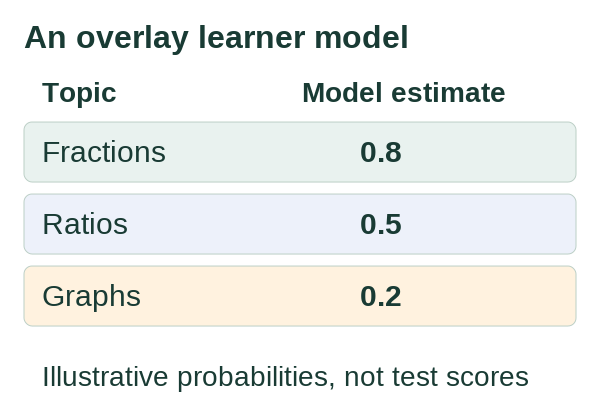
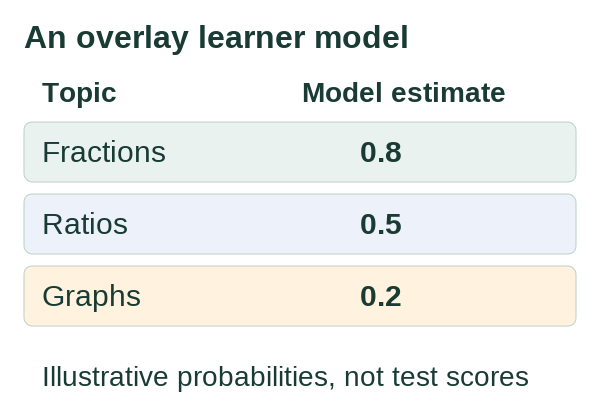
Model tracing reads what the student does. The tutor can then give feedback and help that fit. MAST, the MAth Story problem Tutor, runs on the web. It produces probability word problems that differ in setting, in kind and in difficulty. Its cognitive model imitates how knowledge is represented in human minds. Model tracing interprets student actions as they symbolize word problems and estimate probabilities. The system follows student errors during that step of turning a problem into symbols. Examples include problems about rolling a die and tossing a coin. Evaluation results showed that the tutor greatly improved students' skill at solving probability story problems.[104]
Bayesian nets are directed graphical models. They are often used to build intelligent tutoring systems. These systems interact with learners in real time, fully automatically. Such models rest on expert knowledge. A large number of parameters to fill in may put practitioners off adopting them. The number of parameters also affects how hard the calculations are. Real-time feedback needs fast computation. One proposal uses logical gates with uncertainty to keep the probability tables compact. It also works out a special inference scheme to speed up computation.[105] Students who used the combined system had clearly higher academic performance on average. On average, they also needed less time for the post-test than students using the traditional system.[106]
As online education has grown, knowledge tracing has become central to adaptive learning systems. Current models struggle to combine the varied signals that learning produces. These include features of each exercise and how the student responds. They also include timing and the hierarchy of topics and concepts. Many methods join features by simple concatenation or fixed weighting. This limits their ability to capture interactions among features.[107]
Some tutors show the student model to the learner. A 2010 study tested how the display format matters. Both groups saw skill meters. The experimental group could also open the student model in three forms. These were a concept list, a concept hierarchy or a concept map. Open student models had a positive effect on students' learning. Students clearly preferred simpler representations over more complex ones.[108]
Feedback, hints and help seeking
Many intelligent tutoring systems provide help. They often do so when the student asks. Many such systems offer help on demand. The student must ask before the tutor supplies a hint or a next step.[28] Designers of these systems argue that feedback should match each learner's individuality and special needs as closely as possible.[109]
One 2025 randomized controlled trial tested real-time feedback. It involved 120 students at a Thai demonstration school for gifted students. Of these, 78 were sampled and split into an experimental group and a control group. Both groups used the same system. Only the experimental group received automated feedback as they worked. Mean scores rose from 1.90 to 3.54 with feedback and from 1.90 to 2.85 without it. The effect size was 0.73.[110]
In one algebra tutor, giving less help led to significantly higher learning. One algebra tutor was built with the Cognitive Tutor Authoring Tools. Its main form of help was worked-out examples. A high-help version paired each practice problem with a very similar example. A reduced-assistance version used less similar pairs. Students in the reduced-assistance condition learned significantly more. Their frustration did not rise.[111]
A tutor agent called the Help Tutor gave students feedback while they solved problems. The feedback was in context and in real time, about how they sought help. In a classroom study, this feedback led students to use on-demand help more carefully. The change lasted after the feedback stopped. It did not improve their learning of the subject itself. The same team reviewed the work later. They still recommended on-demand help in tutors under certain circumstances. They rated it as less important than they once did. Aleven, Roll, McLaren and Koedinger still list helping students manage their own learning as a major unsolved problem in the field.[28]
Feedback messages may work better when they are tailored to the particular obstacle a person faces. A 2015 article on clinical audit and feedback proposed computer-supported tailoring of feedback messages. The planned software would make a menu of picture and text messages. Each is linked to a barrier to change, so a supervisor could pick the one that fits the recipient.[112]
A computer tutoring system can give feedback at two levels. These are called inner loop and outer loop feedback. Inner loop feedback concerns the steps within a single task. Outer loop feedback concerns performance across several tasks. Many systems offer both kinds at once. Studies often examine them one at a time. It ran in a first-year university statistics course for social sciences students. The design compared detailed inner loop feedback with minimal inner loop feedback. It also compared outer loop feedback with none, using 521 participants.[29]
Immediate feedback can also work as a support for metacognition. A 2010 study examined this in a pathology tutoring system for medical residents. Participants were placed at random into intervention and control groups. On the first day, immediate feedback clearly raised learning gains. It also raised two measures of how well students judge their own thinking. These were the Goodman-Kruskal gamma correlation and discrimination. When immediate feedback was removed, metacognitive performance declined. Other scaffolds did not prevent that decline. The study concluded that the other scaffolds could not replace immediate feedback. It also found that results taken directly from the tutoring system did not match results from the assessments.[113]
In programming, a 2025 study built a tutoring system around informative tutoring feedback. This feedback gives guidance, not only a right or wrong verdict. The system performed a lexical and syntactic analysis of learners' submitted solutions and displayed them as a tree-like structure. It also compared each answer with the correct ones and studied the gaps. Learners could then see where their thinking fell short. The system improved students' computational thinking. The largest gains came among low-level learners. It also helped improve students' learning motivation and reduce cognitive load. There was no significant difference among learners of different levels.[114]
A 2012 paper described Shufti, a tutoring system for mammography and medical imaging. It chooses when to give feedback and whether it is positive or negative. The system aimed to show medical students a broad range of examples. Customized feedback and hints came from an adaptive reinforcement learning system and clustering techniques. The paper framed this as a response to the Socratic method of later medical education. That method is limited by the number of cases and the length of student rotations.[115]
Adapting to the individual learner
An intelligent tutoring system can change what it offers next. It can also change how it presents that material to fit the learner.[116][117] One approach builds a model of the learner's needs and preferences. It uses this to choose among possible learning paths. According to psychological research, a learning path should follow the students' needs. These include content, level of difficulty or presentation version. The argument is that a well-chosen path can help a student learn more easily and quickly. A 2016 overview of methods for recommending learning material proposed one way to set such a path. It uses the Analytic Hierarchy Process (AHP), a method that ranks options by weighing several criteria against each other. The overview names learner modeling and personalization, collaborative learning, setting and revising learning scenarios, and analyzing learning styles as the main problems adaptability must solve.[116]
A 2020 study built a recommendation part that predicts a learner's style and adapts to it. It uses an improved knowledge base that supports adaptive learning. The knowledge structure in that system changes the presentation to fit each student. Its algorithm picks content based on each learner's characteristics. Pre-tests and post-tests measured how well the system matched suggested courses to a learner's style. The same tests were used with students in a real teaching setting. The results show the system can help students or learners achieve improved learning.[117]
A 2017 tutoring model follows the teaching and evaluation strategies that a human teacher sets. It also draws on each learner's profile and past performance. The designers contrast this with traditional web-based tutoring systems. Those serve fixed pages of course material. They leave out the skill of an experienced teacher. Their system uses a content dependency graph to decide the order in which content is shared. Mandal, Bhattacharya and Basu tested the system on a Programming in C course. Many students took part in a real setting. They checked the results against evaluations by a group of experienced human teachers.[118]
Data about the study process can improve the student's experience. This applies in the classroom and in e-learning. Phones and tablets can act as sensors. They can report learning conditions, location and details about how a learner works through tutoring material. Such data can give a teacher or a tutoring system more exact detail. This applies when the data is placed in the context of the study process. This helps in choosing a suitable tutoring strategy. A 2015 paper analyzes and discusses how this contextual information is gathered, processed and applied.[119]
Personalization is often named as a design principle of these systems. The others are proactive engagement, prompt feedback and flexibility. A 2024 paper discusses the need to match teaching approaches with educational goals when such a system is designed.[120]
One system, SeisTutor, was built to copy a human tutor's cognitive intelligence. It offers a curriculum tailored to each learner. The designers note that putting this kind of cognitive intelligence into a computer system is quite tricky. Singh, Gunjan, Mishra, Mishra and Nawaz evaluated SeisTutor. They used the Kirkpatrick four-phase evaluation model. The experiments showed greater learning with the intelligent version of SeisTutor than without it.[121]
Another design takes a reactive approach. Its agents hold no model of their environment. They act on a stimulus-response basis, reacting to the environment's present state. A system called Makatsina taught skills for solving a truss analysis problem. The method used was the method of joints. Reactive agent programming proved simple, because each agent has simple behaviors. The hard part was analyzing and designing how the environment and the reactive system interact.[122]
Tutors that read emotion and context
A 2017 review of how emotion shapes learning and memory shows why emotion matters at all. Emotion strongly influences attention. It changes what a person selects to notice and what motivates action. It also helps the brain store information and find it again later. The effects are not one-sided. Studies report that emotion can either help or harm learning and long-term memory. The result depends on a range of factors. Brain imaging findings described in that review indicate that the amygdala modulates memory consolidation. The same review suggests this knowledge may help design educational settings. That covers classrooms and online learning technologies.[123]
A broader theory was published in 2022. It argues that social processes affect how individuals learn with digital materials. CASTLE uses the term social schemata for the structures that social cues are said to activate in learners. Activated schemata are said to lead to stronger parasocial, motivational, emotional and metacognitive processes. The theory holds that more social cues in digital materials increase the influence of social processes.[124]
Some systems try to predict student performance from social and emotional factors. They also use cognitive abilities. One 2021 approach, called SoEmo-WMRMF, models how students work together in groups. It also models how their emotions affect performance. It represents five kinds of relations within the domain. It does this with a weighted multi-relational matrix factorization model. One evaluation used survey data from a general secondary school. It showed lower root mean squared error than other models simulated in the paper.[125]
Other systems work on visual context. They use images of settings such as airports, supermarkets and classrooms. A 2026 paper describes a method that sorts pictures of scenes into groups. Examples include airports, supermarkets and classrooms. The method ranks candidate regions of an image by objectness score. It uses BING objectness measures. It keeps the top-L regions as a selected-patch set. One shared CNN pulls out descriptors from the chosen patches. On a very large set of scenery images, the method found learning settings. A tutor aware of context could use them. The paper states that the procedure does not rebuild a human visual scanpath.[126]
A 2012 paper gives practical details of how agents interact on the JADE platform. It uses a set of agents to model a student's emotions. It also explains the concepts of an intelligent and affective tutoring system, an agent, and agent interaction.[127]
Tutors in the classroom and beyond
A cross-sectional questionnaire survey examined what makes faculty willing to use intelligent tutoring systems. It drew on innovation diffusion theory. Complexity had no significant effect on willingness to use intelligent tutoring systems. Experience and compatibility each clearly lowered how complex the system seemed. Trust clearly raised how much advantage people saw in it.[128]
A survey of 209 college teachers found a pattern. Those who used an intelligent tutoring system in their teaching reported higher scores of teaching self-efficacy. That term means their belief in their own ability to teach effectively. Su, Feng and Liu studied how to build a student model and a teacher model. They also studied how to measure cognitive ability with numbers.[129]
One study used mixed methods. It surveyed 93 junior high school mathematics teachers in three Midwestern school districts. It found no statistically significant link between teachers' conception scores and their use of intelligent tutoring systems. These scores mix beliefs and knowledge about mathematics. Conception scores did show significant links with three tools. These were graphing calculators, Desmos and dynamic geometry software.[130]
An online questionnaire of 285 students found fairly positive views of intelligent tutoring systems. The students were recruited as a convenience sample. Perceptions did not differ much by gender. They also showed no significant relationship with anxiety about artificial intelligence. The study ties interest in such tools to distance education, whose need became especially pronounced during the coronavirus pandemic.[131]
At one university, five computer engineering lecturers described tutoring systems as teaching mediators. These keep students motivated. They make teaching a joint process between lecturer and student. Those lecturers also said the tools lower drop-out rates and improve academic performance.[132]
A study looked at 37 university students from underserved South African areas. Their acceptance of homework tutoring systems was shaped more by access limits than by user attitudes. It found infrastructure limits to be the main barrier. The worst were electricity that fails, internet access that drops, and the price of data. Those students still expected the homework tutoring systems to help them. They also expected the systems to be easy to use, and they meant to use them. Acceptance seemed limited more by access than by attitude. Privacy concerns were moderate. The study reads this as limited awareness of data risks. Mogano and Minty recommend offline access and lower data requirements. They also recommend support for several languages. They call the results exploratory because the sample was small.[133]
Open questions and limits of the evidence
One 2010 paper calls the field an ideology. It describes four decades of work spent making virtual tutors more humanlike. That work covered tutoring styles and models of the student and of teaching. It also covered planning of adaptive courses and user interfaces.[134]
A 2024 study of artificial intelligence in education surveyed 260 people at a Saudi Arabian university. It also reviewed 56 studies. It listed concerns about human connection, data privacy, algorithmic bias and transparency. It also named critical thinking, access equity and teacher development.[135]
Inoue (2001) writes that the field is fairly new. Because of this, valid ways to evaluate intelligent tutoring systems are lacking. The knowledge component holds what the system knows. It had not been checked well enough to confirm that knowledge.[136]
A 2016 paper reported that evaluation methods from a 1993 paper were still used. Newer methods were also in use, such as educational data mining and learning analytics.[137] A 2022 review of 163 full texts found that evaluation in these systems was mainly summative and mainly quantitative. Peer and self-evaluation counted for less than evaluation by others. The reviewed studies also did not take a whole view.[138]
Results also vary by outcome and by setting. A 2025 meta-analysis of 30 studies reported an overall effect size of g = 0.86. Effects on learning attitudes and test scores were significant. Effects on knowledge, motivation, performance and problem-solving skills were less clear. The impact varied across countries and educational levels. No significant relationship appeared between educational level and effectiveness. Designs that built in games or worked examples, where a solved example is studied before practice, appeared to help more.[139]
They use its features to make progress while avoiding learning. Gaming has often been linked to lower learning. A detector that worked in earlier work did not show that link in tests with an algebra tutor. The researchers traced the failure to context factors that varied across and within conditions. Their newer method is latent variable-based gaming detection. It compares each student with the expected level for the context. Across three datasets it beat the original detector on validity and reliability. It also showed that gaming the system is linked to how competent students feel in math.[140]
What counts as an intelligent tutor
It models a learner's mental state in order to give that learner individual instruction. Such systems have been built for many subjects, including algebra, medicine, law and reading. Their aim is to help learners gain knowledge specific to a subject. They also aim to build thinking skills and skills for monitoring one's own learning. The main feature is that the program models the learner's psychological states.[141]
A 2025 paper describes how artificial intelligence is changing teaching. It covers lessons that adjust to each learner, feedback given as students work, and curricula shaped by data. That same work raises ethical concerns about data privacy and algorithmic bias. It also notes that people must oversee the system.[142] A high-level review of artificial intelligence in education lists intelligent tutoring systems as a current research area. It also names reducing teachers' workload and changing assessment.[143]
Research suggests that one-to-one human tutoring is the most effective form of instruction. It is rarely the most efficient in money or instructor time.[144] In the pooled comparison, learning from intelligent tutoring systems did not differ significantly from learning with an individualized human tutor (g -.11). It also did not differ much from small-group instruction (g .05). Positive effects appeared whether the system was the main means of instruction, a supplement to a teacher, part of teacher-led lessons, or an aid to homework.[141]
How big are the learning gains
A 2016 review of 50 controlled evaluations gives one widely cited figure. It shows how much intelligent tutoring helps. In those evaluations, the median effect was a rise of 0.66 standard deviations in test scores. The comparison was with conventional teaching.[3]
The size of the gain depended heavily on which test was used to measure it. Evaluations that used locally developed tests found much larger improvements than evaluations that used standardized tests. The review concluded that matching the test to what the tutor taught is a critical determinant of evaluation results. Two smaller groups of evaluations fell outside the main analysis. Six evaluations compared tutoring with an unusual control group. Four tested flawed versions of a tutoring system. The effects in those evaluations were small. This suggests the control condition and how well the system was used also shape the result.[3]
A separate 2014 synthesis looked only at college students. The overall effect there was moderate, with g values from .32 to .37. Effectiveness did not differ much by type of system or subject area. It also did not differ by how, or how much, the system took part in instruction. Earlier studies showed much greater effectiveness than more recent ones. Some evidence pointed to the importance of teachers and pedagogy.[145]
A 2019 review of adaptive e-learning in health education pooled 21 studies. They covered 3684 health professionals and students. The pooled effect was 0.70 for knowledge. The 95% confidence interval ran from -0.08 to 1.49, and the p value was .08. The pooled effect for skills was 1.19. The 95% confidence interval ran from 0.59 to 1.79, and the p value was below 0.00001.[146]
Most of those studies compared intelligent tutoring with regular classroom instruction. A few compared it with human tutoring or homework practices. On that basis, effectiveness appeared small to modest. The systems were also more effective for students from the general population than for low achievers.[147]
Where tutors have been tested
One study of 120 physics students in Makurdi, Nigeria, compared tutoring software with usual teaching methods. It was not a fully random experiment. Students taught physics concepts with the software did better on a performance test. They also showed more interest in the subject. The performance test had a reliability coefficient of 0.80 and the interest inventory 0.86. The hypotheses were tested at the 0.05 significance level.[148]
A second Nigerian study tested a web-based system with 180 technical college students. The experimental group had 68 and the control group had 112. The web-based system raised achievement and interest in technical drawing. It did more than traditional teaching techniques did.[149]
Mathematics has drawn separate trials, including one with 120 secondary students in Amman. The study took place in Amman, Jordan, with 120 secondary students. Each of two schools had an experimental group of 30 and a control group of 30. The tutoring group improved overall mathematical reasoning, and every measured component improved, with conjecture and representation gaining most. Students who engaged more and interacted more often tended to perform better.[150]
In biology, 257 Class XI students in southern districts of West Bengal took part. System use showed a positive, statistically significant link with both learning motivation and achievement. Students who used the system regularly showed more interest in biology. They also solved problems better and scored higher.[151]
A systematic review of 24 studies found growing interest in these systems in STEM education. The studies ran from 2019 to 2024.[152] A separate review looked at systems for problem solving in these fields. It states that empirical studies consistently show the systems can outperform traditional instruction.[153]
College-level differential calculus has its own review. It covers research from 2019 to 2025 in North America, Asia, Europe and Latin America. That review suggests tutoring software can raise engagement and help students grasp concepts better. It also lists remaining issues: accuracy, fairness, teacher involvement and data privacy.[154]
A review looks at systems for underprepared learners in STEM higher education. It describes promise in personalized instruction and adaptive feedback. That review names limitations. They include trouble adapting in real time, unequal access and the ethical handling of data.[155]
Reading comprehension has been tested at university level with a pretest and posttest design. Students who worked with the system improved much in metacomprehension. Only students who also had a human tutor showed greater gains in reading comprehension itself. The study concluded that a human tutor was needed to turn those gains into better text comprehension.[156]
Music education offers one of the longer trials, with 85 undergraduate students in China followed over two semesters. One group used the same ear training system for both semesters. The other group moved to a different system after the first semester. Group A improved significantly in aural dictation, chord recognition and melodic dictation. Melodic dictation did not improve much. This suggests that this skill may need extra teaching strategies.[157]
Talking tutors and dialogue
A 2021 study tested a Chinese dialogue-based tutor for mathematics with 134 fifth-grade students. The unit was multiplying and dividing time expressions. It was taught in three ways: the tutoring system, normal teacher instruction, or reading the material alone. Student performance was similar with the tutoring system and with conventional instruction. It was significantly poorer when no teaching method was used. A questionnaire showed that the tutoring method also raised motivation among the fifth graders.[158]
A 2021 systematic review screened 2,678 publications. It found 74 relevant ones on chatbots in education.[159] Generative artificial intelligence has since been built into tutors as an interactive partner rather than a passive information tool. Students worked under full scaffolding, light scaffolding or no template. Full scaffolding meant a structured prompting template, iterative refinement and reflective guidance. Light scaffolding meant the template alone. Motivation stayed stable, and intrinsic and extraneous cognitive load fell.[30]
Studies of generative tutors in higher education report gains alongside clear cautions.[160][161] At the University of Benghazi, 25 undergraduate Islamic studies students studied Hadith with ChatGPT. The course lasted four weeks. Average scores went from 56.7 before the course to 73.2 after it. That is a mean gain of 16.5 points (p< .001, Cohen's d = 1.45). Interviews and reflective journals showed that students valued the explanations. They also valued the motivation it gave them. Students also raised concerns about the accuracy of responses and over-reliance on AI. The study concluded that teacher mediation matters.[160]
A mixed-method case study of 880 undergraduates used GPTutor, a generative tutoring system. Chatbot use was strongly and positively linked to behavioral and emotional engagement. It was not linked to cognitive engagement. Its exercise generator feature showed no significant links with any of the three engagement dimensions. Focus groups found that students used the system only when they judged it useful, and that this judgment shifted as examinations approached.[161]
Some designers split the tutoring job among several software agents, each with its own role. ELA Tutor, described in 2026, is a generative tutoring system. It is built on a multi-agent architecture. Its specialized agents cover pedagogy, technical support and performance analysis. They also cover adaptive empathy and ethical and pedagogical concerns. An intelligent decision router sends each user query to an agent. It sorts by type, complexity and learning profile. Instructors found the system easy to use. They saw potential in extending tutoring through asynchronous interactions. The work is only an initial check. The team plans to measure learning outcomes and system performance in real classrooms.[162]
A survey looked at 155 second-year business education students. They studied at three Nigerian federal universities. It compared smart chatbots with smart tutoring systems. Students preferred chatbots (overall mean = 4.85) over tutoring systems (overall mean = 3.06). The difference was significant (t = 5.21, p < .001). Chatbots were rated more effective for four things. These were instant feedback, access to materials, personalized learning and engagement. Tutoring systems were rated effective for motivation and autonomy.[163]
Modelling the student step by step
One statistical tool for this job is the hidden Markov model. Here it was applied to a spatial rotation intervention. A 2018 study built such a model to describe learning trajectories, meaning paths of change in fine-grained skills. It applied the model to a spatial rotation training task. The model used Bayesian procedures to estimate its parameters.[164]
A 2010 review described an automated method that judges help seeking, a self-regulation strategy. It judges it in the context where each action occurs. The method rests on a model of the strategy that a computer can run. It was checked by showing it agrees with other measures of help seeking. Feedback on help seeking from this method gave a lasting gain in students' help-seeking behavior. The approach does not intrude on students. It records actions at a fine time scale, and it can be used widely over long periods.[165]
MetaTutor has supported over 10 years of research on self-regulated learning with an intelligent tutoring system. MetaTutor is a hypermedia-based tutor for college students. They learn about the human circulatory system. Its records include log files, eye tracking, facial expressions of emotion and screen recordings. Researchers use these to study cognitive, affective, metacognitive and motivational processes. The project also reported challenges that such data pose for designing real-time instructional interventions.[166]
Newer designs plan a series of exercises toward a specific goal. They use a cognitive diagnosis model to predict how students will respond. A 2025 paper proposed goal-oriented intelligent tutoring systems. In these, a graph-based reinforcement learning framework decides whether to give an exercise or an assessment. That framework uses a cognitive diagnosis model. The model is updated as it goes. It predicts how the student will react to each exercise or assessment. The work also described three benchmark datasets covering different subjects. They are for offline research on this task.[167]
A 2013 article surveyed the techniques used to build and improve these tutor functions. These included probabilistic grammar learning, rule induction, Markov decision processes and classification. It also described combining symbolic search with statistical inference.[168] A 2025 review argued that reinforcement learning, a method that improves behavior through repeated trial and adjustment, can supply customized instructional plans that respond to individual students. The same review called for future work. It asked for such algorithms to be more flexible and effective across a variety of educational settings.[169]
Emotion, motivation and self-regulation
Some tutors are built to notice feelings as well as answers. These are called affective intelligent tutoring systems. A 2024 scoping review searched the Web of Science and Scopus databases. It found 30 studies covering 27 distinct affective systems. The review describes how emotion recognition tools are used. They customize what a tutor presents and how it responds. It also names gaps. These include limited testing across varied educational settings and shallow use of emotional data to refine responses. For the future, it calls for natural dialogue modules and generative AI to build richer interfaces.[170]
Survey data from one Mexican university suggest a large unmet need for support. At the Instituto Politécnico Nacional, 47.7% of surveyed students reported emotional problems. In the same survey, 70.4% did not know about available tutoring services. Also, 93.3% had received no tutorial support. Also, 45.7% thought psychological support was necessary. And 72.8% said they would ask for tutoring help. The study proposes intelligent tutoring systems as one answer. It cites their ability to tailor learning and track progress.[171]
Interest in these tutors grew between 2019 and 2024. Most studies took place in K-12 schools and higher education. The review concludes that artificial intelligence within tutoring systems has a positive impact on student motivation and achievement in STEM courses. It adds that students' prior knowledge of STEM subjects raises their engagement and motivation when using such systems.[152]
Biology has its own evidence. The same link held for achievement. The study also looked at differences by gender and by school board.[151]
Other systems aim at self-regulated learning, the set of plans and checks a student applies to direct their own study. A 2010 method measured one such strategy, help seeking, while students worked in a tutor. The method used a computer-executable model of good help seeking. It agreed with other measures of the same behavior. Automated feedback built on this method produced a lasting improvement in how students sought help. The approach works without interrupting students. It tracks actions closely in time. It could be applied to other self-regulation strategies.[165]
A 2025 qualitative systematic review examined 14 studies of AI tools for self-regulated learning in higher education. The tools included chatbots, adaptive feedback systems, serious games and e-textbooks. The tools showed potential in the forethought, performance and reflection phases of self-regulation. The review also found that control could rest with the student or with the system, and this changed the model of self-regulation involved. It warns that AI support must not undermine students' self-efficacy, their belief in their own capacity to succeed.[172]
Teachers, cost and implementation
One case study traced the value of computer-based tutoring systems over several decades. It covered science and technology investment, research in many organizations, and use in various school settings. The same case study proposed a general model of how value is created in science and technology. The model has testable hypotheses about that process.[173]
Human tutoring carries its own costs in training, because research on personal tutoring in higher education suggests that tutors often lack training for the role. Tutors in that research also reported uncertainty about the purpose and boundaries of personal tutoring. Some lacked confidence in supporting students from diverse backgrounds. The tutors interviewed had different college and work experience. They showed contrasting approaches to tutoring interactions, and more experienced tutors had different continuing development needs.[174]
Instructors' views of tutoring software have been surveyed in at least one country. A 2023 study in Oman asked 59 programming instructors to rate statements on a 5-point scale. The instructors worked at different higher education institutions. It also interviewed 10 instructors. Most surveyed instructors knew that intelligent tutoring systems work well for learning. They believed Omani institutions were ready to adopt them with enough training and support. The interviews were analyzed with text mining. They pointed to English language barriers, weak critical thinking, poor problem solving and poor teaching methods as reasons students do badly in programming courses. The study noted that no earlier research had looked at these systems in Omani higher education institutions.[175]
Tutoring software can also be built into an existing course rather than replacing the teacher. One project took place at a large university in Brazil. There, an open-source learning management system was extended to run a short online financial math course. This software platform hosts online courses. The added tutor gave timely, high-quality feedback. It said whether an answer was correct and how accurate it was relative to the student's current knowledge. It also linked each error to the instruction material and offered a remedial suggestion before the student moved to the next step. Early results showed that this feedback helped students learn more about how to solve the problems. It drew on errors made by earlier groups of students.[176]
The military wants to use intelligent tutoring in training simulators. Its needs differ from those of classroom teaching. Scenario-based training, in which learners practice realistic missions, differs from classroom instruction in significant ways, and the military wanted to apply tutoring methods inside training simulators. A 2004 symposium described ways to build tutoring ideas into scenario-based training systems. It paid attention to diagnosing students and adapting instruction. Most of that work was at an early stage of development.[177]
One demonstration combined a tutoring component with a tactical simulation game. The result was the Virtual Combat Training Center. It simulates an Army training center and its instructors. The game sent a stream of events to the tutoring part. That part read them and responded. Students got guidance during play, not only a review afterward. The system was meant for a military context. Examples include classroom use, field instruction or deployment inside the game.[178]
The Office of Naval Research's STEM Grand Challenge paid for the development and evaluation of tutoring systems. These covered science, technology, engineering and mathematics. A special issue presented evaluations of four intelligent tutoring systems. Each system represented an aspect of how tutoring software can serve STEM education, or how parts of several systems can be combined to support it. The papers in the issue also gave empirical evidence for the effectiveness of each system.[179]
Police training is one setting that has been proposed. It targets French for police duties, which move at a fast pace. A 2026 design proposed a system with interactive language tasks, proficiency assessments and simulated feedback. It adjusts to how each learner performs. Its assessment data were said to show large gains in learner attention and in how fast errors were fixed. They also learned faster. The design was described as a new model for police training. Older models had not dealt with it.[180]
Tutoring software has also been discussed as an administrative tool for institutions. It is not only a teaching tool. A 2024 paper described models in which such systems take over routine tasks. They also give live data analysis and support decisions based on data, which cuts administrative work. It argued that careful use and ongoing evaluation are needed. These must meet challenges that include data privacy and ethics.[181]
Bias, limits and open questions
A tutor can treat two students differently for reasons that have nothing to do with their work. It ran a factorial experiment with 240 university students. It also held think-aloud sessions with 36 participants and audited tutoring platforms. The audits found that Black-coded student profiles got 3.2 times more punitive behaviour recommendations.[182]
A 2025 review looked at 110 peer-reviewed studies of multilingual learners. It notes that generative artificial intelligence may allow deeper personalization and more natural interaction. That review found that some systems improved comprehension, retention, confidence and engagement. These systems had detailed learner models, language-sensitive feedback and multimodal delivery. The same review says care must be taken to prevent bias, protect privacy and preserve cultural diversity.[183]
A 2025 review of generative AI in higher education lists several ethical concerns. These are bias, the digital divide (unequal access to technology) and the environmental impact of AI. It argues that integration must be managed carefully. The aim is to avoid widening existing inequalities.[184]
A 2021 paper on artificial intelligence in education asks how the technology will develop. It also asks what risks it carries. A 2021 paper on artificial intelligence in education contrasts two idealized futures for the technology. It notes that the effects of AI on education policy and practice have not yet drawn public attention. Its use in vehicles, the military and healthcare has. The paper also considers a proposal to use peer review as a gatekeeping strategy against harmful studies. Peer review is the checking of research by other researchers.[185]
A 2026 review of intelligent services for digital mathematics describes a digital paradox. More technological tools do not by themselves improve learning outcomes or student motivation. That review warns that such tools may act as cognitive offloading without a clear methodological framework. They would replace students' own thinking with automated algorithms.[186]
A 2026 article on digital personalization in higher education sets out conditions for effective implementation. A 2026 article on digital personalization in higher education argues that its effectiveness depends on several conditions. These include design grounded in teaching methods, students' digital readiness, teachers' competence, verifiable generated content, data protection and systematic evaluation of outcomes. That article reports that in 2025, 63.80% of people aged 16 to 24 in the European Union used generative artificial intelligence. 39.30% used it for formal education.[187]
Key studies
| Year | Study | Sample | Design | Finding |
|---|---|---|---|---|
| 2008 | El Saadawi et al.[14] | 20 pathology residents from four academic programs | crossover 2 x 2 factorial experiment | Report writing improved significantly after one tutoring session, with a fourfold increase in learning gains, and feedback timing had no effect. |
| 2011 | VanLEHN[31] | experiments comparing human tutoring, computer tutoring, and no tutoring | review of experiments | Human tutoring had an effect size of d = 0.79 and intelligent tutoring systems 0.76, nearly equal and far below the widely believed d = 2.0 for human tutors. |
| 2013 | Folsom-Kovarik et al.[57] | 14 participants in a human study plus simulated students | model construction and simulation study | Compressed representations let POMDPs scale to over 100 independent learner features with instructional efficacy equal to lossless representations. |
| 2014 | Ma et al.[141] | 107 effect sizes involving 14,321 participants | meta-analysis | Intelligent tutoring was linked to greater achievement than teacher-led large-group instruction (g = .42) and than non-ITS computer-based instruction (g = .57). It also beat textbooks or workbooks (g = .35). Ma, Adesope, Nesbit and Liu found no significant difference from individualized human tutoring (g = -.11). |
| 2014 | San Pedro et al.[17] | 126 public high school students in Quezon City, Philippines | log-data study with field observations of affect | Careless errors were common among students who often showed engaged concentration, while confused or bored students made fewer careless errors and learned less overall. |
| 2014 | Pane et al.[6] | Randomized trial in middle and high schools in seven states | There were no effects in the first year, but positive effects in the second year, sufficient to improve the median student's performance by about eight percentile points. | |
| 2016 | Kulik & Fletcher[3] | 50 controlled evaluations of intelligent tutoring systems | meta-analysis | The median effect was to raise test scores 0.66 standard deviations, or from the 50th to the 75th percentile, but the size depended on whether the test was locally developed or standardized. |
| 2016 | Aleven et al.[28] | students using a geometry Cognitive Tutor in a classroom study | classroom study with log analysis | Students viewed 68 percent of hint levels for less than one second, and feedback on help seeking made hint use more deliberate but did not improve learning outcomes. |
| 2018 | Dermeval et al.[60] | 33 papers from 4622 retrieved | systematic literature review | There was empirical evidence of benefits of authoring tools for non-programmer authors, especially for learning content and model-tracing or example-tracing tutors. |
| 2020 | Paladines & Ramirez[2] | 49 primary studies covering 33 intelligent tutoring systems with dialogue | systematic literature review | Most systems targeted STEM at the university level, most used an expectations and misconceptions approach, and empirical evaluations existed for 90.91 percent of them. |
| 2021 | Tacoma et al.[29] | 521 first-year university statistics students | 2 x 2 factorial experiment | Effects of combined within-task and across-task feedback were mixed and depended on prior knowledge, with no overall effect on course performance. |
| 2025 | Létourneau et al.[42] | Systematic review of 20 studies with 2,853 K-12 students | Some studies reported positive effects compared with traditional teaching, but effects were mitigated when compared with non-intelligent tutoring systems. | |
| 2026 | Melanou & Beege[30] | 175 first-semester university students | quasi-experimental pre-post study | All groups gained significantly in knowledge, critical thinking, and reflective use, and scaffolding conditions did not differ significantly. |
See also
References
- Alkhatlan, A., & Kalita, J. (2019). Intelligent Tutoring Systems: A Comprehensive Historical Survey with Recent Developments. International Journal of Computer Applications, 181(43), 1-20. doi:10.5120/ijca2019918451
- Paladines, J., & Ramirez, J. (2020). A Systematic Literature Review of Intelligent Tutoring Systems With Dialogue in Natural Language. IEEE Access, 8, 164246-164267. doi:10.1109/access.2020.3021383
- Kulik, J. A., & Fletcher, J. D. (2016). Effectiveness of Intelligent Tutoring Systems: A Meta-Analytic Review. Review of Educational Research, 86(1), 42-78. doi:10.3102/0034654315581420
- Anderson, J. R., Conrad, F. G., & Corbett, A. T. (1989). Skill Acquisition and the LISP Tutor. Cognitive Science, 13(4), 467-505. doi:10.1207/s15516709cog1304_1
- Xu, Z., Wijekumar, K. (., Ramirez, G., Hu, X., & Irey, R. (2019). The effectiveness of intelligent tutoring systems on K‐12 students' reading comprehension: A meta‐analysis. British Journal of Educational Technology, 50(6), 3119-3137. doi:10.1111/bjet.12758
- Pane, J. F., Griffin, B. A., McCaffrey, D. F., & Karam, R. (2014). Effectiveness of Cognitive Tutor Algebra I at Scale. Educational Evaluation and Policy Analysis, 36(2), 127-144. doi:10.3102/0162373713507480
- Phillips, F., & Johnson, B. G. (2011). Online Homework versus Intelligent Tutoring Systems: Pedagogical Support for Transaction Analysis and Recording. Issues in Accounting Education, 26(1), 87-97. doi:10.2308/iace.2011.26.1.87
- Kumar, A. N. (2005). Results from the evaluation of the effectiveness of an online tutor on expression evaluation. ACM SIGCSE Bulletin, 37(1), 216-220. doi:10.1145/1047124.1047422
- Wong, M. H. I., Zhao, H., & MacWhinney, B. (2018). A Cognitive Linguistics Application for Second Language Pedagogy: The English Preposition Tutor. Language Learning, 68(2), 438-468. doi:10.1111/lang.12278
- Mahmoud, M. H., & Abo El-Hamayed, S. H. (2016). An intelligent tutoring system for teaching the grammar of the Arabic language. Journal of Electrical Systems and Information Technology, 3(2), 282-294. doi:10.1016/j.jesit.2016.04.001
- Rus, V., D'Mello, S., Hu, X., & Graesser, A. C. (2013). Recent Advances in Conversational Intelligent Tutoring Systems. AI Magazine, 34(3), 42-54. doi:10.1609/aimag.v34i3.2485
- WEERASINGHE, A., MITROVIC, A., VAN ZIJL, M., & MARTIN, B. (2010). Evaluating the Effectiveness of Adaptive Tutorial Dialogues in EER-Tutor. International Conference on Computers in Education. doi:10.58459/icce.2010.34
- Pinkwart, N., Ashley, K., Lynch, C., & Aleven, V. (2009). Evaluating an Intelligent Tutoring System for Making Legal Arguments with Hypotheticals. International Journal of Artificial Intelligence in Education, 19(4), 401-424. doi:10.3233/irg-2009-19(4)05
- El Saadawi, G. M., Tseytlin, E., Legowski, E., Jukic, D., Castine, M., Fine, J., Gormley, R., & Crowley, R. S. (2008). A natural language intelligent tutoring system for training pathologists: implementation and evaluation. Advances in Health Sciences Education, 13(5), 709-722. doi:10.1007/s10459-007-9081-3
- Petrovica, S. (2014). Tutoring Process in Emotionally Intelligent Tutoring Systems: . International Journal of Technology and Educational Marketing, 4(1), 72-85. doi:10.4018/ijtem.2014010106
- Sun, Y., Li, Z. P., & Xia, Y. W. (2013). Emotional Interaction Agents in Intelligent Tutoring Systems. Applied Mechanics and Materials, 347-350, 2682-2687. doi:10.4028/www.scientific.net/amm.347-350.2682
- San Pedro, M. O. Z., Baker, R. S. J. d., & Rodrigo, M. M. T. (2014). Carelessness and Affect in an Intelligent Tutoring System for Mathematics. International Journal of Artificial Intelligence in Education, 24(2), 189-210. doi:10.1007/s40593-014-0015-y
- Jackson, G. T., & McNamara, D. S. (2013). Motivation and performance in a game-based intelligent tutoring system. Journal of Educational Psychology, 105(4), 1036-1049. doi:10.1037/a0032580
- Walkington, C., & Bernacki, M. L. (2019). Personalizing Algebra to Students’ Individual Interests in an Intelligent Tutoring System: Moderators of Impact. International Journal of Artificial Intelligence in Education, 29(1), 58-88. doi:10.1007/s40593-018-0168-1
- Rida, Z., Boukachour, H., Ennaji, M., & Machkour, M. (2023). An architecture for the dynamic adaptation of an intelligent multi-tutoring system. Journal of Intelligent & Fuzzy Systems, 45(6), 9899-9913. doi:10.3233/jifs-232319
- Wang, H., Tlili, A., Huang, R., Cai, Z., Li, M., Cheng, Z., Yang, D., Li, M., Zhu, X., & Fei, C. (2023). Examining the applications of intelligent tutoring systems in real educational contexts: A systematic literature review from the social experiment perspective. Education and Information Technologies, 28(7), 9113-9148. doi:10.1007/s10639-022-11555-x
- Long, Y., & Aleven, V. (2017). Educational Game and Intelligent Tutoring System: A Classroom Study and Comparative Design Analysis. ACM Transactions on Computer-Human Interaction, 24(3), 1-27. doi:10.1145/3057889
- Graesser, A. C., Hu, X., Nye, B. D., VanLehn, K., Kumar, R., Heffernan, C., Heffernan, N., Woolf, B., Olney, A. M., Rus, V., Andrasik, F., Pavlik, P., Cai, Z., Wetzel, J., Morgan, B., Hampton, A. J., Lippert, A. M., Wang, L., Cheng, Q., & ... Baer, W. (2018). ElectronixTutor: an intelligent tutoring system with multiple learning resources for electronics. International Journal of STEM Education, 5(1). doi:10.1186/s40594-018-0110-y
- Butz, B. P., Duarte, M., & Miller, S. M. (2006). An Intelligent Tutoring System for Circuit Analysis. IEEE Transactions on Education, 49(2), 216-223. doi:10.1109/te.2006.872407
- Weragama, D., & Reye, J. (2014). Analysing Student Programs in the PHP Intelligent Tutoring System. International Journal of Artificial Intelligence in Education, 24(2), 162-188. doi:10.1007/s40593-014-0014-z
- Abu-Naser, S., Ahmed, A., Al-Masri, N., Deeb, A., Moshtaha, E., & Abu Lamdy, M. (2011). An Intelligent Tutoring System for Learning Java Objects. International Journal of Artificial Intelligence & Applications, 2(2), 68-77. doi:10.5121/ijaia.2011.2205
- Chukhray, A., & Havrylenko, O. (2021). The method of student's query analysis while intelligent computer tutoring in SQL. RADIOELECTRONIC AND COMPUTER SYSTEMS(2), 78-86. doi:10.32620/reks.2021.2.07
- Aleven, V., Roll, I., McLaren, B. M., & Koedinger, K. R. (2016). Help Helps, But Only So Much: Research on Help Seeking with Intelligent Tutoring Systems. International Journal of Artificial Intelligence in Education, 26(1), 205-223. doi:10.1007/s40593-015-0089-1
- Tacoma, S., Drijvers, P., & Jeuring, J. (2021). Combined inner and outer loop feedback in an intelligent tutoring system for statistics in higher education. Journal of Computer Assisted Learning, 37(2), 319-332. doi:10.1111/jcal.12491
- Melanou, C., & Beege, M. (2026). Scaffolding Generative AI as a Tutor: A Quasi-Experimental Study of Learning Outcomes and Motivational, Cognitive and Metacognitive Processes. Education Sciences, 16(4), 651. doi:10.3390/educsci16040651
- VanLEHN, K. (2011). The Relative Effectiveness of Human Tutoring, Intelligent Tutoring Systems, and Other Tutoring Systems. Educational Psychologist, 46(4), 197-221. doi:10.1080/00461520.2011.611369
- Hughes, J. (2021). Deskilling of Teaching and the Case for Intelligent Tutoring Systems. Journal of Ethics and Emerging Technologies, 31(2), 1-16. doi:10.55613/jeet.v31i2.90
- University of Putra Malaysia, Yaakob, R., & Alson Khumbulani, M. (2025). Student Performance Prediction in Intelligent Tutoring Systems: Methods, Challenges, and Future Perspectives. ILIM, 43(1), 18-34. doi:10.47751/skpu.1937.v43i1.2
- Sleeman, D., Kelly, A. E., Martinak, R., Ward, R. D., & Moore, J. L. (1989). Studies of Diagnosis and Remediation with High School Algebra Students. Cognitive Science, 13(4), 551-568. doi:10.1207/s15516709cog1304_3
- Merrill, D. C., Reiser, B. J., Ranney, M., & Trafton, J. G. (1992). Effective Tutoring Techniques: A Comparison of Human Tutors and Intelligent Tutoring Systems. Journal of the Learning Sciences, 2(3), 277-305. doi:10.1207/s15327809jls0203_2
- Aleven, V. A. W. M. M., & Koedinger, K. R. (2002). An effective metacognitive strategy: learning by doing and explaining with a computer‐based Cognitive Tutor. Cognitive Science, 26(2), 147-179. doi:10.1207/s15516709cog2602_1
- Anwar, A., Haq, I. U., Mian, I. A., Shah, F., Alroobaea, R., Hussain, S., Ullah, S. S., & Umar, F. (2022). Applying Real-Time Dynamic Scaffolding Techniques during Tutoring Sessions Using Intelligent Tutoring Systems. Mobile Information Systems, 2022, 1-9. doi:10.1155/2022/6006467
- Nye, B. D., Pavlik, P. I., Windsor, A., Olney, A. M., Hajeer, M., & Hu, X. (2018). SKOPE-IT (Shareable Knowledge Objects as Portable Intelligent Tutors): overlaying natural language tutoring on an adaptive learning system for mathematics. International Journal of STEM Education, 5(1). doi:10.1186/s40594-018-0109-4
- Hooshyar, D., Ahmad, R. B., Yousefi, M., Yusop, F. D., & Horng, S. ‐. (2015). A flowchart‐based intelligent tutoring system for improving problem‐solving skills of novice programmers. Journal of Computer Assisted Learning, 31(4), 345-361. doi:10.1111/jcal.12099
- Akyuz, Y. (2020). Effects of Intelligent Tutoring Systems (ITS) on Personalized Learning (PL). Creative Education, 11(06), 953-978. doi:10.4236/ce.2020.116069
- Son, T. (2024). Intelligent Tutoring Systems in Mathematics Education: A Systematic Literature Review Using the Substitution, Augmentation, Modification, Redefinition Model. Computers, 13(10), 270. doi:10.3390/computers13100270
- Létourneau, A., Deslandes Martineau, M., Charland, P., Karran, J. A., Boasen, J., & Léger, P. M. (2025). A systematic review of AI-driven intelligent tutoring systems (ITS) in K-12 education. npj Science of Learning, 10(1). doi:10.1038/s41539-025-00320-7
- Anderson, J. R., Betts, S., Ferris, J. L., & Fincham, J. M. (2010). Neural imaging to track mental states while using an intelligent tutoring system. Proceedings of the National Academy of Sciences, 107(15), 7018-7023. doi:10.1073/pnas.1000942107
- ROSS, P. (1987). Intelligent tutoring systems. Journal of Computer Assisted Learning, 3(4), 194-203. doi:10.1111/j.1365-2729.1987.tb00331.x
- YAZDANI, M. (1986). Intelligent tutoring systems: An overview. Expert Systems, 3(3), 154-163. doi:10.1111/j.1468-0394.1986.tb00488.x
- Sokolnicki, T. (1991). Towards knowledge-based tutors: a survey and appraisal of Intelligent Tutoring Systems. The Knowledge Engineering Review, 6(2), 59-95. doi:10.1017/s0269888900005622
- Bradáč, V., & Kostolányová, K. (2017). Intelligent Tutoring Systems. Journal of Intelligent Systems, 26(4), 717-727. doi:10.1515/jisys-2015-0144
- Mousavinasab, E., Zarifsanaiey, N., R. Niakan Kalhori, S., Rakhshan, M., Keikha, L., & Ghazi Saeedi, M. (2021). Intelligent tutoring systems: a systematic review of characteristics, applications, and evaluation methods. Interactive Learning Environments, 29(1), 142-163. doi:10.1080/10494820.2018.1558257
- Anderson, J. R., Boyle, C. F., & Reiser, B. J. (1985). Intelligent Tutoring Systems. Science, 228(4698), 456-462. doi:10.1126/science.228.4698.456
- Sleeman, D. (1984). An Attempt to Understand Students' Understanding of Basic Algebra*. Cognitive Science, 8(4), 387-412. doi:10.1207/s15516709cog0804_4
- Payne, S. J., & Squibb, H. R. (1990). Algebra Mal‐Rules and Cognitive Accounts of Error. Cognitive Science, 14(3), 445-481. doi:10.1207/s15516709cog1403_4
- Murray, W. R. (1987). Automatic program debugging for intelligent tutoring systems. Computational Intelligence, 3(1), 1-16. doi:10.1111/j.1467-8640.1987.tb00169.x
- Bregar, W. S., & Farley, A. M. (1982). An intelligent tutor for high school algebra problems: Oregon State University. ACM SIGART Bulletin(79), 78-78. doi:10.1145/1056663.1056717
- Sims-Knight, J. E. (1989). Developing an Empirically-Based Applied Algebra Tutor. Journal of Educational Technology Systems, 17(3), 177-188. doi:10.2190/b8v5-mmh0-pape-5qkl
- Lin, H. T., Lee, P. M., & Hsiao, T. C. (2015). Online Pedagogical Tutorial Tactics Optimization Using Genetic‐Based Reinforcement Learning. The Scientific World Journal, 2015(1). doi:10.1155/2015/352895
- Anohina, A. (2007). Advances in Intelligent Tutoring Systems: Problem-solving Modes and Model of Hints. International Journal of Computers Communications & Control, 2(1), 48. doi:10.15837/ijccc.2007.1.2336
- Folsom-Kovarik, J. T., Sukthankar, G., & Schatz, S. (2013). Tractable POMDP representations for intelligent tutoring systems. ACM Transactions on Intelligent Systems and Technology, 4(2), 1-22. doi:10.1145/2438653.2438664
- Ramírez-Noriega, A., Juárez-Ramírez, R., Jiménez, S., Martínez-Ramírez, Y., & Figueroa Pérez, J. F. (2018). Determination of the course sequencing to intelligent tutoring systems using an ontology and Wikipedia. Journal of Intelligent & Fuzzy Systems, 34(5), 3177-3185. doi:10.3233/jifs-169501
- Fu, Z. (2025). Integrating Reinforcement Learning with Dynamic Knowledge Tracing for personalized learning path optimization. Scientific Reports, 15(1). doi:10.1038/s41598-025-23900-4
- Dermeval, D., Paiva, R., Bittencourt, I. I., Vassileva, J., & Borges, D. (2018). Authoring Tools for Designing Intelligent Tutoring Systems: a Systematic Review of the Literature. International Journal of Artificial Intelligence in Education, 28(3), 336-384. doi:10.1007/s40593-017-0157-9
- Rokhman, N., & Kobar, S. A. (2022). Intelligent Tutoring Systems Authoring Tools For Nonprogrammer Authors: A Systematic Review. SISFORMA, 9(1), 1-8. doi:10.24167/sisforma.v9i1.3022
- Hermawan, F. (2022). Using Intelligent Tutoring Systems Through Cognitive Tutor Authoring Tools to Solve Filling Slot Problems. Jurnal Pendidikan Matematika (Kudus), 5(1), 93. doi:10.21043/jpmk.v5i1.14484
- Lavendelis, E., & Grundspenkis, J. (2009). Requirements analysis of Multi-Agent Based Intelligent Tutoring Systems. Scientific Journal of Riga Technical University. Computer Sciences, 38(38), 37-47. doi:10.2478/v10143-009-0003-0
- Nkambou, R., & Kabanza, F. (2001). Designing intelligent tutoring systems: a multiagent Planning Approach. ACM SIGCUE Outlook, 27(2), 46-60. doi:10.1145/381234.381246
- Chang, M., D'Aniello, G., Gaeta, M., Orciuoli, F., Sampson, D., & Simonelli, C. (2020). Building Ontology-Driven Tutoring Models for Intelligent Tutoring Systems Using Data Mining. IEEE Access, 8, 48151-48162. doi:10.1109/access.2020.2979281
- Rybina, G. V., & Grigoryev, A. A. (2025). Building an adaptive ontological environment for intelligent tutoring based on integrated expert systems. Information-measuring and Control Systems, 67-83. doi:10.18127/j20700814-202502-08
- Yoshikawa, A., Shintani, M., & Ohba, Y. (1992). Intelligent tutoring system for electric circuit exercising. IEEE Transactions on Education, 35(3), 222-225. doi:10.1109/13.144648
- Johnson, B. G., & Holder, D. A. (2002). A Cognitive Modeling Tutor Supporting Student Inquiry for Balancing Chemical Equations. The Chemical Educator, 7(5), 297-302. doi:10.1333/s00897020592a
- Hagen, L. K. (1994). Unification-Based Parsing Applications for Intelligent Foreign Language Tutoring Systems. CALICO Journal, 12(2-3), 5-31. doi:10.1558/cj.v12i2-3.5-31
- Furlan, R., Gatti, M., Menè, R., Shiffer, D., Marchiori, C., Giaj Levra, A., Saturnino, V., Brunetta, E., & Dipaola, F. (2021). A Natural Language Processing–Based Virtual Patient Simulator and Intelligent Tutoring System for the Clinical Diagnostic Process: Simulator Development and Case Study. JMIR Medical Informatics, 9(4), e24073. doi:10.2196/24073
- Suebnukarn, S. (2009). Intelligent Tutoring System for Clinical Reasoning Skill Acquisition in Dental Students. Journal of Dental Education, 73(10), 1178-1186. doi:10.1002/j.0022-0337.2009.73.10.tb04809.x
- Crowley, R. S., Legowski, E., Medvedeva, O., Tseytlin, E., Roh, E., & Jukic, D. (2007). Evaluation of an Intelligent Tutoring System in Pathology: Effects of External Representation on Performance Gains, Metacognition, and Acceptance. Journal of the American Medical Informatics Association, 14(2), 182-190. doi:10.1197/jamia.m2241
- Kaklauskas, A., Ditkevičius, R., & Gargasaite, L. (2006). Intelligent tutoring system for real estate management. International Journal of Strategic Property Management, 10(2), 113-130. doi:10.3846/1648715x.2006.9637548
- Dwolatzky, B., Levin, A., & Shulman, S. (1998). An Investigation Into the Feasibility of Using Intelligent Tutoring Systems in Preparing Students for Laboratory Work. International Journal of Electrical Engineering & Education, 35(2), 107-116. doi:10.1177/002072099803500202
- Harrison, B., & Roberts, D. (2012). A Review of Student Modeling Techniques in Intelligent Tutoring Systems. Proceedings of the AAAI Conference on Artificial Intelligence and Interactive Digital Entertainment, 8(5), 61-66. doi:10.1609/aiide.v8i5.12574
- ELMADANI, M., MATHEWS, M., & MITROVIC, A. (2012). Data-Driven Misconception Discovery in Constraint-based Intelligent Tutoring Systems. International Conference on Computers in Education. doi:10.58459/icce.2012.540
- Liu, R., Stamper, J. C., & Davenport, J. (2018). A Novel Method for the In-Depth Multimodal Analysis of Student Learning Trajectories in Intelligent Tutoring Systems. Journal of Learning Analytics, 5(1). doi:10.18608/jla.2018.51.4
- Elmadani, M., Mitrovic, A., Weerasinghe, A., & Neshatian, K. (2015). Investigating student interactions with tutorial dialogues in EER-Tutor. Research and Practice in Technology Enhanced Learning, 10(1). doi:10.1186/s41039-015-0013-1
- Graesser, A. C., Chipman, P., Haynes, B. C., & Olney, A. (2005). AutoTutor: An Intelligent Tutoring System With Mixed-Initiative Dialogue. IEEE Transactions on Education, 48(4), 612-618. doi:10.1109/te.2005.856149
- Aimeur, E., Frasson, C., & Dufort, H. (2000). Cooperative learning strategies for intelligent tutoring systems. Applied Artificial Intelligence, 14(5), 465-489. doi:10.1080/088395100403388
- Negoita, M. G., & Pritchard, D. (2004). Using a virtual student model for testing intelligent tutoring systems. Interactive Technology and Smart Education, 1(3), 195-204. doi:10.1108/17415650480000023
- (2022). Effects of collaboration on students’ learning using Intelligent Tutoring System. International Journal of Emerging Trends in Engineering Research, 10(8), 391-395. doi:10.30534/ijeter/2022/021082022
- Han, F. (2024). Factors affecting Chinese undergraduate medical students’ behavioural intention and actual use of intelligent tutoring systems. Australasian Journal of Educational Technology. doi:10.14742/ajet.8814
- Ahuja, N. J., Dutt, S., Choudhary, S. l., & Kumar, M. (2025). “Intelligent Tutoring System in Education for Disabled Learners Using Human–Computer Interaction and Augmented Reality”. International Journal of Human–Computer Interaction, 41(3), 1804-1816. doi:10.1080/10447318.2022.2124359
- Rasheed-Karim, W. (2021). Intelligent Tutoring Systems, Learning and Cognitive Styles of Dyslexic Students. International Journal of Emerging Technologies in Learning (iJET), 16(03), 20. doi:10.3991/ijet.v16i03.19317
- Dermeval, D., Albuquerque, J., Bittencourt, I. I., Isotani, S., Silva, A. P., & Vassileva, J. (2019). GaTO: An Ontological Model to Apply Gamification in Intelligent Tutoring Systems. Frontiers in Artificial Intelligence, 2. doi:10.3389/frai.2019.00013
- Dermeval, D., & Bittencourt, I. I. (2020). Co-designing Gamified Intelligent Tutoring Systems with Teachers. Revista Brasileira de Informática na Educação, 28, 73-91. doi:10.5753/rbie.2020.28.0.73
- Lampropoulos, G. (2025). Augmented Reality, Virtual Reality, and Intelligent Tutoring Systems in Education and Training: A Systematic Literature Review. Applied Sciences, 15(6), 3223. doi:10.3390/app15063223
- Laine, J., Lindqvist, T., Korhonen, T., & Hakkarainen, K. (2022). Systematic Review of Intelligent Tutoring Systems for Hard Skills Training in Virtual Reality Environments. International Journal of Technology in Education and Science, 6(2), 178-203. doi:10.46328/ijtes.348
- Su, M., Dang, B., Nguyen, A., & Nagashima, T. (2025). Choice-making in an adaptive learning system with motivational pedagogical agents. npj Science of Learning, 10(1). doi:10.1038/s41539-025-00366-7
- Livergood, N. D. (1994). A Study of the Effectiveness of a Multimedia Intelligent Tutoring System. Journal of Educational Technology Systems, 22(4), 337-344. doi:10.2190/dthe-9hmv-qgr9-d38m
- Anderson, J. R., Betts, S., Ferris, J. L., & Fincham, J. M. (2012). Tracking children's mental states while solving algebra equations. Human Brain Mapping, 33(11), 2650-2665. doi:10.1002/hbm.21391
- Chughtai, R., Zhang, S., & Craig, S. D. (2015). Usability evaluation of intelligent tutoring system: ITS from a usability perspective. Proceedings of the Human Factors and Ergonomics Society Annual Meeting, 59(1), 367-371. doi:10.1177/1541931215591076
- Smale-Jacobse, A. E., Meijer, A., Helms-Lorenz, M., & Maulana, R. (2019). Differentiated Instruction in Secondary Education: A Systematic Review of Research Evidence. Frontiers in Psychology, 10. doi:10.3389/fpsyg.2019.02366
- Triantafyllou, S. A. (2026). Sustainable Intelligent Tutoring Systems for Social Well-Being: A Human-Centered Framework for Inclusive, Ethical, and Resilient Learning. Sustainability, 18(17), 8946. doi:10.3390/su18178946
- Nye, B. D. (2015). Intelligent Tutoring Systems by and for the Developing World: A Review of Trends and Approaches for Educational Technology in a Global Context. International Journal of Artificial Intelligence in Education, 25(2), 177-203. doi:10.1007/s40593-014-0028-6
- Bregar, W. S., Farley, A. M., & Bayley, G. (1986). Knowledge sources for an intelligent algebra tutor. Computational Intelligence, 2(1), 117-129. doi:10.1111/j.1467-8640.1986.tb00077.x
- Suraweera, P., & Mitrovic, A. (2004). An Intelligent Tutoring System for Entity Relationship Modelling. International Journal of Artificial Intelligence in Education, 14(3-4), 375-417. doi:10.3233/irg-2004-14(3-4)07
- Schulze, K. G. (1990). The Use of Multiple Explanations in an Open-Ended Intelligent Tutoring System. Journal of Educational Technology Systems, 18(3), 235-243. doi:10.2190/46l3-rhf6-eqbj-l64j
- Bonar, J., Cunningham, R., & Schultz, J. (1986). An object-oriented architecture for intelligent tutoring systems. ACM SIGPLAN Notices, 21(11), 269-276. doi:10.1145/960112.28723
- Piramuthu, S. (2005). Knowledge-Based Web-Enabled Agents and Intelligent Tutoring Systems. IEEE Transactions on Education, 48(4), 750-756. doi:10.1109/te.2005.854574
- Livergood, N. D. (1991). Specification and Design Procedures, Functions, and Issues in Developing Intelligent Tutoring Systems. Journal of Educational Technology Systems, 19(3), 251-264. doi:10.2190/phg4-1ktp-tb1d-8awg
- Brokken, F. B., & Been, P. H. (1993). Student Modeling in Intelligent Tutoring Systems: Acquisition of Cognitive Skill and Tutorial Interventions. Social Science Computer Review, 11(3), 329-349. doi:10.1177/089443939301100306
- Khodier, N., Elazhary, H., & Wanas, N. (2017). Rule-based Cognitive Modeling and Model Tracing in a Math Story Problem Tutor. International Journal of Emerging Technologies in Learning (iJET), 12(04), 111. doi:10.3991/ijet.v12i04.6592
- Antonucci, A., Mangili, F., Bonesana, C., & Adorni, G. (2022). Intelligent Tutoring Systems by Bayesian Nets with Noisy Gates. The International FLAIRS Conference Proceedings, 35. doi:10.32473/flairs.v35i.130692
- Eryılmaz, M., & Adabashi, A. (2020). Development of an Intelligent Tutoring System Using Bayesian Networks and Fuzzy Logic for a Higher Student Academic Performance. Applied Sciences, 10(19), 6638. doi:10.3390/app10196638
- Wang, Z., Liu, J., & Zeng, C. (2026). GCKT: Context‐Aware Gating of Heterogeneous Learning Features With Transformer for Cognitive Knowledge Tracing in Intelligent Tutoring Systems. International Journal of Intelligent Systems, 2026(1). doi:10.1155/int/3037960
- DUAN, D., MITROVIC, A., & CHURCHER, N. (2010). Evaluating the Effectiveness of Multiple Open Student Models in EER-Tutor. International Conference on Computers in Education. doi:10.58459/icce.2010.44
- Dāboliņš, J., & Grundspeņķis, J. (2013). The Role of Feedback in Intelligent Tutoring System. Applied Computer Systems, 14(1), 88-93. doi:10.2478/acss-2013-0011
- Marwiang, M., Prasertsang, M., & Junpeng, P. (2025). Enhancing Students’ Learning Outcomes in Mathematics through Intelligent Tutoring Systems Based on Real-Time Feedback. Journal of Education and Learning, 14(6), 186. doi:10.5539/jel.v14n6p186
- Borracci, G., Gauthier, E., Jennings, J., Sale, K., & Muldner, K. (2020). The Effect of Assistance on Learning and Affect in an Algebra Tutor. Journal of Educational Computing Research, 57(8), 2032-2052. doi:10.1177/0735633118822103
- Landis-Lewis, Z., Brehaut, J. C., Hochheiser, H., Douglas, G. P., & Jacobson, R. S. (2015). Computer-supported feedback message tailoring: theory-informed adaptation of clinical audit and feedback for learning and behavior change. Implementation Science, 10(1). doi:10.1186/s13012-014-0203-z
- El Saadawi, G. M., Azevedo, R., Castine, M., Payne, V., Medvedeva, O., Tseytlin, E., Legowski, E., Jukic, D., & Crowley, R. S. (2010). Factors affecting feeling-of-knowing in a medical intelligent tutoring system: the role of immediate feedback as a metacognitive scaffold. Advances in Health Sciences Education, 15(1), 9-30. doi:10.1007/s10459-009-9162-6
- Zhong, X., & Zhan, Z. (2025). An intelligent tutoring system for programming education based on informative tutoring feedback: system development, algorithm design, and empirical study. Interactive Technology and Smart Education, 22(1), 3-24. doi:10.1108/itse-09-2023-0182
- JOHNSON, S., & ZAIANE, O. (2012). Intelligent feedback polarity and timing selection in the Shufti Intelligent Tutoring System. International Conference on Computers in Education. doi:10.58459/icce.2012.547
- Bernacki, J. (2016). Recommending learning material in Intelligent Tutoring Systems. Annales Universitatis Mariae Curie-Sklodowska, sectio AI – Informatica, 16(1), 1. doi:10.17951/ai.2016.16.1.1
- Muangprathub, J., Boonjing, V., & Chamnongthai, K. (2020). Learning recommendation with formal concept analysis for intelligent tutoring system. Heliyon, 6(10), e05227. doi:10.1016/j.heliyon.2020.e05227
- Mandal, L., Bhattacharya, S., & Basu, P. N. (2017). An approach to incorporate teachers’ individual teaching and evaluation strategies and experience in tutoring model of an Intelligent Tutoring System. International Journal of Hybrid Intelligent Systems, 14(3), 113-121. doi:10.3233/his-170245
- Bicans, J. (2015). The Acquisition of Context Data of Study Process and their Application in Classroom and Intelligent Tutoring Systems. Applied Computer Systems, 18(1), 27-32. doi:10.1515/acss-2015-0016
- Shah, T. (2024). AI-Powered Personalised Learning Plans for Intelligent Tutoring Systems. International Journal for Research in Applied Science and Engineering Technology, 12(5), 5450-5462. doi:10.22214/ijraset.2024.62879
- Singh, N., Gunjan, V. K., Mishra, A. K., Mishra, R. K., & Nawaz, N. (2022). SeisTutor: A Custom-Tailored Intelligent Tutoring System and Sustainable Education. Sustainability, 14(7), 4167. doi:10.3390/su14074167
- Ana Lilia Laureano Cruces, Fernando (2000). Reactive agent design for intelligent tutoring systems. Cybernetics and Systems, 31(1), 1-47. doi:10.1080/019697200124900
- Tyng, C. M., Amin, H. U., Saad, M. N. M., & Malik, A. S. (2017). The Influences of Emotion on Learning and Memory. Frontiers in Psychology, 8. doi:10.3389/fpsyg.2017.01454
- Schneider, S., Beege, M., Nebel, S., Schnaubert, L., & Rey, G. D. (2022). The Cognitive-Affective-Social Theory of Learning in digital Environments (CASTLE). Educational Psychology Review, 34(1), 1-38. doi:10.1007/s10648-021-09626-5
- ASSIELOU, K. A., HABA, C. T., KADJO, T. L., GOORE, B. T., & YAO, K. D. (2021). A New Approach to Modelling Students’ Socio-Emotional Attributes to Predict Their Performance in Intelligent Tutoring Systems. Journal of Education and e-Learning Research, 8(3), 340-348. doi:10.20448/journal.509.2021.83.340.348
- Yu, Y., & Wu, H. (2026). Context-Aware visual scene analysis and adaptation for intelligent english tutoring systems. Scientific Reports. doi:10.1038/s41598-026-70908-5
- Petrovica, S., & Anohina-Naumeca, A. (2012). Design and implementation of agent interaction mechanisms for emotionally intelligent tutoring systems. Applied Computer Systems, 13(1), 44-53. doi:10.2478/v10312-012-0006-2
- Wang, S., Yu, H., Hu, X., & Li, J. (2020). Participant or spectator? Comprehending the willingness of faculty to use intelligent tutoring systems in the artificial intelligence era. British Journal of Educational Technology, 51(5), 1657-1673. doi:10.1111/bjet.12998
- Su, J., Feng, Y., & Liu, L. (2018). Research on the influence of computer aided intelligent tutoring system on teacher’s self-efficacy. Journal of Intelligent & Fuzzy Systems, 35(3), 2749-2759. doi:10.3233/jifs-169627
- Glaze, A., Moyer-Packenham, P., & Longhurst, M. (2021). Teachers' Conceptions of Mathematics and the Use of Intelligent Tutoring Systems, Calculators, Dynamic Geometry Software and Desmos in the Classroom. Journal of Computers in Mathematics and Science Teaching, 40(3), 201-227. doi:10.70725/601390aategx
- Djokic, N., Milicevic, N., & Djokic, I. (2024). Intelligent Tutoring Systems and Distance Education – Students Perceptions. Proceedings of The World Conference on Education and Teaching, 3(1), 44-52. doi:10.33422/etconf.v3i1.520
- Hidalgo Camacho, O. M. (2026). Educational innovation: intelligent tutoring systems for learning in the university environment. REVISTA CIENTÍFICA SEARCHING DE CIENCIAS HUMANAS Y SOCIALES, 26. doi:10.46363/05g007e01n03oe26
- Mogano, T. M., & Minty, R. (2026). Barriers and Enablers in the Adoption of Homework Intelligent Tutoring Systems among University Students in Disadvantaged South African Areas. International Journal of Learning, Teaching and Educational Research, 25(1), 872-901. doi:10.26803/ijlter.25.1.40
- Yang, F. J. (2010). The ideology of intelligent tutoring systems. ACM Inroads, 1(4), 63-65. doi:10.1145/1869746.1869765
- Al-Zahrani, A. M. (2024). Unveiling the shadows: Beyond the hype of AI in education. Heliyon, 10(9), e30696. doi:10.1016/j.heliyon.2024.e30696
- Inoue, Y. (2001). Methodological Issues in the Evaluation of Intelligent Tutoring Systems. Journal of Educational Technology Systems, 29(3), 251-258. doi:10.2190/b5vf-qk3f-pccd-64lb
- Greer, J., & Mark, M. (2016). Evaluation Methods for Intelligent Tutoring Systems Revisited. International Journal of Artificial Intelligence in Education, 26(1), 387-392. doi:10.1007/s40593-015-0043-2
- Cuéllar-Rojas, O. A., Hincapié-Montoya, M., Contero, M., & Güemes-Castorena, D. (2022). Bibliometric analysis and systematic literature review of the intelligent tutoring systems. Frontiers in Education, 7. doi:10.3389/feduc.2022.1047853
- Huang, X., Xu, W., & Liu, R. (2025). Effects of Intelligent Tutoring Systems on Educational Outcomes: Evidence From a Comprehensive Analysis. International Journal of Distance Education Technologies, 23(1), 1-25. doi:10.4018/ijdet.368420
- Huang, Y., Dang, S., Elizabeth Richey, J., Chhabra, P., Thomas, D. R., Asher, M. W., Lobczowski, N. G., McLaughlin, E. A., Harackiewicz, J. M., Aleven, V., & Koedinger, K. R. (2023). Using latent variable models to make gaming-the-system detection robust to context variations. User Modeling and User-Adapted Interaction, 33(5), 1211-1257. doi:10.1007/s11257-023-09362-1
- Ma, W., Adesope, O. O., Nesbit, J. C., & Liu, Q. (2014). Intelligent tutoring systems and learning outcomes: A meta-analysis. Journal of Educational Psychology, 106(4), 901-918. doi:10.1037/a0037123
- Naayini, P. (2025). AI and the Future of Education: Advancing Personalized Learning and Intelligent Tutoring Systems. Frontiers in Educational Innovation and Research, 1(1), 29-39. doi:10.62762/feir.2025.332098
- Chaudhry, M. A., & Kazim, E. (2022). Artificial Intelligence in Education (AIEd): a high-level academic and industry note 2021. AI and Ethics, 2(1), 157-165. doi:10.1007/s43681-021-00074-z
- Ray, J. M., & Barnett, J. S. (2009). An Evolution of Tutoring and Training from Humans to Intelligent Systems: Human Factors Considerations. Proceedings of the Human Factors and Ergonomics Society Annual Meeting, 53(26), 1898-1902. doi:10.1177/154193120905302603
- Steenbergen-Hu, S., & Cooper, H. (2014). A meta-analysis of the effectiveness of intelligent tutoring systems on college students’ academic learning. Journal of Educational Psychology, 106(2), 331-347. doi:10.1037/a0034752
- Fontaine, G., Cossette, S., Maheu-Cadotte, M. A., Mailhot, T., Deschênes, M. F., Mathieu-Dupuis, G., Côté, J., Gagnon, M. P., & Dubé, V. (2019). Efficacy of adaptive e-learning for health professionals and students: a systematic review and meta-analysis. BMJ Open, 9(8), e025252. doi:10.1136/bmjopen-2018-025252
- Steenbergen-Hu, S., & Cooper, H. (2013). A meta-analysis of the effectiveness of intelligent tutoring systems on K–12 students’ mathematical learning. Journal of Educational Psychology, 105(4), 970-987. doi:10.1037/a0032447
- Fatoki, J. O., Okanche, S., & Onah, B. O. (2026). Effect of Intelligent Tutoring Systems On Academic Performance and Interest of Physics Students in Makurdi Metropolis. British Journal of Education, 14(8), 41-49. doi:10.37745/bje.2013/vol14n84149
- Hassan, A. M., Usman, Bala, Mannir, & Karfe (2023). Web-Based Intelligent Tutoring System On Students Achievement And Interest In Technical Drawing In Niger State. Journal of Information Systems and Technology Research, 2(1), 13-18. doi:10.55537/jistr.v2i1.527
- Department of Curricula & Instruction, Yarmouk University, Jordan., & Alakayleh, D. S. S. (2025). The Impact of Artificial Intelligence-Based Tutoring Systems on Developing Mathematical Reasoning among Secondary School Students. The American Journal of Applied Sciences, 07(11), 85-99. doi:10.37547/tajas/volume07issue11-10
- M.Ed., 2023-25, Ramakrishna Mission Shikshanamandira, Belur Math, Howrah., & Dutta, S. (2025). Exploring the impact of using intelligent tutoring systems (ITS) for biology learning on higher secondary students learning motivation and academic achievement in biology. International Journal of Advanced Research, 13(06), 602-645. doi:10.21474/ijar01/21122
- Ilić, J., Ivanović, M., & Klašnja-Milićević, A. (2024). The impact of intelligent tutoring systems and artificial intelligence on students' motivation and achievement in STEM education: A systematic review. Journal of Educational Studies in Mathematics and Computer Science, 1(2), 5-18. doi:10.5937/jesmac2402005i
- Sulisworo, D., & Arslan, A. (2025). Intelligent Tutoring Systems and the Future of Problem-Solving Education: An Opinionated Synthesis. Jurnal Genesis Indonesia, 4(03), 213-221. doi:10.56741/iistr.jgi.001802
- Barrón, G. G. P. (2025). Artificial Intelligence and Intelligent Tutoring Systems in Differential Calculus Education: A Global Review (2019–2025). Scholars Journal of Engineering and Technology, 13(10), 807-812. doi:10.36347/sjet.2025.v13i10.003
- Thomas, L. M., & Sahai, S. (2026). Effectiveness of Artificial Intelligent Tutoring Systems for Learners with Limited Academic Proficiency: An Analytical Review in STEM Higher Education. International Journal of Research and Innovation in Applied Science, 11(2), 383-389. doi:10.51584/ijrias.2026.110200036
- Montenegro, E., Irrazabal, N., & Tonini, F. (2025). Impact of an Intelligent Tutoring Systems (ITS) Program on University Students’ Reading Comprehension and Metacomprehension. RECIE. Revista Caribeña de Investigación Educativa, 9, e9840. doi:10.32541/recie.v9.840
- Chen, T., & Li, C. (2025). Investigating the Long-Term Impact of Continuous and Transitioned Intelligent Tutoring Systems in Ear Training. International Journal of Sociologies and Anthropologies Science Reviews, 5(4), 941-958. doi:10.60027/ijsasr.2025.6769
- Pai, K. C., Kuo, B. C., Liao, C. H., & Liu, Y. M. (2021). An application of Chinese dialogue-based intelligent tutoring system in remedial instruction for mathematics learning. Educational Psychology, 41(2), 137-152. doi:10.1080/01443410.2020.1731427
- Wollny, S., Schneider, J., Di Mitri, D., Weidlich, J., Rittberger, M., & Drachsler, H. (2021). Are We There Yet? - A Systematic Literature Review on Chatbots in Education. Frontiers in Artificial Intelligence, 4. doi:10.3389/frai.2021.654924
- Abdulghani, N. A., & Touré, Y. A. (2025). Intelligent Tutoring for Hadith: Evaluating ChatGPT-Enhanced Pedagogy in Islamic Higher Education. Indonesian Journal of Islamic Education Studies (INJURIES), 3(3), 190-204. doi:10.61227/injuries.v3i3.211
- Bai, H., Lui, W. C., & Khiatani, P. V. (2025). Promoting student engagement with GPTutor: An intelligent tutoring system powered by generative AI. International Journal of Educational Technology in Higher Education, 22(1). doi:10.1186/s41239-025-00571-9
- López-Goyez, J. P., González-Briones, A., Demazeau, Y., & Guaytarilla G., J. M. (2026). An Exploratory Study of a Generative AI-Based Intelligent Tutoring System Using a Multi-Agent Architecture in Higher Education. Applied Sciences, 16(11), 5453. doi:10.3390/app16115453
- Isiyaku, D. D., Ezeugwu, J. O., Ogbuabor, P. N., & Olori, G. I. (2026). Comparative Evaluation of Intelligent Chatbots and Intelligent Tutoring Systems in Enhancing Management Education Learning Outcomes in Universities of Southeast Nigeria. Journal of Contemporary Education Research. doi:10.70382/hujcer.v12i8.052
- Chen, Y., Culpepper, S. A., Wang, S., & Douglas, J. (2018). A Hidden Markov Model for Learning Trajectories in Cognitive Diagnosis With Application to Spatial Rotation Skills. Applied Psychological Measurement, 42(1), 5-23. doi:10.1177/0146621617721250
- ALEVEN, V., ROLL, I., McLAREN, B. M., & KOEDINGER, K. R. (2010). Automated, Unobtrusive, Action-by-Action Assessment of Self-Regulation During Learning With an Intelligent Tutoring System. Educational Psychologist, 45(4), 224-233. doi:10.1080/00461520.2010.517740
- Azevedo, R., Bouchet, F., Duffy, M., Harley, J., Taub, M., Trevors, G., Cloude, E., Dever, D., Wiedbusch, M., Wortha, F., & Cerezo, R. (2022). Lessons Learned and Future Directions of MetaTutor: Leveraging Multichannel Data to Scaffold Self-Regulated Learning With an Intelligent Tutoring System. Frontiers in Psychology, 13. doi:10.3389/fpsyg.2022.813632
- Deng, Y., Ren, Z., Zhang, A., & Chua, T. S. (2025). Towards Goal-oriented Intelligent Tutoring Systems in Online Education. ACM Transactions on Information Systems, 43(6), 1-26. doi:10.1145/3760401
- Koedinger, K. R., Brunskill, E., Baker, R. S. J. d., McLaughlin, E. A., & Stamper, J. (2013). New Potentials for Data‐Driven Intelligent Tutoring System Development and Optimization. AI Magazine, 34(3), 27-41. doi:10.1609/aimag.v34i3.2484
- Xie, J. (2025). The Role of Reinforcement Learning in Enhancing Education: Applications in Psychological Education and Intelligent Tutoring Systems. Highlights in Science, Engineering and Technology, 124, 123-131. doi:10.54097/rkxbvk42
- Fernández-Herrero, J. (2024). Evaluating Recent Advances in Affective Intelligent Tutoring Systems: A Scoping Review of Educational Impacts and Future Prospects. Education Sciences, 14(8), 839. doi:10.3390/educsci14080839
- Gloria J. Martínez Bejarano (2025). Intelligent Tutoring Systems as A Solution to Emotional and Academic Challenges in Higher Education: Analysis of a Survey from Instituto Politécnico Nacional. Journal of Information Systems Engineering and Management, 10(6s), 493-500. doi:10.52783/jisem.v10i6s.747
- Lan, M., & Zhou, X. (2025). A qualitative systematic review on AI empowered self-regulated learning in higher education. npj Science of Learning, 10(1). doi:10.1038/s41539-025-00319-0
- Rouse, W. B., & Boff, K. R. (2003). Value streams in science & technology: A case study of value creation and intelligent tutoring systems. Systems Engineering, 6(2), 76-91. doi:10.1002/sys.10038
- McFarlane, K. J. (2016). Tutoring the tutors: Supporting effective personal tutoring. Active Learning in Higher Education, 17(1), 77-88. doi:10.1177/1469787415616720
- Al-Shanfari, L., Abdullah, S., Fstnassi, T., & Al-Kharusi, S. (2023). Instructors’ Perceptions of Intelligent Tutoring Systems and Their Implications for Studying Computer Programming in Omani Higher Education Institutions. International Journal of Membrane Science and Technology, 10(2), 947-967. doi:10.15379/ijmst.v10i2.1395
- Oliveira Neto, J. D. d., & Nascimento, E. V. (2012). Intelligent Tutoring System for Distance Education. Journal of Information Systems and Technology Management, 9(1), 109-122. doi:10.4301/s1807-17752012000100006
- Buff, W. L., & Campbell, G. E. (2004). Extending and Incorporating Approaches from Traditional Intelligent Tutoring Systems Into Scenario-Based Training Systems. Proceedings of the Human Factors and Ergonomics Society Annual Meeting, 48(22), 2517-2518. doi:10.1177/154193120404802201
- Murray, W. (2006). Intelligent Tutoring Systems for Commercial Games: The Virtual Combat Training Center Tutor and Simulation. Proceedings of the AAAI Conference on Artificial Intelligence and Interactive Digital Entertainment, 2(1), 66-71. doi:10.1609/aiide.v2i1.18748
- Craig, S. D., Graesser, A. C., & Perez, R. S. (2018). Advances from the Office of Naval Research STEM Grand Challenge: expanding the boundaries of intelligent tutoring systems. International Journal of STEM Education, 5(1). doi:10.1186/s40594-018-0111-x
- Nguyen Thi, H. (2026). Intelligent Tutoring Systems for French Language Learning in Police Training: A Big Data-Driven AI Approach. Qubahan Academic Journal, 6(1), 348-369. doi:10.48161/qaj.v6n1a2256
- Thuy, P. B., & Tien, P. D. (2024). AI-Powered Administration: The Role of Intelligent Tutoring Systems in Education. International Journal of Religion, 5(10), 4560-4569. doi:10.61707/sqwrjn32
- Slavyanskaya, T. (2025). Cognitive bias and discrimination in intelligent tutoring systems applied to digital education. Post-Digital Education & Social Inclusion, 2, 7. doi:10.65835/pdesi.2025.2.7
- MA in English, State University of Bangladesh, Dhaka, Bangladesh, & Akhter, E. (2025). Ai in the classroom: Evaluating the effectiveness of intelligent tutoring systems for multilingual learners in secondary education. ASRC Procedia: Global Perspectives in Science and Scholarship, 01(01), 532-563. doi:10.63125/gcq1qr39
- Francis, N. J., Jones, S., & Smith, D. P. (2025). Generative AI in Higher Education: Balancing Innovation and Integrity. British Journal of Biomedical Science, 81. doi:10.3389/bjbs.2024.14048
- Schiff, D. (2021). Out of the laboratory and into the classroom: the future of artificial intelligence in education. AI & SOCIETY, 36(1), 331-348. doi:10.1007/s00146-020-01033-8
- Shpak, A. E., Semenova, D. A., Rebko, O. V., & Matrosova, N. V. (2026). Intelligent tutoring systems and digital mathematics services: opportunities and limitations. Pedagogy. Theory & Practice, 11(5), 1054-1060. doi:10.30853/ped20260122
- Nahaiev, V., Biriukova, O., & Liubarets, V. (2026). Digital Personalization of Learning in Higher Education Institutions: Adaptive Systems, Intelligent Tutoring Systems and Generative Artificial Intelligence. Academic Visions(59). doi:10.66556/2786-586x.59.nahaiev-v
Cite this page: Atlas Nova editors. (2026). Intelligent tutoring systems. Atlas Nova. https://velocer.io/atlas/intelligent-tutoring-systems/