Technology · Language models
Question answering
Natural language question answering
Question answering is a system that takes a question phrased in ordinary language and returns the answer itself, not a list of places where the answer might be found.
The distinction is easiest to see against a search engine. Ask a search engine what the physiological manifestations of a disorder are and it hands back ranked documents; the user must open them, read, filter, and combine what they find into an answer. A question answering system is built to do that work itself and deliver something concise and understandable, whether a short ranked list of candidate answers for a factoid question or a set of text snippets that together form a coherent summary.[1] The same split is stated more bluntly elsewhere: search engines return ranked lists of documents, but they do not deliver answers, and question answering systems exist to close that gap.[2]
Key facts
| 86.5% | Med-PaLM 2 score on MedQA, over 19% above Med-PaLM (Singhal et al. 2025)[3] |
|---|---|
| 29.8% | RQE-based medical QA exceeded best official TREC 2017 LiveQA score (Ben Abacha & Demner-Fushman 2019)[4] |
| 65.4% | Best system F1 on CoQA, 23.4 points behind humans (Reddy et al. 2019)[5] |
| 86.8% | Human F1 on SQuAD versus 51.0% for logistic regression (Rajpurkar et al. 2016)[6] |
Overview
Question answering
A concrete contrast makes the point. For a question such as what is known about the metabolism of a drug, a search engine's output is a page of links. A question answering system's output is the relevant statements themselves, drawn from articles and databases and presented together. That difference in output shapes everything about how the system is built, because producing an answer requires the machine to decide what the question is asking, find the material that bears on it, and then say something short and true.


The basic pipeline
Most systems follow the same broad shape, commonly described as three modules: question processing, document processing, and answer processing.[7] Question processing (or question classification) works out what kind of thing counts as an answer, since a question asking for a date, a drug name, or a physiological effect each demands a different kind of reply. Document processing retrieves the passages or records likely to contain the answer, typically by searching a large collection with an information retrieval engine. Answer processing then extracts candidate answers from what was retrieved and ranks and validates them, because retrieval usually returns several passages and more than one plausible span of text within them.[7]
The pipeline view also explains why question answering is hard in a way that search is not. A search engine can succeed by ranking a relevant document highly even if the user has to do the reading. A question answering system has no such fallback: if question processing misreads the question, the retrieval step searches for the wrong thing, and the extraction step confidently returns the wrong answer. The three stages compound, so an error early on is not corrected later.
Why the difficulty varies
How hard the task is depends heavily on the domain and the kind of question. A collection of biomedical articles, ontologies, and drug databases poses problems a general web collection does not: the sources are heterogeneous, the vocabulary is specialized, and the answer may need to be assembled from structured records as well as prose. Systems built for such settings must combine information from multiple sources rather than search one index, and they must annotate both questions and documents with concepts from domain ontologies so that a question can be matched to an answer at the level of meaning rather than wording. That machinery is what allows a system to return a concise, user-understandable answer to a question reflecting a real information need, rather than a heap of possibly relevant texts the expert must study and combine alone.[1]
Question type matters as much as domain. Some questions want a single entity, others want a paragraph that summarizes what is known, and the second kind pulls question answering toward text summarization, since the system must decide which pieces of a cluster of documents matter and present them coherently.[1] The chapters that follow take up the individual stages in detail, along with the benchmark datasets used to measure progress and the measured gaps between systems and people.
Question answering differs from search not in the interface but in the output: the system, not the user, does the reading, filtering, and combining.
History
From search engines to answer engines
The idea that a machine should answer a question directly is older than the web. Early question answering systems were built for restricted domains: a small, well-understood subject area whose facts could be written down in advance, so that the system could reason over a hand-encoded knowledge base rather than search a document collection. A program answering questions about a fixed, simple domain could afford to encode the relevant facts by hand, because the domain was narrow enough for someone to enumerate what the system needed to know.[8] The limitation was built in: outside the encoded domain, the system had nothing to draw on.
The shift came when the knowledge source changed from a hand-built database to a collection of ordinary text. Instead of encoding facts, a system would search documents, locate the passage that contained the answer, and return that snippet. This made the domain question a matter of what texts were available rather than what someone had bothered to encode, and it moved the hard work into retrieval and extraction. The general methodology changed from hand-encoded knowledge bases about simple domains to text collections as the main knowledge source over more complex domains.[8]
That change created a measurement problem. If systems are to be compared, they must be run on the same questions with known correct answers, and the comparison must be repeated as methods change. The Text Retrieval Conference, or TREC, supplied this for question answering through a dedicated track, which had run twice by the time of the source, in TREC-8 and TREC-9. Its goal was to retrieve small snippets of text containing the actual answer to a question, rather than the document lists that text retrieval systems traditionally returned.[9] The framing is worth noticing: the track did not ask for a paragraph of explanation, only for the short span that answered the question. That made scoring tractable and made the task a clean test of finding the right piece of text.
The track also showed how much the choice of questions matters. In its first two runs the best systems answered about 70 percent of the questions in TREC-8 and about 65 percent in TREC-9. The lower second figure was not a step backward. TREC-9 was considerably harder because it used actual users' questions, while TREC-8 had used questions constructed for the track.[9] Questions written to be answerable by a system are easier than questions people actually ask, and the drop measured that difference rather than a decline in the systems. This is a recurring pattern in the field: a benchmark's difficulty is set as much by how its questions were collected as by the methods applied to them.
As the questions grew more realistic, so did the expected shape of the answer. More recent research has also explored questions that ideally require a summary of the most important information in a cluster of relevant documents, gradually bringing QA for document collections closer to text summarization.[1] That pulls question answering toward text summarization, because the system must now decide which pieces of a set of documents matter and present them as a coherent whole rather than pointing at one span.[2] A user asking what is known about a topic is not served by a single sentence lifted from one article; the answer has to synthesize.
Running alongside this was a second tradition that returned to structured knowledge, but at web scale. Rather than hand-encoding a small domain, semantic web question answering draws on formal knowledge bases and ontologies published on the web, and the aim is to give users targeted answers without extraneous information, drawn from current and authoritative sources and accompanied by supporting material such as provenance and relevant links.[10] The ambition is not just a shorter answer but a better-attributed one. A next-generation system might also judge whether a question is incoherent and cannot be answered, too general and would retrieve too many answers, or over-constrained and would retrieve almost none.[10] Those judgments are themselves part of answering well, and they have no counterpart in a ranked list of links.
The trajectory across these strands is consistent. Each step moves more of the interpretive work from the user to the system: from encoding facts by hand, to searching text and returning a snippet, to summarizing across documents, to querying structured knowledge and reporting where the answer came from. What stays constant is the target, an answer rather than a reading list, and the difficulty that comes with it, since the system must now be right about what the question means before it can be right about the answer.
The move from search to answering is a move of responsibility: the system takes on the reading, filtering, and combining that a search engine leaves to the user.
How it works
The parts of a question answering system
The three-module description of question answering, question processing, document processing, and answer processing, is a map of the work rather than a fixed architecture.[7] Different systems draw the boundaries differently, and modern ones often merge stages or run them in a loop. What stays constant is the sequence of problems that must be solved: work out what is being asked, find material that bears on it, and turn that material into a short answer. Each problem has its own failure modes, and each has accumulated its own techniques.
Question classification is the first of these. A question asking for a date, a drug name, or a list of symptoms demands a different kind of reply, and a system that mislabels the type will search for the wrong thing and extract the wrong span. The classification step also fixes what counts as a correct answer, which matters later when candidates are ranked: a candidate of the wrong type can be discarded cheaply. In the biomedical setting this step is more than typing. A semantic question answering system associates ontology concepts with each question, so that the question is represented in the same vocabulary used to index the documents it will be matched against.[1] The question is not merely tagged as asking for a disease; it is tied to a specific concept in a formal hierarchy.
Semantic indexing is the other half of that idea. Instead of indexing documents by their words alone, a system annotates them with concepts from established taxonomies or ontologies, so that a document about one term and a question phrased with a synonym can meet at the same concept.[1] This is what makes matching at the level of meaning rather than wording possible, and it is also what allows heterogeneous sources, articles, database records, and ontology entries, to be combined in a single index. The biomedical domain illustrates both the value and the cost: much of the indexing there has traditionally been done by hand, and automating it is necessary to keep pace with the volume of new literature.[1] A system that can assign concepts to documents automatically can then use the same concepts to interpret questions, closing the loop.
Retrieval is the stage that turns a processed question into candidate material. In the simplest arrangement an information retrieval engine returns a ranked list of passages, and the rest of the system works on those. The weakness is that retrieval quality caps everything downstream: an answer that is not in any retrieved passage cannot be extracted. This is why open-domain systems, where no passage is supplied and the corpus is large, invest heavily in the retriever, a topic taken up later. It is also why retrieval is often made iterative. A question whose answer requires combining two facts may need a first search to find one fact, and a second search prompted by what was found.
Multi-hop retrieval names this second pattern. Some questions cannot be answered from any single passage because the facts needed are split across documents, and the system must retrieve, read, and then retrieve again using what it learned. One approach treats this as dense retrieval over a corpus with no special structure, requiring no inter-document hyperlinks or human-annotated entity markers, and reports state-of-the-art performance on two multi-hop datasets while matching the best published accuracy on HotpotQA at ten times faster inference.[11] The point of interest is not the speed figure but the design: the system learns to search in stages, with each stage informed by the last, rather than issuing one query and hoping the right passage surfaces.
Answer extraction and ranking close the pipeline. Retrieval typically returns several passages, and within them several spans of text that could plausibly answer the question, so the system must score candidates and choose. Ranking is where the earlier stages pay off or fail: a candidate that matches the expected answer type scores higher, and a candidate supported by a passage that genuinely addresses the question outranks one that merely shares vocabulary. In open-domain settings this stage is often called the reader, and the combination of a retriever that proposes passages and a reader that extracts from them is the standard retrieval-then-read pipeline. The two components can be trained separately or jointly; joint training of a ranker with an answer-generating reader, using reinforcement learning, has been shown to improve on the prior state of the art across several open-domain datasets.[12] Training them together lets the retriever learn which passages actually yield correct answers, rather than which passages look similar to the question.
The pipeline view also clarifies where errors come from. A misclassified question sends retrieval after the wrong material; a retriever that misses the relevant passage leaves the reader nothing to work with; a reader that extracts a plausible but wrong span produces a confident wrong answer. Because the stages compound, a system's end-to-end accuracy is generally well below what any single stage achieves in isolation, and improving one stage does not guarantee improvement overall if another becomes the bottleneck. This is the practical reason systems are evaluated end to end on shared question sets rather than module by module, and it is why the design of those benchmarks, covered later, shapes what the field optimizes.
The pipeline is a chain of dependencies: each stage can only work with what the previous one handed it, so the weakest stage sets the ceiling.
Reading a passage to find the answer
A large part of question answering narrows the problem deliberately. Instead of searching an open corpus, the system is handed a question together with a single passage of text, and its job is to locate the piece of that passage that answers the question. This setting is called machine comprehension (or reading comprehension): answering a query about a given context paragraph.[13] The passage is guaranteed to contain the answer, so the difficulty is not finding material but understanding it. The system must work out what the question asks, read the passage closely enough to see where the answer sits, and mark the exact span.
The Stanford Question Answering Dataset, or SQuAD, fixed this framing for a generation of systems. Its questions were written by crowdworkers on a set of Wikipedia articles, and the answer to each question is a segment of text from the corresponding reading passage.[6] That last constraint is the important one. The answer is not a paraphrase or a sentence the system composes; it is a contiguous stretch of the passage, which means the task can be scored by comparing the marked span against the reference span. A strong logistic regression model reached an F1 score of 51.0 percent, well above a simple baseline of 20 percent, while human performance was 86.8 percent.[6] The gap between those numbers set the research agenda: the passage was right there, and machines still could not read it as well as people.
Attention over question and passage
The central technical idea that closed much of that gap is attention, a mechanism that lets the model weight parts of one piece of text by their relevance to another. In machine comprehension, attention is used to focus on a small portion of the context and summarize it, so that the representation the model reasons over is shaped by the question rather than fixed in advance. The trouble with early designs was that they summarized too soon, collapsing the passage into a single fixed-size vector before the question had been fully brought to bear, and they often formed attention in one direction only, from question to passage.
The Bi-Directional Attention Flow network, or BiDAF, addressed both problems. It represents the context at different levels of granularity and uses a bi-directional attention flow mechanism to obtain a query-aware context representation without early summarization.[13] The phrase "without early summarization" names the design principle: keep the full passage available, and let the question select from it repeatedly, rather than compressing the passage once and hoping the summary retained what mattered. Attention flowing in both directions matters because the question informs which parts of the passage are relevant, while the passage also informs which words of the question are doing the work.
Coattention and iterative decoding
A related line of work asked what happens when the first guess is wrong. A model that reads the question and passage once and emits an answer has no way to recover if it settles on the wrong span; it is stuck at a local maximum corresponding to an incorrect answer. The Dynamic Coattention Network, or DCN, attacked this by first fusing co-dependent representations of the question and the document, so that each is interpreted in light of the other, and then using a dynamic pointing decoder that iterates over potential answer spans.[14] Iteration is the point: the decoder can revise its choice, moving off an initially attractive but wrong span toward a better one. A single DCN model improved the previous state of the art on SQuAD from 71.0 to 75.9 percent F1, and an ensemble reached 80.4 percent.[14]
The follow-up DCN+ kept the iterative decoder and changed what the model was trained to do. Standard training with cross-entropy loss rewards exact answers and penalizes nearby or overlapping spans that are sometimes equally accurate, which misaligns the training objective with how answers are actually scored. DCN+ combined cross-entropy with self-critical policy learning, using rewards derived from word overlap, and added a deep residual coattention encoder. On SQuAD it reached 75.1 percent exact match and 83.1 percent F1, with an ensemble at 78.9 percent exact match and 86.0 percent F1.[15] The gains came especially on long questions, where capturing long-term dependencies across the passage matters most.
Encoders without recurrence
Running underneath all of this was an architectural assumption: the encoder that turns words into representations was built from recurrent neural networks, which process a sequence one step at a time and carry state forward. Recurrence captures order well but cannot be parallelized along the sequence, so training and inference are slow. QANet removed recurrence entirely. Its encoder consists exclusively of convolution, which models local interactions between nearby words, and self-attention, which models global interactions across the whole passage. On SQuAD the model trained 3 to 13 times faster and ran inference 4 to 9 times faster than recurrent models while achieving equivalent accuracy. The speed was not merely convenient: it allowed training on much more data, and a single model trained with augmented data reached 84.6 F1 on the test set, against the best published 81.8.[16]
The pattern across these designs is worth stating plainly, because it recurs throughout question answering. Progress came from three kinds of change: letting the question shape how the passage is read, allowing the answer to be revised rather than committed to in one pass, and making the machinery fast enough to learn from more examples. None of these is specific to reading a passage. Each is a general strategy for getting a model to attend to the right evidence, and each reappears in the settings covered later, where the passage must first be found.
Machine comprehension isolates the reading half of question answering: the passage is given, and the whole task is to locate the span that answers the question.
Open-domain answering and retrieval augmentation
The reading task described earlier hands the system a passage that is known to contain the answer. Open-domain question answering removes that guarantee. The system is given a question and access to a large corpus, such as Wikipedia or the web, and must first find the passages that might contain the answer before it can read them.[12] Nothing tells it which document matters, and the relevant passage may be one among millions. This changes the balance of the problem: in machine comprehension the reading model is the whole system, while in open-domain answering a retrieval stage sits in front of it and decides what the reader is even allowed to see.
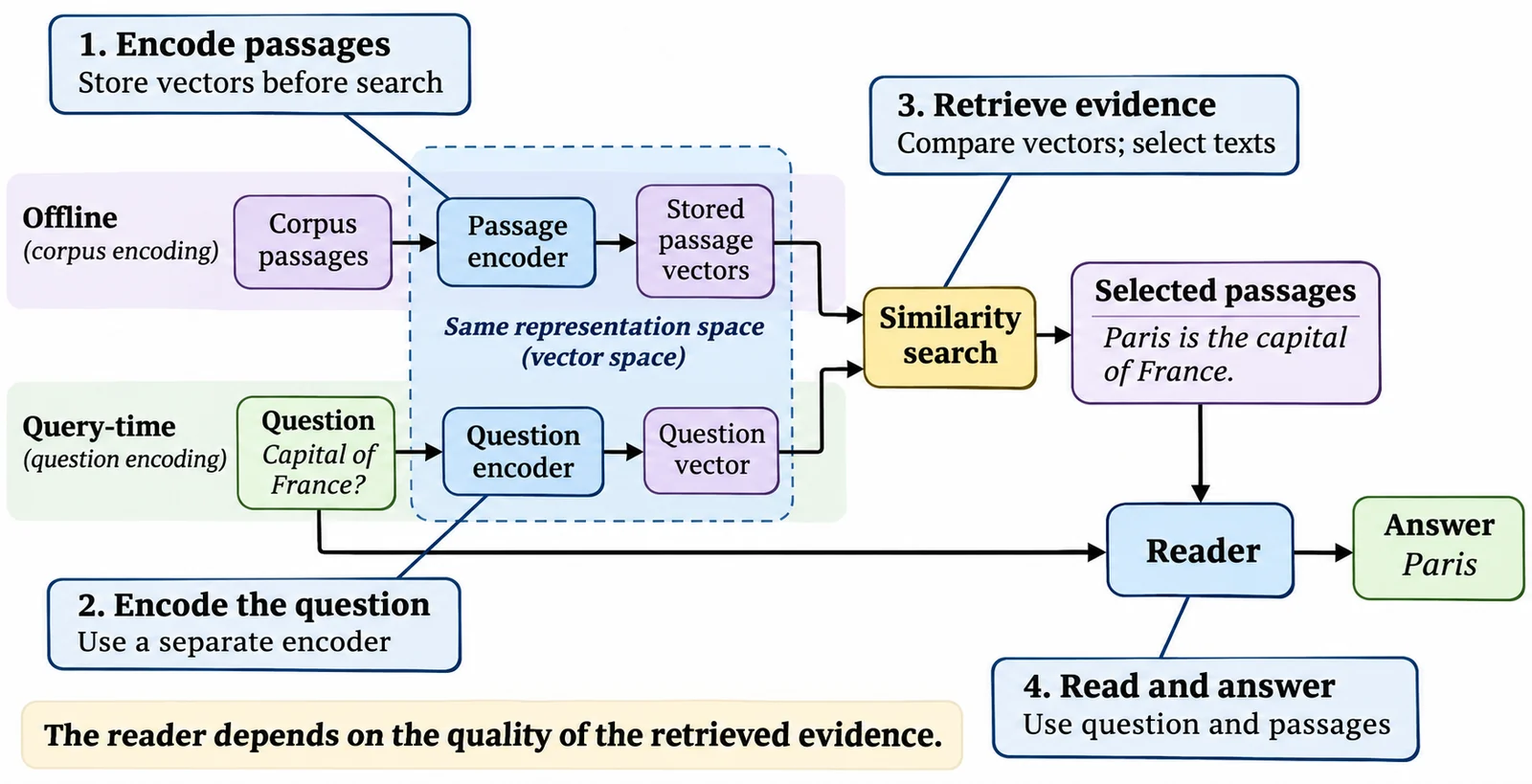
The standard arrangement is therefore a two-part pipeline. A retriever searches the corpus and proposes a set of candidate passages; a reader then examines those passages and extracts or generates an answer. The reader can only be as good as the passages it receives, so retrieval quality sets a ceiling on the whole system. A perfect reader handed the wrong five passages produces a wrong answer with full confidence. This is why open-domain work invests so heavily in the retriever, and why the field moved from keyword matching toward learned representations of meaning.
Dense retrieval
Older retrievers matched words. A question and a passage were compared by the terms they shared, which fails when the question says one thing and the passage says the same thing in different words. Dense passage retrieval replaces term matching with vectors: a dual-encoder architecture learns a dense representation of the question and of each passage, and relevance becomes proximity between those representations in a shared space.[17] Because the passage vectors can be computed once and stored, search at query time is fast, and because the comparison is semantic rather than lexical, a paraphrase can match.
Training such an encoder is harder than it looks. There is a discrepancy between training and inference, since the model is trained on a handful of labelled pairs but must choose among millions of passages at query time; there are unlabeled positives, passages that answer the question but were never marked as correct; and labelled training data are limited. RocketQA addressed these with three techniques: cross-batch negatives, which let passages labelled as non-answers for other questions in the same batch serve as negatives; denoised hard negatives, which filter out the mislabelled ones; and data augmentation. The result significantly outperformed previous state-of-the-art retrievers on two benchmarks, and the work showed that end-to-end question answering improves when built on the better retriever.[17] The lesson is structural: a gain in retrieval propagates through the pipeline, because the reader is now choosing among better candidates.
Training the retriever and reader together
If retrieval caps the reader, the natural next step is to stop training them in isolation. A retriever trained to find passages that look similar to a question is not the same as a retriever trained to find passages that let the reader produce the right answer. The ranker is rewarded for putting answer-bearing passages near the top, which is a different objective from similarity. The approach improved significantly on the prior state of the art across several open-domain datasets.[12]
A later method pushed the same idea further by making the whole pipeline differentiable. Retrieval decisions are modelled as latent variables over sets of relevant documents; since summing over all possible sets is computationally hard, an expectation-maximization algorithm approximates it, alternately estimating which documents are relevant and using that estimate to update both retriever and reader.[18] The hypothesis is that end-to-end training lets the learning signal flow back from the answer to the reader and then to the retriever, which staged training cannot do. On three benchmark datasets the method outperformed comparable approaches by 2 to 3 absolute exact-match points.[18] The retriever learns to select documents that are useful for answering, not merely documents that resemble the question.
Learning to retrieve inside the model
A different response to the same problem is to make retrieval part of the language model itself. A model pretrained on text stores a great deal of world knowledge in its parameters, but that knowledge is implicit, and covering more facts requires ever-larger networks. REALM augments pretraining with a latent knowledge retriever that lets the model retrieve and attend over documents from a large corpus during pretraining, fine-tuning, and inference. The retriever is trained without supervision, using masked language modeling as the learning signal and backpropagating through a retrieval step that considers millions of documents. On open-domain question answering benchmarks it outperformed all previous methods by 4 to 16 percent absolute accuracy, while also offering interpretability and modularity, since the retrieved documents can be inspected and the knowledge store updated without retraining the model.[19]
The appeal of this design is that it separates knowing how to reason from knowing facts. The parameters hold the reasoning; the corpus holds the facts and can be swapped or corrected. That modularity is also why retrieval augmentation has spread beyond open-domain answering into domain-specific settings, where the knowledge base must reflect a particular field rather than the open web. Those applications are covered later.
In open-domain answering the retriever decides what the reader can possibly get right, so the two are best trained with the same goal in view.
Uses
Medical question answering
Medicine is a demanding place to put question answering to work, and the reasons are worth separating. The questions themselves are often long, complex, and phrased the way a worried person actually talks rather than the way a textbook is indexed. The sources that could answer them are numerous and heterogeneous: journal articles, clinical guidelines, drug databases, formal ontologies, consumer health sites. And the cost of a wrong answer is not a wasted click. A system that returns a confident but incorrect statement about a drug or a symptom can cause harm, so the answer has to be not only short but trustworthy and traceable to a reliable source.


The mismatch between what search offers and what a clinician or patient needs is stark. A study of expert search strategies among healthcare information professionals found that, for a given search task, they spent an average of 60 minutes per collection or database, about 3 minutes examining the relevance of each document, and 4 hours of total search time, with a written-out strategy spanning over 15 lines and sometimes reaching 105.[4] That is the work a question answering system is meant to absorb. The same source notes that dedicated systems are viable here precisely because they are designed to understand natural language questions without relying on external information about the user, which suits a domain where the same question can come from a physician and a patient with equal urgency.[4]
The BIOASQ challenge
One response to this was to build a shared competition around real biomedical information needs. BIOASQ, an EU-funded challenge, asked participants to do two things at once: semantically index documents from large biomedical repositories, and assemble information from multiple heterogeneous sources, such as scientific articles and ontologies, in order to compose answers to real-life biomedical English questions.[1] The framing captures what makes the domain distinctive. Indexing and answering are treated as one problem, because the concepts used to annotate documents are the same concepts used to interpret questions, and that shared vocabulary is what lets a question meet an answer at the level of meaning.
The challenge split into two tasks. In Task 1a, participants classified new English abstracts as they appeared online, before human curators had annotated them, assigning subject headings from the MeSH hierarchy; at any point there was usually a backlog of roughly 10,000 unannotated abstracts, and the systems' predictions were later scored against the manual annotations as those became available.[1] Task 1b turned to answering. Participants annotated natural language questions with biomedical concepts and retrieved relevant documents, snippets, and triples, then in a second phase reported answers, which were compared against model answers written by biomedical experts using measures from question answering and summarization. The benchmark used 29 development and 282 test English questions, with reference answers prepared by a team of biomedical experts from around Europe.[1]
The results divided sharply. Task 1a drew twelve teams and 46 system runs, and one team performed consistently better than the MTI indexer that the National Library of Medicine uses to suggest MeSH headings to its curators. Task 1b drew only three teams and 11 runs, and performance was not very high, mostly because of the complexity and difficulty of the task; the manual evaluation of the "ideal" paragraph-sized answers, however, received relatively high scores, meaning the systems could produce good summaries that answered part or sometimes all of a question.[1] The asymmetry is instructive. Assigning concepts to a document is a classification problem with a large, clean training signal, while composing a trustworthy answer from scattered evidence is not, and the participation numbers track that difference in difficulty.
Matching a new question to an answered one
A different strategy sidesteps answer composition altogether. If many questions have already been answered by reliable sources, a system can look for an existing question whose answer also answers the new one, and return that. The relation that licenses this is question entailment: a question A entails a question B if every answer to B is also a correct answer to A.[4] The relation is deliberately looser than similarity. If the premise question is a request for cold medications for a 30-year-old woman, a system should treat the more general request for cold medications as relevant, because its answers serve the narrower question too.[4] Entailment here means a meaningful relaxation of the constraints in the original question, not a rewording of it.
To test this at scale, the researchers built MedQuAD, a collection of 47,457 question-answer pairs drawn from trusted medical sources such as NIH websites, and made it public. The answering system then combined ordinary information retrieval, to pull candidate questions, with a model that recognizes entailment, to decide which candidates genuinely entail the new question and to rank their stored answers. Evaluated on the medical questions of the TREC 2017 LiveQA challenge, following that challenge's own evaluation process, the approach exceeded the best official score on the medical task by 29.8 percent, using only the 47,000-odd pairs as its answer source.[4] Two things follow. Question entailment is a workable route into medical answering, and restricting the answer source to a curated set of reliable material can improve results rather than limit them, which matters when trustworthiness is the point.
Large language models on medical questions
The most recent turn in this story is the application of large language models, trained broadly and then adapted to medicine. Med-PaLM 2 combined improvements to its base model, fine-tuning on medical material, and new strategies for reasoning and grounding, including ensemble refinement and chain of retrieval. On MedQA, a dataset of free-form multiple-choice questions collected from professional medical board exams, it scored up to 86.5 percent, an improvement of over 19 percent on its predecessor Med-PaLM, with large gains also reported on MedMCQA, PubMedQA, and the clinical topics portion of MMLU.[3] MedQA itself is hard: the dataset spans English, simplified Chinese, and traditional Chinese, with 12,723 English questions, and the best method reported with the dataset's release reached only 36.7 percent test accuracy on the English questions.[20] The jump from that figure to the mid-eighties is a measure of how much changed in a few years.
Scores on multiple-choice exams, though, say little about whether an answer is useful to a person. The evaluation that matters more asked physicians to compare Med-PaLM 2's long-form answers against answers written by other physicians. In a pilot study using real-world medical questions, specialists preferred Med-PaLM 2 answers to those of generalist physicians 65 percent of the time; specialist answers were still preferred overall, but both specialists and generalists rated the model's answers as safe as physician answers. The model's answers were also longer on average than either its predecessor's or the physicians', which may help in many cases and may also mean unnecessary detail is added or important detail omitted.[3]
Those caveats are part of the finding, not a footnote to it. The comparison used physicians who were asked for one answer per question and were not given a specific clinical scenario or the communication needs of a particular audience, and the rating rubric was not a formally validated instrument. The authors also note that the evaluation did not consider multi-turn dialogue or the case where the right response is to ask for more information rather than list every possible cause.[3] Medical question answering has moved from retrieving a snippet to composing an answer that physicians often judge well made, and the open question is now less whether a system can produce such an answer than how to verify, in real workflows, that it should be trusted with one.
Medicine raises the stakes of every earlier problem: the questions are messier, the sources more varied, and a plausible wrong answer costs more than a missing one.
Conversational and multilingual answering
A single question asked in isolation is the easy case. People rarely gather information that way. They ask something, hear the answer, and ask a follow-up that leans on what came before: "and what about the other one?", "does that apply to children too?", "why?" Such a follow-up is often uninterpretable on its own, because the words that identify its subject, the pronoun or the omitted noun, live in an earlier turn. Conversational question answering is the setting in which a system must answer a series of interconnected questions about a passage, using the history of the exchange to make sense of each new one.[5] The system is not just answering a question; it is tracking what the conversation is about.
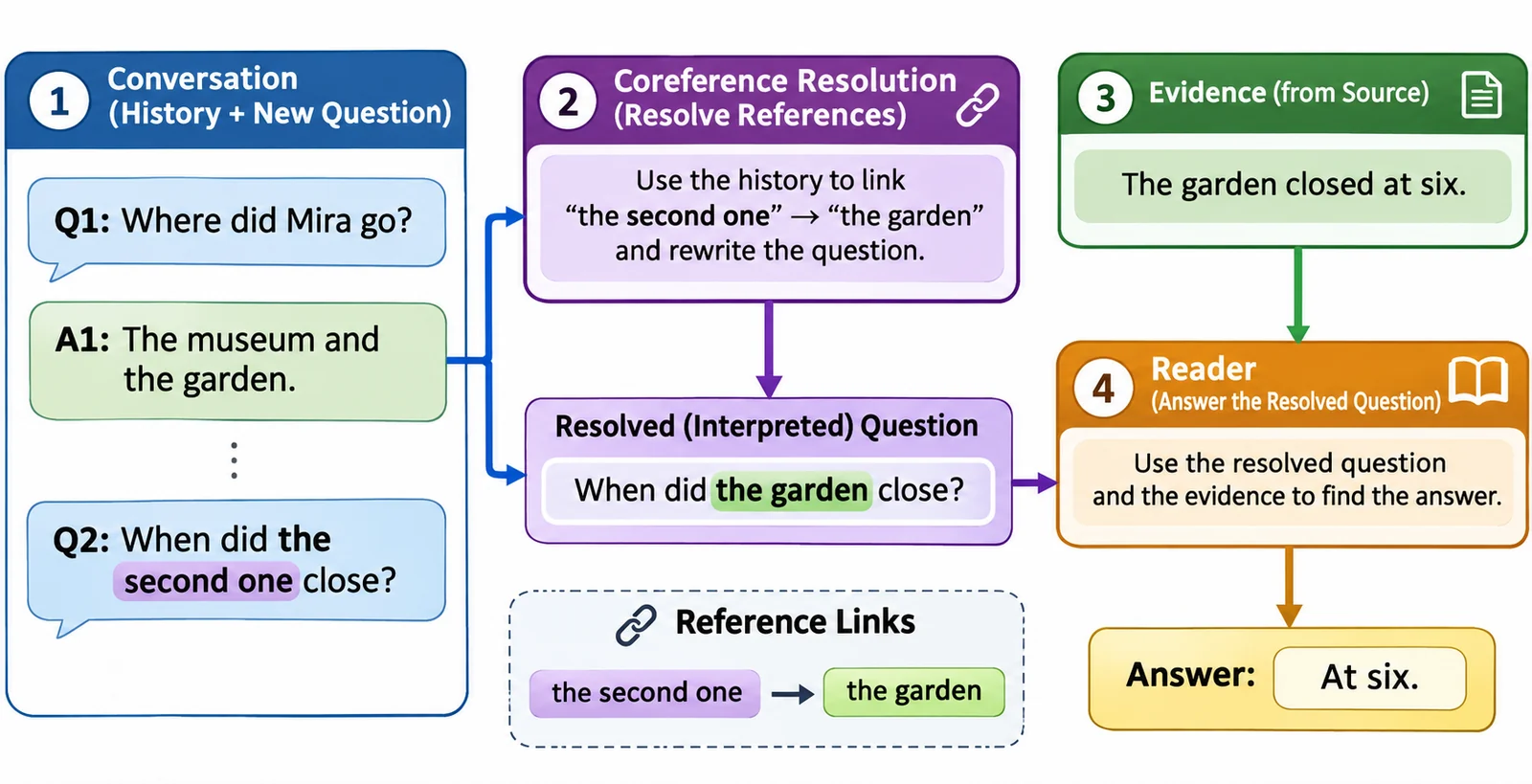
The difficulty is not simply that the questions are short. Conversational questions carry phenomena that ordinary reading-comprehension questions do not, and the two named in the literature are coreference, where a pronoun or a phrase like "the second one" refers back to something mentioned earlier, and pragmatic reasoning, where the point of the question has to be inferred from what the asker is trying to accomplish rather than from its literal wording.[5] A question such as "what about the other treatment?" contains no clue to its subject except the previous turn. A system that reads each question in isolation has nothing to work with.
CoQA and the conversational setting
The CoQA dataset was built to make this setting measurable. It contains 127,000 questions with answers, gathered from 8,000 conversations about text passages drawn from seven diverse domains, and the questions are genuinely conversational, with answers given as free-form text and the supporting evidence highlighted in the passage.[5] The highlighting matters for the same reason span annotation mattered in the reading task: it lets an evaluator check not only whether the answer is right but whether the system was looking at the right place. Because the passages come from several domains, a system cannot succeed by memorizing the vocabulary of one.
CoQA also made the difficulty visible in a way that single-turn benchmarks had not. When strong dialogue and reading-comprehension models were run on it, the best system reached an F1 score of 65.4 percent, which was 23.4 points behind human performance at 88.8 percent.[5] The size of that gap is the finding. Models that had become good at answering a question about a passage lost a great deal of that ability once the question depended on earlier turns, which says that following a conversation is a distinct skill rather than a small addition to reading comprehension.
Topic switching
A further complication is that real conversations do not stay on one subject. A person seeking information may begin with one topic and, as the exchange proceeds, move to a related one, a pattern commonly seen in information-seeking search sessions. Earlier conversational datasets were limited in two ways: they did not contain topic switches, and they assumed the reference text for the conversation was supplied, so the setting was not open-domain.[21] Both assumptions make the task easier than the real thing. If the passage is given and the topic never moves, the system need only track a single thread through a single document.
TopiOCQA was built to remove both assumptions. It is an open-domain conversational dataset based on Wikipedia that includes topic switches, containing 3,920 conversations with information-seeking questions and free-form answers, where a conversation spans 13 question-answer turns on average and involves four topics, that is, four separate documents.[21] The system must therefore do two things at once: retrieve the right document on each turn, and use the conversational history to interpret the question. Combining state-of-the-art document retrieval with neural reader models, the best system reached an F1 of 55.8, 14.2 points short of human performance.[21] The shortfall is smaller than CoQA's, which fits the added demands: the system must now decide not only what the question means in context but which document the conversation has moved to.
Many languages at once
A second dimension of difficulty is language. Most question answering research has been conducted in English, and a system that performs well on English questions may have learned something specific to English vocabulary, word order, or the way English speakers phrase a request. Testing across languages is how that dependence is exposed. TyDi QA is a question answering dataset covering 11 typologically diverse languages, with 204,000 question-answer pairs, where the languages were chosen for diversity in the linguistic features they express, so that a model performing well across the set would be expected to generalize to many of the world's languages.[22]
The way TyDi QA's questions were collected is as important as the languages. To make the task resemble real information seeking and to avoid priming effects, the questions were written by people who wanted to know the answer but did not yet know it, and the data was collected directly in each language rather than translated from English.[22] This matters because a translated question carries the phrasing of its source language underneath. A question written natively reflects how a speaker of that language actually asks, which is the thing a deployed system would face.
MKQA approaches the same problem from a different angle. It is an open-domain evaluation set of 10,000 question-answer pairs aligned across 26 typologically diverse languages, for 260,000 pairs in total, and its answers rest on a heavily curated, language-independent representation so that results are comparable across languages and do not depend on passages in any one language.[23] Alignment is the design idea: the same question is asked in every language, so a difference in score reflects the language rather than a difference in what was asked. Benchmarking generative and extractive methods trained on Natural Questions, the researchers found the set challenging even in English, and especially so in low-resource languages.[23]
That last result is the recurring lesson of multilingual work. The problem is not that a language is intrinsically harder to answer questions in, but that the resources available for it are thinner: less training data, fewer annotated examples, fewer tools. A model trained mostly on English carries its English knowledge into other languages unevenly, and the languages with the least material to learn from show the largest shortfall. Conversational and multilingual answering thus press on the same weakness from two directions. In one, the context a system needs is in the previous turn; in the other, it is in a language the system has seen too little of. Both require the system to bring more to the question than the question's own words.
A question is rarely self-contained: its meaning may sit in the previous turn or in the resources of a language the system has barely seen.
Answering over knowledge bases and the semantic web
Not every question is best answered from prose. Much of the world's organized information sits in knowledge bases: stores of facts broken into structured records, where an entity such as a drug or a city is linked to other entities by named relations. A knowledge graph is such a store viewed as a network, with entities as nodes and relations as edges. A triple is the smallest unit in this form, a statement of the shape subject, relation, object, for instance that a particular drug treats a particular condition. A query language such as SPARQL is the formal notation used to ask these stores questions. The obstacle is that a person asks in ordinary words while the store expects a precise formal query built from its own vocabulary, and bridging that gap is the whole problem of knowledge-base question answering.


The semantic web is the vision that gives this work its name: facts published on the web in machine-readable form, linked across sources, so that a question can be answered from authoritative data rather than from whatever text happens to rank highly. The aim is targeted answers without extraneous information, drawn from current and authoritative sources and accompanied by supporting material such as provenance and relevant links.[10] Provenance is not decoration here. When an answer comes from a structured record, the system can say which record and which source it came from, which is exactly what a ranked list of web pages cannot do.
From question to formal query
The central move is semantic parsing: translating a natural language question into a structured query over the knowledge base. The straightforward way to do this runs the question through a syntactic parser and builds the query from the parse. The weakness is that a parse error produces a false structured query, and a false query yields false or incomplete answers; the problem gets worse for complex questions, where more of the sentence must be interpreted correctly for the query to come out right.[24]
Template decomposition takes a different route. Rather than parsing the question into a tree and converting it, the system holds a large collection of binary templates, small paired patterns that each capture one way of asking for a relation, and it decomposes the question by matching and combining these templates. Because sufficient templates are critical, the method includes a low-cost way to build a great many of them automatically, an index to keep the online search over templates tractable, and strategies for resolving two kinds of ambiguity: which entity the question means, and which structure of relations it intends. The reported experiments over several benchmarks found the approach significantly outperformed prior methods on both precision and recall.[24] The design idea is worth separating from the numbers. Templates replace a single fragile parse with many small, independently checkable matches, so a question that defeats one pattern can still be caught by another.
Answering from a graph without a query language
A second family of methods never writes a formal query at all. Instead it learns to score candidate answers directly from the graph. One system learns low-dimensional embeddings, vector representations, of both the words in a question and the constituents of the knowledge base, and uses those representations to score natural language questions against candidate answers. Training uses pairs of questions with structured representations of their answers, together with pairs of paraphrased questions, and the resulting system is competitive on a standard benchmark while relying on few hand-crafted features.[25] The appeal is that the same learned space can relate a word in a question to a node in the graph even when their surface forms differ, which is the same semantic-matching idea that dense retrieval brought to text.
Several knowledge bases, several languages
Most systems of this kind are built for one knowledge base in one language, usually English, and adapting them to a new store or a new language means substantial rework. One approach set out to be knowledge-base-agnostic and multilingual: it translates natural language questions into SPARQL queries and can query several knowledge bases at once, in different languages, and can be ported to other stores and languages with relative ease. The evaluation used five large and well-known knowledge bases, Wikidata, DBpedia, MusicBrainz, DBLP, and Freebase, and five languages, English, German, French, Italian, and Spanish.[26] The work is described as a first approximation that validates the concept rather than a finished system, which is the honest framing for a problem this broad.
What unites these approaches is a trade that text-based answering does not have to make. A structured source gives precision and provenance: the answer is a fact drawn from a record, and the system can show which record. It also demands that the question be mapped onto a fixed vocabulary before anything can be retrieved, and that mapping is where the difficulty concentrates. The methods above differ mainly in how they perform it, by parsing, by templates, by learned similarity, or by translation into a formal query, but all of them stand or fall on getting the question's meaning into the shape the store can accept.
A knowledge base trades the messiness of text for the rigidity of a schema: answers become precise and traceable, but the question must first be translated into the store's own terms.
Visual question answering
Everything described so far assumes the question is about text. Visual question answering (VQA) asks the same kind of question about an image: the system receives a picture and a question phrased in ordinary language, and must produce the answer. The question might ask what an object is, how many of something are present, or how two things in the scene relate to each other. The task is harder than it sounds because the answer usually depends on combining two quite different kinds of information, what the image shows and what the words ask for, and a system can be right about one while ignoring the other.
Remote sensing gives a concrete version of the problem. Satellite and aerial images hold a great deal of information useful for land cover classification, counting objects, or detecting them, but most available methods are built for one specific task, which makes the information hard to reach for anyone without specialist knowledge. RSVQA reframes this as a question answering problem: a user asks a question in natural language and the system uses it to interrogate the image, so that high-level information about the scene, or relations between objects visible in it, can be obtained without a bespoke tool for each query.[27]
Building such a system requires training data, and the RSVQA work generated it automatically rather than by hand. An automatic method produced two datasets of image, question, and answer triples, one from low-resolution imagery and one from high-resolution imagery, with the questions and answers derived by querying OpenStreetMap, the collaborative map of the world.[27] The map supplies the ground truth: if the map records a particular kind of land use at a location, a question about that location has a known answer. A model combining a convolutional neural network, which processes the image, with a recurrent neural network, which processes the question, was trained on both datasets and produced promising results in each case.[27]
Answering without looking
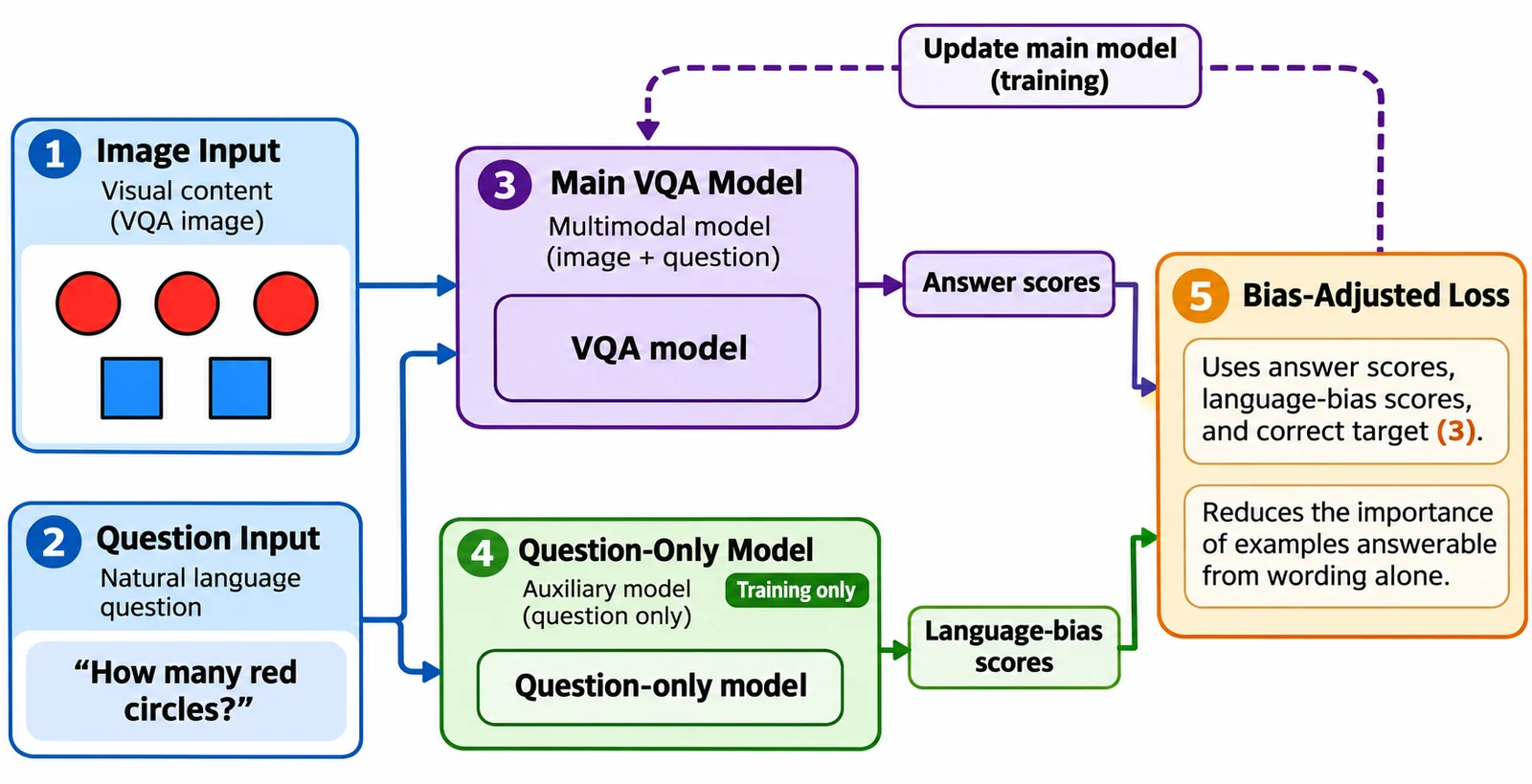
The deeper difficulty with VQA is not building a model that scores well, but knowing what the model is actually using to score well. Many questions carry strong statistical regularities between their wording and their answer. A question beginning "what color is the..." may be followed by "white" often enough in the training data that a model can learn the association and answer correctly without examining the image at all. This is unimodal bias: the model exploits regularities in one input modality, here the language, to produce the answer while ignoring the other, here the picture. A biased model can look accurate on data that resembles its training set and then fail badly on anything outside that distribution, which makes it unsuitable for real use.[28]
The reason the failure is easy to miss is that the training and test data usually come from the same source, so the regularities hold in both. The bias only shows when the test questions are deliberately built so that the patterns learned in training no longer apply. A dataset designed for exactly this purpose presents the model, at test time, with question biases different from those seen during training, and a biased model's performance drops sharply on it.[28]
RUBi
RUBi is a training strategy that attacks the bias directly rather than trying to design it out of the architecture. It works by reducing the importance of the most biased examples, meaning those that can be answered correctly without looking at the image at all, which implicitly pushes the model to use both inputs instead of relying on statistical regularities between question and answer.[28] The mechanism is a second, question-only model that captures the language biases, identifying when the unwanted regularities are being used. That question-only model then influences the predictions of the main VQA model, preventing it from learning those regularities, and the effect is a loss that adjusts dynamically to compensate for the bias.[28]
The strategy is designed to be general: it can be applied to any VQA model rather than requiring a particular architecture, and it was validated by surpassing the previous state of the art on the bias-focused benchmark described above.[28] The lesson generalizes beyond pictures. Whenever a system is trained on paired inputs, one of which is richer or more regular than the other, there is a risk that it learns the cheap signal and never uses the expensive one, and the remedy is to measure performance on data where the cheap signal has been made useless.
A model that answers correctly without looking has not learned to answer; it has learned the shortcuts in its training data.
Research
Benchmarks and datasets
A question answering system can be tested on questions written by its own builders, but that proves little. The builders know what their system can do and unconsciously write questions it can handle. Comparing systems, and knowing whether the field is making progress at all, requires a shared set of questions with reference answers that everyone runs against, so that a difference in score reflects a difference in method rather than a difference in what was asked. This is what a benchmark dataset provides: a fixed collection of questions, each paired with an answer agreed in advance to be correct, plus a scoring rule. The reference answers are the crucial part. Without them there is nothing to compare a system's output against, and with them a score becomes a claim that can be checked.
Building such a dataset is a design decision all the way down, because the way questions are collected determines what the scores mean. Questions invented by researchers to be answerable tend to be tidier than questions people actually ask, and a system that does well on the tidy version may struggle on the real one. Questions harvested from real users carry the opposite problem: they are messy, sometimes ambiguous, and sometimes unanswerable, which makes them realistic but harder to score. Much of the history of the field can be read as a series of attempts to get the collection method right, each new dataset correcting something the previous one made too easy.
Questions people actually asked
Natural Questions took the realistic route directly. Its questions are real, anonymized queries that people typed into the Google search engine, not questions composed for a test. For each one, an annotator was shown the question along with a Wikipedia page drawn from the top five search results, and marked a long answer, typically a paragraph, and a short answer, one or more entities, where those appeared on the page, or marked the question as having no answer there.[29] The two answer levels are the interesting design choice. They acknowledge that a real question can want either a name or a passage of explanation, and they let a system be scored on producing the right span and on identifying the right supporting text.
The scale was built for training as well as testing: the public release contains 307,373 training examples with a single annotation each, 7,830 development examples annotated five ways, and a further 7,842 test examples also annotated five ways and held back.[29] Annotating the same question several times is not waste. It measures how much people disagree about what the answer is, which sets a realistic ceiling: if five careful annotators pick different spans, a system that picks one of them should not be counted as simply wrong. The researchers examined this directly with 25-way annotations on a small set of 302 examples, and used what they found to define scoring metrics that are robust to that variation.[29] A benchmark, in other words, has to decide what counts as correct before it can say how correct a system is.
Questions written over a known passage
SQuAD took the opposite approach and made it rigorous. Its more than 100,000 questions were written by crowdworkers on a set of Wikipedia articles, with the constraint that the answer to each question must be a segment of text from the corresponding passage.[6] Fixing the answer to a contiguous span of the given text is what makes automatic scoring possible: the system's marked span is compared against the reference span, and no judgment about paraphrase is needed. It also fixes what the dataset measures. Because the passage is supplied and guaranteed to contain the answer, SQuAD tests reading rather than searching, and a high score says nothing about whether a system could have found that passage on its own.
Those three numbers together describe the benchmark's value: the task was clearly learnable, clearly not solved, and had a known human ceiling to measure against. The gap between the model and the people is what made SQuAD a challenge worth working on, and the comparison to human performance became a standard part of how new datasets were presented.
Conversations and retrieved context
CoQA extended the reading setup from a single question to a conversation. Its 127,000 questions with answers came from 8,000 conversations about passages drawn from seven diverse domains, with answers given as free-form text and the supporting evidence highlighted in the passage.[5] Two departures from SQuAD matter. The answers need not be a contiguous span, so the system must produce text rather than point at one, and the questions depend on the turns before them, so the passage alone is not enough context. Highlighting the evidence preserves automatic checkability even with free-form answers, since the system's grounding can be inspected separately from its wording.
SearchQA attacked a different simplification. Datasets like SQuAD start from an existing article and generate a question whose answer is in it, which assumes the retrieval step has already been done correctly. SearchQA starts from an existing question-answer pair, crawled from the archive of the television quiz show Jeopardy!, and augments each pair with text snippets retrieved by Google. The result is more than 140,000 question-answer pairs, each with 49.6 snippets on average, along with metadata such as each snippet's web address.[30] This reflects a fuller pipeline: the system is handed the noisy output of a real search engine, complete with irrelevant snippets, rather than a clean passage chosen by a dataset builder. The gap between human and machine performance on it was meaningful, which the designers took as evidence the set could serve as a benchmark.[30]
Across languages
Most of these datasets are English, and a system tuned on English may have learned something specific to English wording. TyDi QA was built to test that, covering 11 typologically diverse languages with 204,000 question-answer pairs, where the languages were selected for diversity in the linguistic features they express, so that good performance across the set would suggest generalization to many of the world's languages. The collection method was chosen with care: to make the task resemble real information seeking and to avoid priming effects, the questions were written by people who wanted to know the answer but did not yet know it, and the data was gathered directly in each language rather than translated.[22] A question written natively reflects how a speaker of that language actually asks, which is what a deployed system would face and what a translation would hide.
A field of many datasets
The pace of dataset construction has been remarkable. A large survey of the field counted more than 80 new datasets appearing in the two years before it was written, and set out to organize the various formats and domains these resources cover, along with the gaps that remain.[31] That volume is a sign of health and a problem at the same time. Each dataset tends to measure something slightly different, whether reading a supplied passage, searching an open corpus, following a conversation, or working in a particular language or specialty, so a system's score on one says little about another. The survey also raises the concentration on English as a limitation in its own right, since resources for other languages are far thinner.[31]
The practical consequence is that a single number never describes a question answering system. A benchmark is a controlled comparison, useful precisely because it holds the questions fixed, and misleading the moment its results are treated as a general measure of ability. What the datasets above collectively provide is a set of distinct lenses, each correcting a simplification in the ones before it, and the discipline of reporting which lens a score was obtained through.
A benchmark is an argument about what answering a question should mean, made concrete in the questions it chooses to ask and the answers it accepts.
How well systems answer
Scores on a benchmark are only meaningful against something. A number like 65 percent accuracy says nothing on its own, because it depends on how hard the questions were, how the answer was scored, and what a person would have managed on the same set.[9] The useful comparisons are therefore two: how far systems have come from a trivial baseline, and how far they remain from human performance. Both are reported routinely, and the second is usually the more informative, because it sets a ceiling that no amount of engineering can raise.
The earliest large-scale measurements already showed a pattern that would repeat. In the first two runs of the TREC question answering track, the best systems answered about 70 percent of the questions in TREC-8 and about 65 percent in TREC-9.[9] Those figures look modest beside later results, but the task was narrow by design: retrieve a small snippet of text containing the actual answer, rather than a ranked list of documents. A system that answered two thirds of factual questions correctly was doing something a search engine could not, and the drop between the two years came from using real users' questions rather than ones constructed for the track, a harder test rather than a worse system.
Reading a supplied passage
When the task was narrowed further, so that the passage was handed to the system and the answer was guaranteed to be a span within it, the numbers became easier to interpret. The Stanford Question Answering Dataset was built this way, with more than 100,000 crowdwritten questions over Wikipedia articles, each answered by a segment of the corresponding passage. Its designers established the range of difficulty with a strong logistic regression model, which reached an F1 score of 51.0 percent against a simple baseline of 20 percent, while human performance on the same questions was 86.8 percent.[6] Three numbers, each doing a different job: the baseline shows the task is not free, the model shows it is learnable, and the human score shows it is not solved. The 35-point gap between model and people was the challenge the dataset was published to pose.[6]
That gap narrowed as attention-based and then recurrence-free reading models improved on it, with QANet reaching 84.6 F1 on the SQuAD test set, but the shape of the comparison stayed the same.[16] Human performance on a reading task is high and fairly stable, so it functions as a fixed target, and progress is read off as the distance to it shrinking.
Conversations and the cost of context
The framing becomes more revealing when the task changes. CoQA asked systems to answer questions that depend on earlier turns of a conversation, with free-form answers rather than extracted spans, over passages from seven domains. Strong dialogue and reading-comprehension models were run on it, and the best reached an F1 of 65.4 percent, which was 23.4 points behind human performance at 88.8 percent.[5] The absolute machine score is not far below what reading models were achieving on single-turn data at the time; what stands out is the size of the remaining gap. Models that had become competent at answering a question about a passage lost much of that competence once the question leaned on what had been said before. Conversational questions bring challenging phenomena that are not present in existing reading comprehension datasets, and the best system's 65.4 percent F1 leaves ample room for improvement.[5]
When the questions are hard
A different kind of evidence comes from benchmarks built so that the questions resist the methods available. The AI2 Reasoning Challenge assembled grade-school science questions and partitioned them, with a Challenge Set containing only questions that both a retrieval-based algorithm and a word co-occurrence algorithm had answered incorrectly. Leading neural models from the reading and inference literature were then tested on that set, and none was able to significantly outperform a random baseline.[32] This is a stronger statement than a low score. A system scoring well below human performance might still be learning something; a system indistinguishable from guessing on a set of questions is not, and the result located a class of question, requiring outside knowledge and reasoning that the passage does not supply, where the prevailing methods had nothing to offer.
CommonsenseQA produced a comparable picture with a different construction. Its questions were built from ConceptNet by extracting multiple target concepts that share a semantic relation to a single source concept, then asking crowdworkers to write multiple-choice questions that mention the source and discriminate among the targets, which pushes the questions toward complex semantics that require prior knowledge. The best baseline, based on BERT-large, reached 56 percent accuracy, well below human performance at 89 percent.[33] The gap is wide, and its width is the point: the questions were designed so that the passage alone could not settle them, and the models' shortfall measures how much of answering depends on knowledge the text does not contain.
Confidence and correctness
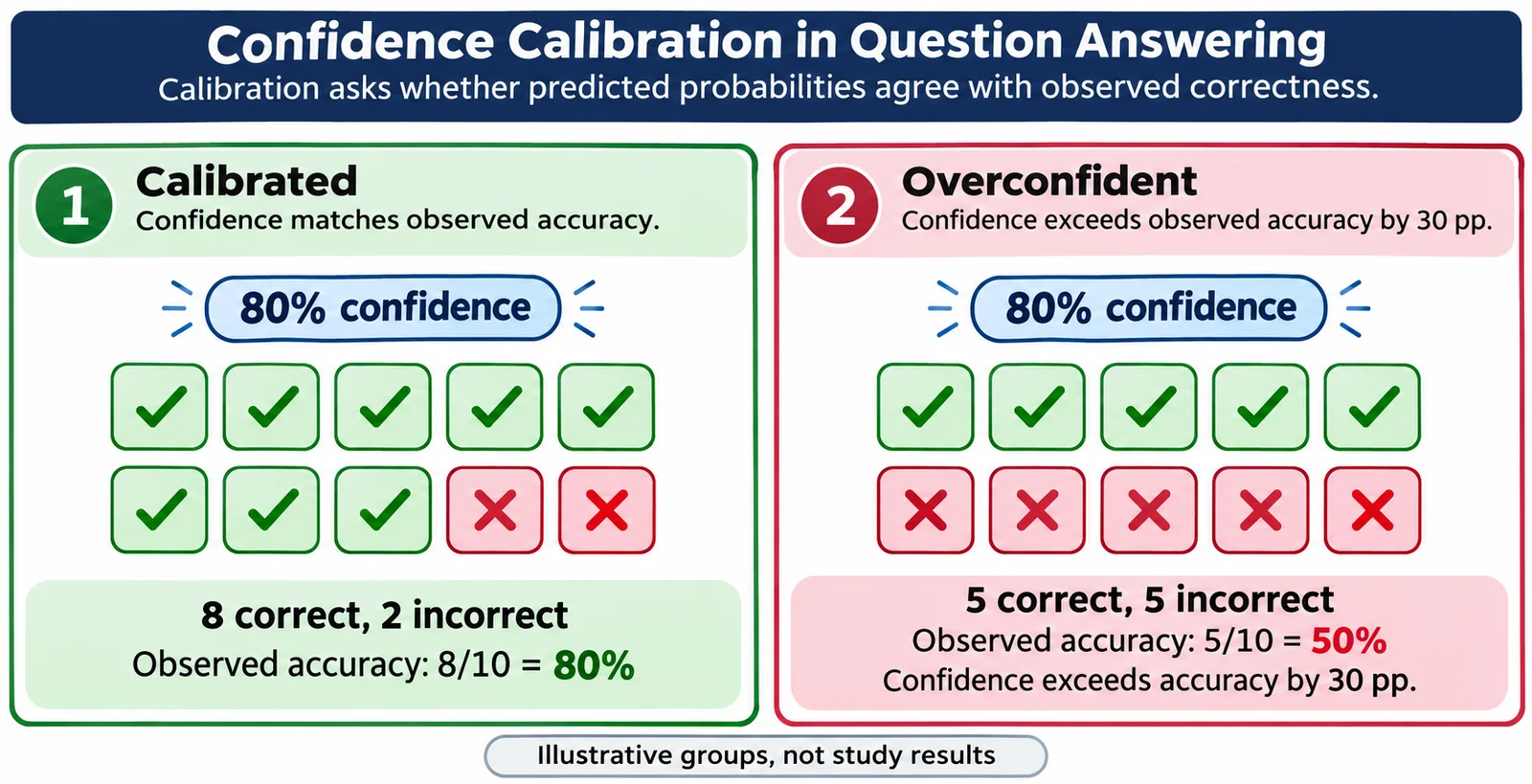
There is a further question that accuracy figures do not answer: whether a system knows when it is likely to be wrong. A model that is right 80 percent of the time is more useful if its errors cluster where it expresses low confidence, so that a user or a downstream process can tell which answers to check.[34] This property is called calibration, the correspondence between a model's predicted probabilities and the actual probability of being correct. Three strong generative models, T5, BART, and GPT-2, were examined on question answering tasks, and their probabilities turned out to be relatively poorly calibrated.[34] The confidence a model attaches to an answer is not a reliable guide to whether that answer is right.
That finding matters because confidence scores are what a deployed system would use to decide when to answer and when to defer, and because a poorly calibrated model can be confidently wrong in exactly the cases where a person would want a warning. The same work examined methods for improving calibration, through fine-tuning, post-hoc adjustment of probabilities, or changes to the predicted outputs or inputs, and found them effective across a range of datasets.[34] Calibration is therefore treatable, but it has to be measured and treated deliberately; it does not come for free with accuracy.
Accuracy says how often a system is right; calibration says whether it knows when it is not, and the two do not rise together.
What the numbers mean together
Read as a whole, the measurements describe a field that has moved a long way on well-posed tasks and much less on the ones that resemble ordinary human questioning. On a supplied passage with an extractable answer, systems improved from an F1 of 51.0 percent to 84.6 F1 on the SQuAD test set.[6][16] On the ARC Challenge Set, none of the tested neural baselines was able to significantly outperform a random baseline.[32] The pattern is consistent with the design of the benchmarks: each one that removed a simplification, by taking away the supplied passage, by requiring earlier turns, or by demanding knowledge the text does not contain, produced a larger shortfall.
Two cautions belong with these figures. The first is that a benchmark score is a controlled comparison, obtained on questions collected in a particular way, and it does not transfer to a differently built set; the same system can look strong on one and weak on another. The second is that human performance is itself an average over annotators who sometimes disagree, which is why datasets that annotate the same question several times report the variation and build scoring rules robust to it.[29] The distance to human performance is a useful target, but it is a target with a margin, and the margin is part of what the numbers mean.
Questions that need reasoning and common sense
Most of the benchmarks described so far share a quiet assumption: the material needed to answer the question sits in one place, and the system's job is to find it and read it. A large class of real questions breaks that assumption. The facts needed are scattered across separate passages, or they are not written down anywhere in the supplied text at all, because the asker expects the answerer to bring ordinary world knowledge to the task. These are the questions that separate finding from thinking.


Multi-hop question answering names the first kind. A question is multi-hop when no single passage contains the answer, because the facts must be chained: one passage supplies a fact, that fact identifies where to look next, and a second passage supplies the rest. The system must retrieve, read, and then retrieve again using what it learned, rather than issuing one query and hoping the right passage surfaces. The difficulty is not only that two lookups are needed but that the second lookup cannot be formulated until the first has been understood, so an error at either step produces a confident wrong answer.
Composing sentences to answer
The QASC dataset was built to make this kind of composition measurable. It is a multi-hop reasoning dataset that requires retrieving facts from a large corpus and composing them to answer a multiple-choice question, and it was designed with two properties that earlier sets lacked: the facts to be composed are annotated in a large corpus, and the decomposition into those facts is not evident from the question itself.[35] That second property is what makes it hard. If a question announces its own parts, a system can look each part up separately. When the decomposition has to be discovered, the system must introduce new concepts or relations of its own in order to find the facts that could be combined, and then judge which combinations are valid using common sense.[35]
The researchers supplied annotations for the supporting facts and their composition, and used them to build a two-step method that eases the retrieval problem, drawing on other multiple-choice datasets as additional training data to strengthen the reasoning model.[35] The approach improved over current state-of-the-art language models by 11 percent absolute. That gain did not close the task: the model still lagged 20 percent behind human performance, and the retrieval and reasoning problems were described as remaining unsolved.[35] The two numbers together are the finding. Composition can be taught to some degree, and the residue is large enough to say that teaching it is not the same as solving it.
Questions that need knowledge from outside
CommonsenseQA attacks the second kind of question, where the passage cannot settle the matter because the answer depends on knowledge the text does not contain. Its construction is worth following, because the difficulty is engineered rather than incidental. The builders took ConceptNet, a graph of everyday concepts and the relations between them, and extracted multiple target concepts that share a semantic relation to a single source concept. Crowdworkers were then asked to write multiple-choice questions that mention the source concept and discriminate in turn between each of the targets.[33] Because the targets are all related to the source in the same way, a question cannot be answered by spotting an association; the asker has to know which of several plausible relations actually holds.
The procedure produced 12,247 questions, and a large set of strong baselines was run against them to demonstrate the difficulty. The best baseline, built on BERT-large, reached 56 percent accuracy, against human performance of 89 percent.[33] The size of that gap is the point. These are not trick questions or specialist questions; they are the kind of thing a person answers without noticing that any reasoning took place. A model that has read a great deal of text still falls well short, which says that much of what makes such a question easy for a person is knowledge that is never stated in the sentence being asked about.
Grade-school science that resists pattern matching
The AI2 Reasoning Challenge, or ARC, pushed the same idea further by selecting for questions that defeat the standard methods outright. Its question set consists only of natural, grade-school science questions authored for human tests, making it the largest public-domain set of its kind at 7,787 questions, and it is partitioned into a Challenge Set and an Easy Set, where the Challenge Set contains only questions that both a retrieval-based algorithm and a word co-occurrence algorithm answered incorrectly.[32] The filter is the design. Rather than hoping the questions are hard, the builders removed every question that a simple method could get right, so what remains is by construction the part that pattern matching cannot reach.
Leading neural models from the reading and inference literature were then tested on the Challenge Set, and none was able to significantly outperform a random baseline.[32] That result is stronger than a low score. A system that scores below human performance may still be learning something real; a system indistinguishable from guessing has nothing to offer on that class of question, and the failure is categorical rather than a matter of degree. The corpus released alongside the questions, 14 million science sentences relevant to the task, shows that the missing ingredient is not raw text. The material was there, and the methods could not use it to reason.
What unites these three efforts is a shared diagnosis. QASC shows that composing facts is a skill distinct from retrieving them, and that a model can improve at it while staying far from people. CommonsenseQA shows that a question can be unanswerable from its own wording because the needed knowledge lives outside the text. ARC shows that when questions are chosen precisely to exclude what retrieval and word association can do, the prevailing methods fall to chance. Each removes a crutch that the earlier benchmarks had quietly supplied, and each leaves a gap to human performance that is wider than the ones measured on well-posed reading tasks. How those gaps fit into the broader picture of what question answering systems still get wrong is covered later.
Retrieval finds what is written; these questions ask for what must be inferred, combined, or known without being written down at all.
Risks and limits
Limits, failures and open problems
These are named as the central difficulties of question answering, and they are stubborn because both question understanding and answer extraction remain difficult tasks. A system can be excellent at retrieving relevant text and still fail, because it misread the question; it can understand the question perfectly and still fail, because the answer was phrased in a way its extraction step did not anticipate.[4]
The two hard problems
Question understanding fails in ways that are easy to overlook. A question may be long and complex, carrying several constraints at once, and a system that drops one of them searches for something subtly different from what was asked. Answer extraction has its own failure mode: the right passage is retrieved, the answer is present in it, and the system returns a span that is plausible, well-formed, and wrong. Because both failures produce fluent output, neither announces itself. A system that misreads a question does not return an error; it returns a confident answer to a question nobody asked.
The cost of a narrow answer source
One response to unreliable answers is to restrict where answers may come from, using only a curated set of trusted sources. This helps, and the evidence for it is real: relying on a restricted set of reliable answer sources brought a substantial improvement in medical question answering.[4] But the same restriction sets a ceiling. The same work found that relying on a restricted set of reliable answer sources can bring a substantial improvement in medical question answering. The trade is between trustworthiness and coverage.[4]
Shortcuts that look like skill
A subtler failure is a system that scores well for the wrong reason. When a model is trained on paired inputs, one of which carries stronger statistical regularities than the other, it may learn the cheap signal and never use the expensive one. In visual question answering this shows up as unimodal bias, where a model exploits regularities in the question's wording to produce the answer without examining the image at all, and such a model suffers a large drop in performance when evaluated on data outside its training distribution, which makes it unsuitable for real-world settings.[28] The failure is invisible on ordinary test data, because the regularities hold there too. It surfaces only when the test set is built so that the patterns learned in training no longer apply.
The general lesson extends past pictures. Wherever a benchmark's questions can be answered by a shortcut, a high score may measure the shortcut rather than the skill the benchmark was meant to test.
Not knowing when it is wrong
Accuracy figures leave a further question unanswered: whether a system's confidence tracks its correctness. Calibration is the property of a model's predicted probabilities being well correlated with the probabilities of correctness, and three strong generative models examined on question answering tasks turned out to be relatively poorly calibrated, meaning the confidence attached to an answer is not a reliable guide to whether that answer is right.[34] For a deployed system this is a practical problem rather than a technical curiosity. The same work found that calibration can be improved through fine-tuning, adjustment of probabilities, or changes to inputs and outputs, so the problem is treatable, but only if it is measured.[34]
Answers that are right in outline
Long-form answers introduce a failure mode that accuracy scoring handles badly. In the medical setting, model answers were found to be longer on average than physician answers, which may help in many cases but may also mean unnecessary detail is included or important information omitted.[3] Length is not itself the fault; the fault is that a longer answer creates more opportunities to say something true in general and wrong for this question.
Evaluation that has not been validated
Judging such answers requires human raters, and the instruments those raters use are often less rigorous than the numbers they produce suggest. The rating rubric used in that medical evaluation was not a formally validated qualitative instrument, though interrater reliability was observed to be high. The comparison also rested on physicians who were asked for a single answer per question and were not given a specific clinical scenario or the communication needs of a particular audience, and the evaluation did not consider multi-turn dialogue or the case where the right response is to ask for more information rather than list every possible cause.[3] Each of these is a reasonable simplification for a study, and each narrows what the resulting preference scores can be taken to mean.
The gap to real work
Put together, these limits explain why a strong benchmark score does not transfer directly to a working tool. Evaluation should be grounded in specific workflows and clinical scenarios rather than in benchmark sets alone.[3] Closing them requires evaluation grounded in specific workflows and clinical scenarios rather than in benchmark sets alone, and that work is ongoing.
A system's limits show up less in the questions it gets wrong than in the ones it answers confidently for the wrong reason.
Later developments
Where the field is heading
Models that read and retrieve together
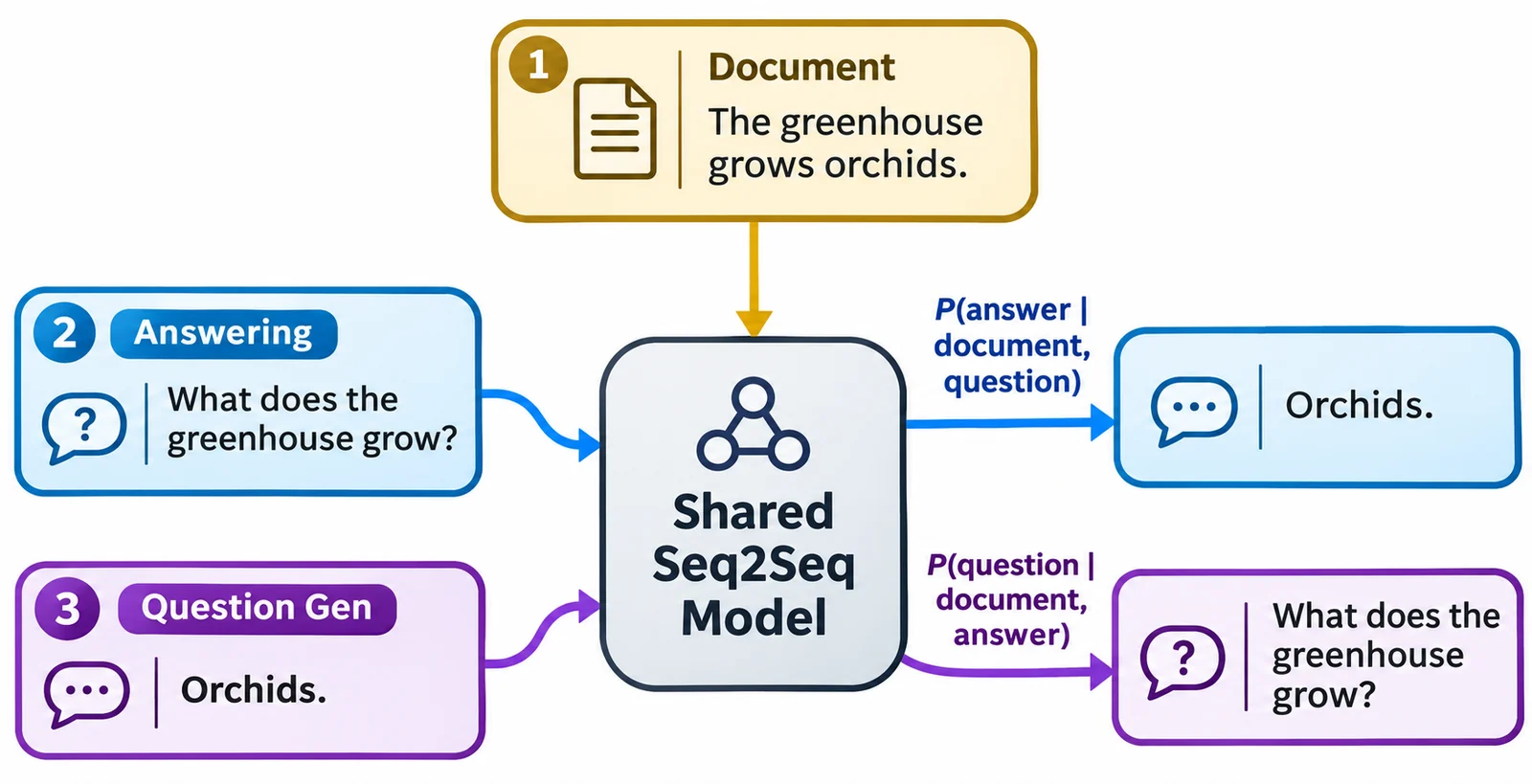
One direction makes retrieval part of the model's own training, so that the knowledge a system draws on sits in a corpus it can search rather than only in its parameters.
Retrieval-augmented generation, or RAG, joins a retriever to a generator that composes the answer, and it was first trained and explored with a Wikipedia-based external knowledge base, which leaves it poorly optimized for specialized domains such as healthcare and news. The proposed remedy, RAG-end2end, adapts to a domain-specific knowledge base by updating all components of the external knowledge base during training, and adds an auxiliary training signal that forces the model to reconstruct a given sentence by accessing the relevant information from the knowledge base. The important change is that, unlike RAG, RAG-end2end does joint training of the retriever and generator for the end QA task and domain adaptation, and the approach was evaluated on datasets from three domains, COVID-19, News, and Conversations, where it achieved significant improvements over the original RAG model.[36] Domain adaptation here is not a matter of swapping in a new index and hoping the generator copes; the whole pipeline is retrained so that retrieval and generation agree about what counts as a useful passage.
Grounding as a design requirement
A second thread is the demand that an answer be grounded, meaning traceable to evidence the system actually consulted rather than produced from memory alone. The medical work makes the requirement concrete. Med-PaLM 2 combined base model improvements, fine-tuning on medical material, and new strategies for improving reasoning and grounding through ensemble refinement and chain of retrieval.[3] The pairing of reasoning with retrieval in that description is deliberate: the model is not merely asked to recall, it is given a route to the material and asked to reason over what it finds.
The same concern shapes how such systems are judged. The evaluation of Med-PaLM 2 went beyond multiple-choice scores to long-form answers assessed by physicians along multiple axes of quality and safety, on consumer questions, adversarial questions designed to probe limitations, and questions that arose during routine care.[3] Grounding and evaluation grow together, because an answer that cites its evidence can be assessed on whether the evidence supports it, which a bare assertion cannot.
Asking as well as answering
A less obvious direction treats answering and question generation as two halves of one skill. The intuition is that the tasks are connected: a model that can produce a good question for a given answer has understood something about what the answer implies, and that understanding can feed back into answering. One framework trains a question answering model and a question generation model simultaneously, using their probabilistic correlation to guide the training of both, with the answering model judging whether a generated question is relevant to an answer and the generation model supplying the probability of a question given an answer as evidence that helps the answering side. Experiments on three datasets showed the joint framework improved both tasks, with the improved answering model performing comparably to strong baselines on all three.[37]
A related design has a single model learn to ask and to answer over the same document, using a sequence-to-sequence framework that encodes the document and generates a question given an answer, or an answer given a question. Training on the SQuAD corpus produced a significant improvement in performance, supporting the hypothesis that learning both tasks helps.[38]
One task to rule them all
The most ambitious reframing casts many language tasks as question answering over a context. The Natural Language Decathlon, or decaNLP, spans ten tasks, among them question answering, machine translation, summarization, natural language inference, sentiment analysis, and semantic role labeling, and treats each as a question posed about some context. A single multitask model, the Multitask Question Answering Network, jointly learns all ten without any task-specific modules or parameters in the multitask setting, and shows improvements in transfer learning for machine translation and named entity recognition, domain adaptation for sentiment analysis and natural language inference, and zero-shot capabilities for text classification.[39]
Evaluation that keeps up
The final direction is less a technique than a discipline. Models change quickly enough that a result reported against one system can be out of date before it is widely read, and the medical work says so directly: since Med-PaLM 2's release, the field has been reshaped by models with far larger context windows and by systems that process images as well as text, which makes ongoing evaluation and benchmarking necessary to keep understanding of model capabilities current. The same work notes that its evaluation framework was designed to scale with larger datasets and to adapt as the model landscape shifts.[3]
That is the shape of the field's next stage. Retrieval is being folded into the model, domain knowledge is being folded into retrieval, answering is being paired with asking, and more of language processing is being expressed as a question about a context. Each of these increases what a system can do and, at the same time, raises the difficulty of saying how well it does it, since a system that retrieves, reasons, and composes in one pass is harder to inspect than one whose stages are separate. The measurement problem described earlier does not recede as the systems improve; it becomes the constraint on knowing whether they have.
The direction of travel is toward systems that retrieve, reason, and compose in a single pass, which makes careful evaluation harder and more necessary at the same time.
Key studies
| Year | Study | Sample | Design | Finding |
|---|---|---|---|---|
| 2001 | VOORHEES[9] | 20 organizations and 45 runs over 198 official test questions | large-scale evaluation of question answering systems in the TREC track | The best systems answered about 70% of the questions in TREC-8 and about 65% in TREC-9. |
| 2015 | Tsatsaronis et al.[1] | twelve teams in Task 1a and three teams in Task 1b, with 282 test English questions | biomedical semantic indexing and question answering competition | One team performed consistently better than the MTI indexer used by the National Library of Medicine, and systems received high scores on manual evaluation of paragraph-sized answers. |
| 2016 | Rajpurkar et al.[6] | more than 100,000 crowdworker questions on Wikipedia articles | reading comprehension benchmark with a logistic regression baseline | The logistic regression model reached an F1 score of 51.0%, against 20% for a simple baseline and 86.8% for human performance. |
| 2018 | Clark et al.[32] | 7,787 grade-school science questions | challenge set of questions missed by a retrieval method and a word co-occurrence method, tested with neural baselines | None of the leading neural models significantly outperformed a random baseline on the Challenge Set. |
| 2018 | Talmor et al.[33] | 12,247 multiple-choice questions | commonsense question answering benchmark built from ConceptNet relations | The best baseline, built on BERT-large, reached 56% accuracy, well below human performance of 89%. |
| 2019 | Ben Abacha & Demner-Fushman[4] | 850 consumer health questions, plus 8,588 clinical question pairs | comparison of logistic regression and deep learning for question entailment, then end-to-end medical question answering | Logistic regression trained on clinical question pairs reached 73.18% accuracy on the 850 consumer health questions, and the full system exceeded the best official medical task score by 29.8%. |
| 2019 | Kwiatkowski et al.[29] | 307,373 training examples, 7,830 development examples and 7,842 test examples | benchmark dataset built from real search engine queries with annotated Wikipedia answers | Annotators marked a long answer and a short answer on a Wikipedia page from the top 5 search results, or marked null when no answer was present. |
| 2019 | Reddy et al.[5] | conversational question answering benchmark with dialogue and reading comprehension models | The strongest system on CoQA scored 65.4% F1, while people scored 88.8%, a gap of 23.4 points. | |
| 2020 | Khot et al.[35] | 5,962 training, 825 development and 873 test questions | multi-hop question answering dataset requiring retrieval and composition of facts | A two-step retrieval method improved over the best language models by 11%, but the model still lagged 20% behind human performance. |
| 2021 | Jiang et al.[34] | three generative models, T5, BART and GPT-2, over a diverse range of question answering datasets | study of calibration, the match between predicted probabilities and correctness | The models' probabilities on question answering tasks were poorly calibrated, and fine-tuning or post-hoc adjustment improved the match. |
| 2022 | Adlakha et al.[21] | 3,920 conversations averaging 13 question-answer turns and four topics | open-domain conversational benchmark with topic switches, tested with retrievers and neural readers | The best model reached an F1 of 55.8, falling short of human performance by 14.2 points. |
| 2025 | Singhal et al.[3] | physician raters and a pilot study of real-world medical questions | human evaluation of long-form medical answers from Med-PaLM 2 and physicians | Med-PaLM 2 scored up to 86.5% on MedQA, and specialists preferred its answers to generalist physician answers 65% of the time. |
See also
References
- Tsatsaronis, G., Balikas, G., Malakasiotis, P., Partalas, I., Zschunke, M., Alvers, M. R., Weissenborn, D., Krithara, A., Petridis, S., Polychronopoulos, D., Almirantis, Y., Pavlopoulos, J., Baskiotis, N., Gallinari, P., Artiéres, T., Ngomo, A. C. N., Heino, N., Gaussier, E., Barrio-Alvers, L., & ... Paliouras, G. (2015). An overview of the BIOASQ large-scale biomedical semantic indexing and question answering competition. BMC Bioinformatics, 16(1). doi:10.1186/s12859-015-0564-6
- HIRSCHMAN, L., & GAIZAUSKAS, R. (2001). Natural language question answering: the view from here. Natural Language Engineering, 7(4), 275-300. doi:10.1017/s1351324901002807
- Singhal, K., Tu, T., Gottweis, J., Sayres, R., Wulczyn, E., Amin, M., Hou, L., Clark, K., Pfohl, S. R., Cole-Lewis, H., Neal, D., Rashid, Q. M., Schaekermann, M., Wang, A., Dash, D., Chen, J. H., Shah, N. H., Lachgar, S., Mansfield, P. A., & ... Natarajan, V. (2025). Toward expert-level medical question answering with large language models. Nature Medicine, 31(3), 943-950. doi:10.1038/s41591-024-03423-7
- Ben Abacha, A., & Demner-Fushman, D. (2019). A question-entailment approach to question answering. BMC Bioinformatics, 20(1). doi:10.1186/s12859-019-3119-4
- Reddy, S., Chen, D., & Manning, C. D. (2019). CoQA: A Conversational Question Answering Challenge. Transactions of the Association for Computational Linguistics, 7, 249-266. doi:10.1162/tacl_a_00266
- Rajpurkar, P., Zhang, J., Lopyrev, K., & Liang, P. (2016). SQuAD: 100,000+ Questions for Machine Comprehension of Text. arXiv. doi:10.48550/arxiv.1606.05250 Free full text
- Gupta, P., & Gupta, V. (2012). A Survey of Text Question Answering Techniques. International Journal of Computer Applications, 53(4), 1-8. doi:10.5120/8406-2030
- Mollá, D., & Vicedo, J. L. (2007). Question Answering in Restricted Domains: An Overview. Computational Linguistics, 33(1), 41-61. doi:10.1162/coli.2007.33.1.41
- VOORHEES, E. M. (2001). The TREC question answering track. Natural Language Engineering, 7(4), 361-378. doi:10.1017/s1351324901002789
- McGuinness, D. L. (2004). Question answering on the semantic Web. IEEE Intelligent Systems, 19(1), 82-85. doi:10.1109/mis.2004.1265890
- Xiong, W., Li, X. L., Iyer, S. V., Du, J., Lewis, P., Yang, W. W., Mehdad, Y., Yih, W. t., Riedel, S., Kiela, D., & Oğuz, B. (2020). Answering Complex Open-Domain Questions with Multi-Hop Dense Retrieval. arXiv. doi:10.48550/arxiv.2009.12756 Free full text
- Wang, S., Yu, M., Guo, X., Wang, Z., Klinger, T., Zhang, W., Chang, S., Tesauro, G. J., Zhou, B., & Jiang, J. (2017). R$^3$: Reinforced Reader-Ranker for Open-Domain Question Answering. arXiv. doi:10.48550/arxiv.1709.00023 Free full text
- Seo, M. J., Kembhavi, A., Farhadi, A., & Hajishirzi, H. (2016). Bidirectional Attention Flow for Machine Comprehension. arXiv. doi:10.48550/arxiv.1611.01603 Free full text
- Xiong, C., Victor, Z., & Socher, R. (2016). Dynamic Coattention Networks For Question Answering. arXiv. doi:10.48550/arxiv.1611.01604 Free full text
- Xiong, C., Victor, Z., & Socher, R. (2017). DCN+: Mixed Objective and Deep Residual Coattention for Question Answering. arXiv. doi:10.48550/arxiv.1711.00106 Free full text
- Yu, A. W., Dohan, D., Luong, M. T., Zhao, R., Chen, K., Norouzi, M., & Le, Q. V. (2018). QANet: Combining Local Convolution with Global Self-Attention for Reading Comprehension. arXiv. doi:10.48550/arxiv.1804.09541 Free full text
- Qu, Y., Ding, Y., Liu, J., Liu, K., Ren, R., Zhao, W. X., Dong, D., Wu, H. R., & Wang, H. (2020). RocketQA: An Optimized Training Approach to Dense Passage Retrieval for Open-Domain Question Answering. arXiv. doi:10.48550/arxiv.2010.08191 Free full text
- Sachan, D. S., Reddy, S., Hamilton, W. L., Dyer, C., & Yogatama, D. (2021). End-to-End Training of Multi-Document Reader and Retriever for Open-Domain Question Answering. arXiv. doi:10.48550/arxiv.2106.05346 Free full text
- Guu, K., Lee, K., Tung, Z., Pasupat, P., & Ming-Wei, C. (2020). REALM: Retrieval-Augmented Language Model Pre-Training. arXiv. doi:10.48550/arxiv.2002.08909 Free full text
- Jin, D., Pan, E., Oufattole, N., Weng, W. H., Fang, H., & Szolovits, P. (2021). What Disease Does This Patient Have? A Large-Scale Open Domain Question Answering Dataset from Medical Exams. Applied Sciences, 11(14), 6421. doi:10.3390/app11146421
- Adlakha, V., Dhuliawala, S., Suleman, K., de Vries, H., & Reddy, S. (2022). TopiOCQA: Open-domain Conversational Question Answering with Topic Switching. Transactions of the Association for Computational Linguistics, 10, 468-483. doi:10.1162/tacl_a_00471
- Clark, J. H., Choi, E., Collins, M., Garrette, D., Kwiatkowski, T., Nikolaev, V., & Palomaki, J. (2020). T y D i QA: A Benchmark for Information-Seeking Question Answering in Ty pologically Di verse Languages. Transactions of the Association for Computational Linguistics, 8, 454-470. doi:10.1162/tacl_a_00317
- Longpre, S., Lu, Y., & Daiber, J. (2021). MKQA: A Linguistically Diverse Benchmark for Multilingual Open Domain Question Answering. Transactions of the Association for Computational Linguistics, 9, 1389-1406. doi:10.1162/tacl_a_00433
- Zheng, W., Yu, J. X., Zou, L., & Cheng, H. (2018). Question answering over knowledge graphs: question understanding via template decomposition. Proceedings of the VLDB Endowment, 11(11), 1373-1386. doi:10.14778/3236187.3236192
- Bordes, A., Chopra, S., & Weston, J. (2014). Question Answering with Subgraph Embeddings. arXiv. doi:10.48550/arxiv.1406.3676 Free full text
- Diefenbach, D., Both, A., Singh, K., & Maret, P. (2020). Towards a question answering system over the Semantic Web. Semantic Web, 11(3), 421-439. doi:10.3233/sw-190343
- Lobry, S., Marcos, D., Murray, J., & Tuia, D. (2020). RSVQA: Visual Question Answering for Remote Sensing Data. IEEE Transactions on Geoscience and Remote Sensing, 58(12), 8555-8566. doi:10.1109/tgrs.2020.2988782
- Cadène, R., Dancette, C., Ben-younes, H., Cord, M., & Parikh, D. (2019). RUBi: Reducing Unimodal Biases in Visual Question Answering. arXiv. doi:10.48550/arxiv.1906.10169 Free full text
- Kwiatkowski, T., Palomaki, J., Redfield, O., Collins, M., Parikh, A., Alberti, C., Epstein, D., Polosukhin, I., Devlin, J., Lee, K., Toutanova, K., Jones, L., Kelcey, M., Chang, M. W., Dai, A. M., Uszkoreit, J., Le, Q., & Petrov, S. (2019). Natural Questions: A Benchmark for Question Answering Research. Transactions of the Association for Computational Linguistics, 7, 453-466. doi:10.1162/tacl_a_00276
- Dunn, M., Sagun, L., Mike, H., Güney, V. U., Cirik, V., & Cho, K. (2017). SearchQA: A New Q&A Dataset Augmented with Context from a Search Engine. arXiv. doi:10.48550/arxiv.1704.05179 Free full text
- Rogers, A., Gardner, M., & Augenstein, I. (2023). QA Dataset Explosion: A Taxonomy of NLP Resources for Question Answering and Reading Comprehension. ACM Computing Surveys, 55(10), 1-45. doi:10.1145/3560260
- Clark, P. E., Cowhey, I., Etzioni, O., Khot, T., Sabharwal, A., Schoenick, C., & Tafjord, O. (2018). Think you have Solved Question Answering? Try ARC, the AI2 Reasoning Challenge. arXiv. doi:10.48550/arxiv.1803.05457 Free full text
- Talmor, A., Herzig, J., Lourie, N., & Berant, J. (2018). CommonsenseQA: A Question Answering Challenge Targeting Commonsense Knowledge. arXiv. doi:10.48550/arxiv.1811.00937 Free full text
- Jiang, Z., Araki, J., Ding, H., & Neubig, G. (2021). How Can We Know When Language Models Know? On the Calibration of Language Models for Question Answering. Transactions of the Association for Computational Linguistics, 9, 962-977. doi:10.1162/tacl_a_00407
- Khot, T., Clark, P., Guerquin, M., Jansen, P., & Sabharwal, A. (2020). QASC: A Dataset for Question Answering via Sentence Composition. Proceedings of the AAAI Conference on Artificial Intelligence, 34(05), 8082-8090. doi:10.1609/aaai.v34i05.6319
- Siriwardhana, S., Weerasekera, R., Wen, E., Kaluarachchi, T., Rana, R., & Nanayakkara, S. (2023). Improving the Domain Adaptation of Retrieval Augmented Generation (RAG) Models for Open Domain Question Answering. Transactions of the Association for Computational Linguistics, 11, 1-17. doi:10.1162/tacl_a_00530
- Tang, D., Duan, N., Qin, T., Yan, Z., & Zhou, M. (2017). Question Answering and Question Generation as Dual Tasks. arXiv. doi:10.48550/arxiv.1706.02027 Free full text
- Wang, T., Yuan, X., & Trischler, A. (2017). A Joint Model for Question Answering and Question Generation. arXiv. doi:10.48550/arxiv.1706.01450 Free full text
- Bryan, M., Keskar, N. S., Xiong, C., & Socher, R. (2018). The Natural Language Decathlon: Multitask Learning as Question Answering. arXiv. doi:10.48550/arxiv.1806.08730 Free full text
Cite this page: Atlas Nova editors. (2026). Question answering. Atlas Nova. https://velocer.io/atlas/question-answering-systems/