Technology · Language models
Retrieval-augmented generation
Information retrieval technique
Retrieval-augmented generation is a technique for addressing this by pairing the model with an external store of documents.
That design has a consequence: when the model is asked about something that changed after its training data was collected, or about a narrow specialty it saw little of, it may answer fluently and wrongly. Instead of relying only on what it absorbed during training, the model is handed relevant passages at the moment it answers, and it is asked to build its response from them.
Key facts
| 1.35 | Pooled odds ratio for RAG over baseline LLMs, Liu et al. 2025 meta-analysis[1] |
|---|---|
| 99 | Percent accuracy on hepatitis C guideline questions with RAG, Kresevic et al. 2024[2] |
| 99 | Percent accuracy on supplement true-or-false questions, Hou et al. 2025[3] |
| 96.4 | Percent accuracy judging surgical fitness with GPT-4 RAG, Ke et al. 2025[4] |
Overview
Retrieval-augmented generation
A concrete case shows the shape of it. A physician asks which treatment a patient with a particular stage of chronic kidney disease should receive. A plain model answers from memory, which may lag behind current practice. A RAG system first searches a collection of clinical guidelines, pulls the passages that bear on the question, and passes them to the model along with the question. The answer is then written against the guideline text rather than recalled, and the passages can be shown alongside it.[5] The same pattern applies to any body of material a specialist would consult: statutes, product manuals, internal reports.
The three stages
The pipeline has three parts. Indexing happens ahead of time: documents are split into passages, each passage is converted into a vector embedding (a list of numbers representing its meaning), and the vectors are stored in a database. Retrieval happens at query time: the question is embedded the same way, and the system returns the passages whose vectors are closest to it. Generation is the model's turn: the question and the retrieved passages go into the prompt together, and the model writes an answer conditioned on both.[6]
Grounding matters for two reasons. It improves accuracy on questions that need specific facts, because the facts arrive as text rather than as a memory. It also improves transparency, since a response can be traced to the passages behind it, at least in principle.[6] The dependence runs both ways, however. A system built on an outdated guideline, a biased source, or a retrieval step that returns the wrong passage will produce confident answers resting on poor evidence, and the model's own knowledge can still leak into the output. Retrieval reduces the room for invention; it does not close it.
RAG changes where a model's facts come from, not whether those facts are right.
History
From open-domain question answering to a general technique
The idea of handing a model documents at answer time did not begin as a general-purpose tool. It began as a way to improve open-domain question answering, the task of answering a question whose supporting fact could lie anywhere in a large corpus. REALM augmented language model pre-training with a latent knowledge retriever: a component that selects documents from a large corpus such as Wikipedia and is learned jointly with the model rather than bolted on afterward; the authors showed for the first time how to pre-train such a retriever in an unsupervised manner.[7] The retriever was trained without explicit labels, using masked language modeling as the learning signal and backpropagating through a retrieval step that considered millions of documents. On three open-domain question answering benchmarks, this approach beat prior methods by 4 to 16 percentage points of absolute accuracy, while also providing qualitative benefits such as interpretability and modularity.[7]
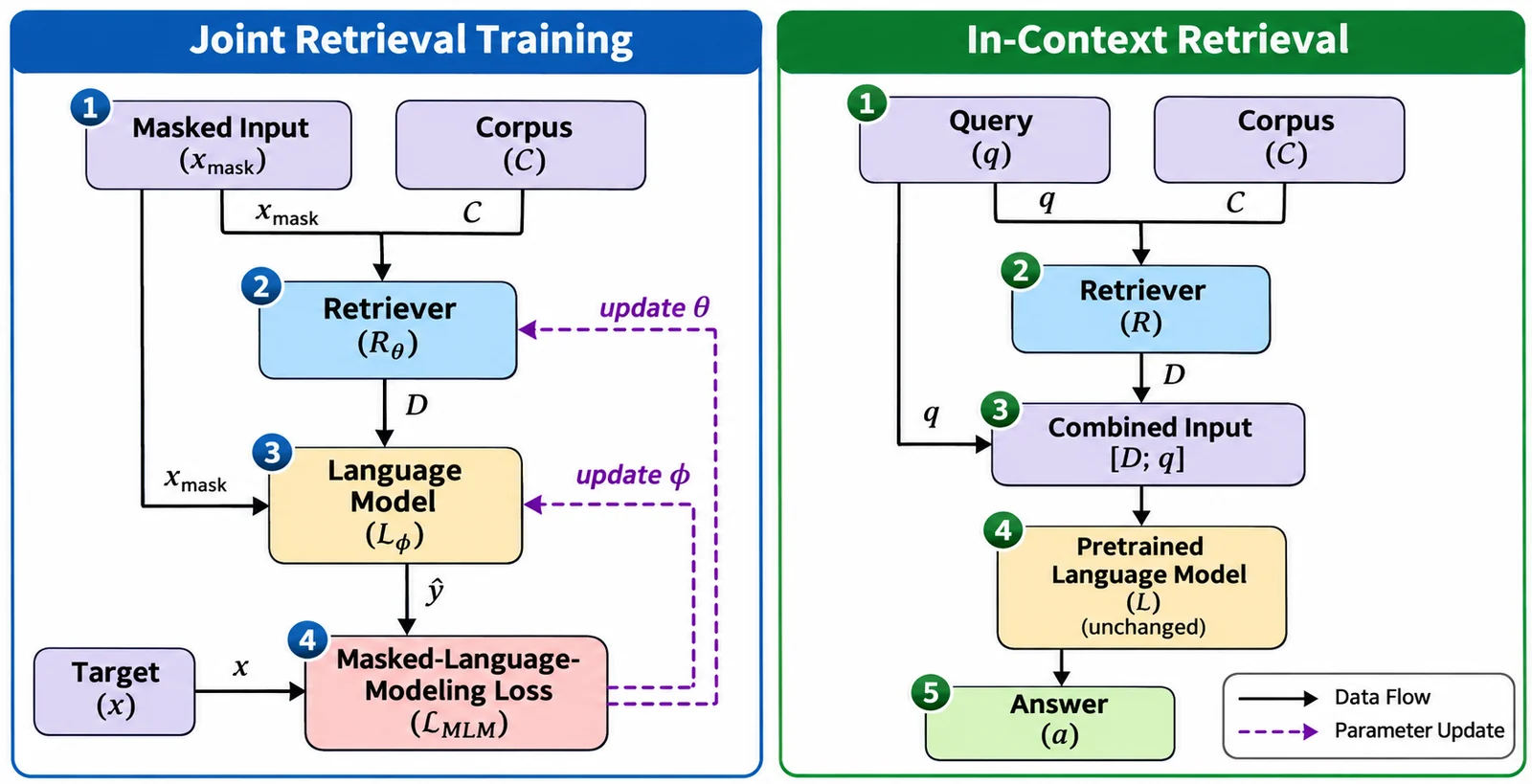
That design changed the model's architecture, which complicates deployment. A later line of work asked whether the same benefit could be had without touching the model at all. In-context retrieval-augmented language modeling leaves the model unchanged and simply prepends retrieved documents to the input, with no further training. Building on off-the-shelf general-purpose retrievers, this simple arrangement produced large gains in language modeling performance across model sizes and diverse corpora, and specializing the retrieval and ranking step to the task pushed performance further. The practical significance is that a pretrained model can be grounded even when it is available only through an API and cannot be modified.[8]
Surveys organize RAG systems into paradigms, including naive RAG, advanced RAG, and modular RAG. The review frames every system around three components, retrieval, generation, and augmentation, and notes that the approach addresses hallucination, outdated knowledge, and untraceable reasoning, while allowing knowledge to be updated without retraining the model. The same review frames every system around three components, retrieval, generation, and augmentation, and notes that the approach addresses hallucination, outdated knowledge, and untraceable reasoning, while allowing knowledge to be updated without retraining the model.[9]
The arc, then, runs from a retriever trained inside the model, to documents prepended to an untouched model, to a family of architectures whose parts can be swapped. What stayed constant is the core move: bring outside text into the moment of generation.
How it works
How retrieval and generation fit together
The pipeline described so far has three stages, and each one can be built in more than one way. Indexing is the preparation done before any question is asked: a body of documents is split into chunks, each chunk is encoded into a vector, and the vectors are stored in a database. Retrieval is the search done at question time: the query is encoded with the same method, and the system returns the chunks whose vectors sit closest to the query vector under a similarity calculation. Generation is the writing: the query and the retrieved chunks are placed in the prompt together, and the model produces its answer from both.[6] The three stages are separable, which is why so much of the engineering in a RAG system happens at the seams rather than inside the model.
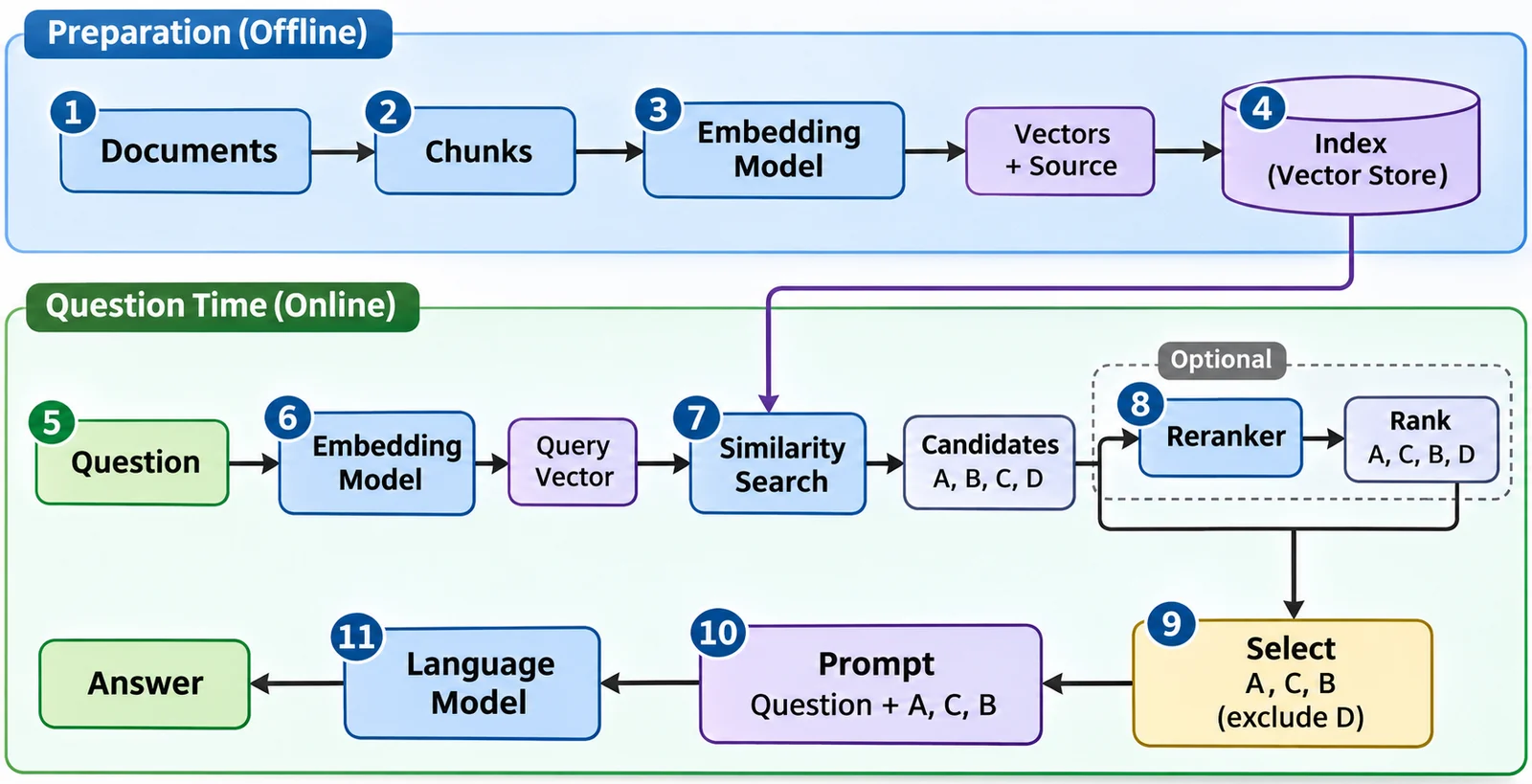
The retrieval stage is where most of the design choices live. Dense retrieval is the vector-similarity method just described, and it is the default in most systems. It is not the only option: retrieval can also be sparse, matching on words rather than meaning, or hybrid, combining the two so that exact terms and paraphrases are both caught. A further step, reranking, takes the retrieved chunks and reorders them with a second, more careful model before they reach the prompt.[6] The reason to bother is that the generator can only work with what it is handed. A passage that is relevant but ranked below the cutoff never enters the prompt, and a passage that is ranked highly but off-topic becomes noise the model must see past.
Chunking, the first stage's main decision, has received attention of its own. Splitting a document at fixed lengths is simple but can cut a table or a recommendation in half, separating a statement from the condition it depends on. One study of financial reports compared paragraph-level chunking with chunking by structural element, such as headings and tables, and found that element-based chunking largely improved results on question answering over those reports, with the approach yielding the best chunk size without tuning.[10] The finding is specific to that document type, but the underlying point generalizes: what counts as a coherent unit depends on how the source is organized, and the retrieval step inherits whatever the chunking decided.
When the knowledge has structure
Vector similarity treats a corpus as a flat sea of passages, which suits prose but fits poorly with material whose meaning lies in the links between things. Graph-based retrieval, often called GraphRAG, addresses this by storing entities and their relationships as a graph and retrieving along those connections rather than by embedding distance alone. A survey of the approach describes a workflow of graph-based indexing, graph-guided retrieval, and graph-enhanced generation, and argues that leveraging structural information across entities enables more precise and comprehensive retrieval and more accurate, context-aware responses.[11] The appeal is concrete: a question about how one drug interacts with a condition may need two or three linked facts, and a graph can walk those links where a similarity search would have to hope all the facts landed in one chunk.
Practical systems often combine these choices rather than picking one. A systematic review of clinical RAG applications proposes a framework (GUIDE-RAG) organized as iterative across a pre-retrieval stage of task definition and resource selection, a retrieval stage of chunking and indexing, and a post-retrieval stage of evaluation and knowledge updating.[1] The framework's emphasis on evaluating each stage separately reflects a practical reality: when a RAG answer is wrong, the fault may lie in the index, the retriever, the prompt, or the model, and only stage-by-stage checking locates it.
The model writes the answer, but the retriever decides what the answer can be about.
Building and maintaining the knowledge base
Everything a retrieval system can say is bounded by what sits in its index, and the index is built before any question is asked. The work begins with chunking: dividing a corpus into passages small enough to embed and retrieve as units. Each chunk is then encoded into a vector and stored in a database, where a query vector can later be matched against it by similarity.[6] The chunk is the atom of retrieval, so the boundaries drawn at this stage decide what can ever be returned. A recommendation split from the condition it applies to, or a table separated from its caption, becomes two chunks that each mean something different from the original.
Fixed-length chunking, cutting every so many words or characters, is the simplest rule and the easiest to automate. Its weakness is that it is blind to meaning: it will slice through a list of criteria or a dosage table wherever the count falls. The alternative is to let the document's own structure set the boundaries. Recursive chunking divides text hierarchically, first at headings, then at subheadings, paragraphs, and sentences, so that a chunk tends to correspond to a coherent unit of the source. Sliding window chunking overlaps consecutive chunks, so that material near a boundary appears in both and context spanning the seam is not lost. A further variant enriches each chunk with a short summary of its contents, giving the retriever more to match against than the raw text alone.[1]
Which rule suits a corpus depends on how that corpus is organized, and the difference is measurable. A study of financial reports compared ordinary paragraph-level chunking with chunking by structural element, such as the headings and tables that give a report its shape, and found that element-based chunking largely improved question answering over those documents, with a workable chunk size emerging without separate tuning.[10] The result belongs to financial reporting, but the mechanism behind it does not: a chunk that coincides with a complete thought retrieves cleanly, while one that cuts across two thoughts retrieves as noise.
Structure is not only a matter of where to cut. Clinical guidelines carry much of their content in tables, flowcharts, and figures, and a pipeline that indexes only running text will miss it. The review of clinical retrieval systems notes that only 3 of the studies it examined explicitly described extracting text from tables or figures during preprocessing, and that relying on a general model to read a table is unreliable, since a preliminary study cited in the review found GPT-4 Turbo had only a 16% accuracy rate in extracting table data.[1] Converting a table into a text list before indexing is a preprocessing decision, made once, that determines whether the information inside it is reachable at all.
Keeping the index current
A corpus is not a fixed object. Guidelines are revised, labels are reissued, new literature appears, and an index built a year ago describes a world that has moved. The dietary supplement knowledge base iDISK2.0 shows the scale of the problem in one narrow field. The update also corrected errors, removing an ingredient that had been mislabeled in the older source.[3] A system that had never been refreshed would have answered from a store that was both incomplete and wrong, and it would have answered with the same confidence as one built on current data.
Currency is not a technicality that can be deferred. A liver disease system built on a fixed set of guidance documents gave incorrect justifications in part because the particular version of a guideline it needed was not among the documents it had been given.[12] The retrieval step worked as designed; the shelf was simply missing the right volume. Because a grounded system presents its answers as coming from its sources, an outdated source produces an error that looks like a citation, which is harder for a reader to catch than an answer with no support at all.
The practical consequence is that a knowledge base needs an owner and a schedule. Someone must decide which sources are authoritative enough to include, how often the index is rebuilt, and how documents are re-chunked when their format changes. The review of clinical retrieval systems found that current studies use fixed external datasets and that clear strategies for updating knowledge should be defined, leaving open how a deployed system would stay current.[1] Building the index is a one-time task; maintaining it is a commitment that lasts as long as the system answers questions.
A retrieval system is only as good as the corpus behind it, and a corpus goes stale.
Uses
Clinical decision support and guideline interpretation
Clinical guidelines are a natural target for retrieval-augmented generation because they are exactly the kind of knowledge a general model handles badly: long, detailed, revised periodically, and written in a mixture of prose, tables, and flowcharts. A model trained on a broad slice of the internet may have absorbed fragments of a guideline, but it cannot be relied on to reproduce the current recommendation for a specific patient. Grounding the model in the guideline text at answer time is meant to close that gap, and the clinical decision support systems built on this idea are where the technique's promise and its fragility both show clearly.
The clearest demonstration comes from chronic hepatitis C, a disease with well-codified management guidelines and, notably, poor real-world adherence to them. A team built a framework around GPT-4 Turbo in which the hepatitis C guideline was converted into a form the model could process, then supplied as context alongside each clinical question. The baseline model, answering from its own knowledge, was correct 43 percent of the time. With the guideline present as a coherent body of text and non-text sources converted into text, accuracy rose to 99 percent, a difference the authors report as statistically significant.[2]
The intermediate steps are as instructive as the final number. The model was poor at reading tables, and consistent text formatting with tables re-formatted as text-based lists lifted accuracy to 90 percent, with custom prompt engineering reaching 99 percent.[2] Few-shot learning, the practice of supplying worked examples in the prompt, added nothing once the guideline was properly formatted. The lesson is that retrieval alone does not guarantee a good answer; the retrieved material has to arrive in a shape the model can actually use.
A second system, Almanac, applied the same principle across a broader range of medicine. Almanac retrieves from curated medical resources rather than the open web, and a panel of eight board-certified clinicians and two health care practitioners compared its answers with those of standard chatbots on a set of 314 clinical questions spanning nine specialties. Almanac showed a significant improvement in factuality, completeness, user preference, and resistance to adversarial prompts; in an earlier evaluation, factuality rose by an average of 18 percent across specialties.[13][14] The adversarial measure is worth pausing on: it tests whether a system can be talked into unsafe advice, and a grounded system proved harder to derail than an ungrounded one.
Not every attempt lands cleanly, and the failures are informative. LiVersa, a liver disease-specific system built on 30 guidance documents from the American Association for the Study of Liver Diseases, answered all 10 forced yes-or-no questions correctly when compared against trainees on a published knowledge assessment. When 15 hepatologists rated its outputs against ChatGPT 4 and Meta's LLaMA 2 on 10 hepatology topic questions, LiVersa's answers were more accurate but were rated less comprehensive and safe compared to those of ChatGPT 4.[15] A system can be right about the narrow question and still thin on the surrounding context a clinician needs, and the size of its document collection sets a ceiling on what it can supply.
Taken together, these systems show what grounding in guidelines buys and what it costs. The gain in factual accuracy can be large, and it comes from a source a clinician can inspect. The cost is that everything depends on the quality and formatting of the documents fed in, and on the retrieval step selecting the right passage. A guideline that is outdated, a table the model cannot parse, or a corpus too small for the question will each produce a confident answer resting on weak evidence. The pattern carries over to diagnosis, screening, and patient-specific assessment, where the same architecture is applied to different clinical tasks, as covered later.
Grounding a model in a guideline improves accuracy only as far as the guideline's format and coverage allow.
Diagnosis, screening, and patient-specific tasks
The guideline systems described earlier answer questions about what a document says. A harder use of the same architecture asks the model to reach a judgment about a particular patient, where the relevant evidence is scattered across imaging reports, clinical notes, and eligibility criteria rather than gathered in one guideline. Here the retrieval step does more work, because the system must first find the passages that bear on this patient before it can reason about them, and the stakes of a missed passage are higher than in a lookup.
Differential diagnosis from imaging findings is one such task. A study of gastrointestinal cases gave GPT-4 the findings from imaging studies and asked it to name the main diagnosis, comparing the plain model against one augmented with retrieval over a curated reading list of 96 peer-reviewed documents. The augmented model identified the main diagnosis correctly 78 percent of the time, against 54 percent for the base model, and offered at least one correct differential diagnosis in 98 percent of cases against 92 percent.[12] The improvement came at a price in cost and response time, and the base model leaned more heavily on clinical information while the augmented one actually used the imaging findings. That detail matters: the retrieval did not merely add facts, it changed which evidence the model attended to.
Clinical trial screening poses a different problem, because eligibility depends on many separate criteria, each answerable from a patient's notes, and the criteria must all be checked. The RECTIFIER system applied retrieval over clinical notes to decide inclusion and exclusion for a heart failure trial, with an expert clinician's blinded chart review as the gold standard. Across criteria its accuracy ranged from 97.9 to 100 percent, against 91.7 to 100 percent for trained study staff, and it was better at the specific criterion of symptomatic heart failure, 97.9 percent against 91.7 percent.[16] The comparison is not a claim that the system replaces the staff; the developers frame it as a tool that needs final clinician review, and the value lies in consistency and in the time saved on manual chart reading.
Preoperative assessment tests whether a grounded model can judge fitness for surgery and issue the instructions that follow. Using 35 local and 23 international preoperative guidelines, a team built retrieval systems around ten different language models and tested them on 14 clinical scenarios, with correct answers set by established guidelines and expert physician judgment. The best configuration, GPT-4 with retrieval, reached 96.4 percent accuracy in assessing fitness for surgery, against 86.6 percent for human-generated answers.[4] The use of both local and international guidelines is itself instructive: the international documents tended to be more complete, with text explanations accompanying diagrams and tables, and the system performed better on them, while local guidelines were thinner and gave the model less to work with. A retrieval system inherits the quality of whatever corpus it is pointed at, and a hospital's own protocols are not always written in a form a model can use.
What these three applications share is a shift in what retrieval is for. In guideline question answering, the retrieved passage is usually the answer in paraphrase. In diagnosis, screening, and fitness assessment, the retrieved material is evidence the model must weigh and combine, and the output is a judgment rather than a quotation. That makes the systems more useful and also harder to check, since a wrong answer may rest on a passage that was retrieved but misread, or on one that was never retrieved at all. The evidence on how often that happens, and on what retrieval costs in time and money, is taken up later.
When the task is a judgment about a patient, retrieval supplies evidence to weigh, not an answer to quote.
Question answering over specialized knowledge bases
A general model's knowledge of a narrow field is thin and uneven, and the thinner the field, the more confidently it can be wrong. Dietary supplements make the problem vivid. They are regulated as food rather than as drugs, so the evidence about them is scattered across product labels, herb monographs, and interaction databases that change as formulations change. A team built a retrieval system around a curated supplement knowledge base, iDISK2.0, which integrates 174,317 entities across seven categories, including 8,091 supplement ingredients, 163,806 products, 786 diseases, and 625 drugs, joined by six types of relationships. On true-or-false questions about supplement effectiveness the system answered 99 percent correctly, and on multiple-choice questions about supplement-drug interactions 95 percent, where the standalone GPT-4o scored 62 percent and 52 percent on the same two tasks.[3]
The structure of that knowledge base is as important as its size. A knowledge graph stores facts as entities joined by typed relationships, so that an ingredient is linked to the diseases it treats and the drugs it interacts with, rather than sitting in a passage that mentions them. Retrieval then means pulling a relevant subgraph rather than a nearby chunk of text. The design pays off on exactly the questions that defeat flat search: asked which disease coenzyme Q10 is effective for, the standalone model answered cholestasis, while the grounded system returned migraines, the use the source database documents.[3] A passage-based index might have surfaced either claim; a graph makes the curated relationship the thing retrieved.
Biomedical literature poses the same problem at a larger scale, since the relevant evidence for a question may sit in one paper among thousands. A retrieval model built over a corpus of 1,868 full-text articles on diffuse large B-cell lymphoma, a cancer of the immune system, was compared with GPT-3.5, GPT-4, and another commercial model on 19 questions about the disease's biology and treatment. Eight independent reviewers scored the answers for accuracy, relevance, and readability. The retrieval model scored highest on average for accuracy and relevance and took the most top scores across questions, while the general models produced more answers containing hallucinations, in the form of references that did not exist and responses that were simply wrong.[17] Readability ran the other way: the general models wrote more smoothly, which is a reminder that fluent prose and correct content are separate properties.
The lymphoma case also shows where a knowledge base can fail. One question asked about minimal residual disease in that cancer, and the retriever returned papers about the same measure in two different blood cancers, multiple myeloma and chronic lymphocytic leukemia. The model summarizing them did not distinguish between the diseases and gave a wrong answer. When the retrieval step was changed to search a literature database directly for supporting articles, the system produced informative and relevant answers.[17] The retrieval layer, not the generator, was the weak point, and fixing it fixed the answer.
What these systems share is a bet that a curated, structured store beats a general model's memory on questions of fact. The bet pays when the store is current and well organized, and it fails when the store is thin or the retriever fetches the wrong thing. How often it pays across many tasks, and what it costs in time and money, is covered later.
Adapting RAG to new domains and tasks
The pipeline described so far is domain-neutral in its parts and domain-bound in its performance. Indexing, retrieval, and generation work the same way whether the corpus holds clinical guidelines or tax statutes, but the choices inside each stage, what counts as a chunk, which retriever, which embedding model, are settled by the material. Moving a system from one field to another is therefore less a matter of porting code than of rebuilding the knowledge layer and, often, retraining the parts that search it.
The clearest evidence that the retriever itself can be adapted comes from open-domain question answering. Standard retrieval-augmented generation had been trained and tested almost entirely against a Wikipedia-based store, leaving it unoptimized for specialized collections such as healthcare or news. RAG-end2end extends the design by updating all components, retriever and generator together, during training on the target domain, and adds an auxiliary training signal that forces the model to reconstruct a sentence by pulling the relevant passage from the external store. Evaluated on COVID-19, news, and conversation datasets, the jointly trained system improved significantly over the original.[18] The point is that a retriever tuned on general prose does not automatically know what a relevant passage looks like in a new field, and training it against the new corpus teaches it.
Domain-specific corpora matter for the same reason at the level of content. The lymphoma system described earlier drew its advantage from a focused collection of full-text articles rather than a general model's memory, and its failures traced to the retriever returning papers about the wrong disease.[17] A corpus that is narrow, current, and well organized is what makes grounding work; a corpus assembled carelessly reproduces the general model's weaknesses with extra steps.
Law, finance, and education
Legal work suits retrieval because the authoritative text is fixed and citable, and because a wrong answer carries consequences. A survey of retrieval in legal technology sets out the stages, techniques, and applications in the field, and stresses that implementing RAG pipelines requires careful attention to the techniques and methods used at each stage; it also catalogues the quantitative and qualitative metrics used to judge such systems and the ethical and privacy questions raised by handling case material.[19] The emphasis on evaluation is not incidental. Legal answers are judged against statutes and precedent, and a system that retrieves the right statute but misreads its scope produces an error a citation cannot catch.
Financial reporting poses a different test, because the relevant facts sit in tables and structured statements rather than flowing prose. A study built a retrieval system for question answering over banks' half-yearly and quarterly reports, using a design-science method to develop and compare configurations of its components. The strongest combination paired OpenAI ADA embeddings with OpenAI GPT-4, while a configuration using the MiniLM embedder scored significantly lower, and well-structured reports produced better results than less coherent ones. Qualitative questions scored higher than quantitative ones, showing the system handled descriptive material more comfortably than figures.[20] The finding echoes the chunking lesson from earlier: the shape of the source document sets a ceiling on what retrieval can extract from it.
Education brings a third set of demands, since the material must be accurate, current, and pitched to a learner. A survey of retrieval in educational applications describes the approach as improving factual accuracy and enabling dynamic knowledge updates, making LLMs particularly suitable for educational applications, and reviews work covering interactive learning systems, generation and assessment of educational content, and large-scale deployment in educational ecosystems. The same review lists the obstacles that remain: mitigating hallucination, ensuring retrieved knowledge is complete and timely, holding down computational cost, and extending support to multiple media.[21] What distinguishes the educational case is that the retrieved passage is not only evidence for an answer but part of what is being taught, so an outdated source misinforms twice.
Languages and low-resource settings
A corpus also carries a language, and most do not carry many. A perspective on retrieval in health care notes that 92.64 percent of GPT-3's pre-training corpus is derived from English sources, resulting in limited coverage of communities that use other languages. Building multilingual medical knowledge bases could let retrieval bridge that gap, but the same account cautions that current models support only a limited number of mainstream languages, which restricts retrieval in low-resource settings.[6] Adapting a system to a new domain, then, can mean adapting it to a new language as well, and the two problems compound: a field with sparse literature in a language with sparse coverage gives the retriever very little to find.
Research
Evidence on effectiveness across tasks
The individual studies described so far each measure something slightly different: accuracy on guideline questions, correctness of a diagnosis, agreement with expert reviewers. To ask whether grounding helps in general, one has to pool results across many tasks and many systems, which is what a meta-analysis does, combining effect sizes from separate studies into a single estimate. Pooling those comparisons gave an odds ratio of 1.35, with a 95 percent confidence interval of 1.19 to 1.53, meaning the odds of a correct or preferred outcome were about a third higher with retrieval, and the interval excludes the possibility of no effect.[1]
Retrieval against retraining
The natural alternative to fetching documents is to change the model itself. Fine-tuning continues training a pretrained model on a smaller, domain-specific dataset so that the knowledge is absorbed into its weights, in contrast to retrieval, which leaves the weights untouched and supplies knowledge at answer time. A study set out to compare the two directly, along with a third option that combines them. Answers were scored with a battery of measures, from word-overlap metrics such as BLEU and ROUGE to semantic similarity scores.[22]
Phi's combined method reached a BLEU of 0.136 and a ROUGE-1 of 0.391, well above its fine-tuned scores of 0.036 and 0.267.[22] The variation across models is the substantive point: whether retrieval helps, and by how much, depends on the model it is paired with and the measure used to judge it, so a single headline comparison would misrepresent the evidence.
Why the averages hide variation
Two features of this evidence deserve attention. The first is that the outcome being measured shapes the result. Word-overlap scores reward an answer for sharing vocabulary with a reference, not for being factually right, and a separate guideline study found that these similarity scores did not track expert judgments of correctness, so a response could score well while being wrong.[2] A pooled odds ratio built from such measures inherits their limits.
The second is that retrieval does not switch off a model's tendency to invent. In the lymphoma comparison described earlier, GPT-4 and GPT-3.5 had more answers with hallucinations than the other models, and the retrieval model's failure on one question traced to the retriever returning papers about the wrong diseases.[17]
Pooled across tasks, retrieval gives a moderate average gain, and the size of the gain depends on the model, the task, and the measure.
Evaluating retrieval-augmented generation
A retrieval system produces text, and text is hard to grade. Two answers can say the same thing in different words, or use the same words to say different things, and any automatic measure has to decide which of those differences to count. The measures borrowed from machine translation and summarization count overlap. BLEU compares the short word sequences in a generated answer against those in a reference answer; ROUGE measures how much of the reference's content the answer recovers, usually through overlapping word sequences; METEOR adds stemming and synonym matching so that a paraphrase is not automatically penalized. BERTScore goes further, comparing the meaning of words and phrases through learned embeddings rather than exact strings. Each was built to reward an answer for resembling a reference, and none was built to check whether the answer is true.
That gap between resemblance and correctness is not hypothetical. In the hepatitis C guideline work described earlier, the team scored its outputs with BLEU, ROUGE-L, METEOR, and a custom score, and set those numbers beside expert-graded judgments of accuracy. The similarity scores moved when the system's formatting changed, but they did not track the experts' verdicts: an answer could look lexically close to the reference and still be factually wrong, or be phrased quite differently and be right. The authors name the two failure directions directly, false positives for fluent wrong answers and false negatives for correct answers worded unlike the reference, and conclude that automated grading of clinical responses remains unresolved.[2] The lesson generalizes past medicine. A metric that rewards shared vocabulary will reward a confident fabrication that borrows the reference's phrasing.
What human review adds, and what it costs
Expert judgment supplies what the overlap measures cannot: a reader who knows the domain decides whether the answer is correct, complete, and safe. The clinical studies in this chapter lean on it heavily. Almanac's comparison rested on a panel of eight board-certified clinicians and two health care practitioners rating answers across factuality, completeness, preference, and resistance to adversarial prompts.[13] The lymphoma comparison used eight independent reviewers scoring accuracy, relevance, and readability, with three independent reviews of each question to account for variance among reviewers.[17] The preoperative assessment study set its correct answers by established guidelines and expert physician judgment before any model was run.[4]
Human review brings its own difficulties. Raters disagree, and the disagreement is not always noise: in the preoperative study, agreement between individual clinicians and the expert-panel ground truth was lower than the models' agreement with it, which reflects genuine variation in how clinicians weigh risk.[4] Review is also slow and expensive, which caps how many answers can be graded and pushes evaluations toward small question sets. The lymphoma study assessed 19 questions on a single disease, a limitation its authors acknowledge.[17] A small, carefully graded set says a great deal about those questions and rather less about the next hundred.
The missing common yardstick
Because studies choose their own tasks, models, retrieval sources, and metrics, their numbers cannot be laid side by side. A systematic review of retrieval systems in healthcare found no standardized framework for evaluating them, with metrics varying across studies in a way that makes comparison difficult, and observed that most of the studies it examined did not address the safety and ethical questions that arise in clinical use.[23] The same review points out that a system can fail at several joints, since the model's pretraining may leak into the answer, irrelevant passages may be retrieved, or the generation may simply go astray, and a single end-to-end score cannot say which happened.
The response to that problem is to grade the stages separately. That is more work than scoring final answers, and it is what makes a failure diagnosable rather than merely visible. Domain-specific benchmarks, built from real clinical questions with expert-verified answers, are the other half of the answer, and the same review notes that constructing them is ongoing.[1]
A score that measures resemblance to a reference answer is not a measure of whether the answer is right.
Risks and limits
Hallucination, retrieval errors, and source dependence
The case for retrieval rests on a simple claim: a model that is handed the relevant text is less likely to invent an answer. That claim holds on average, but it is not a guarantee, and the ways it fails are worth understanding because they determine how much a grounded system can be trusted without a person checking it.
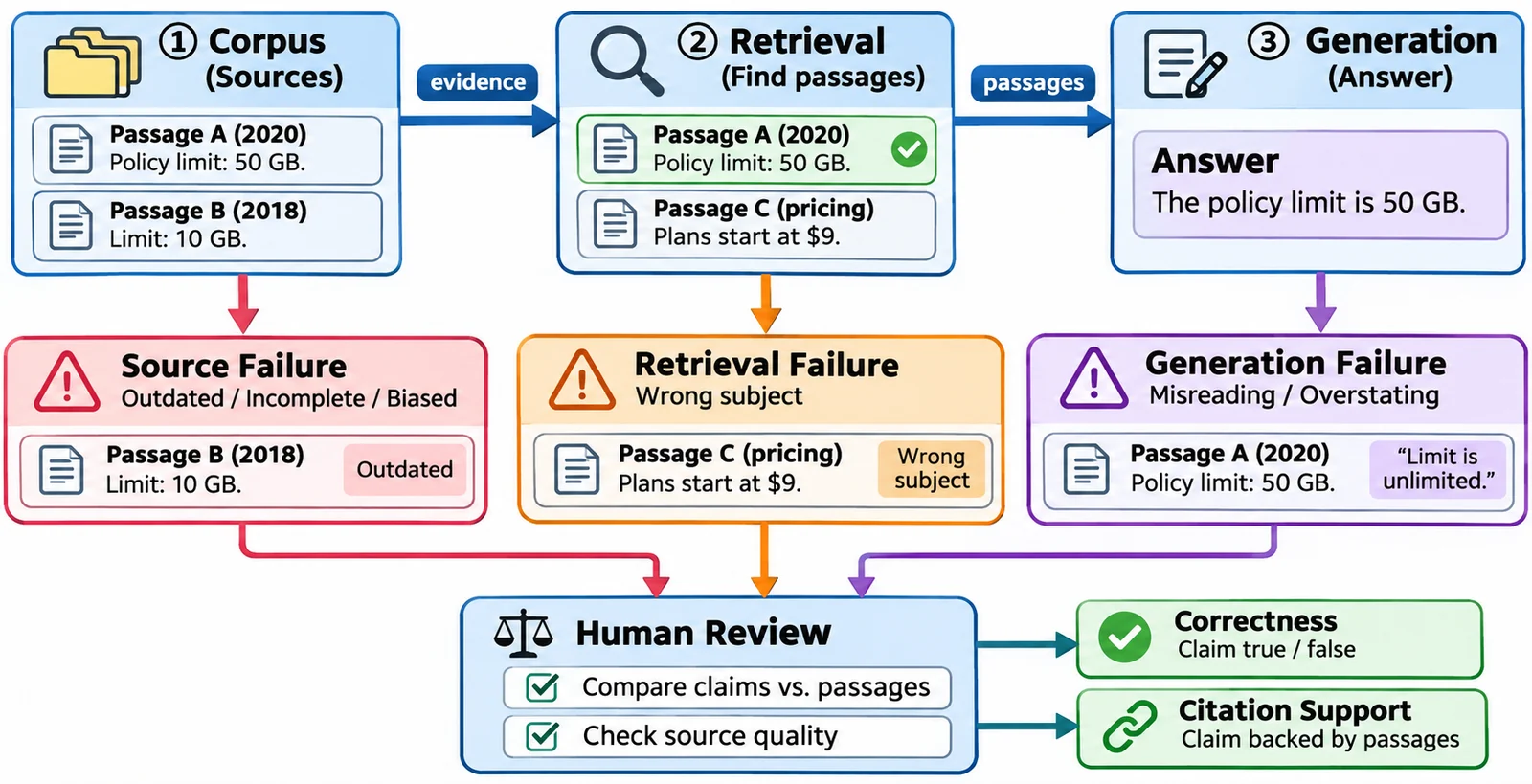
Hallucination is the generation of content that is fluent and confident but factually wrong or unsupported by any source. Retrieval reduces it by supplying evidence the model can copy from rather than recall, yet the model still writes the final sentence, and it can misread, overstate, or blend what it was given. The lymphoma comparison described earlier shows the mechanism plainly: the retrieval model produced fewer hallucinated answers than the general models, but it was not free of them, and its worst failure came from the retriever rather than the writer. Asked about minimal residual disease in one blood cancer, the retriever returned papers about the same measure in two other blood cancers, and the model summarizing them did not notice the mismatch and answered wrongly. Redirecting the retrieval step to search a literature database directly fixed the answer.[17] The generator had done what it was asked; the evidence it was handed was about the wrong disease.
A systematic review of retrieval systems in healthcare puts a number on how often the retrieved material fails to support the response. A study cited in a systematic review of retrieval systems in healthcare found that, across medical queries, roughly 45 percent of the responses GPT-4 produced with retrieval were not completely backed by the URLs the system had retrieved.[23] That figure is a measure of support, not of error: an answer can be correct and still not be fully traceable to the passages cited, and it can cite a passage that does not quite say what the answer claims. Either way, the citation trail that makes retrieval attractive is only as good as the match between what was retrieved and what was written.
When the sources themselves are the problem
Grounding ties an answer to a corpus, and a corpus can be wrong in ways the model cannot detect. A guideline that has been superseded, a database entry that was never corrected, a body of literature that underrepresents a group of patients: each becomes a confident answer, because the system has no vantage point outside its sources from which to notice the flaw. The dependence runs in both directions, on coverage and on currency. The retrieval worked; the shelf was incomplete.
Bias enters the same way. If the retrieved literature skews toward one population, the answer inherits the skew, and the system will present it with the same fluency as a well-supported one. Retrieval can also introduce conflict, handing the model two passages that disagree, and the model must then choose or blend them without any reliable way to weigh their authority.
The place of human oversight
These failure modes explain why the systems described in the clinical studies were framed as aids rather than replacements, with a qualified clinician reviewing recommendations before they reach a patient.[4] A person reading the answer alongside the retrieved passages can catch the mismatch between them, which is precisely the check the model performs poorly on its own. The practical value of retrieval, then, is not that it removes the need for verification but that it makes verification possible: an answer with sources attached can be audited in a way that an answer recalled from training data cannot. What retrieval costs in time and money, and where the technique is heading, are covered later.
Retrieval makes an answer checkable; it does not make it checked.
Cost, latency, and operational challenges
Grounding a model in retrieved documents buys accuracy, and the bill arrives in three currencies: time, money, and maintenance. The retrieval step is not free. A query must be embedded, compared against an index, and the winning passages fetched and inserted into the prompt before the model writes a single word, and the model then reads a longer input than it would have otherwise. Each of those operations adds to the end-to-end delay, and the delay compounds when a system retrieves in several rounds or reranks its results with a second model.
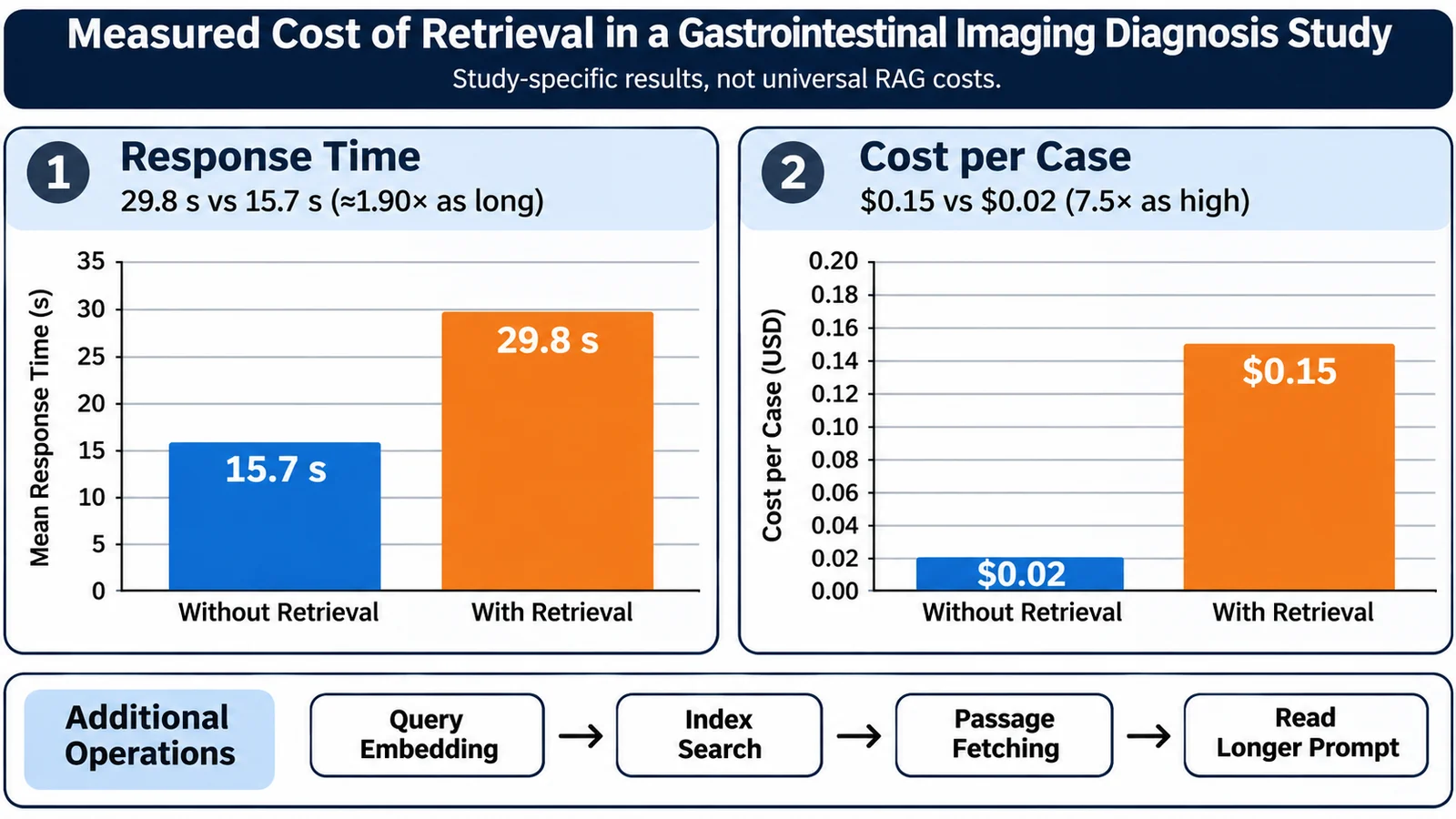
The size of the overhead is measurable. In a review of retrieval systems for clinical tasks, one study that compared a model with and without retrieval on gastrointestinal imaging diagnosis reported a mean response time of 29.8 seconds with retrieval against 15.7 seconds without, and a cost of $0.15 per case against $0.02.[1] The retrieval roughly doubled the wait and multiplied the price by more than seven. Neither figure is catastrophic in isolation, but a clinician waiting half a minute for an answer, or a hospital paying that premium on every query, is making a different calculation than one waiting fifteen seconds. The same review notes that advanced retrieval strategies, such as building a knowledge graph to search over, demand substantial resources of their own and can lengthen responses further, so the more sophisticated the retrieval, the larger the bill.[1]
Money and time are the visible costs. The hidden one is upkeep. A retrieval system is only as good as the corpus behind it, and a corpus is a living thing: guidelines are revised, drug labels change, new literature appears. Someone must decide when the index is rebuilt, how documents are re-chunked when their format changes, and which sources are authoritative enough to include. The review of healthcare retrieval systems found that current studies use fixed external datasets and that clear strategies for updating knowledge should be defined, which leaves open how a deployed system would stay current.[1] A system that quietly serves last year's guideline is worse than one that admits it does not know, because its answers carry the same confidence either way.
Integration adds a further layer. A retrieval system that reads patient records must connect to the electronic health record, respect the privacy rules that govern it, and fit into a clinician's existing workflow without adding clicks. The preoperative assessment study is instructive here: its retrieval pipeline generated answers in under 20 seconds, with guideline retrieval taking less than 5 seconds, against the roughly 10 minutes clinicians typically estimate for the same task, and the developers describe deployment as a support tool under human review rather than an autonomous decision-maker.[4] That framing keeps a person in the loop, but it also means the time saved is only realized if the review itself is quick. The operational question is not whether retrieval can be made fast and cheap enough to run, but whether it can be kept accurate, current, and trusted inside the systems where the answers are actually used.
Retrieval adds latency and cost to every query, and the larger cost is keeping the corpus current.
Later developments
Current directions: agents, graphs, and multimodal RAG
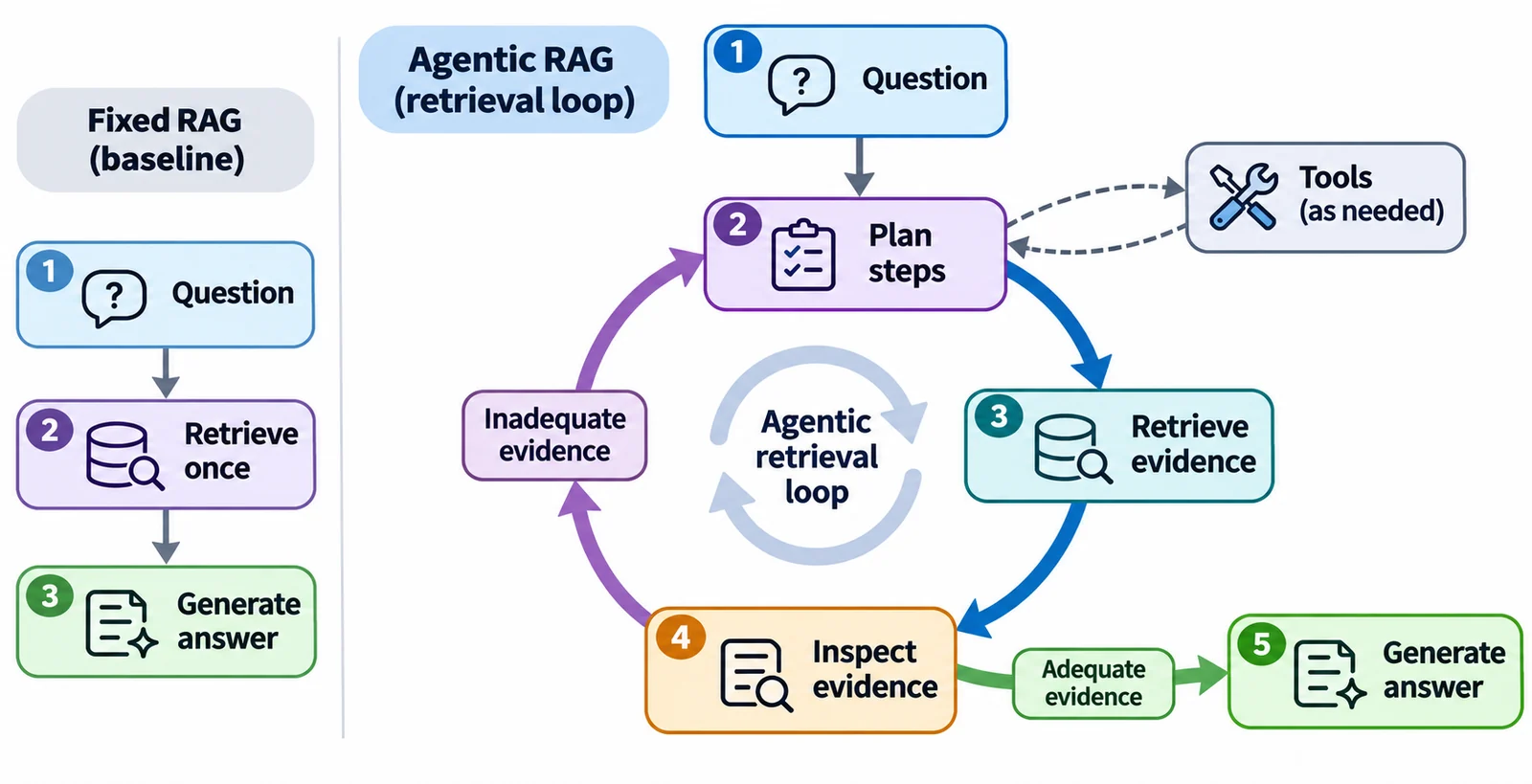
The pipeline described in earlier sections retrieves once, at the start, and generates from whatever that single search returned. That fixed sequence is the simplest arrangement, and it is also the one most likely to fail on a question that needs several pieces of evidence gathered in stages. A newer line of work, agentic RAG, embeds autonomous agents into the pipeline: software components that can plan a sequence of steps, decide what to retrieve next, reflect on what came back, and call other tools when retrieval alone is not enough. A survey of the approach describes agents using reflection, planning, tool use, and collaboration among multiple agents to manage retrieval strategies dynamically and refine their understanding iteratively, rather than following a static workflow.[24] The difference in practice is between a system that answers from one search and one that notices its first search was inadequate and searches again.
The second direction concerns what is being searched. Flat passage retrieval treats a corpus as a sea of chunks, which fits prose but fits poorly with knowledge whose meaning lies in relationships. Graph-based retrieval stores entities and their links as a graph and retrieves along those connections, and a survey of the area describes a workflow of graph-based indexing, graph-guided retrieval, and graph-enhanced generation, arguing that structural information across entities allows more precise and context-aware retrieval than passage similarity alone.[11] The clinical knowledge bases described earlier already lean this way, since a supplement ingredient linked to the diseases it treats is a graph relationship rather than a paragraph.
The third direction widens the input beyond text. Clinical guidelines and reports carry much of their content in tables, flowcharts, and images, and a text-only pipeline cannot read them. Multimodal RAG retrieves across formats, and the need is concrete: a perspective on retrieval in health care notes that a multimodal system could recognize a drug's appearance, such as its color, shape, and imprints, and match those features against a database to support pharmacists in identifying medications, while cautioning that such applications remain at an early stage and need validation before use. The same perspective sets out the broader promise, that retrieval could support more personalized care by drawing on an individual's records, biomarkers, and lifestyle to tailor guidance, and the corresponding caution that sources can carry their own biases and that sensitive data in a retrieval database can be extracted through crafted prompts.[6]
What holds these directions together is a gap in how they are judged. A systematic review of retrieval systems in healthcare found no standardized framework for evaluating them, with metrics varying across studies in ways that make comparison difficult, and noted that the majority of studies did not assess or address ethical considerations related to RAG in healthcare.[23] A system that plans, walks a graph, and reads images is harder to audit than one that retrieves a passage, and the tools for judging whether it works have not kept pace with the architectures.
The architectures are diversifying faster than the methods for judging them.
Key studies
| Year | Study | Sample | Design | Finding |
|---|---|---|---|---|
| 2020 | Guu et al.[7] | three open-domain question-answering benchmarks | pre-training with a learned retriever followed by fine-tuning | The retrieval-augmented model outperformed previous methods by 4 to 16 percent absolute accuracy. |
| 2023 | Zakka et al.[14] | 130 clinical scenarios, judged by five board-certified and resident physicians | panel evaluation of a retrieval-augmented framework | Factuality rose by a mean of 18 percent across all specialties, with gains in completeness and safety. |
| 2023 | Ram et al.[8] | experiments varying retrieval frequency and query length | Retrieval every four tokens let a 6.7B parameter model match a 66B parameter model, and a query length of 32 tokens worked best. | |
| 2023 | Siriwardhana et al.[18] | COVID-19, news, and conversation question-answering datasets | domain adaptation experiments with joint retriever and generator training | RAG-end2end achieved significant performance improvements over the original retrieval-augmented model across the three domains. |
| 2024 | Zakka et al.[13] | 314 clinical questions spanning nine medical specialties, judged by eight board-certified clinicians and two health care practitioners | panel evaluation comparing a retrieval-augmented system with standard language models | Almanac improved significantly over standard models on factuality, completeness, user preference, and adversarial safety. |
| 2024 | Kresevic et al.[2] | hepatitis C guideline questions graded by experts across five experimental setups | ablation study of formatting and prompting strategies | Accuracy rose from 43 percent to 99 percent when guidelines were provided as a coherent text corpus with tables converted to text. |
| 2024 | Unlu et al.[16] | 100 development patients, 282 validation patients, and 1894 test patients | blinded comparison of a retrieval-augmented screening system with study staff | RECTIFIER reached 97.9 percent accuracy on symptomatic heart failure against 91.7 percent for staff, with overall sensitivity of 92.3 percent and specificity of 93.9 percent. |
| 2024 | Ge et al.[15] | 10 knowledge questions and 10 topic questions rated by 15 hepatologists | two-round evaluation of a liver disease-specific retrieval-augmented model | LiVersa answered all 10 questions correctly when forced to yes or no, but its detailed responses were not fully correct for three questions. |
| 2024 | Soong et al.[17] | 19 questions on lymphoma biology and treatment, assessed by eight independent reviewers | comparison of a retrieval model with general language models on a 3-point scale | The retrieval model had the most top accuracy scores, 12 of 19, while two general models produced more hallucinated answers. |
| 2025 | Ke et al.[4] | 3682 evaluated responses from ten language models and human clinicians | comparison of models with local and international preoperative guidelines | The GPT4 model with international guidelines reached 96.4 percent accuracy on fitness for surgery against 86.6 percent for human answers. |
| 2025 | Liu et al.[1] | 20 studies selected from 335 identified records | systematic review and random-effects meta-analysis | The pooled odds ratio was 1.35, with a 95 percent confidence interval of 1.19 to 1.53. |
| 2025 | Hou et al.[3] | comparison of a knowledge-graph retrieval system with stand-alone language models | The retrieval system reached 99 percent accuracy on true-or-false questions and 95 percent on multiple-choice questions, against 62 percent and 52 percent for GPT-4o. |
See also
References
- Liu, S., McCoy, A. B., & Wright, A. (2025). Improving large language model applications in biomedicine with retrieval-augmented generation: a systematic review, meta-analysis, and clinical development guidelines. Journal of the American Medical Informatics Association, 32(4), 605-615. doi:10.1093/jamia/ocaf008
- Kresevic, S., Giuffrè, M., Ajcevic, M., Accardo, A., Crocè, L. S., & Shung, D. L. (2024). Optimization of hepatological clinical guidelines interpretation by large language models: a retrieval augmented generation-based framework. npj Digital Medicine, 7(1). doi:10.1038/s41746-024-01091-y
- Hou, Y., Bishop, J. R., Liu, H., & Zhang, R. (2025). Improving Dietary Supplement Information Retrieval: Development of a Retrieval-Augmented Generation System With Large Language Models. Journal of Medical Internet Research, 27, e67677. doi:10.2196/67677
- Ke, Y. H., Jin, L., Elangovan, K., Abdullah, H. R., Liu, N., Sia, A. T. H., Soh, C. R., Tung, J. Y. M., Ong, J. C. L., Kuo, C. F., Wu, S. C., Kovacheva, V. P., & Ting, D. S. W. (2025). Retrieval augmented generation for 10 large language models and its generalizability in assessing medical fitness. npj Digital Medicine, 8(1). doi:10.1038/s41746-025-01519-z
- Miao, J., Thongprayoon, C., Suppadungsuk, S., Garcia Valencia, O. A., & Cheungpasitporn, W. (2024). Integrating Retrieval-Augmented Generation with Large Language Models in Nephrology: Advancing Practical Applications. Medicina, 60(3), 445. doi:10.3390/medicina60030445
- Yang, R., Ning, Y., Keppo, E., Liu, M., Hong, C., Bitterman, D. S., Ong, J. C. L., Ting, D. S. W., & Liu, N. (2025). Retrieval-augmented generation for generative artificial intelligence in health care. npj Health Systems, 2(1). doi:10.1038/s44401-024-00004-1
- Guu, K., Lee, K., Tung, Z., Pasupat, P., & Ming-Wei, C. (2020). REALM: Retrieval-Augmented Language Model Pre-Training. arXiv. doi:10.48550/arxiv.2002.08909 Free full text
- Ram, O., Levine, Y., Dalmedigos, I., Muhlgay, D., Shashua, A., Leyton-Brown, K., & Shoham, Y. (2023). In-Context Retrieval-Augmented Language Models. Transactions of the Association for Computational Linguistics, 11, 1316-1331. doi:10.1162/tacl_a_00605
- Gao, Y., Xiong, Y., Gao, X., Jia, K., Pan, J., Bi, Y., Dai, Y. Q., Sun, J., Meng, W., & Haofen, W. (2023). Retrieval-Augmented Generation for Large Language Models: A Survey. arXiv. doi:10.48550/arxiv.2312.10997 Free full text
- Yepes, A. J., You, Y., Milczek, J., Laverde, S., & Li, L. (2024). Financial Report Chunking for Effective Retrieval Augmented Generation. arXiv. doi:10.48550/arxiv.2402.05131 Free full text
- Peng, B., Zhu, Y., Liu, Y., Bo, X., Shi, H., Hong, C., Zhang, Y., & Tang, S. (2026). Graph Retrieval-Augmented Generation: A Survey. ACM Transactions on Information Systems, 44(2), 1-52. doi:10.1145/3777378
- Gargari, O. K., & Habibi, G. (2025). Enhancing medical AI with retrieval-augmented generation: A mini narrative review. DIGITAL HEALTH, 11. doi:10.1177/20552076251337177
- Zakka, C., Shad, R., Chaurasia, A., Dalal, A. R., Kim, J. L., Moor, M., Fong, R., Phillips, C., Alexander, K., Ashley, E., Boyd, J., Boyd, K., Hirsch, K., Langlotz, C., Lee, R., Melia, J., Nelson, J., Sallam, K., Tullis, S., & ... Hiesinger, W. (2024). Almanac — Retrieval-Augmented Language Models for Clinical Medicine. NEJM AI, 1(2). doi:10.1056/aioa2300068
- Zakka, C., Chaurasia, A. R., Shad, R., Dalal, A. R., Kim, J. L., Moor, M., Alexander, K. M., Ashley, E. A., Boyd, J. H., Kathleen, B., Hirsch, K. G., Langlotz, C. P., Nelson, J. K., & Hiesinger, W. (2023). Almanac: Retrieval-Augmented Language Models for Clinical Medicine. arXiv. doi:10.48550/arxiv.2303.01229 Free full text
- Ge, J., Sun, S., Owens, J., Galvez, V., Gologorskaya, O., Lai, J. C., Pletcher, M. J., & Lai, K. (2024). Development of a liver disease–specific large language model chat interface using retrieval-augmented generation. Hepatology, 80(5), 1158-1168. doi:10.1097/hep.0000000000000834
- Unlu, O., Shin, J., Mailly, C. J., Oates, M. F., Tucci, M. R., Varugheese, M., Wagholikar, K., Wang, F., Scirica, B. M., Blood, A. J., & Aronson, S. J. (2024). Retrieval-Augmented Generation–Enabled GPT-4 for Clinical Trial Screening. NEJM AI, 1(7). doi:10.1056/aioa2400181
- Soong, D., Sridhar, S., Si, H., Wagner, J. S., Sá, A. C. C., Yu, C. Y., Karagoz, K., Guan, M., Kumar, S., Hamadeh, H., & Higgs, B. W. (2024). Improving accuracy of GPT-3/4 results on biomedical data using a retrieval-augmented language model. PLOS Digital Health, 3(8), e0000568. doi:10.1371/journal.pdig.0000568
- Siriwardhana, S., Weerasekera, R., Wen, E., Kaluarachchi, T., Rana, R., & Nanayakkara, S. (2023). Improving the Domain Adaptation of Retrieval Augmented Generation (RAG) Models for Open Domain Question Answering. Transactions of the Association for Computational Linguistics, 11, 1-17. doi:10.1162/tacl_a_00530
- Hindi, M., Mohammed, L., Maaz, O., & Alwarafy, A. (2025). Enhancing the Precision and Interpretability of Retrieval-Augmented Generation (RAG) in Legal Technology: A Survey. IEEE Access, 13, 46171-46189. doi:10.1109/access.2025.3550145
- Iaroshev, I., Pillai, R., Vaglietti, L., & Hanne, T. (2024). Evaluating Retrieval-Augmented Generation Models for Financial Report Question and Answering. Applied Sciences, 14(20), 9318. doi:10.3390/app14209318
- Li, Z., Wang, Z., Wang, W., Hung, K., Xie, H., & Wang, F. L. (2025). Retrieval-augmented generation for educational application: A systematic survey. Computers and Education: Artificial Intelligence, 8, 100417. doi:10.1016/j.caeai.2025.100417
- Pingua, B., Sahoo, A., Kandpal, M., Murmu, D., Rautaray, J., Barik, R. K., & Saikia, M. J. (2025). Medical LLMs: Fine-Tuning vs. Retrieval-Augmented Generation. Bioengineering, 12(7), 687. doi:10.3390/bioengineering12070687
- Amugongo, L. M., Mascheroni, P., Brooks, S., Doering, S., & Seidel, J. (2025). Retrieval augmented generation for large language models in healthcare: A systematic review. PLOS Digital Health, 4(6), e0000877. doi:10.1371/journal.pdig.0000877
- Singh, A., Ehtesham, A., Kumar, S., Khoei, T. T., & V., V. A. (2025). Agentic Retrieval-Augmented Generation: A Survey on Agentic RAG. arXiv. doi:10.48550/arxiv.2501.09136 Free full text
Cite this page: Atlas Nova editors. (2026). Retrieval-augmented generation. Atlas Nova. https://velocer.io/atlas/retrieval-augmented-generation/