

Technology · AI safety and society
Artificial general intelligence
Hypothetical general-purpose artificial intelligence
Artificial general intelligence is the project of building computer systems, in software or hardware, whose intelligence is general: on a par with human intelligence, and in the long run possibly beyond it.[1]
It is a system whose general intelligence is comparable to a human's, and perhaps greater.[1] An early version of one model solved new tasks in many fields, strikingly close to human level.[2] In a 2023 survey, researchers put a 50% chance on unaided machines outperforming humans in every possible task by 2047.[3]
Overview
What the term means
Artificial general intelligence, usually shortened to AGI, is a proposed kind of artificial intelligence that could perform any intellectual task a human can.[5][6][7] A 2014 survey described the aim as building machines whose intelligence is general, matching people and in time perhaps exceeding them.[1]
Narrow systems are built for specific, well-defined tasks, and one review says such a system can perform only a limited set of tasks.[5][8] AGI, by contrast, is meant to carry knowledge from one domain to another and adapt across many domains.[5] One review sums up the difference as human-like learning, reasoning and behavior rather than a single narrow skill.[8] A 2024 review lists cognitive flexibility, autonomous decision-making and problem-solving among the defining features of AGI.[7]
Several abilities are named repeatedly as part of general intelligence.[5][7] One review takes in how such systems learn and adapt, their everyday reasoning, their independent choices, the reuse of learning across tasks, and their inventiveness and problem solving.[5] A 2015 book-length presentation of AGI research describes the target as autonomous, self-reflective, self-improving and commonsensical intelligence. The same volume treats AGI work as distinct from ordinary AI work because it aims explicitly at engineering general intelligence in the short term.[9]
The 2014 survey reviews several approaches to defining AGI, including mathematical formalisms, engineering views and perspectives borrowed from biology. That range of definitions matters because the designs proposed for AGI systems differ widely, with symbolic, emergentist, hybrid and universalist characteristics.[1]
Judging whether a system has reached human-level AGI is treated as easier than measuring progress toward it. The 2014 survey suggests that tests of full human-level AGI may be relatively straightforward, giving the Turing Test as an example.[1] A 2025 review assesses several such tests for their relevance to AGI, including the Turing Test, the Winograd Schema Challenge, the Coffee Test and the Lovelace 2.0 Test.[5]
The many definitions of general intelligence
Islam (2024) treats general intelligence as machines that can understand, learn and apply intelligence across many tasks, in the manner of human cognition. Weinbaum and Veitas (2017) describe the field as seeking principles of intelligence that hold regardless of any particular problem domain, and as building systems able to perform any intellectual task a human can and beyond.[10][11] One common framing treats AGI as a field of research that seeks the principles of intelligence operating independently of any specific problem domain, then uses those principles to build systems able to perform any intellectual task a human being can perform and beyond.[11] A related framing sets the target at the level of people or higher.[12] Other work describes the goal as systems with cognitive characteristics similar to those of the human brain that can solve problems in different fields without being trained for one specific type of work.[13]
A second family of definitions is formal rather than descriptive, and it treats AGI as a precisely specified agent.[14][15] One definition treats an AGI as an agent that needs less information than any other agent in order to predict accurately. The general reinforcement learning agent AIXI was argued to meet that definition, and to be the only mathematical formalism that did so.[14]
AIXI was incomputable, meaning no real machine could run it, and its performance was judged subjective.[14][15] A later proposal replaces compression, the usual stand-in for intelligence, with a quantity called weakness, and it reports a proof that optimal behaviour is attained when weakness is maximised. The same work reports experiments in which weakness outperformed description length, the closest analogue to compression available without reintroducing subjectivity. Its results also indicate that if cognition is enactive, meaning it arises through interaction with the environment, then minimising description length is neither necessary nor sufficient for optimal performance.[15]
A third strand defines general intelligence through the functions a system must perform, and it treats those functions as separable parts with well-defined interfaces that can be implemented one at a time. The approach is called Human-Centric Functional Modeling. It has been used to define a model of AGI thought to have human-like general problem-solving ability, and a related model of General Collective Intelligence that might merge individuals into one collective whose general problem-solving ability is exponentially greater than that of any member.[16] A companion paper asks what a shared library of AI algorithms would need in order to raise a system's general problem-solving ability, including a common set of semantic functional building blocks in which models can be represented.[17] Another proposal defines AGI through an algorithm called Cognitoid, built on an asynchronous neural network whose neurons are advanced computational units rather than simple input adders. That algorithm is described as modality agnostic, able to accept as many modalities as needed, and capable of one-shot learning.[18]
Rathi (2022) compares proposed routes to AGI, including human brain emulation, AIXI and integrated cognitive architectures, and concludes that integrated cognitive architectures are the most promising because they need less computation. One analysis states its own definition of AGI and its requirements before comparing proposed routes to it, including human brain emulation, AIXI and integrated cognitive architectures. The same analysis concludes that integrated cognitive architectures are the most promising route, because human brain emulation was found to need scanning technologies most likely unavailable until the 2030s and because integrated architectures have reduced computational requirements.[19] Measurement is affected as well: benchmarks adequate to track progress toward AGI are described as absent, and the kinds of evaluation developed for narrow AI are said not to perform adequately when applied to AGI. Named flaws in existing benchmarks include biased sampling and overfitting. The review also names the so-called AI effect, in which a task stops counting as a measure of intelligence once it has been solved.[13]
Some writers question whether the concept should be defined as a property of individual agents at all. One proposal shifts from intelligence as a competence of individual agents defined against a problem domain or goal to intelligence as a formative process of self-organisation, which it calls open-ended intelligence. That proposal traces the limitations of the usual approach to the ontological roots of the concept of intelligence and frames open-ended intelligence as a distributed, self-organising network of interacting elements that is scalable.[11] A critique from Islamic philosophy holds that AGI claims of cross-domain cognitive abilities equal to human rationality remain within a computational paradigm that reduces intelligence to symbolic processing and algorithmic optimisation. On that account AGI operates at a representational and instrumental level, through symbol manipulation, statistical learning and probabilistic calculation, without reflective awareness or a change in the subject's ontological status.[20]
Artificial general intelligence (AGI) is the name given to machine systems meant to match or exceed human intelligence across a broad range of domains, rather than staying confined to the limits of narrow AI, which addresses particular problems in a single domain.[21] One overview says strong AI yields intelligence at the human level, which it describes as sensing, understanding, reasoning, learning and acting within changing environments. That overview holds that strong AI is more than a composition of narrow AI technologies and requires a holistic approach to understanding the operating environment and to decision-making.[22] A Russian philosophical treatment frames AGI as an artificial system that approaches the functional capabilities of natural intelligence, and it sets the paired terms strong and weak against general and narrow.[23] Writers do not agree on a single definition, and one analysis argues that the label AI itself is used in several very different senses, with confusion among those senses at the root of many disagreements.[24]
One family of definitions centers on generality across tasks rather than on any single skill. A 2019 paper defines general intelligence as the capacity to take knowledge and models drawn from earlier experience and use them to produce answers to problems never met before.[25] A 2020 proposal treats general intelligence as a capacity for cognition and behavior that is flexible, integrated and steady across conditions. It offers this notion as a theoretically neutral heuristic for judging which artificial systems might be conscious.[26]
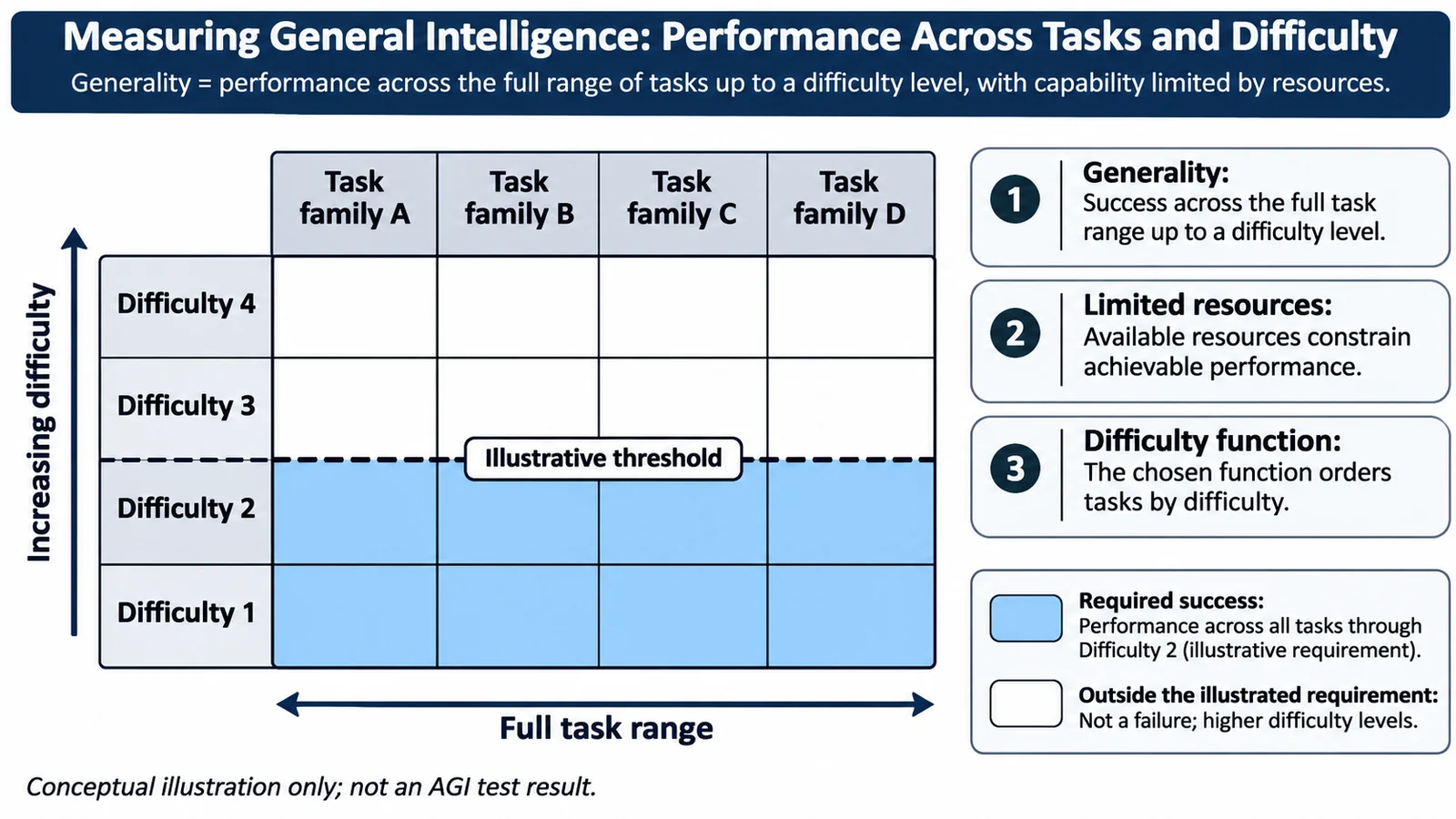
A 2021 paper splits the notion into two measures, generality and capability. Generality describes how an agent's capability is spread across levels of task difficulty. Applying these measures to humans, other animals and AI systems, the study found that generality and capability can come apart at the individual level, so that very specialized agents can show high capability and the reverse also occurs. The same study reports that the metrics also decouple at the population level and that it rarely saw diminishing returns in generality for groups of high capability.[27]
A third family ties general intelligence to behavior under scarcity. One 2019 article proposes that intelligence means adaptation with insufficient knowledge and resources, and argues that a good working definition should resemble common usage, draw a sharp boundary, lead to fruitful research and stay as simple as possible.[28] The 2019 paper on consciousness and general intelligence likewise describes systems that can generate policies from a small number of trial and error attempts at novel problems.[25] A 2021 comparison of human and artificial intelligence argues that human intelligence is one of many possible forms of general intelligence. It adds that, for the time being, AI systems will have cognitive qualities and abilities that differ fundamentally from those of biological systems.[29]
A fourth strand makes consciousness, or something close to it, part of the definition. One 2021 article argues that research on consciousness matters for building general artificial intelligence, and that the operationalist methodology of Turing's test, which excludes study of consciousness as subjective reality, is limited for this purpose.[23] A 2026 paper holds that without realizing consciousness, subject and subjectivity, self-awareness, intentionality and homeostasis, it is impossible to speak of conscious activity in artificial systems.[30] The 2020 overview of strong AI asks whether strong AI could become conscious. It requires that such a system show sentience, emotional intelligence, imagination, effective control of other machines or robots, and qualities of self-reference and self-reflection.[22]
The boundary between narrow and general is contested partly because the terms are defined by different criteria that need not agree. One 2018 analysis concludes that a computer system could follow the same laws of thought as the human mind and show similar properties. Yet such a system, lacking a human body and human experience, would not behave exactly like a human, and it would not be smarter than a human on all tasks. The same analysis argues that building an AGI requires a fairly good grasp of how intelligence works in general. For that reason, the system's behavior would in principle stay understandable and predictable.[24] A 2026 paper notes that debate continues over whether general intelligence can be reached within connectionist models alone, such as large language models, through self-organization, and over which subsystems a system must contain before it counts as general. The 2026 paper adds that the history of tests grouped as Turing tests shows a need for a set of metrics that would allow objective judgments about whether a given system has reached the level of general intelligence.[30]
The gap between narrow and general systems
Artificial intelligence systems have scored striking successes in recent years, and many trained networks have met or exceeded human benchmarks within the domains where they were trained. That record of success has begun to overshadow the failures, yet much still separates these tools from the general learners that humans are.[31] A system built for one task can be an expert at that task and still lack the adaptability, reasoning and learning across diverse domains that general intelligence would require.[32] One review describes today's AI as a simulation of part of human intelligence: it can imitate, replace, extend or expand some human abilities, not the whole set.[33]
Majumder (2024) writes that current AI systems excel in specific, narrow tasks but fall short of generalization, creativity and transferability.[32] A 2022 paper argues that human intelligence is built up from ten ingredients that work together, and that higher-order cognition and intelligence emerge from their combination. The same paper proposes architectural changes inspired by neuromorphic computing, which borrows design ideas from the structure of the brain, as a route toward systems that are smarter, more explainable and more generalizable.[31]
The human abilities that current systems do not reproduce include imagination, emotion, intuition, potential and tacit knowledge, the kind of know-how that people rarely state in words. One account holds that brain-computer interfaces, devices that connect the brain directly to a computer, together with further study of the human brain, would be needed before AI could simulate and replace those forms of personalized intelligence.[33] Practical obstacles also appear in how systems are built, because creating labeled datasets, in which each example carries a correct answer supplied by people, is labor-intensive. That cost has pushed research toward unsupervised and semi-supervised learning, methods that need fewer labeled examples. A scoping review of 2022 articles in three machine learning journals found that efficient updating of learning algorithms and interpretability of predictions were key considerations for development.[34]
The words used for the goal are themselves unsettled, and a 2022 paper notes that "human-level artificial intelligence" and "artificial general intelligence" are poorly defined terms. The same paper suggests that these terms do not necessarily capture what matters most for future effects on society, and proposes "transformative AI" as a helpful alternative. In that proposal, a system of this kind might reshape society greatly while never matching human cognitive abilities. The paper distinguishes three levels at which AI might be called transformative, each tied to a different degree of societal change.[35]
Definitions and the adaptation standard
Artificial general intelligence, usually shortened to AGI, has no single agreed definition, and recent papers treat that absence as a fact about the field rather than a gap waiting to be closed.[36][37] A 2025 overview notes that the term has attracted so much hype and speculation that it has become something of a Rorschach test, an image onto which each observer projects a different reading. The same overview reports that Melanie Mitchell and others have questioned whether the term still carries meaning, and that Mitchell holds the debate will be settled only through long term scientific investigation.[37] One common contrast survives the confusion: narrow or weak systems are built for specific tasks or particular problems, while AGI is meant to reason, learn and solve problems with the competence and flexibility of humans.[38]
A 2024 paper offers a definition centred on adaptation: a system shows general intelligence when it adjusts to open environments, follows certain principles, and works with limited resources. In that account, learning or adaptation is a necessary feature of intelligence. What remains disputed is the set of principles, and these can be described from more than one standpoint.[39] A 2025 overview reaches a similar place by comparing definitions of intelligence and settling on intelligence in terms of adaptation, with AGI framed as an artificial scientist. The same overview describes two foundational tools for building adaptive systems, search and approximation, and concludes that AGI will be a fusion of tools and overall approaches rather than one method. It also reports that hardware improvements enabled the growth of large language models, and that the bottlenecks are now sample and energy efficiency.[37]
Other definitions stress autonomy and range of action rather than learning alone. A 2022 philosophical analysis describes AGI as able to go beyond narrow AI, gain a high degree of autonomy, and independently solve problems in different environmental conditions, so that it can perform the functions of natural intelligence.[40] The 2026 review also holds that an AGI agent must be able to work in the real world. It raises the idea that AGI may have an ensemble nature, assembled from several components rather than one mechanism.[36] A 2023 article frames the goal as machine intelligence with human-level cognitive capabilities across various domains, and lists learning from limited data among the challenges.[41]
The choice of yardstick is itself contested, and because natural and artificial systems progress at different rates, their cognitive abilities, functions, resources, values, ethical frameworks, worldviews and existential objectives could drift apart, a gap the paper calls the AGI evolutionary gap.[42] Definitions also carry assumptions about how intelligence should be studied, and the 2026 review sets out the three foundational paradigms of symbolism, connectionism and enactivism as competing starting points.[36] A 2021 overview adds that the character of human beliefs about AGI has itself been described in conflicting ways, and that several meta-level theories may be needed to describe it.[43]
History
Where the idea came from
Early in the field, researchers explored ideas about intelligence by writing programs that behaved intelligently. Hand-written programs, though, were neither sturdy nor general. Later, research moved toward learners that infer behavior and functions from experience and data. It also moved toward solvers for well-defined but intractable models, among them SAT, classical planning, Bayesian networks and POMDPs. Model-based approaches, for their part, need models and algorithms that scale. Geffner drew a parallel between these two strands and current theories of the human mind. Model-free learners resemble System 1, a fast, opaque and inflexible intuitive mind. Model-based solvers resemble System 2, a slow, transparent and flexible analytical mind. The gap between the two must be bridged for intelligent systems that are sturdy and general.[44]
Some treatments of the idea reach back to the founding question of the philosophy of artificial intelligence. Alekseev argued in 2023 that the AGI project, which would carry out a broad range of mental acts, can be studied through a complex Turing test. That test is aimed at the main question of the philosophy of artificial intelligence, whether a computer can do everything. Its universal quantifier runs through private Turing tests, which ask whether a computer can understand, live, create, be aware, love or be friends. Alekseev proposed studying the issues that arise in developing an AGI project by explicating seven functions of the complex test. Those functions are communicative, interrogative, organizational, definitive, critical and constructive, and constitutive.[45]
The idea and its early history
Artificial general intelligence, usually shortened to AGI, names a hoped-for kind of machine: one that would match the breadth of human mental ability rather than excel at a single task.[46][47] The term is best understood against the narrower systems that exist now, which perform well on particular jobs but remain limited in reasoning and adaptability.[46] One 2024 paper describes AGI as a reflection of the shared variance in the performance of artificial systems, borrowing an idea from the study of human general intelligence, where a person's scores across many different tests tend to rise and fall together. Gignac and Szodorai (2024) describe artificial general intelligence as a reflection of the shared variance in the performances of artificial systems, drawing a parallel with human general intelligence. The same paper argues that current evidence supports a description of artificial achievement or expertise rather than artificial intelligence, because training and testing practices reward narrow accomplishment.[47]
The ambition behind AGI is older than the name. Artificial intelligence as a field dates its conception to the mid 1950s, and from the start it carried a wish to understand and emulate intelligence in natural and artificial settings alike.[48] A 2012 overview treats artificial intelligence as the science and engineering of systems that display traits we associate with human intelligence. It groups the field by the parts of an intelligent agent, among them knowledge representation, planning, learning, language and vision, and robotics.[49] Two ambitions the field had long held were a computer simulation of a whole biological brain and the laboratory creation of new life forms by manipulating cellular and genetic material.[48]
Definitions of intelligence itself have never settled, and the difficulty carries over to machines. A 2024 review of published definitions found both consistencies and inconsistencies, and proposed abstract and operational definitions that emphasize a maximal capacity for completing novel goals successfully through perceptual-cognitive processes in people and computational processes in machines. The same review treats intelligence, human and artificial, as consistent with a model of many separate capabilities rather than a single quantity. It also recommends that computer science adopt a discipline of AI metrics, in parallel with psychometrics, the field that builds and checks tests of mental ability, so that evaluations of artificial systems report reliability and validity and follow standardized measurement procedures.[47]
A 2024 analysis of the path from narrow systems to AGI and then to a theoretical artificial superintelligence reports an accelerating curve of capability, with gains of 18 to 67 percentage points on challenging benchmarks within single years. The same analysis points to persistent limitations in reasoning, adaptability and safety alignment that would have to be addressed before general intelligence is reached. It also gathers expert predictions that AGI may emerge within this decade, a forecast rather than a finding.[46] Earlier writing on the field's direction stressed abilities that remain goals rather than accomplishments: learning from other projects, being inventive, and being integrative.[48]
The conference series and its aims
The term artificial general intelligence became the name of a research field partly through a small annual conference that began in 2008. The First Conference on Artificial General Intelligence, known as AGI-08, was held on March 1 to 3, 2008, at the University of Memphis. The conference set out to build shared agreement on which routes to human-level and higher general intelligence look most promising. A second aim was to share interim results and ideas from researchers already working toward powerful artificial general intelligence.[50]
The Third Conference on Artificial General Intelligence was held on March 5 to 8, 2010, at the University of Lugano in Lugano, Switzerland. Marcus Hutter chaired the meeting, with Eric Baum and Emanuel Kitzelmann as co-chairs. The 2010 meeting also served as the venue for awarding the 2010 Kurzweil Prizes.[51] Across the first three meetings the organizers set out to settle what the most promising routes to general intelligence were and to compare interim work, while the technical content of that work belongs to the research literature that followed.[50][52][51]
Main ideas
How researchers propose to build it
The brain-inspired camp argues that general intelligence should be reached by imitating the brain rather than by first understanding the principle of intelligence. A 2017 paper by Huang calls this philosophy imitationalism and compares it to engineering methods practiced for thousands of years, such as the invention of the first airplane. The proposed machine, a neurocomputer, copies the brain's wiring using neuromorphic devices, hardware parts built to act like neurons, synapses and other neural components. Such a machine could take in its surroundings through sensors and act through a physical body.[53] A 2020 framework by Nadji-Tehrani and Eslami borrows a different biological process, neuroembryogenesis, the growth of the brain in the embryo. A simplified implementation of the human visual cortex built this way recognized characters.[54]
Prudkov (2025) states a condition called goals-means correspondence: a goal can be reached only when the means match it. Prudkov argues that neither design explains human action and thought, and that systems built on them cannot reach general intelligence. The proposed alternative builds goals and means jointly, choosing the pair with the lowest construction cost, and lets an agent's structure change over time.[55]
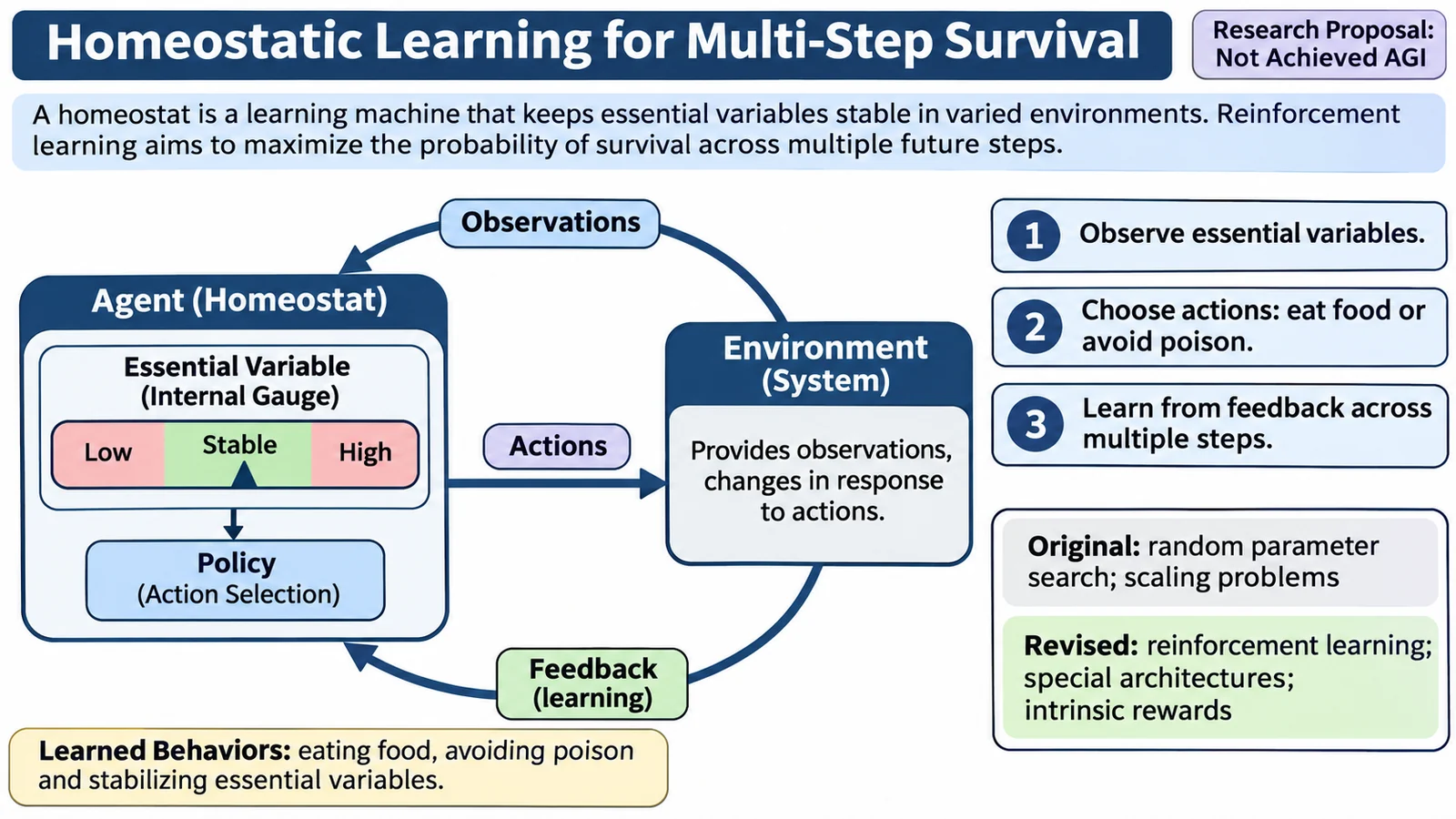
Yoshida (2017) redefines the objective of homeostats, learning machines from early artificial intelligence that hold an agent's essential variables steady in varied environments. The new objective is to maximize the multi-step probability of survival, treated with reinforcement learning, in which an agent learns from rewards, plus special architectures and intrinsic reward functions derived from theory. The original homeostats could not scale because they searched their parameters at random. Agents built on the new design learned to eat food, avoid poison and stabilize essential variables, including in environments with visual stimuli.[56]
Li and Li (2023) argue that the traditional learning paradigm, which assumes independent and identically distributed data, struggles with causal relationships. Understanding causality, in their view, requires the perspective of a creator rather than an observer, because what-if questions hold only inside a possible world one conceives. Their relation-first paradigm is implemented as Relation-Indexed Representation Learning, and experiments reported in the paper support it.[57]
Kejriwal (2021) argues that an AI able to handle context, the surrounding information that shapes what a situation means, must treat it as a first-class citizen of research. Reviewing sub-areas such as representation learning and commonsense reasoning, it identifies seven features associated with context and argues these are necessary for a sufficiently rich theory.[58]
Slavin (2023) borrows an architectural approach used to model enterprise information systems and applies it to a conceptual model of general intelligence with three layers and five levels. Two levels, entropy and process, sit at the technological layer. Two more, social and linguistic, sit at a relationship layer that governs behavior. The top level, actualization, is where general intelligence is supposed to appear. The social layer requires an intellect that decides independently and answers for its decisions, while the top layer concerns self-identification and understanding one's place. The paper also hypothesizes that a limited life cycle is an important condition for intelligence to become actual.[59]
Formal models and their limits
The proposed measure assumes that the surroundings an agent acts in may change at any step it takes. This makes the measure more general than the universal intelligence measure of Legg and Hutter (2007) and the anytime universal intelligence test of Hernández-Orallo and Dowe (2010). Its main advantage is that an agent's computational complexity enters the measure in a natural way. He also shows that how intelligent an agent scores depends on how well it can process in parallel.[60]
One framework starts from Penrose's Gödelian argument, which denies that Turing machines can realise general intelligence. From that starting point the author formulates several theses on the noncomputable character of such systems. The paper supports the claim that noncomputability of an infinitary kind might be a workable route to future implementations. That route looks more promising when paired with nonlocality and with a probabilistic structure of the nonclassical kind found in quantum physics. It then sets out a mathematical framework for building such systems from interconnected dynamic agents, called multi-agent assemblages.[61]
General intelligence involves reasoning about a situation, seeing things from another point of view, picking goals, and coping with information that is ambiguous. All of these, the argument runs, depend on identifying and exploiting new affordances, meaning opportunities or impediments on the path to a goal. The use of an object in an agent's hands is given as a general example of an affordance. The authors show that no list of such uses can be written in advance, so they cannot be handled by an algorithm. On this view, AI agents and organisms differ in their ability to exploit new affordances, and only organisms can do it. The authors conclude that true artificial general intelligence is not achievable within the current algorithmic frame of AI research.[62]
Formal measures of general intelligence
Marek, Feyereisl and GoodAI (2016) propose a framework for studying, measuring and testing the skills a human-level intelligent machine needs, and Alexander and Hibbard (2021) survey measures of intelligence for agents that compete in a sequence prediction game.[63][64] One early statement of the problem came from John McCarthy, whose 1971 Turing Award lecture was titled "Generality in Artificial Intelligence"; in a 1987 paper he wrote that the problem of generality in artificial intelligence was almost as unsolved as ever. He judged that finding a language for expressing general commonsense knowledge in such a database was the key problem of generality in artificial intelligence.[65]
A 2016 framework proposed by researchers including Marek and Feyereisl treats intelligence as a tool for searching for general solutions to problems. In that account, intelligence is the ability to pick up skills that make this search narrower, more varied, and better aimed at promising areas. The framework also offers suggestions for studying, measuring and testing the skills that a human-level intelligent machine would need, and it is meant to be independent of any particular implementation.[63]
A 2021 paper by Alexander and Hibbard builds on a 2011 proposal by Hibbard, who suggested an intelligence measure for agents that compete in an adversarial sequence prediction game. The 2021 paper separates Hibbard's idea into two parts: measuring intelligence from the growth rates of the runtimes of the competitors an agent defeats, and one specific, somewhat arbitrary method for measuring those growth rates. Surveying other ways to measure function growth rates yields further Hibbard-like measures, including taxonomies based on Big-O and Big-Theta notation, which the paper describes as challenging conventional ideas of what an intelligence measure should look like. The authors argue that measuring sequence predictors in this way can serve indirectly as a measure of agents with artificial general intelligence.[64]
A 2021 paper by Hernández-Orallo, Loe, Cheke, Martínez-Plumed and Ó hÉigeartaigh starts from the classical interpretation of general intelligence as success in all sorts of situations. When resources are limited, an agent's capability must be limited as well. Generality is then read as performance across the full range of tasks up to some level of difficulty. This splits general intelligence into two measures that do not rest on population averages: generality and capability. The choice of the difficulty function plays a prominent role in this conception of generality, which the authors present as a quantitative tool for questions about the evolution of general intelligence and for evaluating progress toward artificial general intelligence.[27]
The computability problem in formal agents
One route to a precise definition of artificial general intelligence (AGI) treats it as a theoretical agent, a mathematical object that can be analysed or built, rather than as a product or a benchmark score. The general reinforcement learning agent AIXI is the best known such formalism, and one 2022 analysis describes it as apparently the only formalism of AGI supported by proof that its behaviour is optimal.[66][67] AIXI reaches that result by using compression as a stand-in for intelligence: the agent is defined so that its predictions and choices follow from finding the shortest description of what it has observed.[68][66] An earlier statement of the same definition puts it in terms of information. An AGI is an agent that needs less information than any other agent to make an accurate prediction. AIXI arguably met that definition, and it was the only mathematical formalism to do so.[69][70]
AIXI is incomputable, so no machine can carry out the procedure the definition describes.[71][72] One diagnosis holds that both problems follow from how AIXI pictures cognition. It treats thinking as happening apart from the environment in which goals are pursued, a split the analysis calls Cartesian dualism.[66][67]
Proposed replacements keep the demand for proof and change the measure of intelligence. One line of work combines ideas from cognitive science (enactivism, the view that cognition arises through an agent's interaction with its surroundings), philosophy of language (intension and extension), and machine learning and planning (satplan) to give the notion of an arbitrary task mathematical rigour.[71][68] Within that model, a different proxy for intelligence, called weakness, replaces compression, and the claim is that maximising weakness maximises intelligence. The result is presented as both computable and objective, and the proof is backed by experiments comparing weakness with description length, the closest analogue to compression that would not bring back subjective performance. In those experiments weakness outperformed description length, which the work treats as evidence that weakness is the better proxy.[68][66] The same work argues that if cognition is enactive, then minimising description length is neither necessary nor sufficient for optimal performance, a result that undercuts the idea that compression is closely tied to intelligence.[66][67]
The trade-off is stated plainly by the proposals themselves.[71][68] The formalism is offered not as a cure-all but as a demonstration of principles that might be combined with existing tools such as neural networks, and several open questions remain about implementing general intelligence at scale.[68][66]
Large language models and claims of generality
Large language models (LLMs) are computer programs trained on very large amounts of text so that they can produce and interpret language, and the most widely discussed examples are GPT-4 and ChatGPT.[73][74] The arrival of these models has led some researchers to describe them as a step toward artificial general intelligence (AGI), a system able to handle tasks that require human-level reasoning, problem-solving and decision-making rather than a single narrow job.[73][75] A 2023 position paper on AGI in education argued that such models represent a significant leap in machine capability, extending to reasoning, problem-solving, decision-making and even the understanding of human emotions and social interactions.[73] A 2025 survey of generative artificial intelligence described recent breakthroughs and gathering advances toward possible AGI, including agents that can scale their thinking when solving complex reasoning tasks.[76] A 2024 guide for health professions educators listed characteristics it attributed to AGI: multi-modality, generality, adaptability, autonomy and learning ability.[77]
Claims of general capability rest on evaluations, and these have used two broad families of test: standardized examinations and benchmarks built around particular abilities. A 2023 perspective paper reviewed existing evaluations of LLMs using both kinds of test and identified several problems with the methods that tend to overstate what the models can do. That paper proposed four characteristics a generally intelligent agent should have. It can perform unlimited tasks, and it can generate new tasks within a context. It operates from a value system that underpins task generation, and it has a world model reflecting reality that shapes how it interacts with the world. Measured against those four characteristics, the paper argued that LLMs lack the unity of knowing and acting, and that active engagement with objects in the real world supplies stronger signals for forming conceptual representations than passive input does. In that account, knowledge is not acquired through passive input alone. It also takes repeated trials and errors.[78]
Direct comparisons with task-specific models give a more concrete picture of where general models stand. ChatGPT also proved more resistant to noisy data, a condition under which Word2Vec produced worse results. The evaluation concluded that ChatGPT is a good generalist model, reaching good results across various problems without specialized training.[79]
Specialized fields expose further gaps. A 2025 review in medical imaging noted that large AGI models including ChatGPT and GPT-4 have achieved unprecedented success on general domain tasks, yet when applied directly to medical imaging they face notable challenges arising from the field's inherent complexities and unique characteristics.[74] A 2023 paper on radiation oncology described LLMs such as GPT-4 and PaLM 2 processing extensive texts. It also described large vision models such as the Segment Anything Model processing extensive imaging data. The paper argued that these models should complement human expertise and care rather than replace it.[80] A 2023 review of foundation models for medicine proposed generalist medical AI. Such models carry out many different tasks with very little or no task-specific labelled data, and they are built through self-supervision on large, diverse datasets.[81]
Consciousness, emotion and embodiment
One family of arguments holds that general intelligence in machines may require features that narrow systems lack, such as consciousness, emotion, belief or a body acting in an environment.[25][30][82][83][22] A 2019 proposal defines general intelligence as the capacity to take knowledge and models gained from past experience and apply them to new problems. It suggests that consciousness evolved as a platform for that capacity. On that view an artificial consciousness would integrate specialized forward models and let an agent choose which model to apply to a novel problem, reaching policies after a small number of trial and error attempts.[25] A 2020 paper argues that strong artificial intelligence must show sentience, emotional intelligence, imagination, command of other machines, and self-referring and self-reflecting qualities, and that it is more than a collection of narrow technologies.[22]
Models of cognition have been built that include such features rather than treating them as extras.[84][82][83] The Learning Intelligent Distribution Agent (LIDA) model rests on stated conceptual commitments, tentative hypotheses that connect perception, memory, attention, action selection and learning into one framework while the underlying subfields remain unsettled.[84] A 2025 study added abstract emotion-triggering mechanisms to a nonaxiomatic reasoning system, a reasoning framework that draws on cognitive appraisal theory, the idea that emotions arise from how events are evaluated against goals. That emotion-driven system modulated the priority and durability of cognitive resources according to goal alignment and timing, and it beat its nonemotional counterpart on decision-making efficiency and goal prioritization in the Flappy Bird and airplane combat simulations used for testing.[82] A 2021 paper proposed a three-dimensional network model of how belief is represented, generated and adjusted, with belief expressed as a sentence or as a structure diagram and built from content, value, grammar and link, as a step toward simulating human-like belief.[83]
Embodiment arguments start from a lower level than human intelligence. A 2022 framework holds that intelligent behavior in nature arose from an organism interacting with surroundings that could change over time. It adds that learning occurs when an agent acts in an environment and interprets the sensory feedback that follows.[85]
One 2026 paper argues that a system cannot be called conscious without consciousness, a subject, self-awareness, intentionality (the directedness of thought toward objects) and homeostasis treated as a construct of cybernetics.[30] A 2023 account proposes info-autopoiesis, the self-referential, recursive and interactive self-production of information, as the general framework for judging artificial intelligence, and treats the connection between human and machine intelligence as the question that must be answered first.[86] A 2021 philosophical paper holds that Turing's operationalist method, which judges intelligence by observable behavior, is limited, and that studying subjective reality through phenomenological analysis should inform new cognitive architectures.[23]
Others treat general intelligence itself as the practical bridge to artificial consciousness.[26][87] A functional modeling framework published the same year claims the capacity to represent the full set of functions of human consciousness and cognition. Its functions can be checked through human self-awareness rather than through the assumptions of any one model. The paper summarizes a model of cognition proposed to meet its criteria for artificial general intelligence.[87]
Embodiment here means more than a physical shell, because it includes how a living system depends on its surroundings. A 2023 paper on this problem draws attention to a lack of coherence in how intelligence is understood. Human intelligence grows out of human experience and strains to reach past its bodily limits. Building autonomy and broad ability into a machine would therefore require recreating an organism's natural condition of embodiment. Whether such artificial bodies are feasible, controllable or even worthwhile remains uncertain.[88]
A 2026 paper argues that a human-like general intelligence must explore reality on its own, set its own goals and show genuine creativity, such as making original scientific discoveries. Human creativity, in that account, rests on high-level consciousness and a subjective feeling of being a person. A machine that is intelligent but not conscious could only imitate the random processes from which creativity arises, not reproduce them. The paper concludes that a sentient general intelligence is not possible with conventional computer science methods. It names biocomputing and quantum-based models of consciousness as possible future routes, and notes the ethical questions that new forms of awareness would raise.[89]
A 2022 paper holds that general intelligence, unlike narrow artificial intelligence, must work with meanings. Existing definitions of meaning are loose and cannot be programmed, according to that paper. It calls for formal descriptions of meaning and knowledge that could be coded directly.[90]
A 2025 paper considers an embodied general intelligence that could hold a form of consciousness unlike a person's, with a wider computational boundary. It draws on embodied cognition, on Michael Levin's idea of a computational boundary of a self, and on Donald Hoffman's interface theory of perception.[91]
Theories of intelligence behind the proposals
Proposals for artificial general intelligence rest on theories about what intelligence is and whether it can be separated from the body and situation of a living agent.[11][92] One framing treats the field as an attempt to distil principles of intelligence that hold regardless of any particular problem domain, then to use those principles to build systems able to perform any intellectual task a person can perform and more. A 2017 paper argues that this framing carries serious limitations traced to the philosophical roots of the concept of intelligence. That account draws on the philosophical idea of individuation, the process by which an agent comes to be a distinct entity, and on sense-making, and it describes general cognitive agents as a distributed, self-organising network of interacting elements that can scale.[11]
The SP Theory of Intelligence takes information compression as a key principle in human learning, perception and cognition, and it achieves that compression through a mechanism called SP-multiple-alignment. A 2023 paper presents the theory and its realisation in the SP Computer Model as a promising foundation for intelligence at the level of people or higher, and it compares the theory with alternatives chosen to represent other possible foundations. The same paper holds that many uncertainties lie between current work and anything that might qualify as an AGI, so a multi-pronged attack on the problem is needed, with the SP Theory as one prong. It also argues that useful benefits and applications may appear along the road even though AGI will take time to achieve.[12]
Human-Centric Functional Modeling decouples the components of complex systems such as cognition through well-defined interfaces so that each component can be implemented separately, which breaks the large problem into a number of simpler ones. A 2021 paper uses this approach to define a model of AGI believed to have human-like general problem-solving ability. It also sets out a model of General Collective Intelligence that could combine individuals into a single collective with potentially exponentially greater general problem-solving ability than any member of the group. The paper explores how a rudimentary AGI and a rudimentary collective intelligence might be built by approximating each function, so that the resulting systems provide enough value to encourage more sophisticated versions over time.[16] An earlier paper by the same author sets out requirements for a searchable library of AI models, described in a common set of semantic functional building blocks, that an AGI could draw on to increase its general problem-solving ability.[17]
Neuropsychoanalysis offers a different basis, arguing that the AGI agenda would advance further if grounded in affective neuroscience, the study of emotion in the brain, rather than in cognitive science alone. A 2021 paper contends that AGI research has been too cortical-centric, privileging the cerebral cortex and its cognitive functions, and that emotions and affects arising in the subcortical area deserve central place in mental life. The paper sets out design principles for an AGI system based on the brain and mind model formulated in the work of Mark Solms and Jaak Panksepp. It examines how Panksepp's seven affective systems might be embedded in such a system through Judea Pearl's causal analysis. The conclusion argues that an AGI built on sub-cortical principles offers the best route to the problem of controlling AI.[93]
Neurosymbolic artificial intelligence combines symbolic methods with methods based on artificial neural networks, and a 2022 overview notes that this combination has a long-standing history and categorises recent publications from key conferences to map current trends.[94] A 2026 paper proposes that neurosymbolic methods can support mechanistic interpretability, the effort to explain how a model's internal workings produce its outputs, and explainable AI by making decision processes more transparent. It sets out a five-phase methodology: identifying components, aligning them with symbolic representations, verifying causal links, setting evaluation metrics, and refining iteratively. The phases are illustrated with a hypothetical medical imaging scenario rather than empirical experiments. The paper closes by considering how neurosymbolic AI might help AGI advance, chiefly through greater transparency, accountability and alignment with human values.[95]
Critiques of pure learning question whether general intelligence can emerge from training algorithms alone.[96][97] A 2019 critique argues that most animal behaviour is not the product of clever supervised or unsupervised learning but is encoded in the genome, since animals are born with highly structured brain connectivity that lets them learn very rapidly. The genome cannot specify a wiring diagram of such complexity explicitly, so the paper holds that the diagram must be compressed through a genomic bottleneck. That bottleneck is presented as a path toward artificial networks capable of rapid learning.[96] A 2020 book makes a related case. It argues that despite progress on individual tasks, research has not been on a road that could lead to general intelligence, and that a stack of systems each knowing one big thing cannot duplicate the intelligence of a system that knows many things.[97]
Some critiques deny that computation of any kind can supply general intelligence.[98][92] Hubert Dreyfus's book, first published in 1972 and reissued in 1994 with a new introduction assessing connectionism and neural networks, predicted that grand plans for general problem solvers and automatic translation would fail. In his account, their conception of mental functioning was naive.[98] A 2023 article argues that intelligence, following Nicholas of Cusa, depends equally on handling the unknown as it unfolds in the present moment, which ties intelligence to having and acting through an organic body and makes the phrase artificial intelligence an oxymoron. The same article observes that when AI-powered automated systems are employed in general areas of messy socio-cultural reality, they often fail or produce unintended consequences.[92]
Learning, creativity and world models
Sejnowski (2020) describes deep learning as foundational for building artificial general intelligence. Such networks have been trained to recognize speech, to caption photographs and to translate text between languages, all at high levels of performance. Why they work so well is not understood. Sample complexity in statistics and nonconvex optimization theory suggest the results should not be possible, and insights are being sought in the geometry of high-dimensional spaces. The approach was inspired by the architecture of the cerebral cortex. The same account suggests that clues about autonomy and general intelligence may lie in other brain regions, ones essential for planning and survival. A mathematical theory of deep learning would let researchers judge the strengths and weaknesses of different network architectures. Major breakthroughs will be needed before these goals are reached.[99]
Generative models mark a shift from data-driven, discriminative tasks toward creative tasks, producing novel and realistic content such as texts, images or programming code from basic user prompts. These systems build on deep generative models, and overviews of the field set out their underpinning concepts, their potentials and their challenges.[100] Computational creativity, the branch of the field that builds systems for artistic production or for creative problem solving, has developed unevenly. Systems aimed at artistic production or performance have already seen several great successes. Work on creative problem-solving, or on models of creative cognitive capacities, remains in its infancy.[101]
One proposal gives an agent a learned model of its surroundings that it can read in language, called a language-guided world model: a probabilistic model that simulates an environment from text. Agents equipped with such models give humans more extensive and efficient control, allowing behavior in multiple tasks to be altered at once through natural verbal communication. On a benchmark built from the game MESSENGER that requires varying degrees of compositional generalization, the state-of-the-art Transformer model offered only marginal improvements in simulation quality over a no-text baseline. Fusing the Transformer with the EMMA attention mechanism produced a model that substantially outperformed the Transformer and approached a model with oracle semantic parsing and grounding capability. In a simulated scenario, the model let an agent present plans to a human before execution and revise them in response to language feedback.[102]
Projective simulation describes a learning agent that interacts with its environment through a simulation-based projection. The agent projects itself into future situations before it takes real action. During simulation the clips are screened for specific features that trigger factual action, and the scheme offers a natural route for generalization to quantum-mechanical operation, connecting reinforcement learning and quantum computation.[103]
A contrasting strategy would build an AI-generating algorithm, one that automatically learns how to produce general artificial intelligence, rather than assembling hand-designed pieces of intelligence one by one. The proposal argues that either approach could produce general AI first and that both are scientifically worthwhile, while noting that the machine learning community is currently committed to the manual approach.[104]
Proposed architectures for general agents
Latapie and colleagues (2021) introduce a metamodel-based knowledge representation for autonomous learning, while Osmani (2026) formalizes general intelligence as a typed meta-model with representational maps, hypothesis spaces, structural priors, evaluators and memory operators.[105][106] One line of work combines symbolic and neural methods, on the argument that reasoning over knowledge graphs and machine learning should interoperate rather than compete. A 2021 proposal introduced a metamodel, meaning a framework that specifies how knowledge is defined and manipulated, and reported that it addresses the symbol grounding problem, the difficulty of tying abstract symbols to things in the world. The same framework was tried on time series analysis, computer vision and natural language understanding. Latapie and colleagues report that it lets machine learning, graph network analysis and reasoning engines work together. The proposal also claims cumulative learning and federated learning, in which separate learners share what they learn, and its authors trace part of their inspiration to Alfred Korzybski's general semantics.[105]
A structural theory published in 2026, called SMGI, shifts the problem from optimizing hypotheses inside fixed environments to controlled change of the learning interface itself. The theory keeps this structure apart from the behavior it induces. General intelligence is then defined as coupled dynamics meeting four obligations: closure of structure under typed transformations, stability under certified evolution, bounded statistical capacity, and invariance of evaluation across regime shifts. Its author proves a structural generalization bound and a structural inclusion theorem, the latter placing classical empirical risk minimization, reinforcement learning, Solomonoff-style program-prior models and modern agentic pipelines as restricted instances of the framework.[106]
A third proposal treats temporal imagination as the missing capacity, defined as the ability to simulate, timestamp and causally order counterfactual scenarios, meaning alternatives to what actually happened, before acting. The design is meant to build timestamped scenario simulations spanning nanoseconds to years, reconstruct causal chains across parallel timelines, and self-train through rehearsal on millions of internally generated experiences. It also specifies containment boundaries that keep simulated actions from affecting the external environment until explicit authorization is given.[107]
A 2026 paper starts from neurons rather than knowledge or timelines. It builds on the Liu-Chen-Ao hypothesis, which holds that entanglement at the quantum level may be what synchronizes millions of neurons. Because that hypothesis is hard to test directly, the authors model collective behavior with a nonlocal many-body wave equation and look for its signatures in Chinese intraday stock market data. Adaptive entangled game modes explained 82% to 94% of decision patterns, against neoclassical finance predictions that assume independent rational agents; 2% to 12% of actions adapted to news and environmental changes, and truly independent behavior accounted for less than 5%. The authors read these results as indirect support for the hypothesis and propose combining ordinary artificial neural networks with probability-wave simulations of entangled neurons to build human-like processing units for embodied intelligence and robotics.[108]
Su, Guo and Chen (2019) assign a mathematical meaning to the philosophical concept of subjectivity and build a data representation of general intelligence, and Alekseev (2019) proposes artificial need as a basis for AGI within a general functionalist approach.[109][110] Subjectivity learning theory, put forward in 2019, drops two assumptions it says constrain current systems: that data are independent and identically distributed samples, and that each input maps to a single output value. It gives the philosophical notion of subjectivity a mathematical representation, sets global risk as the learning goal, and claims a lower risk bound than traditional machine learning, with a practical procedure called empirical global risk minimization.[109] A 2019 article in a Russian philosophy journal argues instead for an artificial need, built by formalizing the concept of need rather than pain within a functionalist account of mind descended from H. Putnam's work of the 1960s. That account treats AGI as a complexity system and places an observer inside its network of functional relations.[110]
Formal models of rational general agents
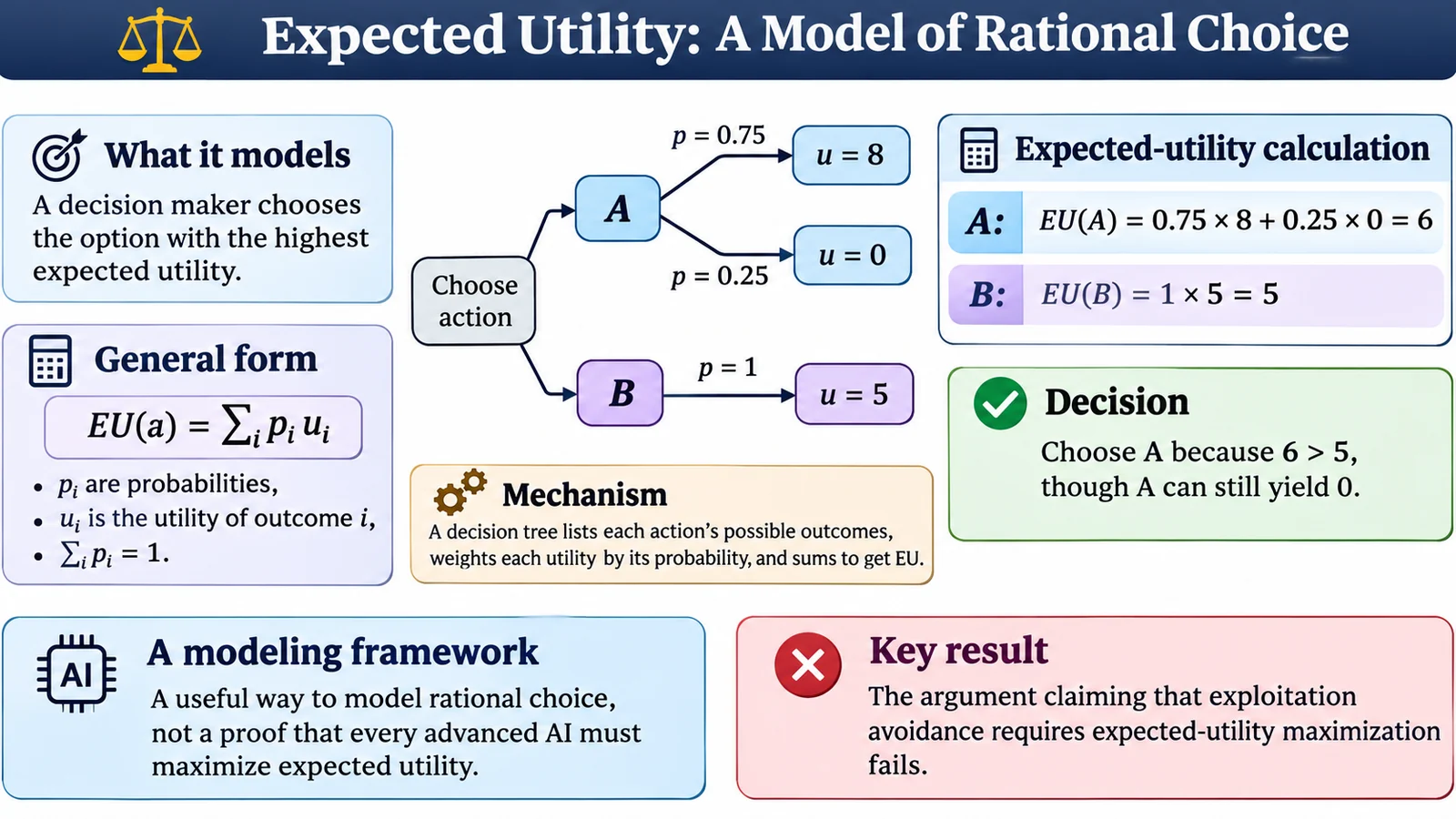
One common way to describe an advanced artificial system as a rational agent borrows a standard tool from economics: expected utility theory, which treats a decision maker as choosing the option with the highest average payoff, weighted by how likely each outcome is. A simple argument holds that an agent must act as if it were maximizing expected utility, because an agent that does not can be exploited, meaning that another party can arrange the situation so the agent ends up worse off than it needed to be. If advanced artificial intelligence is expected to avoid exploitation, the argument continues, then it should be expected to act as if maximizing expected utility. A 2025 paper by Bales sets out this argument more carefully and shows that it fails, while arguing that the way it fails is instructive for how advanced systems should be modeled.[111]
A group who believed probability theory was being unfairly dismissed by the rest of the artificial intelligence community held the first conference on uncertainty in artificial intelligence in 1985. Mainstream opinion at the time held that probabilistic methods demanded too much computation and too much data for realistic use, so the group's position met a cool reception. Parsons records that the first conference on Uncertainty in Artificial Intelligence took place in 1985, convened by researchers who felt their views on probability theory were not getting a fair hearing. It was organized by people who believed the rest of the field was dismissing their views on probability theory.[112]
Ginsberg (1988) shows that first-order theorem provers, assumption-based truth maintenance systems, default logic and circumscription can be subsumed under a single framework based on a mathematical structure called a bilattice. The same general-purpose theorem prover, differing only in the choice of bilattice, was used for a digital simulation task in first-order logic, a diagnostic task, and a default reasoning problem.[113] A 2026 paper by Mikale proposes a mathematical framework for general intelligence without agency, and states an impossibility theorem holding that persistent optimization toward goals under constraints of generality is structurally incompatible with reachability preservation, meaning the system's ability to keep every state reachable.[114]
Bales (2025) sets out an argument that advanced AI systems can be fruitfully modeled using expected utility theory, on the grounds that an agent will need to act as if maximizing expected utility if it is to avoid exploitation. Bales (2025) demonstrates that the argument fails, and holds that the manner of its failure is instructive: exploring the argument gives insight into how to model advanced AI systems.[111] The non-agentic alternative treats general intelligence as a property that can be defined and studied without any system that pursues goals at all.[114]
Modular and bio-inspired construction proposals
Several proposals for building artificial general intelligence depart from the strategy of enlarging a single model and instead divide the work among specialized parts or borrow their organization from biology.[115][116] One modular framework, presented in 2024 as the first paper in a series, describes a collaborative system in which separate modules each concentrate on a distinct cognitive domain, so that expertise and efficiency can be developed in depth. The modules are then integrated so that the combined system does more than its parts working alone, and the distributed arrangement is meant to allow rapid iteration and the quick addition of new technology. The same proposal names integration complexity, standardization and ethical governance as the main difficulties, and it treats reliable communication between modules and shared protocols as necessary for the system to hold together.[115] A related line of work argues that the components of a complex system such as cognition can be separated through well-defined interfaces and implemented one at a time, which turns one hard problem into a set of simpler ones.[117]
A bio-inspired framework proposed in 2019 distributes learning across many agents that evolve through rewards from their environment and learn during their lifetime without supervision, a process the proposal calls self-learning through embodiment. Each agent is controlled by a spiking neural network, a model of neurons that imitates biological signaling, and evolution acts on the network topology, the neuron types and the type of learning rather than on the connection strengths. Newborn networks carry no trained weights and no innate knowledge of the environment, so the ability to learn and adapt in changing surroundings must be built into the controllers passed between generations. Pontes-Filho and Nichele suggest that this route could give rise to the most basic form of artificial general intelligence.[116]
A 2025 preprint draws an analogy with living organisms, treating DNA not as a static archive but as a set of instructions executed step by step to assemble a being. By extension, the proposal pictures artificial general intelligence as a digital organism carrying a minimal code of everything, a kind of digital DNA that is inert outside a computational environment but unfolds into a full system inside one. This code would not hold knowledge directly; it would encode rules for reaching ontologies, loading modules and assembling intelligence, with different tasks activating different genes in a manner compared to epigenetic switching in cells. The comparison prompts practical questions: what resources such a system would draw on, how it could copy itself without harm, and which digital surroundings would keep it running.[118]
Another proposal builds on an undirected active network of communicating operators and nodes that can extend itself, and converts it into a network of semantic structures able to handle language. The network, known as Active Structure, was loaded with tens of thousands of definitions drawn from a dictionary written for human readers. Where that dictionary failed, through circular definitions, a flat ordering of senses, or thin coverage of verbs, the entries were heavily edited by hand. The machine that results can reach every sense of every word it holds. Its job is to pick the correct sense for each occurrence, which the proposal observes is something human minds do without conscious effort.[119]
A 2021 paper proposes a hybrid system for extracting the meaning of a text that follows the principles of the hermeneutical circle, the idea that understanding a whole text and understanding its parts depend on each other. The concept combines connectionist and symbolic approaches in sequence, adds methods of cluster analysis, and rests on the idea of building hybrid systems that are primarily human-machine. The paper frames the underlying problem as the insufficiency of particular approaches and mathematical models for general artificial intelligence.[120]
A 2023 paper sets out a scheme for an artificial general intelligence with self-awareness that includes a new method for attention mechanisms and a way to give machines self-demands. The scheme also includes a value evaluation system that fits the network, a method for building world models, and a top-down hierarchy for thinking and deciding. General decision-making and response abilities are part of it as well. The authors first analyze shortcomings of large language models and then argue that their scheme addresses them, presenting a step-by-step implementation roadmap and a demonstration. The system as described would take in data of every modality in one unified form. It would also pick up human experience straight from language, which Chen, Zeng and Xingyue say removes the need for reinforcement learning at each decision.[121]
World models and general world simulation
A world model is an internal model of an environment that a machine can use to represent the present state of that environment or to predict how it will change. A 2026 survey in ACM Computing Surveys treats world models as central to the pursuit of artificial general intelligence, a term for machine intelligence that matches human breadth across many tasks rather than one narrow skill. The same survey sorts the literature by two functions: building internal representations that capture how the world works, and predicting future states so that a system can simulate outcomes and guide decisions.[122] A 2024 survey makes the stronger claim outright. It calls general world models a central route toward AGI and a foundation for uses that run from virtual environments to decision-making systems.[123]
Much of the recent work rests on two families of generative systems: multimodal large language models, which process text together with images or other media, and video generation models that produce moving pictures from a prompt.[122] The 2026 survey names GPT-4 and Sora as examples that brought world models significant attention, and the 2024 survey devotes much of its analysis to generative methods for video, where world models serve as constructs for synthesizing highly realistic visual content.[122][123] The 2024 survey describes Sora as showing an incipient comprehension of physical laws, a preliminary grasp rather than a demonstrated understanding of physics.[123]
Surveys ask world models to do different jobs in different settings, and each setting draws on one of the two functions. In autonomous driving, world models are examined for their role in reshaping transportation and urban mobility, and the 2026 survey treats driving as one of the key application domains.[122][123] In robotics, the emphasis falls on prediction that can guide action, while social simulacra, simulated populations of artificial agents, test how well a model captures the behavior of many interacting agents.[122] For autonomous agents generally, the 2024 survey describes world models as enabling intelligent interaction within dynamic environmental contexts.[123]
Both surveys close on limits rather than on settled capability. The 2026 survey outlines key challenges and points to future research directions, and the 2024 survey examines the challenges and limitations of world models before discussing where the field might go. The claim that general world models lead to AGI therefore remains a research program with named applications and open problems, not a result that either survey reports as achieved.[122][123]
Research
Evidence from large language models
On all of these tasks, its performance came strikingly close to human-level performance and often far exceeded earlier models such as ChatGPT. Given that breadth and depth, the team judged that the system could reasonably be seen as an early version of an artificial general intelligence (AGI) system, though still an incomplete one.[2]
One 2024 analysis proposed that ChatGPT may instead lead to an artificial special intelligence, a term the paper introduces for a system whose environment consists only of text. A text-only environment avoids the problem of giving an agent a body, according to that analysis, and yields a system with restricted capabilities compared with AGI.[124]
A separate 2023 paper assessed ChatGPT through Human-Centric Functional Modeling, a framework that its proponents hypothesize can measure whether general problem-solving ability exists and how large it is. That paper set out to decide whether ChatGPT shows narrow problem-solving ability, which would classify it as an artificial intelligence, or general problem-solving ability, which would classify it as AGI.[125]
Measuring progress and benchmarks
Measuring progress toward artificial general intelligence, or AGI, is difficult without commonly accepted methods of evaluation. In the first, called the direction task, a person acting as coach tells a machine how to carry out a new task in a setting it does not know. That task is extremely broad, and the paper calls it possibly idealistic. In the second, called the AGI battery, candidate systems are scored on a collection of more specific tasks.[126]
A later proposal argues that AGI should be judged through dynamic embodied physical and social interactions. The 2024 paper lists five critical characteristics to consider in an AGI benchmark. It then proposes the Tong test as an evaluation system for AGI. The Tong test is value- and ability-oriented, and it marks five levels of AGI milestones. Testing happens in a virtual environment built around dynamic embodied physical and social interactions, which allows for infinite task generation.[127]
A third proposal borrows its tasks from human intelligence testing. The 2024 perspective notes that current model evaluations rely mainly on specific tasks and datasets, with no united framework for assessing multidimensional intelligence. It advocates a framework of cognitive science-inspired AGI tests covering crystallized, fluid, social, and embodied intelligence. The tests are well-designed cognitive tests borrowed from human intelligence tests, and they are gathered into an immersive virtual community.[128]
A different line of work treats handling several kinds of data at once, called multimodality, as a route toward general capability. One 2022 study notes that most existing AI methods have only a single cognitive ability. To address this, the researchers pre-trained a foundation model, a large model that is later adapted to many tasks, on huge multimodal data. Training used self-supervised learning, in which the model learns from the data without human-labeled answers, on weakly related data crawled from the Internet. The model could then be quickly adapted for various downstream cognitive tasks, with promising results across a wide range of them.[129]
Risk, control and the alignment problem
The peer-reviewed literature on the risks of artificial general intelligence (AGI, a system with general rather than task-specific abilities) is small and uneven in method.[130] A separate survey of why AGI could threaten human survival on Earth argued that the control problem, the task of keeping a system's behaviour within intended limits, must be solved before the first AGI is created. If it is not, the survey said, the default outcome could be total human annihilation. The same survey held that an AI arms race would almost certainly weaken safety precautions during research and development. Such a race, it argued, could prove fatal not just to states but to the entire human species.[131]
One paper argued against deliberately creating an AI failure as a warning, a fringe proposal it described as a way to make humanity take existential dangers seriously sooner, and it relied on an analogy to inoculation theory in making that case.[132] A 2022 preprint reasoned that delaying superintelligent AI could lower total existential risk by giving humanity more time to work on the AI alignment problem. It could also raise other existential risks, especially from future technologies such as synthetic biology and molecular nanotechnology.[133]
The alignment problem itself has been analysed as a set of philosophical questions rather than a single technical target.[134] A 2023 article in a global health journal described three ways misused narrow AI threatens human health. It widens opportunities for control and manipulation of people, it strengthens lethal weapon capacity while dehumanising it, and it makes human labour increasingly obsolescent.[135]
Some work questions whether risk is the right frame at all.[136] Other writers locate the danger less in the machine than in who controls it: a two-part 2024 study held that the threats of information technology and AI are aggravated by monopolization of their development by the state, intelligence services and major corporations. That study also described AI advances becoming a means of control over populations, of imposing ideologies and priorities, of influencing election results, and of undermining security in geopolitical struggle.[137][138] A 2018 paper treated the technological singularity, the idea of a runaway acceleration in machine capability, as frequently reified, meaning treated as a concrete thing, and sought to separate facts about it from more speculative beliefs about creating AGI.[139]
Benchmarks and tests for general agents
The Arcade Learning Environment (ALE) is a platform for evaluation. It poses the challenge of building agents with general competency across dozens of Atari 2600 games.[140][141] Its high-profile successes include Deep Q-Networks (DQN), a system that learned to play Atari games from screen pixels.[140] A 2018 review found that evaluation methods in the ALE had become increasingly diverse over time and set out concerns about how agents are scored there. The review proposed best practices for future evaluations. It also introduced a new version of the ALE, which supports multiple game modes and adds a form of randomness the authors call sticky actions.[140][141]
Grid-based games, among them Tic-Tac-Toe, Connect-Four and Gomoku, have been proposed as a platform for testing large language models (LLMs) on reasoning, rule comprehension and strategic thinking. Performance varied significantly: simpler games such as Tic-Tac-Toe produced fewer invalid moves, while Connect-Four and Gomoku posed greater challenges. The benchmark is open-source, and the study lists limitations in handling visual data and complex scenarios as areas for improvement.[142]
A developmental approach instead simulates the growth of a human mind, on the argument that this can build the everyday common sense that purely data-driven methods lack. VECA (Virtual Environment for Cognitive Assessment) is a benchmark and toolkit for this purpose. Its benchmark virtually implements the cognitive scale of the Bayley Scales of Infant and Toddler Development-IV (Bayley-4), which the authors describe as the standard developmental assessment for human infants and toddlers. The toolkit gives a toddler-like embodied agent human-like perceptual features, including binocular vision, 3D-spatial audio and tactile receptors. A 2022 study compared several modern reinforcement learning algorithms on VECA and analyzed the benchmark's validity and the effect of the human-like sensory features on cognitive skills.[143]
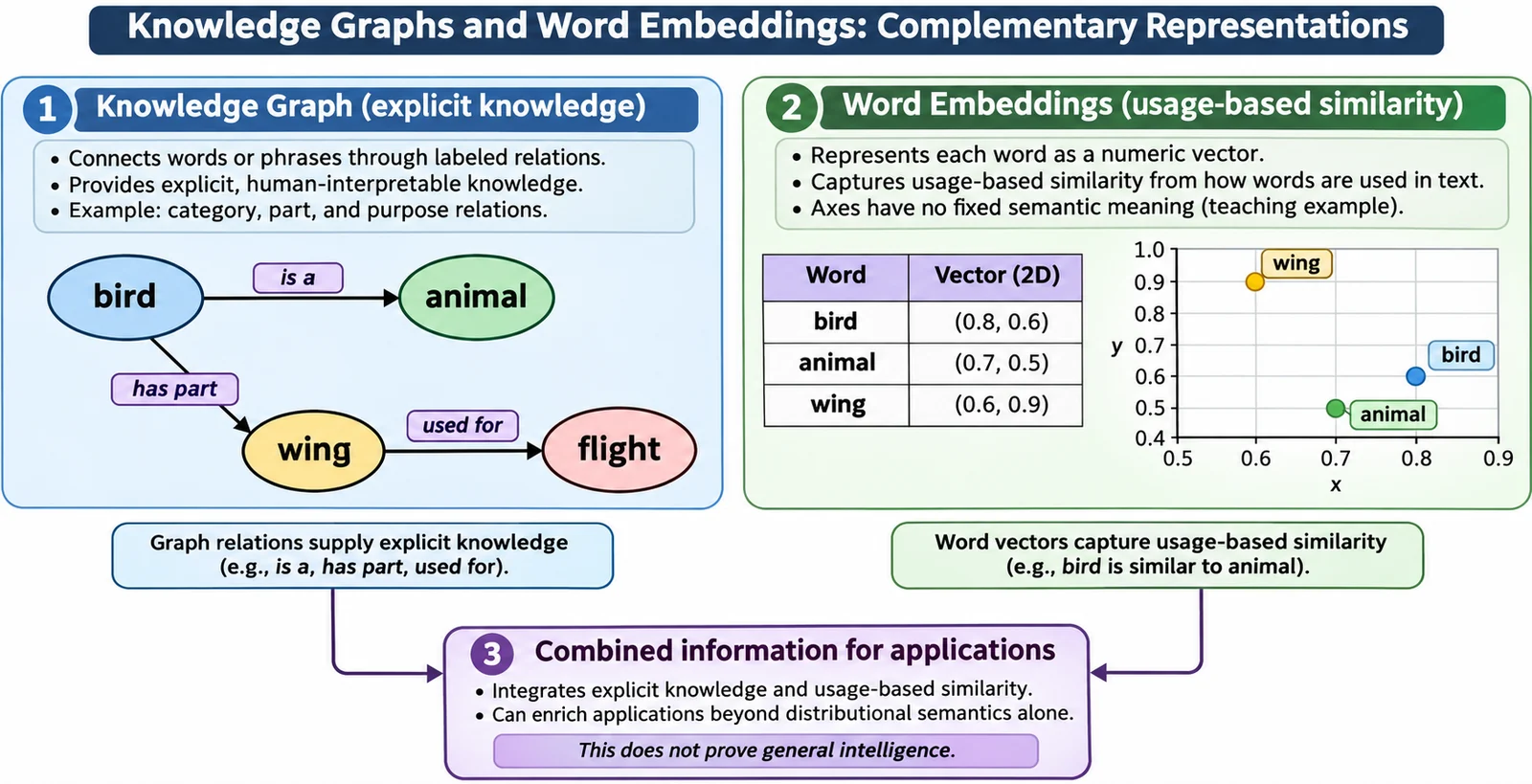
ConceptNet is a knowledge graph, a network in which words and phrases of natural language are joined by labeled edges, and version 5.5 was released in 2017. Combined with word embeddings, which are numeric vectors that represent word meaning, ConceptNet gave applications understanding that distributional semantics alone did not provide, nor did narrower resources such as WordNet or DBPedia.[144]
Measuring development rather than task scores
Most current evaluation of artificial intelligence rests on static benchmarks and task-specific performance metrics, which allow systems to be compared but say little about developmental progression, cognitive architecture, adaptive transfer or real-world applicability. A fixed test set measures what a system does on that set, and a developmental approach asks instead how capacities grow and whether they carry over to new settings. One 2026 article proposes an operational version of a General-Specialized-Applicable framework, which sorts evidence into three stages that the article treats as non-interchangeable. The General stage looks at basic capacities for open-ended generalization, regulation by values, and autonomy. The Specialized stage rates steady competence in one domain. The Applicable stage asks whether that competence can be used safely in realistic settings. The same article adds a pipeline that generates tasks dynamically and a provisional rubric for reading evidence at each stage.[145]
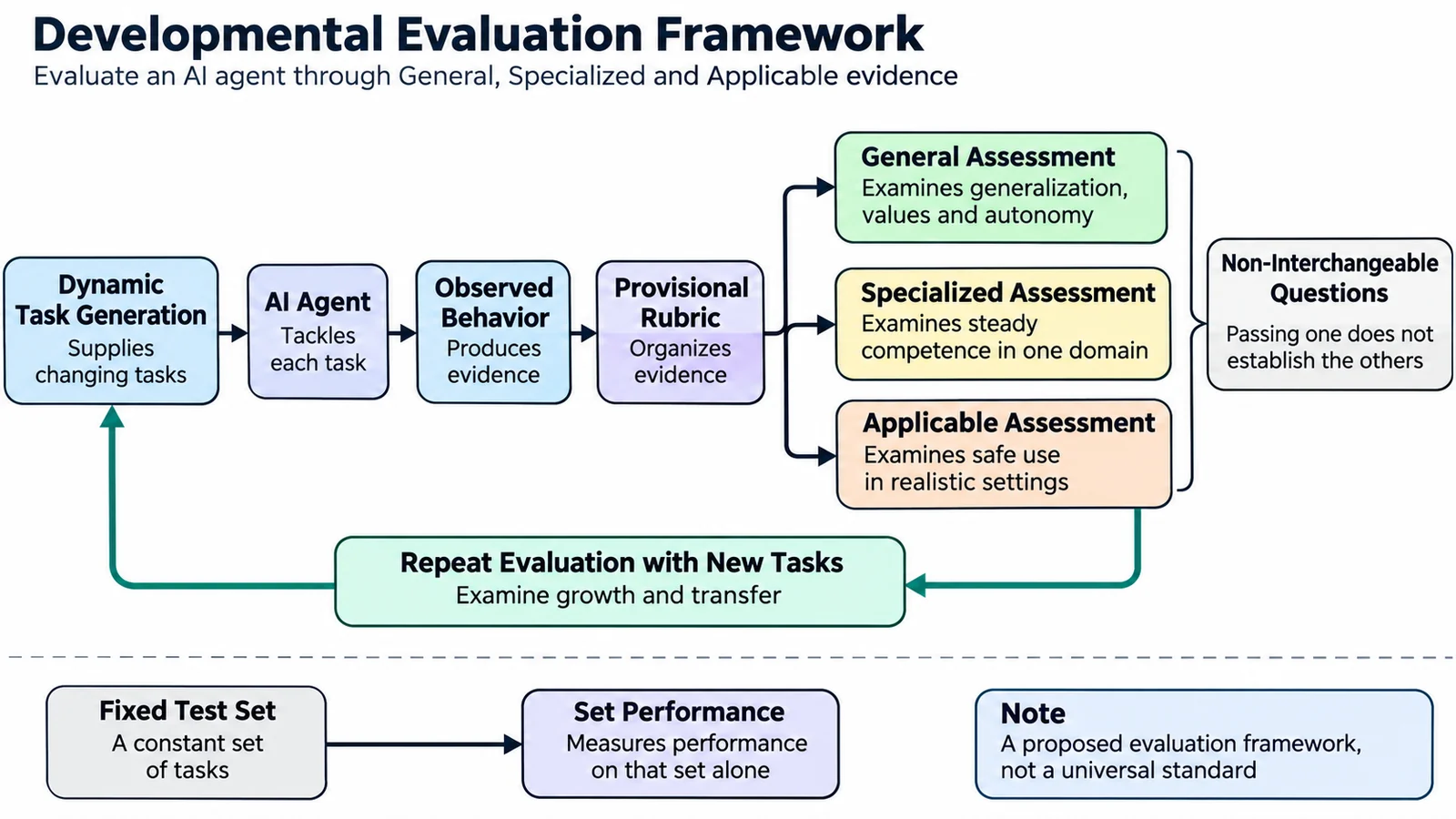
An illustrative case study used household tasks in a simulated embodied environment, a computer-generated setting in which an agent acts through a body. In that case the staged framework identified capability gaps in current multimodal large language model agents, which are systems that process text together with other kinds of input such as images. Such diagnostic information goes beyond what an aggregate benchmark score reports, because a single score collapses distinct capacities into one number. The article presents the framework as an evaluation-oriented structure linking benchmark performance to architectural readiness, specialization and deployment-level applicability, not as a final universal standard.[145]
A cognitive-architecture view asks what internal organization an agent needs, and one line of work treats a theory of mind, the capacity to model the beliefs and intentions of others, as foundational for agents that collaborate with human team members. Under that proposal, an agent with artificial social intelligence would need to perceive, interpret and generate combinations of social cues in order to work inside a human-agent team. Modeling the mental states of human partners could also support transparent communication and help people predict how an agent will behave.[146] A separate 2023 analysis argues that methods built on big data cannot form a holistic representation of the objects of cognition or of the world as a whole, and it proposes an empirical-metaphysical general theory of systems as a tool for deterministic description. That analysis also distinguishes natural from artificial intelligence by whether intelligence is integrated across physical, biological, social and spiritual systems.[147]
Evaluation frameworks and the Turing test
A 2025 study argued that several claims that large language models have passed the test are premature, because none of the earlier studies followed Turing's original instructions precisely. The researchers ran Turing's three-player imitation game with a large language model, applying scientific standards wherever Turing's guidelines left details unspecified. They staged a computer-imitates-human game with no time limit and a man-imitates-woman game as a benchmark. In the game where the computer imitates a human, just one participant failed to identify the large language model. Participants needed more than five minutes for both tasks, and the man-imitates-woman game took longer, so shorter time limits used elsewhere may explain earlier positive results. Temtsin, Proudfoot, Kaber and Bartneck expect the Turing test to stay at the centre of machine intelligence assessment for years.[148]
Other proposals set aside the imitation game and build evaluation frameworks around the work an agent is meant to do. One 2025 framework addresses engineering artificial general intelligence, a specialization of artificial general intelligence for problems in the engineering of physical systems and their controllers, with software engineering excluded to keep the scope tractable. Such agents are expected to hold background knowledge of facts and methods, know tools and processes, understand industrial components and well-known design families, and transfer ideas from one context to another. The framework grounds Bloom's taxonomy, a scheme for classifying levels of human learning, in an engineering design context and spans questions from methodological knowledge to real-world design problems. The framework scores structured design artifacts, among them CAD models and SysML models, alongside text. An automatable procedure lets it be tailored to different engineering contexts.[149]
A separate line of work treats benchmark scores themselves as a measure of system complexity and asks whether rising complexity keeps producing rising capability. A 2026 study used agent-based modelling, in which simulated agents interact under programmed rules, to model artificial intelligence systems with benchmark performances standing in for complexity. The simulations described critical points, compared to phase transitions, at which growing complexity yields performance plateaus or instability rather than greater capability. The researchers proposed a heuristic detection method based on stochastic gradient descent, a stepwise search procedure, and compared it with cumulative sum (CUSUM) and Lyapunov exponent techniques for spotting instability. They connected the results to the jagged capability frontier observed in large language models, where performance rises unevenly across tasks.[150]
A 2022 analysis defined complexity by how many sensors a system has and how many environments or situations it operates in. It judged difficulty by the system's final performance, not by the effort of designing it. As complexity grows linearly, the analysis found, contingencies grow exponentially, and the number of possible design performances grows as a compound exponential. In that worst case, assessing every contingency becomes difficult and eventually impossible, and unexpected and undesirable contingencies are expected to multiply. For loosely connected, or disjunctive, systems, contingencies grow only linearly with complexity. The authors proposed design expertise and iterative redesign informed by intelligent testing as ways to limit unexpected outcomes.[151]
Some researchers argue that human intelligence is the wrong yardstick altogether. A 2025 paper examined the traditional approach of judging intelligent systems by how closely they imitate human actions and by how they score on scales of human cognitive skills. Dolgikh identified an unstated assumption that the intelligence building a system and the intelligence emerging in it are equivalent, or at least similar and compatible. Under some natural assumptions, the paper argued, secondary intelligent systems will form their own intents and objectives.[42]
In practice
Hardware, energy and infrastructure
A 2024 paper on system design argues that the computation needed to train each new AI model has doubled every 2 months since 2020. That paper calls the resulting energy use unsustainable during both training and daily operation, and names it the Energy Wall. The same paper treats three grand challenges together: the energy wall, the alignment problem, and the step from narrow AI to general AI.[152]
Photonic chips, which carry and process signals as light rather than electricity, are one proposed answer to the computing demand. Integrated photonic circuits offer high processing speed and efficiency, but unavoidable errors have limited them to simple tasks and shallow models. The design reached millions of neurons and an energy efficiency of 160 tera-operations per second per watt, written 160 TOPS/W. On a test of 1623 categories of handwritten characters, the Omniglot dataset, the chip classified items at 91.89% accuracy.[4]
Wireless networks are another setting where general-purpose AI is being planned for. A 2025 paper proposes artificial general intelligence-native wireless systems for networks beyond 6G, the sixth generation of mobile technology. The proposal rests on three parts: a module for perception, a model of the world, and a part that plans actions.[153] A 2024 paper on telecom's vision points to quantum and neuromorphic computing as emerging technologies on the path toward general intelligence.[154]
The Internet of Things, the network of countless connected devices and sensors that gather and share data, is a further target. A 2023 paper sketches a conceptual framework for integrating general intelligence into such networks, with uses from smart grids and manufacturing to agriculture and healthcare.[155]
Sector applications and open disputes
A position paper on education argues that AGI could improve intelligent tutoring systems, adapt to individual student needs, and adjust teaching methods as a student progresses. It raises data bias, fairness and privacy as ethical concerns and calls for codes of conduct covering homework, teaching and recruitment.[73] In medical imaging, a 2025 review reports that large language models such as ChatGPT and GPT-4 succeed on general tasks but face challenges when applied directly to a specialised domain that demands in-depth expertise.[74] A 2025 review of cancer diagnosis and treatment presents foundation models, large-scale tools trained on massive amounts of data, as versatile and high-performing, and lists obstacles that could hinder their clinical translation.[172]
A 2025 review of oil and gas reservoir development reports that AGI systems using retrieval-augmented generation, a method that pulls relevant stored text into a model's working context, have automated data-driven decisions, interpreted seismic data and geophysical surveys, and predicted equipment failures in real time.[173] A 2024 review of the upstream geoenergy industry, covering geothermal and oil and gas work, describes gains in production optimisation, downtime reduction, safety and drilling, and notes that deployment requires skilled professionals and that models trained on constrained datasets adapt poorly across contexts. The same review argues that the sector's complex operational problems require near-human levels of intelligence.[174]
For scientific discovery, one 2022 paper argues that machines able to do science remain far off and that builders should be guided by the principles scientists use across physics, mathematics and biology, rather than by the narrow objectives dominant in current systems.[175] A 2012 roadmap proposed seven scenarios as milestones toward human-level AGI and treated the choice of suitable tasks and environments for measuring it as an open challenge.[176] A 2023 roadmap paper surveys applications across science, healthcare, education, security and the economy and states that the exact timeline for AGI remains uncertain.[177]
Whether human-level AGI will be realised at all is disputed.[178][179] A 2020 article argues that general artificial intelligence will not be realised. It revives the philosopher Hubert Dreyfus's argument that computers, having no body, no childhood and no cultural practice, are not in the world, and that tacit human knowledge cannot be fully articulated in a program.[178] A 2024 paper argues that deep neural networks, the backbone of nearly all current AI methods, are poor candidates for any AGI to arise. It holds that the threat from the current AI race lies in the limitations and uses of present models and the lack of regulation rather than in AGI.[179]
Allyn-Feuer and Sanders (2023) estimate that transformative AGI by 2043 is 0.4% likely, and McAleese (2022) writes that superhuman AGI could be created this century.[159][133] A 2022 paper on how AI timelines affect existential risk states that superhuman AGI could be created this century.[133]
A 2025 review of more than 40 recent sources examined how AGI might change the global job market.[180] A second 2025 paper set out four scenarios for society and firms, ranging from utopian synergy to existential risks. It called for retraining, international cooperation and ethical rules so that the benefits are shared widely.[181]
Metha (2025) proposes a modular architecture for AGI-based consumer proxies that represent preferences, negotiate algorithmically and comply with regulations, and reports that algorithm-to-algorithm interaction will redefine brand loyalty and require new pricing strategies. A 2025 paper imagined a marketplace in which autonomous consumer agents, rather than people, mediate buying decisions.[182] A separate 2025 review of business and finance reported a projected market growth rate of 36.9% a year through 2031. That review named financial services as the leading adopting sector, at 38% of investments by 2028.[183]
The oil and gas industry has its own review, published in 2024. It argued that AGI could bring large gains in efficiency and innovation to the industry's upstream sector.[184]
A 2025 article in a clinical practice journal treated AGI as a possible threat to public health. For AGI, the article described two broad categories of harm: misuse and misalignment. In misuse, adversaries use AGI for cyberattacks, disinformation, or chemical, biological, radiological and nuclear weapons.[185]
Chips, energy and the cost of scale
AI chips have increasingly been designed to carry out neural computing at low power and low cost, and their generalisation, performance, reliability and scalability are increasingly compared with human-like intelligence. Market demand for them has come from intelligent sensing, automation and edge computing, the practice of running computation on or near the device that collects the data rather than in a distant data center. A 2022 overview of the field describes the move from application-specific chips to chips aimed at general intelligence as a cross-disciplinary problem, and it sets out a funnel-shaped design flow for developing such a chip along with methods for testing and validating it. The same overview compares chip solutions with human-like intelligence on generalisation, performance, reliability and scalability. It also lists the design considerations that building a general intelligence chip would require.[186]
Training demands are one reason hardware limits matter. Sample complexity in statistics, which concerns how much data a method needs, suggests those empirical results should not be possible. So does nonconvex optimization theory, which concerns the difficulty of finding good settings for a network's parameters.[99] A 2019 critique makes a related point about data. In contrast to young animals, artificial networks need enormous numbers of labeled examples, and the argument is that much animal behavior is encoded in the genome rather than learned, through a compressed "genomic bottleneck" that permits very rapid learning.[96]
Pan (2016) attributes the formation of AI 2.0 to the popularization of the Internet, the spread of sensor networks, the emergence of big data and the fusion of data across physical space and cyberspace. These changes form the environment in which artificial intelligence develops.[187]
Education, health and other applied settings
A 2025 review in IEEE Transactions on Learning Technologies examined how multimodal artificial general intelligence, a system that handles text, images, audio and video together, might be used in classrooms.[188] The review treats such a system as an educational agent already tested in various educational situations, and it builds on earlier work by the same group of researchers, posted as a preprint in 2023, on how multimodal approaches could lead toward general intelligence in education.[188][189] The 2023 paper describes multimodality as spanning auditory, visual, kinesthetic and linguistic modes of learning, and it sets out to assess the transformative potential of general systems for teaching and learning effectiveness.[189]
A 2024 paper in Sensors considers general intelligence as a tool for detecting neurodegenerative disorders, naming Parkinson's disease and Alzheimer's disease as among the most common. The paper notes that these diseases are correlated with advancing age and are therefore becoming increasingly prevalent in developed countries with aging populations. Diagnosis and prediction of these diseases draw on pathological and genetic tests, radiological scans and clinical examinations, and the paper discusses detecting them by analyzing diagnostic data with general systems.[190]
A 2023 article in Frontiers in Artificial Intelligence frames the broader claim that artificial intelligence is reaching and surpassing human capabilities in tasks once thought unattainable by machines, including language translation, music composition, object detection, medical diagnoses and software programming. That article asks what the impact on society will be and which jobs artificial intelligence puts at risk, and it argues that reasoning about such questions matters for predicting future scenarios and preparing for their consequences.[191] A 2024 paper in the Indian Journal of Computer Science likewise lists potential applications and ethical implications among the topics it examines, alongside approaches to building general models such as symbolic artificial intelligence and connectionist models.[192] Lee and colleagues (2025) discuss research gaps and future directions for multimodal AGI in education in a closing section.[188]
Applications in medicine, education and games
A study of courses on one educational platform analyzed how 36226 enrolled participants progressed, sorting the courses into three groups by how many learners reached the end. The study concluded that course design did not affect learning effectiveness or the share of learners who finished. It attributed that result to the near absence of instructional presence and social presence in online learning, since contact with the instructor and with other learners is minimal. Cognitive presence, formed through interaction with the material alone, was judged insufficient to build the engagement needed to complete a course. The study also recorded where learners dropped out and which strategies they adopted, and it found that qualitative psychological characteristics of learners had the strongest influence on completion and effectiveness.[193]
Yannakakis and Togelius (2015) identify ten main research areas in artificial and computational intelligence in games, among them non-player character behavior learning, search and planning, player modeling, procedural content generation and general game artificial intelligence. The overview examines each area by the dominant AI methods it uses, its relation to the human user, and its place in the interaction between player and game. It also describes how the areas inform one another and points to interactions that remain unexplored.[194]
Applied settings in health, education and work
A 2026 opinion paper on the clinical laboratory takes a different route and does not depend on any particular arrival date for artificial general intelligence. It notes that Demis Hassabis of Google DeepMind has projected arrival around 2030, and it treats such timelines as contested and as one plausible scenario rather than an established forecast. Laboratory professionals are recast as "Diagnostic Data Scientists" who govern AI-assisted workflows within interoperable infrastructures aligned with HL7 FHIR standards, and the paper proposes algorithmic quality indicators that extend established quality indicator frameworks to continuous monitoring of AI model performance. The paper states that its mechanisms are aspirational, require empirical validation, and face substantial barriers, and it considers an equity dimension.[195]
In education, a 2023 study examines artificial general intelligence as a tool for reshaping teachers' roles, arguing that it could improve pedagogy, enable personalized learning, and transform assessment methodologies. The study also addresses the ethical issues raised by bringing such systems into educational settings and suggests ways to empower teachers to use them effectively.[196] A 2024 study of English language learning drew on a literature review within a qualitative approach. Purnama and Gaspersz concluded that artificial general intelligence could make learning more accessible, faster and more effective. That study also names ethics, privacy and data security as challenges that need serious consideration in development and implementation, and it limits its scope to the educational unit level in English language learning.[197]
For hiring, a 2023 Korean study starts from the observation that organizations have long used cognitive abilities as a selection factor and as a predictor of performance. The study argues that systems such as ChatGPT, AutoGPT and BabyAGI herald the rise of artificial general intelligence, which would make the cognitive skills required of employees less and less important. Drawing on a literature review and expert discussions, it proposes augmented intelligence, defined as the intelligence needed to understand, use and make decisions about artificial general intelligence, and it sets out sub-factors and behavioral indicators for measuring it. It also matches detailed skills, cognitive abilities and knowledge to the U.S. occupational classification so that the measure can be applied in research and practice.[198]
A 2023 paper on qualitative data analysis discusses artificial general intelligence as an aim to replicate human-like intelligence and adaptability, in contrast to narrow or weak AI systems built for specific tasks or particular problems. Abdüsselam notes that when extra nonvisual information is available, multimodal data can give high-quality answers on corrupted or visually attacked images. It attributes the trend toward models with billions of parameters to the growth of data modality, which raises model complexity considerably.[38]
A 2024 paper on digital journalism describes AI abilities that go beyond generating text to creating video and graphics, automating processes, programming, and processing very large bodies of information. It treats journalism and mass media as industries that shape public opinion and set the direction of social development, and it argues that analysts should study AI's entry into media with particular care, including the range of risks that use creates.[199] A 2023 analysis of artificial general intelligence for the arts and humanities surveys systems used across poetry, history, marketing, film, communication and classical art, covering text, graphics, audio and video.[200]
On labor, a 2025 study extends the Constant Elasticity of Substitution production function, an economic model in which inputs can be swapped at a fixed rate, to include AGI-driven labor and capital alongside traditional inputs. From that framework Stiefenhofer derives four models. The first covers substitution and complementarity between AGI labor and human labor, with conditions under which AGI augments or displaces human workers. The second covers how AGI capital accumulation affects wage structures and income distribution. The third covers long-run equilibrium dynamics, in which an economy dominated by AGI capital may drive human wages down and call for redistributive mechanisms. The fourth covers AGI's effect on total factor productivity, which depends on whether AGI complements or substitutes for human labor. Stiefenhofer concludes that policy interventions are needed for economic stability and a fair spread of wealth. Without regulatory measures, the paper warns, rising inequality and weaker aggregate demand could bring stagnation even as technology advances.[201]
What this looks like in practice
A team at the Beijing Academy of Artificial Intelligence built BriVL, a foundation model trained on about 650 million weakly matched Chinese image-text pairs gathered from news sites, encyclopedias and social media. The model was pre-trained by self-supervised learning, a method that learns from the data's own structure without human labels. The pre-trained model was then tested on several downstream tasks: classifying remote sensing scenes, classifying news items, retrieving across images and text, and answering questions about pictures. A visualization tool showed what image the model produced for a given sentence, which the authors treated as evidence of an imagination ability.[129]
Amin, Cambria and Schuller set ChatGPT three affective computing problems: predicting big-five personality traits, judging sentiment, and detecting suicide tendency. They compared it with RoBERTa-base, a language model trained for the specific task, with Word2Vec and with a simple bag-of-words baseline. RoBERTa trained for the specific task generally performed best, while ChatGPT gave decent results comparable to the Word2Vec and bag-of-words baselines. ChatGPT held up better against noisy data, where Word2Vec gave worse results. Amin, Cambria and Schuller reported that ChatGPT works well as a generalist across varied problems without any specialized training, while a model trained for one downstream task still does better on that task.[79]
Topsakal, Colby and Jackson ran 2,310 simulated matches of grid games, among them Tic-Tac-Toe, Connect-Four and Gomoku, and tested leading models including Claude 3.5 Sonnet, GPT-4 Turbo and Llama3-70B. Each model received prompts in three forms: a list, an illustration and an image. Simpler games produced fewer invalid moves, and list prompts were generally handled well. Illustration and image prompts led to more disqualifications and missed opportunities. The authors propose grid games as a test of strategic thinking and adaptability, with lessons for robotics and autonomous systems.[142]
A separate study placed multimodal language model agents in a simulated home and gave them household tasks. Performance was limited in all three categories, and even the best model reached only a modest average score. Models did relatively better at object understanding than at spatial intelligence or social activity. Scores across the 17 model-level tasks correlated from r = -0.32 to 0.79, with a median of 0.47, so the authors read performance as a profile of capabilities rather than one number. If you study such agents, the authors suggest recording stage-specific evidence rather than a single aggregate benchmark score.[145]
Later developments
Forecasts, timelines and disagreement
In October 2023, 2,778 researchers who had published in top artificial intelligence venues gave predictions on the pace and impacts of AI progress. They estimated a 10% chance that unaided machines would outperform humans in every possible task by 2027, and a 50% chance by 2047. That 2047 figure came 13 years earlier than the answer in a 2022 survey of 738 researchers. Respondents put full automation of all occupations much further off: a 10% chance by 2037 and a 50% chance by 2116, against 2164 in the 2022 survey.[3]
Surveys show that experts and non-experts agree AGI is a pressing existential risk, though the basis for that agreement remains obscure.[202] Among the surveyed researchers, 68% in 2023 thought good outcomes from high-level machine intelligence were more likely than bad ones.[3]
Criticism
Risks, control and alignment
A 2019 essay called corrigibility a necessary roadblock on the path to AGI.[203] Value learning is the attempt to have an agent learn what people value rather than maximize a fixed reward. A 2014 paper argued that it is essential for safe AGI, because agents can find undesirable ways to maximize any prior reward function. That paper proposed an extension of AIXI, a formal model of an intelligent agent, in which rewards only start a hierarchical process of value learning.[204]
The alignment problem is the problem of making an AGI pursue goals that match human interests. A 2022 paper argued that AGIs trained like today's most capable models could learn goals in conflict with those interests. AGIs with these properties would be hard to align, and they may look aligned even when they are not. Deploying them might irreversibly undermine human control over the world.[205]
A 2023 survey sent 50 statements about what AGI laboratories should do to 92 leading experts.[206] A 2023 review of risk assessment techniques from other safety-critical industries discussed three risk identification methods, five risk analysis methods and two risk evaluation methods for AGI companies.[207]
Open questions and criticism
A 2019 paper by Landgrebe and Smith argues that a machine able to hold a convincing dialogue with a person is a necessary condition of AGI. The paper then argues that no program can master human dialogue in its full generality, for mathematical reasons. If this holds, a Turing machine, meaning a modern computer, cannot possess AGI, because it fails a necessary condition.[208]
A different line of criticism asks whether people read human qualities into machine output that is not really there. Veale's 2015 paper notes that as generative systems grow more sophisticated, expectations of their outputs rise.[209]
Radun's 2025 paper argues that the move from narrow AI to AGI makes social control of the technology necessary.[210] A 2024 critical review by Sonko and colleagues lists accountability, transparency and control as central ethical concerns.[211]
A study by Raman and colleagues reviewed the literature and sorted the issues into five pathways. The pathways are societal integration, technological advancement, explainability, cognitive and ethical considerations, and brain-inspired systems.[212]
One recent proposal treats AGI not as a single finished system but as something formed together with society. Zilberman's 2026 paper argues that a purely computational AGI may be cognitively powerful yet struggle to understand the human social environment. The paper proposes a "Social AGI" that develops internal social understanding, internalizes norms in a manner similar to humans, and acts on that understanding. Such a system cannot be produced by technical alignment or external governance alone, the paper argues.[213]
A companion 2026 paper by Zilberman and Tamir argues that assumptions about the nature of thought shape what kind of AGI gets built. The paper contrasts computation theory, the dominant model for explaining cognitive functioning, with embodied cognition theory, which stresses the role of the body and environment.[214]
Catastrophic risk and how to reduce it
A survey of the field published in 2015 noted that many researchers expected artificial general intelligence (AGI, a system able to solve arbitrary solvable problems) to be built within the next twenty to one hundred years. Some of them argued it could do grave harm to human well-being worldwide, a risk the survey calls catastrophic risk.[215][216] A 2020 paper states the danger that narrow systems do not present. A system smarter than humans across every domain, if indifferent to human concerns, would be an existential threat, in the way that humans threaten many other species without any ill will. That paper also reports that even the theory of how to keep an AGI's goals aligned with human goals, meaning matched to what people actually want, has proven highly elusive.[216]
A 2023 overview of robots built around advanced artificial intelligence sorts the potential threats by approach, covering social, security and safety problems, and it adds that risks arise not only from the AGI but also from how people behave around it. Among the applications that overview assesses are chatbots, android robots and lethal weapons, judged by observed flaws such as an intention to harm humans, manipulation of people's point of view, and erroneous harming states. The same overview asks whether human society is able to predict and control the development of AGI and to cope with the risks that follow.[217]
An example of the third family appeared in 2020, when researchers presented what they describe as the first algorithm for an asymptotically unambitious AGI, one whose lack of ambition includes not seeking arbitrary power. That result is offered as an exception to the Instrumental Convergence Thesis, the rough claim that by default an AGI would seek power, including power over humans.[216] A 2015 article on research priorities for beneficial artificial intelligence argues that success in the field could bring unprecedented benefits. It is therefore worth studying how to maximize those benefits while avoiding potential pitfalls, and the article gives examples of research aimed at keeping AI reliable and beneficial.[218]
A 2023 paper presents the views of 10 researchers working in AI safety on the risks of AGI, the human factors and ergonomics concepts that AGI design should take into account, and the activities the field needs to carry out. The activities it proposes include collaborating with AGI developers, circulating human factors work in other relevant disciplines, embedding human factors throughout the AGI lifecycle, and applying systems human factors methods to identify and manage risks.[219]
Khan (2024) argues that humanity should expedite the creation of AGI, calling it a profound leap rather than an existential threat. A 2024 essay recommends that humanity speed up the creation of AGI, reading modern human history as a psychological arc in which AGI would be an ultimate taming of primordial drives rather than an existential threat. The essay points to global political events, to actual existential threats such as climate and nuclear weapon disasters, and to cyclical trends against science and toward warfare, often driven by excess economic inequality, as reasons to expedite research and development.[220] Williams (2020) argues that General Collective Intelligence is a more important innovation than AGI. That paper holds that a recently proposed model of collective intelligence might prove necessary. On its account, the model would be needed to achieve the benefits of AGI reliably while reliably avoiding its potentially catastrophic costs.[221]
One speculative line of work asks whether a future AGI could suffer from a mental illness. It argues by deductive thought experiment that a future AGI will be a person, meaning a conscious entity able to generate new knowledge, and therefore can suffer from a mental illness. The argument rests on the Church-Turing-Deutsch principle, which holds that any Turing-complete system can simulate any physical system, including the human brain. All modern computers belong to that class. An AGI's mind would presumably run on a silicon-based substrate rather than a biological brain. The paper suggests that brains are therefore not fundamental to the pathophysiology of mental illness, and that information and its aberrant processing may play a more central role.[222]
Forecasts for when artificial general intelligence might arrive span a wide range, and many researchers have argued that humanity will create it within the next twenty to one hundred years.[215] A 2025 comparison of ChatGPT, Claude and Gemini against public education standards found that these large language models, or LLMs (systems trained on very large amounts of text), significantly outperform human benchmarks on tasks such as undergraduate knowledge and advanced reading comprehension. That study treated such results as evidence of substantial progress toward AGI rather than as proof that it has been reached.[223]
Clarke (2025) argues from the Church-Turing-Deutsch principle that AGI must be possible in principle, and that a future AGI, as a conscious person, could suffer from a mental illness. One 2025 thought experiment reasons from computer science and psychiatry that a future AGI would be a person, a conscious entity capable of generating new knowledge, and therefore could suffer from mental illness, although AGI systems do not yet exist.[222] A 2023 assessment holds that prevailing theories cannot properly implement AGI because they rely on concepts of time and space considered outdated, and recommends a prototype built on a universal database spanning multiple domain knowledge representations.[224]
Ethics, trust and contested framings
A 2023 overview of artificial intelligence ethics groups the recurring concerns into privacy leakage, discrimination, unemployment and security risks, and notes that these have caused trouble for individuals and organizations alike. The same overview describes ethics as a shared concern for individuals, organizations, countries and society, and reviews the guidelines and principles that various organizations have issued. It also points to challenges in putting those principles into practice, which it treats as a separate problem from stating them.[225]
Mohamed, Png and Isaac argue that vulnerable peoples carry the heaviest burden of the negative effects of innovation, and they propose three tactics for a decolonial field of AI: a critical technical practice, reverse tutelage and reverse pedagogies, and renewed affective and political communities. A 2020 paper argues that systems which continually adapt promise far-reaching positive change while posing significant risks, especially to already vulnerable peoples, and that values and power sit at the center of the discussion. The paper draws on post-colonial and decolonial theory, which reads history backward to explain how power is patterned. Its stated aim is to center vulnerable peoples and to align research with established ethical principles, with beneficence and justice for all as the goal.[226]
Li (2023) argues that panentheism, a form of theism that stresses God's immanence, parallels the resistance to anthropocentrism that AGI implies, though Li concludes that panentheism points to the stronger form of that resistance. A 2023 article argues that if artificial general intelligence is possible and in prospect, panentheism offers a parallel. Panentheism is a form of theism that stresses God's immanence, and its anti-anthropocentrism resembles the anti-anthropocentrism such systems imply. The article discusses anthropomorphism and anthropocentrism as concepts for how humans may relate to artificial intelligence, then concludes that an analogy holds between the two forms of anti-anthropocentrism but that panentheism points to the stronger form.[227]
Open disputes about feasibility and impact
Crafts (2021) examines the productivity impact of general-purpose technologies such as steam, electricity and information and communication technology, and finds that they had big effects but only with a lag that was substantial in the first two cases. A historical review of those earlier technologies found that they had large effects on productivity, but only after a lag that was substantial in the cases of steam and electricity. The same review argues that the First Industrial Revolution mattered less for rapid short-run productivity growth than for the invention of a new method of invention, which raised technological progress over the long run. Because artificial intelligence may raise the productivity of research and development, the review suggests it could serve as the basis for a Fourth Industrial Revolution.[228]
Reviews of artificial intelligence and machine learning describe potential advantages alongside concerns about job displacement and about the susceptibility of the technology to misuse. The same reviews stress that ethical considerations and conscientious development practices are needed if the benefits are to be realized while adverse repercussions are limited.[229] A separate treatment of the data economy argues that when data are the main input to artificial intelligence, the amount of knowledge generated can fall below the amount society would want. That argument holds that intervention could take the form of encouraging additional knowledge creation through data sharing.[230]
Artificial intelligence is commonly described as computer systems and algorithms that perform tasks normally needing human intelligence, with learning, problem solving and decision making as examples. Machine learning, by contrast, is described as the construction of algorithms that let computers draw insights from data and improve their performance over time without explicit programming.[229]
Containment, governance and collective control
Containment proposals treat an artificial general intelligence, a system able to perform tasks it was not built for, as something that may need to be confined while it is studied.[231][232] One line of work builds an ontology, a structured list of the concepts a field needs, for containment technology, drawing on existing academic literature to produce a single-domain ontology with five levels, 32 codes and 32 associated descriptors. That ontology names humans, the AGI and the cyber world as new kinds of agent that future containment work must account for, and it places containment within cyber science.[231] A second line sets out guidelines for sandboxing software, meaning a sealed computing environment in which an intelligent program runs, so that researchers can study an artificial agent while guarding against information leakage, social engineering attacks and cyberattacks launched from inside the container.[233]
Governance proposals extend beyond technical confinement to the rules under which such systems would operate. A polycentric governance framework, one that spreads authority across many overlapping centres rather than a single regulator, is proposed for sentient AGI, building on the work of Ostrom (2009) and Williamson (2009) and aiming at human and AGI collaboration with minimal existential risk. The proposal argues that current regulatory and firm-level approaches focus on minimising generative AI risks while leaving AGI's existential risk aside. It then asks how AGI can be aligned with universal human values, what rights would support coexistence, how democracies can build safe systems before autocracies, and how the human right to work and think independently can be safeguarded.[234][235]
Legal responses have taken shape at the level of national regulation. An analysis of China's practices identifies several risks from the AGI industry: ethical concerns in science and technology, questions of who bears liability, intellectual property monopolies, data security and algorithm manipulation. The same analysis describes a crisis of trust in AI development. Chen calls for using the Interim Administrative Measures for Generative Artificial Intelligence Services as an opening. Under the rule of law, supervision of scientific and technological ethics should be strengthened, the liability system improved, fair competition weighed against encouragement of innovation, and data security protection reinforced.[236] A separate appraisal argues that big technology companies have started an AGI race at a supranational level. It proposes a synthetic regulation framework under Digital Humanism, a set of principles placing human dignity and safety at the centre of digital policy, to keep AGI applications within human ethics and rules.[237]
Some arguments hold that socially minded governance cannot control the technology at all. Gans builds a model on idealised conditions: AGI risks are real, safe AGI products can be made, and socially minded funders would pay for safe AGI even without maximum profit. The model concludes that an entity formed by such funders could not minimise the harm from unrestricted products released by for-profit firms. Gans gives the reason: such an entity can cut the use of unrestricted AGI products only afterwards, by competing with for-profit firms, and at a financial cost high enough to rule it out. It therefore does not get ahead of the AGI those firms develop.[238]
A justice-oriented framework makes fairness, wider capability, relational equality, procedural legitimacy and ecological sustainability the conditions for governing intelligent systems. Its simulation study, described as conceptual and diagnostic rather than empirically validated, examines three structural paradoxes: efficiency gains that accelerate ecological degradation, local fairness that externalises global harm, and coordination that reinforces concentration of power. Monte Carlo ensembles, which repeat a randomised simulation thousands of times, indicate that justice-compatible trajectories are statistically rare, so ethical and sustainable AGI outcomes do not arise spontaneously. The framework therefore treats justice as a feasibility boundary and calls for anticipatory governance, transparent design and institutional calibration to a safe and just operating space for humanity.[239]
Skeptical arguments and feasibility disputes
A recurring objection holds that today's generative systems cannot reach artificial general intelligence because people do most of the work before the model starts. A 2025 commentary argues that current and foreseeable generative models carry what it calls anthropogenic debt: they depend heavily on human input to supply well-structured problems, the architecture, and the training data. Such systems treat every problem as a matter of learning language patterns, which the commentary says leaves them without the autonomy general intelligence would require. On this account, the models succeed because people have already solved most of the problem, leaving only simple computations such as gradient descent, the step-by-step adjustment of model weights during training. The same commentary adds that some problems, including what it calls insight problems, cannot be solved by available computational methods at all. It also contends that benchmarks and tests cannot establish generality, because a test-specific method and a test-general method could both produce a passing result, and inferring the method from the success is the logical fallacy of affirming the consequent.[240]
A stronger version of the skepticism treats AGI as an illusion rather than a distant target. A 2023 paper separates thermodynamic systems, which include humans, from computer systems, stressing the different physical basis of human intelligence. Because computers are not living and stand outside evolutionary processes, the paper argues, they lack the goal orientation that it treats as a prerequisite for consciousness and mind. The paper attributes the appeal of AGI, also called strong AI, to an ontological error rooted in human psychology and the predictive habits of human cognition.[241][242] A 2025 editorial in higher education makes a related point about the wider claims around AI, describing the technology as a product of human ingenuity rather than an autonomous or objective intelligence.[243]
Other critics locate the obstacle in complexity and in the conditions under which intelligence arises.[244][245] A 2023 preprint argues that intelligence is grounded in human experience and that its embodiment extends beyond physical instantiation to the interdependence of a self-producing, or autopoietic, system with its environment. Reaching autonomy and general capability, on this view, would require recreating the organism's natural condition of embodiment, and the feasibility, controllability and advantages of artificial embodiment remain uncertain.[244] A 2025 paper takes a biological lens and answers no to the question of whether AGI can ever be achieved, because artificial systems differ from biological ones in their relationship to reproduction. Yeralan conjectures that reproduction, or self-replication, is a precondition for human-like cognition, intelligence and even consciousness. The paper predicts that systems unable to self-replicate will stay peripheral curiosities, with little societal or evolutionary impact.[245]
Ismail (2024, 2022) sets out a game-theoretic impossibility theorem: four assumptions, namely a superhuman machine, machine strategy, rationality and strategic unpredictability, are inconsistent when taken together, and relaxing any one of them gives a consistent set. Mikki (2022) proposes infinitary noncomputability as a possible path toward future AGI implementations. Ismail (2022, 2024) sets out four assumptions about a superhuman machine agent and shows that they cannot all hold at once, though dropping any one of them restores consistency. Mikki (2022) draws on Penrose's argument against realizing AGI through Turing machines and proposes that noncomputable processes, possibly with nonlocal or quantum structure, might be needed instead.[246][247][248][249]
A game-theoretic analysis, issued as a 2022 preprint and as a 2024 journal note, models how a human agent and a possible superhuman machine agent interact strategically.[246][247] The 2022 version names four assumptions: strategic unpredictability, access to the machine's strategy, rationality, and the existence of a superhuman machine.[247] The 2024 note states the requirement differently, holding that a system counts as general only if it reaches superhuman performance in general-sum games as well as zero-sum games, that is, in settings where winning and losing are not clearly defined.[246] A 2022 paper on noncomputability, the property of problems no step-by-step computing procedure can settle, draws on Penrose's Gödelian argument against realizing AGI through Turing machines.[248][249]
Common misconceptions
Ma, Chi and Zhu reviewed evaluations of large language models and identified problems with current methods, which they say tend to overstate what those models can do.[78] Static benchmarks and task-specific scores are useful for comparing systems but limited for judging developmental progression, adaptive transfer and real-world use.[145] Public benchmarks can also be contaminated by material in pre-training or fine-tuning data, and older decontamination methods such as string matching and n-gram overlap proved inadequate.[13]
It is often assumed that a general model will beat a specialized one at every task, yet a direct comparison found the task-trained RoBERTa model generally superior to ChatGPT. On the three affective tasks, ChatGPT scored close to the Word2Vec and bag-of-words baselines, and noise in the data hurt Word2Vec more than it hurt ChatGPT.[79]
Some expect that a computer following the same laws of thought as the human mind would be smarter than a human on all tasks, but Wang and colleagues argue it will have neither a human body nor human experience. Their conclusion is that such a system will not behave exactly like a human and will not be smarter on every task.[24]
Key studies
| Year | Study | Sample | Design | Finding |
|---|---|---|---|---|
| 2014 | Goertzel[1] | Survey of the AGI research community and its approaches | Metrics for human-level AGI may be straightforward, but metrics for partial progress remain controversial. | |
| 2020 | Cohen et al.[216] | a formal agent called BoMAI with a human mentor | theoretical algorithm with proofs | The authors present an algorithm for asymptotically unambitious AGI whose exploration probability is square-summable almost surely. |
| 2021 | Hernández-Orallo et al.[27] | 496 participants on 23 maze items, plus other agents and tasks | generality analysis of response matrices | Generality and capability decoupled at the individual level, with a mean normalized generality of 0.31 and 13.31% of subjects classed as abstruse. |
| 2022 | Fei et al.[129] | about 650 million Chinese image-text pairs | foundation model pre-training and downstream evaluation | Pre-trained by self-supervised learning on weakly correlated web data, BriVL gave promising results on several downstream tasks, and visualization tools showed the images it formed from text inputs. |
| 2022 | Roli et al.[62] | Conceptual analysis of general intelligence and affordances | The authors argue that true AGI cannot be reached within the algorithmic frame that AI research uses today. | |
| 2023 | Amin et al.[79] | three affective computing tasks with three baselines | model comparison | RoBERTa trained for a specific downstream task generally did better than ChatGPT, which scored close to Word2Vec and bag-of-words and held up better when the data were noisy. |
| 2023 | Bubeck et al.[2] | Experiments with an early version of GPT-4 across many tasks | GPT-4 solved novel and difficult tasks in mathematics, coding, vision, medicine, law and psychology, strikingly close to human level. | |
| 2024 | Xu et al.[4] | Photonic chiplet Taichi tested on classification and content generation | It reached 91.89% accuracy in the 1623-category Omniglot dataset and 160 TOPS/W energy efficiency. | |
| 2025 | Grace et al.[3] | 2,778 researchers who published in top-tier AI venues | survey with bias evaluations | Respondents estimated a 10% chance by 2027 and a 50% chance by 2047 that unaided machines outperform humans on every task. |
| 2025 | Topsakal et al.[142] | 2,310 simulated matches across three language models | grid-game benchmark with three prompt types | Simpler games yielded fewer invalid moves, and illustration and image prompts led to more disqualifications. |
| 2025 | Stiefenhofer[158] | a dynamic growth model with AGI capital | mathematical political economy model | With a tax rate between 0 and 1 on AGI capital income redistributed as universal basic income, the human disposable income share converges to a strictly positive limit. |
| 2026 | Fu et al.[145] | 17 model-level task scores from multimodal agents in a simulated home | developmental evaluation framework case study | All models showed limited performance, with task correlations from r = -0.32 to 0.79 and a median of 0.47. |
| 2026 | Li et al.[108] | Chinese intraday stock market data | probability-wave model fitted to trading behavior | Adaptive entangled game modes explained 82% to 94% of decision patterns, while truly independent behaviors made up less than 5%. |
See also
References
- Goertzel, B. (2014). Artificial General Intelligence: Concept, State of the Art, and Future Prospects. Journal of Artificial General Intelligence, 5(1), 1-48. doi:10.2478/jagi-2014-0001
- Bubeck, S., Chandrasekaran, V., Eldan, R., Gehrke, J. E., Horvitz, E., Kamar, E. S., Peter, L., Lee, Y. T., Li, Y., Lundberg, S., Nori, H., Palangi, H., Ribeiro, M. T., & Zhang, Y. (2023). Sparks of Artificial General Intelligence: Early experiments with GPT-4. arXiv. doi:10.48550/arxiv.2303.12712 Free full text
- Grace, K., Sandkühler, J. F., Stewart, H., Weinstein-Raun, B., Thomas, S., Stein-Perlman, Z., Salvatier, J., Brauner, J., & Korzekwa, R. C. (2025). Thousands of AI Authors on the Future of AI. Journal of Artificial Intelligence Research, 84. doi:10.1613/jair.1.19087
- Xu, Z., Zhou, T., Ma, M., Deng, C., Dai, Q., & Fang, L. (2024). Large-scale photonic chiplet Taichi empowers 160-TOPS/W artificial general intelligence. Science, 384(6692), 202-209. doi:10.1126/science.adl1203
- (2025). Understanding Artificial General Intelligence: Defining Characteristics and Benchmarks. Journal of Artificial Intelligence & Control Systems. doi:10.66967/jaics.2025.v1i103
- Bakura, S. A., Bada, A. B., Karatu, M. T., Haruna, M., Magawata, A. I., Chizzy, E. I., & Yau, S. (2025). The Role and Future of Artificial General Intelligence (AGI). International Journal of Innovative Science and Research Technology, 2805-2810. doi:10.38124/ijisrt/25sep1292
- Joshi, K. (2024). Artificial General Intelligence (AGI): A Comprehensive Review. Journal of the Epidemiology Foundation of India, 2(3), 93-96. doi:10.56450/jefi.2024.v2i03.004
- Yenduri, G., Murugan, R., Kumar Reddy Maddikunta, P., Bhattacharya, S., Sudheer, D., & Bhushan Savarala, B. (2025). Artificial General Intelligence: Advancements, Challenges, and Future Directions in AGI Research. IEEE Access, 13, 134325-134356. doi:10.1109/access.2025.3592708
- Goertzel, B. (2015). Artificial General Intelligence. Scholarpedia, 10(11), 31847. doi:10.4249/scholarpedia.31847
- Islam, M. M. (2024). Artificial General Intelligence: Conceptual Framework, Recent Progress, and Future Outlook. Journal of Artificial Intelligence General science (JAIGS) ISSN:3006-4023, 6(1), 1-25. doi:10.60087/jaigs.v6i1.212
- Weinbaum (Weaver), D., & Veitas, V. (2017). Open ended intelligence: the individuation of intelligent agents. Journal of Experimental & Theoretical Artificial Intelligence, 29(2), 371-396. doi:10.1080/0952813x.2016.1185748
- Wolff, J. G. (2023). The SP Theory of Intelligence, and Its Realisation in the SP Computer Model, as a Foundation for the Development of Artificial General Intelligence. Analytics, 2(1), 163-197. doi:10.3390/analytics2010010
- Raheja, R. (2023). From Narrow to General: Rethinking Benchmarking for Artificial General Intelligence. TEJAS Journal of Technologies and Humanitarian Science, 3(3), 40-51. doi:10.63920/tjths.33005
- Bennett, M. T. (2022). Computable Artificial General Intelligence. Institute of Electrical and Electronics Engineers (IEEE). doi:10.36227/techrxiv.19740190.v2
- Bennett, M. T. (2022). Computable Artificial General Intelligence. Institute of Electrical and Electronics Engineers (IEEE). doi:10.36227/techrxiv.19740190.v7
- Williams, A. E. (2021). Approximating an Artificial General Intelligence or a General Collective Intelligence. Center for Open Science. doi:10.31730/osf.io/zsbfe
- Williams, A. E. (2020). Defining Functional Models of Artificial Intelligence Solutions to Create a Library that an Artificial General Intelligence can use to Increase General Problem Solving Ability. Center for Open Science. doi:10.31730/osf.io/hpzb7
- Inyushkin, S. A. (2023). Cognitoid - an Artificial General Intelligence algorithm. Center for Open Science. doi:10.31219/osf.io/f4wq3
- Rathi, S. (2022). Approaches to Artificial General Intelligence: An Analysis. arXiv. doi:10.48550/arxiv.2202.03153 Free full text
- Karakaş, S., Durmaz, N., & Yeşilçayır, M. (2026). The Hierarchy of Intellect in Islamic Philosophy as a Framework for Critique of the Epistemological Limits of Artificial General Intelligence. Al-Qarawiyyin: Jurnal Ilmu Ushuluddin, 2(2), 112-135. doi:10.64691/7hnxtq10
- Pandey, A. (2024). Human Cognition in AI: Overview on rise of Artificial General Intelligence. International Journal for Research in Applied Science and Engineering Technology, 12(4), 1610-1619. doi:10.22214/ijraset.2024.60171
- Ng, G. W., & Leung, W. C. (2020). Strong Artificial Intelligence and Consciousness. Journal of Artificial Intelligence and Consciousness, 07(01), 63-72. doi:10.1142/s2705078520300042
- Dubrovsky, D. I. (2021). The Task of the Creation of Artificial General Intelligence and the Problem of Consciousness. Russian Journal of Philosophical Sciences, 64(1), 13-44. doi:10.30727/0235-1188-2021-64-1-13-44
- Wang, P., Liu, K., & Dougherty, Q. (2018). Conceptions of Artificial Intelligence and Singularity. Information, 9(4), 79. doi:10.3390/info9040079
- Kanai, R., Fujisawa, I., Tamai, S., Magata, A., & Yasumoto, M. (2019). Artificial Consciousness as a Platform for Artificial General Intelligence. Center for Open Science. doi:10.31219/osf.io/e4jh2
- Shevlin, H. (2020). General Intelligence: An Ecumenical Heuristic for Artificial Consciousness Research? Journal of Artificial Intelligence and Consciousness, 07(02), 245-256. doi:10.1142/s2705078520500149
- Hernández-Orallo, J., Loe, B. S., Cheke, L., Martínez-Plumed, F., & Ó hÉigeartaigh, S. (2021). General intelligence disentangled via a generality metric for natural and artificial intelligence. Scientific Reports, 11(1). doi:10.1038/s41598-021-01997-7
- Wang, P. (2019). On Defining Artificial Intelligence. Journal of Artificial General Intelligence, 10(2), 1-37. doi:10.2478/jagi-2019-0002
- Korteling, J. E. (., van de Boer-Visschedijk, G. C., Blankendaal, R. A. M., Boonekamp, R. C., & Eikelboom, A. R. (2021). Human- versus Artificial Intelligence. Frontiers in Artificial Intelligence, 4. doi:10.3389/frai.2021.622364
- Kovalev, M. (2026). On the Problematic of Modeling Consciousness in the Tasks of Artificial General Intelligence. Artificial societies, 21(2), 0. doi:10.18254/s207751800038254-8
- Nair, A., & Banaei‐Kashani, F. (2022). Bridging the Gap between Artificial Intelligence and Artificial General Intelligence: A Ten Commandment Framework for Human-Like Intelligence. arXiv. doi:10.48550/arxiv.2210.09366 Free full text
- AIML Engineer, & Majumder, E. (2024). Creating Artificial General Intelligence: A Holistic and Practical Approach. INTERANTIONAL JOURNAL OF SCIENTIFIC RESEARCH IN ENGINEERING AND MANAGEMENT, 08(12), 1-6. doi:10.55041/ijsrem40019
- Dong, Y., Hou, J., Zhang, N., & Zhang, M. (2020). Research on How Human Intelligence, Consciousness, and Cognitive Computing Affect the Development of Artificial Intelligence. Complexity, 2020, 1-10. doi:10.1155/2020/1680845
- Shuford, J., & Islam, M. M. (2024). Exploring the Latest Trends in Artificial Intelligence Technology: A Comprehensive Review. Journal of Artificial Intelligence General science (JAIGS) ISSN:3006-4023, 2(1). doi:10.60087/jaigs.v2i1.p13
- Gruetzemacher, R., & Whittlestone, J. (2022). The transformative potential of artificial intelligence. Futures, 135, 102884. doi:10.1016/j.futures.2021.102884
- Leshchev, S. V., & Kalushev, K. A. (2026). On Certain Aspects of the Concept of Artificial General Intelligence. Automatic Documentation and Mathematical Linguistics, 60(3), 141-148. doi:10.3103/s0005105526700494
- Bennett, M. T. (2025). What the F*ck Is Artificial General Intelligence?. Center for Open Science. doi:10.31219/osf.io/w7nm4_v2
- Abdüsselam, M. S. (2023). Qualitative Data Analysis in the Age of Artificial General Intelligence. International Journal of Advanced Natural Sciences and Engineering Researches, 7(4), 1-5. doi:10.59287/ijanser.454
- Xu, B. (2024). What is Meant by AGI? On the Definition of Artificial General Intelligence. arXiv. doi:10.48550/arxiv.2404.10731 Free full text
- Dubrovsky, D. I. (2022). An Epistemological Analysis of the Social and Humanitarian Significance of Artificial Intelligence Innovations in Context of Artificial General Intelligence. Russian Journal of Philosophical Sciences, 65(1), 10-26. doi:10.30727/0235-1188-2022-65-1-10-26
- (2023). Unleashing the Potential: Exploring the Path to Artificial General Intelligence (AGI). International Research Journal of Modernization in Engineering Technology and Science. doi:10.56726/irjmets43196
- Dolgikh, S. (2025). The trap of presumed equivalence: Artificial General Intelligence should not be assessed on the scale of human intelligence. Discover Artificial Intelligence, 5(1). doi:10.1007/s44163-025-00317-6
- Alattas, K., Alkaabi, A., & Alsaud, A. B. (2021). An Overview of Artificial General Intelligence: Recent Developments and Future Challenges. Journal of Computer Science, 17(4), 364-370. doi:10.3844/jcssp.2021.364.370
- Geffner, H. (2018). Model-free, Model-based, and General Intelligence. Proceedings of the Twenty-Seventh International Joint Conference on Artificial Intelligence, 10-17. doi:10.24963/ijcai.2018/2
- Alekseev, A. Y. (2023). General issues of artificial general intelligence. Journal of Digital Economy Research, 1(3), 6-37. doi:10.24833/145117912023-3-6-37
- B, R. (2024). Artificial Intelligence, Artificial General Intelligence, and Artificial Superintelligence: A Comprehensive Analysis of Current Systems, Evolutionary Pathways, and Future Horizons. International Research Journal of Education and Technology, 6(11), 159-170. doi:10.70127/irjedt.vol.8.issue11.170
- Gignac, G. E., & Szodorai, E. T. (2024). Defining intelligence: Bridging the gap between human and artificial perspectives. Intelligence, 104, 101832. doi:10.1016/j.intell.2024.101832
- Berrar, D., Sato, N., & Schuster, A. (2010). Quo Vadis, Artificial Intelligence? Advances in Artificial Intelligence, 2010, 1-12. doi:10.1155/2010/629869
- Tecuci, G. (2012). Artificial intelligence. WIREs Computational Statistics, 4(2), 168-180. doi:10.1002/wics.200
- de Garis, H., & Goertzel, B. (2009). Report on the First Conference on Artificial General Intelligence (AGI‐08). AI Magazine, 30(1), 121-123. doi:10.1609/aimag.v30i1.2151
- Goertzel, B., & Hutter, M. (2010). Report on the Third Conference on Artificial General Intelligence. AI Magazine, 31(3), 123-124. doi:10.1609/aimag.v31i3.2294
- de Garis, H., & Goertzel, B. (2009). The Second International Conference on Artificial General Intelligence (AGI‐09). AI Magazine, 30(4), 115-116. doi:10.1609/aimag.v30i4.2244
- Huang, T. J. (2017). Imitating the brain with neurocomputer a “new” way towards artificial general intelligence. International Journal of Automation and Computing, 14(5), 520-531. doi:10.1007/s11633-017-1082-y
- Nadji-Tehrani, M., & Eslami, A. (2020). A Brain-Inspired Framework for Evolutionary Artificial General Intelligence. IEEE Transactions on Neural Networks and Learning Systems, 31(12), 5257-5271. doi:10.1109/tnnls.2020.2965567
- Prudkov, P. (2025). On the construction of artificial general intelligence based on the correspondence between goals and means. Frontiers in Artificial Intelligence, 8. doi:10.3389/frai.2025.1588726
- Yoshida, N. (2017). Homeostatic Agent for General Environment. Journal of Artificial General Intelligence, 8(1), 1-22. doi:10.1515/jagi-2017-0001
- Li, J., & Li, X. (2023). Relation-First Modeling Paradigm for Causal Representation Learning toward the Development of AGI. arXiv. doi:10.48550/arxiv.2307.16387 Free full text
- Kejriwal, M. (2021). Essential Features in a Theory of Context for Enabling Artificial General Intelligence. Applied Sciences, 11(24), 11991. doi:10.3390/app112411991
- Slavin, B. B. (2023). An architectural approach to modeling artificial general intelligence. Heliyon, 9(3), e14443. doi:10.1016/j.heliyon.2023.e14443
- Gavane, V. (2013). A Measure of Real-Time Intelligence. Journal of Artificial General Intelligence, 4(1), 31-48. doi:10.2478/jagi-2013-0003
- Mikki, S. (2023). Artificial General Intelligence and Noncomputability: A Dynamical Framework. Journal of Artificial Intelligence and Consciousness, 10(01), 71-101. doi:10.1142/s2705078522500163
- Roli, A., Jaeger, J., & Kauffman, S. A. (2022). How Organisms Come to Know the World: Fundamental Limits on Artificial General Intelligence. Frontiers in Ecology and Evolution, 9. doi:10.3389/fevo.2021.806283
- Marek, R., Feyereisl, J., & GoodAI, C. T. (2016). A Framework for Searching for General Artificial Intelligence. arXiv. doi:10.48550/arxiv.1611.00685 Free full text
- Alexander, S., & Hibbard, B. (2021). Measuring Intelligence and Growth Rate: Variations on Hibbard’s Intelligence Measure. Journal of Artificial General Intelligence, 12(1), 1-25. doi:10.2478/jagi-2021-0001
- McCarthy, J. (1987). Generality in artificial intelligence. Communications of the ACM, 30(12), 1030-1035. doi:10.1145/33447.33448
- Bennett, M. T. (2022). Computable Artificial General Intelligence. Institute of Electrical and Electronics Engineers (IEEE). doi:10.36227/techrxiv.19740190
- Bennett, M. T. (2022). Computable Artificial General Intelligence. arXiv. doi:10.48550/arxiv.2205.10513 Free full text
- Bennett, M. T. (2022). Computable Artificial General Intelligence. Institute of Electrical and Electronics Engineers (IEEE). doi:10.36227/techrxiv.19740190.v6
- Bennett, M. T. (2022). Computable Artificial General Intelligence. Institute of Electrical and Electronics Engineers (IEEE). doi:10.36227/techrxiv.19740190.v1
- Bennett, M. T. (2022). Computable Artificial General Intelligence. Institute of Electrical and Electronics Engineers (IEEE). doi:10.36227/techrxiv.19740190.v3
- Bennett, M. T. (2022). Computable Artificial General Intelligence. Institute of Electrical and Electronics Engineers (IEEE). doi:10.36227/techrxiv.19740190.v5
- Bennett, M. T. (2022). Computable Artificial General Intelligence. Institute of Electrical and Electronics Engineers (IEEE). doi:10.36227/techrxiv.19740190.v4
- Latif, E., Mai, G., Nyaaba, M., Wu, X., Liu, N., Lu, G., Li, S., Liu, T., & Zhaı, X. (2023). AGI: Artificial General Intelligence for Education. arXiv. doi:10.48550/arxiv.2304.12479 Free full text
- Li, X., Zhao, L., Zhang, L., Wu, Z., Liu, Z., Jiang, H., Cao, C., Xu, S., Li, Y., Dai, H., Yuan, Y., Liu, J., Li, G., Zhu, D., Yan, P., Li, Q., Liu, W., Liu, T., & Shen, D. (2025). Artificial General Intelligence for Medical Imaging Analysis. IEEE Reviews in Biomedical Engineering, 18, 113-129. doi:10.1109/rbme.2024.3493775
- Qiao, Y., Le, H. Q., Raha, A. D., Tran, P. N., Adhikary, A., Zhang, M., Nguyen, L. X., Huh, E. N., Niyato, D., & Hong, C. S. (2025). Towards Artificial General or Personalized Intelligence? A Survey on Foundation Models for Personalized Federated Intelligence. Institute of Electrical and Electronics Engineers (IEEE). doi:10.36227/techrxiv.174762883.35612385/v1
- McIntosh, T. R., Susnjak, T., Liu, T., Watters, P., Xu, D., Liu, D., & Halgamuge, M. N. (2025). From Google Gemini to OpenAI Q* (Q-Star): A Survey on Reshaping the Generative Artificial Intelligence (AI) Research Landscape. Technologies, 13(2), 51. doi:10.3390/technologies13020051
- Masters, K., Herrmann-Werner, A., Festl-Wietek, T., & Taylor, D. (2024). Preparing for Artificial General Intelligence (AGI) in Health Professions Education: AMEE Guide No. 172. Medical Teacher, 46(10), 1258-1271. doi:10.1080/0142159x.2024.2387802
- Ma, Y., Chi, Z., & Zhu, S. C. (2023). Brain in a Vat: On Missing Pieces Towards Artificial General Intelligence in Large Language Models. arXiv. doi:10.48550/arxiv.2307.03762 Free full text
- Amin, M. M., Cambria, E., & Schuller, B. W. (2023). Will Affective Computing Emerge From Foundation Models and General Artificial Intelligence? A First Evaluation of ChatGPT. IEEE Intelligent Systems, 38(2), 15-23. doi:10.1109/mis.2023.3254179
- Liu, C., Liu, Z., Holmes, J., Zhang, L., Zhang, L., Ding, Y., Shu, P., Wu, Z., Dai, H., Li, Y., Shen, D., Liu, N., Li, Q., Li, X., Zhu, D., Liu, T., & Liu, W. (2023). Artificial general intelligence for radiation oncology. Meta-Radiology, 1(3), 100045. doi:10.1016/j.metrad.2023.100045
- Moor, M., Banerjee, O., Abad, Z. S. H., Krumholz, H. M., Leskovec, J., Topol, E. J., & Rajpurkar, P. (2023). Foundation models for generalist medical artificial intelligence. Nature, 616(7956), 259-265. doi:10.1038/s41586-023-05881-4
- Li, X., Li, Y., Bai, L., & Zhao, J. (2025). Emotional Intelligence: Abstract Cognition Innovation in Artificial General Intelligence Systems. IEEE Transactions on Cognitive and Developmental Systems, 17(5), 1272-1285. doi:10.1109/tcds.2025.3547934
- Kai, Z., & Fu, X. (2021). Psychological model of representation, generation, and adjustion of belief for artificial general intelligence. Human Behavior and Emerging Technologies, 3(5), 865-875. doi:10.1002/hbe2.275
- Franklin, S., Strain, S., McCall, R., & Baars, B. (2013). Conceptual Commitments of the LIDA Model of Cognition. Journal of Artificial General Intelligence, 4(2), 1-22. doi:10.2478/jagi-2013-0002
- Pontes-Filho, S., Olsen, K., Yazidi, A., Riegler, M. A., Halvorsen, P., & Nichele, S. (2022). Towards the Neuroevolution of Low-level artificial general intelligence. Frontiers in Robotics and AI, 9. doi:10.3389/frobt.2022.1007547
- Cárdenas-García, J. F. (2023). Info-Autopoiesis and the Limits of Artificial General Intelligence. Computers, 12(5), 102. doi:10.3390/computers12050102
- Williams, A. E. (2020). A Model for Artificial General Intelligence. Center for Open Science. doi:10.31730/osf.io/xtq2v
- Zaman, B. U. (2023). Challenges of Replicating Embodiment in Artificial General Intelligence. Institute of Electrical and Electronics Engineers (IEEE). doi:10.36227/techrxiv.24548827
- Zarkadakis, G. (2026). General Artificial Intelligence needs Consciousness. Studium. Filosofía y Teología, 29(57), 73-87. doi:10.53439/stdfyt57.29.2026.73-87
- Senkevich, V. (2022). Existence and perception as the basis of AGI (Artificial General Intelligence). arXiv. doi:10.48550/arxiv.2202.03155 Free full text
- Schmalzried, M. (2025). A Philosophical and Ontological Perspective on Artificial General Intelligence and The Metaverse. Journal of Metaverse, 5(2), 168-180. doi:10.57019/jmv.1668494
- Svensson, J. (2023). Artificial intelligence is an oxymoron: The importance of an organic body when facing unknown situations as they unfold in the present moment. AI & SOCIETY, 38(1), 363-372. doi:10.1007/s00146-021-01311-z
- Possati, L. M. (2021). Freud and the algorithm: neuropsychoanalysis as a framework to understand artificial general intelligence. Humanities and Social Sciences Communications, 8(1). doi:10.1057/s41599-021-00812-y
- Sarker, M. K., Zhou, L., Eberhart, A., & Hitzler, P. (2022). Neuro-symbolic artificial intelligence: Current trends. AI Communications, 34(3), 197-209. doi:10.3233/aic-210084
- Weinberg, A. I. (2026). Neurosymbolic artificial intelligence and mechanistic interpretability in the era of artificial general intelligence. Discover Artificial Intelligence, 6(1). doi:10.1007/s44163-026-01424-8
- Zador, A. M. (2019). A critique of pure learning and what artificial neural networks can learn from animal brains. Nature Communications, 10(1). doi:10.1038/s41467-019-11786-6
- Roitblat, H. L. (2020). Algorithms Are Not Enough: Creating General Artificial Intelligence. The MIT Press. doi:10.7551/mitpress/11659.001.0001
- Penny, S., & Dreyfus, H. (1994). What Computers Still Can't Do: A Critique of Artificial Reason. Leonardo, 27(1), 83. doi:10.2307/1575958
- Sejnowski, T. J. (2020). The unreasonable effectiveness of deep learning in artificial intelligence. Proceedings of the National Academy of Sciences, 117(48), 30033-30038. doi:10.1073/pnas.1907373117
- Banh, L., & Strobel, G. (2023). Generative artificial intelligence. Electronic Markets, 33(1). doi:10.1007/s12525-023-00680-1
- Besold, T. R., Kühnberger, K. U., & Veale, T. (2015). Editorial: Computational Creativity, Concept Invention, and General Intelligence. Journal of Artificial General Intelligence, 6(1), 1-4. doi:10.1515/jagi-2015-0001
- Zhang, A., & Nguyen, K. (2024). Language-Guided World Models: A Model-Based Approach to AI Control. AGI - Artificial General Intelligence - Robotics - Safety & Alignment, 1(1). doi:10.70777/agi.v1i1.10705
- Briegel, H. J., & De las Cuevas, G. (2012). Projective simulation for artificial intelligence. Scientific Reports, 2(1). doi:10.1038/srep00400
- Clune, J. (2019). AI-GAs: AI-generating algorithms, an alternate paradigm for producing general artificial intelligence. arXiv. doi:10.48550/arxiv.1905.10985 Free full text
- Latapie, H., Kilic, O., Liu, G., Kompella, R., Lawrence, A., Sun, Y., Srinivasa, J., Yan, Y., Wang, P., & Thórisson, K. R. (2021). A Metamodel and Framework for Artificial General Intelligence From Theory to Practice. Journal of Artificial Intelligence and Consciousness, 08(02), 205-227. doi:10.1142/s2705078521500119
- Osmani, A. (2026). SMGI: A Structural Theory of General Artificial Intelligence. arXiv. doi:10.48550/arxiv.2603.07896 Free full text
- Abrar, K. T. (2025). ChronoMind-TxMU: Real-Time Temporal Imagination Architecture for Sandboxed Multi-Timeline Causal Reasoning, Counterfactual Simulation, and Self-Training in Artificial General Intelligence-AGI Systems. Wiley. doi:10.22541/au.175615718.80540720/v1
- Li, H., Guo, X., Ouyang, J., Zhang, W., & Shi, L. (2026). Adaptive Entangled Neurons in the Brain and Natural Intelligence Simulations for Artificial General Intelligence. arXiv. doi:10.48550/arxiv.2609.09226 Free full text
- Su, X. B., Guo, S., & Chen, F. (2019). Subjectivity Learning Theory towards Artificial General Intelligence. arXiv. doi:10.48550/arxiv.1909.03798 Free full text
- Alekseev, A. Y. (2019). The General Functionalist Concept of Artificial Need as the Basis of Artificial General Intelligence. Russian Journal of Philosophical Sciences, 62(11), 111-124. doi:10.30727/0235-1188-2019-62-11-111-124
- Bales, A. (2025). Will AI avoid exploitation? Artificial general intelligence and expected utility theory. Philosophical Studies, 182(7), 1519-1538. doi:10.1007/s11098-023-02023-4
- Parsons, S. (1994). Uncertainty in artificial intelligence. The Knowledge Engineering Review, 9(1), 65-66. doi:10.1017/s0269888900006597
- Ginsberg, M. L. (1988). Multivalued logics: a uniform approach to reasoning in artificial intelligence. Computational Intelligence, 4(3), 265-316. doi:10.1111/j.1467-8640.1988.tb00280.x
- Mikale, JD, E. (2026). A Formal Theory of Non-Agentic General Intelligence: Reachability Preservation and the Boundary Flow Theorem. Journal of Artificial Intelligence and AI Ethics, 1-7. doi:10.64978/jaiae.2026.0324005
- Sood, N. (2024). A Modular Framework for Artificial General Intelligence Development – The Quest for a Comprehensive AGI – Part One. Center for Open Science. doi:10.31219/osf.io/mx3uy
- Pontes-Filho, S., & Nichele, S. (2019). A Conceptual Bio-Inspired Framework for the Evolution of Artificial General Intelligence. arXiv. doi:10.48550/arxiv.1903.10410 Free full text
- Williams, A. E. (2021). Approximating an artificial general intelligence or a general collective intelligence. International Journal of Collaborative Intelligence, 2(3), 210. doi:10.1504/ijci.2021.122708
- Babenko, Y. (2025). The Path to Artificial General Intelligence Through the Concept of a Digital Organism. MDPI AG. doi:10.20944/preprints202509.1612.v1
- Brander, J., & Sigmundson, R. (2022). An Active Structure-based Artificial General Intelligence. MDPI AG. doi:10.20944/preprints202211.0573.v1
- Kovalev, M. (2021). The Concept of the Cognitive Cycle in tasks of General Artificial Intelligence. Artificial societies, 16(2), 0. doi:10.18254/s207751800015292-0
- Chen, Y., Zeng, T., & Xingyue, C. (2023). A new solution and concrete implementation steps for Artificial General Intelligence. arXiv. doi:10.48550/arxiv.2308.09721 Free full text
- Ding, J., Zhang, Y., Shang, Y., Zhang, Y., Zong, Z., Feng, J., Yuan, Y., Su, H., Li, N., Sukiennik, N., Xu, F., & Li, Y. (2026). Understanding World or Predicting Future? A Comprehensive Survey of World Models. ACM Computing Surveys, 58(3), 1-38. doi:10.1145/3746449
- Zhu, Z. H., Wang, X., Zhao, W., Min, C., Bohan, L., Deng, N., Dou, M., Wang, Y., Shi, B., Wang, K., Zhang, C., Yang, Y., Zhang, Z., Zhao, D., Xiao, L., Zhao, J. H., Lu, J., & Huang, G. J. (2024). Is Sora a World Simulator? A Comprehensive Survey on General World Models and Beyond. arXiv. doi:10.48550/arxiv.2405.03520 Free full text
- Emmert-Streib, F. (2024). Is ChatGPT the way toward artificial general intelligence. Discover Artificial Intelligence, 4(1). doi:10.1007/s44163-024-00126-3
- Williams, A. E. (2023). Has OpenAI Achieved Artificial General Intelligence in ChatGPT? Artificial Intelligence and Applications. doi:10.47852/bonviewaia3202751
- Rohrer, B. (2010). Accelerating progress in Artificial General Intelligence: Choosing a benchmark for natural world interaction. Journal of Artificial General Intelligence, 2(1), 1-28. doi:10.2478/v10229-011-0005-5
- Peng, Y., Han, J., Zhang, Z., Fan, L., Liu, T., Qi, S., Feng, X., Ma, Y., Wang, Y., & Zhu, S. C. (2024). The Tong Test: Evaluating Artificial General Intelligence Through Dynamic Embodied Physical and Social Interactions. Engineering, 34, 12-22. doi:10.1016/j.eng.2023.07.006
- Qu, Y., Wei, C., Du, P., Che, W., Zhang, C., Ouyang, W., Bian, Y., Xu, F., Hu, B., Du, K., Wu, H., Liu, J., & Liu, Q. (2024). Integration of cognitive tasks into artificial general intelligence test for large models. iScience, 27(4), 109550. doi:10.1016/j.isci.2024.109550
- Fei, N., Lu, Z., Gao, Y., Yang, G., Huo, Y., Wen, J., Lu, H., Song, R., Gao, X., Xiang, T., Sun, H., & Wen, J. R. (2022). Towards artificial general intelligence via a multimodal foundation model. Nature Communications, 13(1). doi:10.1038/s41467-022-30761-2
- McLean, S., Read, G. J. M., Thompson, J., Baber, C., Stanton, N. A., & Salmon, P. M. (2023). The risks associated with Artificial General Intelligence: A systematic review. Journal of Experimental & Theoretical Artificial Intelligence, 35(5), 649-663. doi:10.1080/0952813x.2021.1964003
- Torres, P. (2019). The possibility and risks of artificial general intelligence. Bulletin of the Atomic Scientists, 75(3), 105-108. doi:10.1080/00963402.2019.1604873
- Yampolskiy, R. (2024). Against Purposeful Artificial Intelligence Failures. AGI - Artificial General Intelligence - Robotics - Safety & Alignment, 1(1). doi:10.70777/agi.v1i1.9943
- McAleese, S. (2022). How Do AI Timelines Affect Existential Risk? arXiv. doi:10.48550/arxiv.2209.05459 Free full text
- Gabriel, I. (2020). Artificial Intelligence, Values, and Alignment. Minds and Machines, 30(3), 411-437. doi:10.1007/s11023-020-09539-2
- Federspiel, F., Mitchell, R., Asokan, A., Umana, C., & McCoy, D. (2023). Threats by artificial intelligence to human health and human existence. BMJ Global Health, 8(5), e010435. doi:10.1136/bmjgh-2022-010435
- Faroldi, F. L. G. (2025). Risk and artificial general intelligence. AI & SOCIETY, 40(4), 2541-2549. doi:10.1007/s00146-024-02004-z
- Grinin, L., Grinin, A., & Grinin, I. (2024). The Evolution of Artificial Intelligence: From Assistance to Super Mind of Artificial General Intelligence? Article 2. Artificial Intelligence: Terra Incognita or Controlled Force? Social Evolution & History, 23(2), 165-189. doi:10.30884/seh/2024.02.07
- Grinin, L., Grinin, A., & Grinin, I. (2024). The Evolution of Artificial Intelligence: From Assistance to Super Mind of Artificial General Intelligence? Article 1. Information Technology and Artificial Intelligence: The Past, Present and Some Forecasts. Social Evolution & History, 23(1), 156-183. doi:10.30884/seh/2024.01.07
- Potapov, A. (2018). Technological Singularity: What Do We Really Know? Information, 9(4), 82. doi:10.3390/info9040082
- Machado, M. C., Bellemare, M. G., Talvitie, E., Veness, J., Hausknecht, M., & Bowling, M. (2018). Revisiting the Arcade Learning Environment: Evaluation Protocols and Open Problems for General Agents. Journal of Artificial Intelligence Research, 61, 523-562. doi:10.1613/jair.5699
- C. Machado, M., G. Bellemare, M., Talvitie, E., Veness, J., Hausknecht, M., & Bowling, M. (2018). Revisiting the Arcade Learning Environment: Evaluation Protocols and Open Problems for General Agents (Extended Abstract). Proceedings of the Twenty-Seventh International Joint Conference on Artificial Intelligence, 5573-5577. doi:10.24963/ijcai.2018/787
- Topsakal, O., Colby, E., & Jackson, H. (2025). Evaluating the Performance of Large Language Models (LLMs) Through Grid-Based Game Competitions: An Extensible Benchmark and Leaderboard on the Path to Artificial General Intelligence (AGI). The Journal of Cognitive Systems, 9(2), 8-19. doi:10.52876/jcs.1611181
- Park, K., Oh, H., & Lee, Y. (2022). VECA: A New Benchmark and Toolkit for General Cognitive Development. Proceedings of the AAAI Conference on Artificial Intelligence, 36(1), 38-48. doi:10.1609/aaai.v36i1.19877
- Speer, R., Chin, J., & Havasi, C. (2017). ConceptNet 5.5: An Open Multilingual Graph of General Knowledge. Proceedings of the AAAI Conference on Artificial Intelligence, 31(1). doi:10.1609/aaai.v31i1.11164
- Fu, Y., Wang, Y., Xie, H., Zhao, S., Liu, M., Lu, Y., He, X., Cheng, Z., Peng, Y., & Zhang, Z. (2026). Bridging Cognitive Architecture and Developmental Measurement for Artificial General Intelligence. Journal of Intelligence, 14(8), 179. doi:10.3390/jintelligence14080179
- Williams, J., Fiore, S. M., & Jentsch, F. (2022). Supporting Artificial Social Intelligence With Theory of Mind. Frontiers in Artificial Intelligence, 5. doi:10.3389/frai.2022.750763
- Gribkov, A. A., & Zelenskii, A. A. (2023). General Systems Theory and Creative Artificial Intelligence. Философия и культура(11), 32-44. doi:10.7256/2454-0757.2023.11.68986
- Temtsin, S., Proudfoot, D., KABER, D. B., & Bartneck, C. (2025). A Rigorous Turing Test: a Foundation for Evaluating Artificial General Intelligence. arXiv. doi:10.48550/arxiv.2501.17629 Free full text
- Neema, S. K., Jha, S., Nagel, A., Lew, E., Sureshkumar, C., Gordic, A., Shimmin, C. O., Nguygen, H., & Eremenko, P. (2025). On the Evaluation of Engineering Artificial General Intelligence. arXiv. doi:10.48550/arxiv.2505.10653 Free full text
- Susnjak, T., McIntosh, T. R., Barczak, A. L. C., Reyes, N. H., Liu, T., Watters, P., & Halgamuge, M. N. (2026). Over the Edge of Chaos? Excess Complexity as a Roadblock to Artificial General Intelligence. IEEE Transactions on Cybernetics, 56(1), 29-41. doi:10.1109/tcyb.2025.3609349
- Haug, S., Marks, R. J., & Dembski, W. A. (2022). Exponential Contingency Explosion: Implications for Artificial General Intelligence. IEEE Transactions on Systems, Man, and Cybernetics: Systems, 52(5), 2800-2808. doi:10.1109/tsmc.2021.3056669
- Kurshan, E. (2024). From Pursuit of the Universal AGI Architecture to Systematic Approach to Heterogeneous AGI (SAGI): Addressing Alignment, Energy & AGI Grand Challenges. International Journal of Semantic Computing, 18(03), 465-500. doi:10.1142/s1793351x24300073
- Saad, W., Hashash, O., Thomas, C. K., Chaccour, C., Debbah, M., Mandayam, N., & Han, Z. (2025). Artificial General Intelligence (AGI)-Native Wireless Systems: A Journey Beyond 6G. Proceedings of the IEEE, 113(9), 849-887. doi:10.1109/jproc.2025.3526887
- Chaccour, C., Karapantelakis, A., Murphy, T., & Dohler, M. (2024). Telecom’s Artificial General Intelligence (AGI) Vision: Beyond the GenAI Frontier. IEEE Network, 38(5), 21-28. doi:10.1109/mnet.2024.3425594
- Dou, F., Ye, J., Geng, Y., Lu, Q., Niu, W., Sun, H., Le, G., Lu, G., Mai, G., Liu, N., Jin, L., Liu, Z., Wu, Z., Tan, C., Xu, S., Wang, X., Li, G., Chai, L., Li, S., & ... Song, W. (2023). Towards Artificial General Intelligence (AGI) in the Internet of Things (IoT): Opportunities and Challenges. arXiv. doi:10.48550/arxiv.2309.07438 Free full text
- Aschenbrenner, L. (2024). Situational Awareness-Contents-Part IV: The Project. AGI - Artificial General Intelligence - Robotics - Safety & Alignment, 1(1). doi:10.70777/agi.v1i1.11093
- Carlson, K. (2019). Safe Artificial General Intelligence via Distributed Ledger Technology. MDPI AG. doi:10.20944/preprints201906.0149.v1
- Stiefenhofer, P. (2025). Artificial General Intelligence and the Social Contract: A Dynamic Political Economy Model. Journal of Economic Analysis, 4(3), 142-183. doi:10.58567/jea04030007
- Allyn-Feuer, A., & Sanders, T. D. (2023). Transformative AGI by 2043 is <1% likely. arXiv. doi:10.48550/arxiv.2306.02519 Free full text
- Scott, A. C., Solórzano, J. R., Moyer, J. D., & Hughes, B. B. (2022). The Future of Artificial Intelligence. International Journal of Artificial Intelligence and Machine Learning, 2(1), 1. doi:10.51483/ijaiml.2.1.2022.1-37
- Jiang, Y., Li, X., Luo, H., Yin, S., & Kaynak, O. (2022). Quo vadis artificial intelligence? Discover Artificial Intelligence, 2(1). doi:10.1007/s44163-022-00022-8
- Peter, S., Brooks, R. A., Brynjolfsson, E., Calo, R., Etzioni, O., Hager, G., Hirschberg, J., Kalyanakrishnan, S., Kamar, E. S., Kraus, S., Leyton‐Brown, K., Parkes, D. C., Press, W. H., Saxenian, A., Shah, J., Tambe, M., & Teller, A. (2022). Artificial Intelligence and Life in 2030: The One Hundred Year Study on Artificial Intelligence. arXiv. doi:10.48550/arxiv.2211.06318 Free full text
- Naudé, W., & Dimitri, N. (2020). The race for an artificial general intelligence: implications for public policy. AI & SOCIETY, 35(2), 367-379. doi:10.1007/s00146-019-00887-x
- Salmi, J. (2023). A democratic way of controlling artificial general intelligence. AI & SOCIETY, 38(4), 1785-1791. doi:10.1007/s00146-022-01426-x
- Carlson, K. W. (2019). Safe Artificial General Intelligence via Distributed Ledger Technology. Big Data and Cognitive Computing, 3(3), 40. doi:10.3390/bdcc3030040
- Friederich, S. (2024). Symbiosis, not alignment, as the goal for liberal democracies in the transition to artificial general intelligence. AI and Ethics, 4(2), 315-324. doi:10.1007/s43681-023-00268-7
- Tianyu, X. (2024). Impact of next-generation Artificial General Intelligence (AGI) on international relations. JOURNAL OF REGIONAL AND INTERNATIONAL COMPETITIVENESS, 5(1), 64-69. doi:10.52957/2782-1927-2024-5-1-64-69
- Joshi, S. (2025). AI Governance in the Era of Agentic Generative AI and AGI: Frameworks, Risks, and Policy Directions. International Journal of Innovative Research in Computer Science and Technology, 13(5), 14-24. doi:10.55524/ijircst.2025.13.5.3
- Linarelli, J. (2019). Artificial General Intelligence and Contract. Uniform Law Review, 24(2), 330-347. doi:10.1093/ulr/unz015
- Gebru, T., & Torres, É. P. (2024). The TESCREAL bundle: Eugenics and the promise of utopia through artificial general intelligence. First Monday. doi:10.5210/fm.v29i4.13636
- Peters, T. F. (2025). Machine Intelligence, Artificial General Intelligence, Super-Intelligence, and Human Dignity. Religions, 16(8), 975. doi:10.3390/rel16080975
- Tarhini, A. A., Dave, P., & El Naqa, I. (2025). General artificial intelligence for the diagnosis and treatment of cancer: the rise of foundation models. BJR|Artificial Intelligence, 2(1). doi:10.1093/bjrai/ubaf015
- Wang, J., Luo, X., Zhang, X., & Du, S. (2025). Artificial General Intelligence (AGI) Applications and Prospect in Oil and Gas Reservoir Development. Processes, 13(5), 1413. doi:10.3390/pr13051413
- Li, J. X., Zhang, T., Zhu, Y., & Chen, Z. (2024). Artificial general intelligence for the upstream geoenergy industry: A review. Gas Science and Engineering, 131, 205469. doi:10.1016/j.jgsce.2024.205469
- Khalili, A. M. (2022). Artificial General Intelligence: A New Perspective, with Application to Scientific Discovery. Open Engineering Inc. doi:10.31224/osf.io/duz8g
- Adams, S. S., Arel, I., Bach, J., Coop, R., Furlan, R., Goertzel, B., Hall, J. S., Samsonovich, A., Scheutz, M., Schlesinger, M., Shapiro, S. C., & Sowa, J. F. (2012). Mapping the Landscape of Human‐Level Artificial General Intelligence. AI Magazine, 33(1), 25-41. doi:10.1609/aimag.v33i1.2322
- Obaid, O. I. (2023). From Machine Learning to Artificial General Intelligence: A Roadmap and Implications. Mesopotamian Journal of Big Data, 2023, 81-91. doi:10.58496/mjbd/2023/012
- Fjelland, R. (2020). Why general artificial intelligence will not be realized. Humanities and Social Sciences Communications, 7(1). doi:10.1057/s41599-020-0494-4
- Sublime, J. (2024). The AI Race: Why Current Neural Network-based Architectures are a Poor Basis for Artificial General Intelligence. Journal of Artificial Intelligence Research, 79, 41-67. doi:10.1613/jair.1.15315
- Joshi, S. (2025). Review of Artificial General Intelligence (AGI): Implications for the U.S. Workforce and Economic Stability. International Journal of Innovations in Science Engineering And Management, 336-350. doi:10.69968/ijisem.2025v4i2336-350
- Makridakis, S., & Michailides, M. (2025). The Forthcoming AGI Revolution: Its Impact on Society and Firms. MDPI AG. doi:10.20944/preprints202508.0201.v1
- Metha, S. (2025). Reimagining financial marketing in the era of artificial general intelligence: architectural, strategic, and regulatory perspectives. Discover Artificial Intelligence, 5(1). doi:10.1007/s44163-025-00486-4
- Satyadhar Joshi, S. J. (2025). Comprehensive review of Artificial General Intelligence (AGI): Applications in Business and Finance. International Journal of Advances in Engineering and Management, 7(5), 250-261. doi:10.35629/5252-0705250261
- Li, J. X., Zhang, T., Zhu, Y., & Chen, Z. (2024). Artificial General Intelligence (AGI) for the oil and gas industry: a review. arXiv. doi:10.48550/arxiv.2406.00594 Free full text
- Armitage, R. C. (2025). Artificial General Intelligence and Its Threat to Public Health. Journal of Evaluation in Clinical Practice, 31(6). doi:10.1111/jep.70269
- James, A. P. (2022). The Why , What , and How of Artificial General Intelligence Chip Development. IEEE Transactions on Cognitive and Developmental Systems, 14(2), 333-347. doi:10.1109/tcds.2021.3069871
- Pan, Y. (2016). Heading toward Artificial Intelligence 2.0. Engineering, 2(4), 409-413. doi:10.1016/j.eng.2016.04.018
- Lee, G., Shi, L., Latif, E., Gao, Y., Bewersdorff, A., Nyaaba, M., Guo, S., Liu, Z., Mai, G., Liu, T., & Zhai, X. (2025). Multimodality of AI for Education: Toward Artificial General Intelligence. IEEE Transactions on Learning Technologies, 18, 666-683. doi:10.1109/tlt.2025.3574466
- Lee, G. G., Shi, L., Latif, E., Gao, Y., Bewersdorff, A., Nyaaba, M., Guo, S., Wu, Z., Liu, Z., Wang, H., Mai, G., Liu, T., & Zhaı, X. (2023). Multimodality of AI for Education: Towards Artificial General Intelligence. arXiv. doi:10.48550/arxiv.2312.06037 Free full text
- Qadri, Y. A., Ahmad, K., & Kim, S. W. (2024). Artificial General Intelligence for the Detection of Neurodegenerative Disorders. Sensors, 24(20), 6658. doi:10.3390/s24206658
- Buttazzo, G. (2023). Rise of artificial general intelligence: risks and opportunities. Frontiers in Artificial Intelligence, 6. doi:10.3389/frai.2023.1226990
- Bhattacharjee, S. (2024). The Red Carpet : The Unstoppable Artificial General Intelligence Models. Indian Journal of Computer Science, 9(2), 44. doi:10.17010/ijcs/2024/v9/i2/173862
- Bashkin, E. B., Baskakov, P. A., Ershova, R. V., & Plotnikov, A. Y. (2023). General issues of artificial general intelligence. Journal of Digital Economy Research, 1(3), 79-101. doi:10.24833/14511791-2023-3-79-101
- Yannakakis, G. N., & Togelius, J. (2015). A Panorama of Artificial and Computational Intelligence in Games. IEEE Transactions on Computational Intelligence and AI in Games, 7(4), 317-335. doi:10.1109/tciaig.2014.2339221
- Yuji, K., & Yuji, W. (2026). Artificial general intelligence and the clinical laboratory: a paradigm shift toward Lab 2.0. Clinical Chemistry and Laboratory Medicine (CCLM), 64(11), 2382-2388. doi:10.1515/cclm-2026-0789
- Yolcu, H. H. (2023). Redefining the Teacher's Role in Education through Artificial General Intelligence (AGI). Center for Open Science. doi:10.31219/osf.io/b83ps
- Purnama, Y., & Gaspersz, S. (2024). Artificial General Intelligence: Advantages in English Language Learning. Scientechno: Journal of Science and Technology, 3(1), 159-171. doi:10.55849/scientechno.v3i1.1049
- The Korean Association Of Personnel Administration, Lee, J., Jung, J., & Song, T. (2023). Research on Personnel Selection in the Age of Artificial General Intelligence Focusing on Augmented Intelligence. Korean Academy of Organization and Management, 47(2), 113-137. doi:10.36459/jom.2023.47.2.113
- Пань, В., & Цзы, Е. (2024). Роль искусственного интеллекта (AGI) в цифровой журналистике: от производства новостей до взаимодействия со зрителем: The role of artificial intelligence (AGI) in digital journalism: from news production to viewer interaction. Modern Humanities Success(8), 36-40. doi:10.58224/2618-7175-2024-8-36-40
- Liu, Z., Li, Y., Cao, Q., Chen, J., Yang, T., Wu, Z., John, H., John, G., Rasheed, K., Liu, N., Mai, G., & Liu, T. (2023). Transformation vs Tradition: Artificial General Intelligence (AGI) for Arts and Humanities. arXiv. doi:10.48550/arxiv.2310.19626 Free full text
- Stiefenhofer, P. (2025). The Future of Work: An AGI Production Model. Letters in Economic Research Updates, 01(02), 01-07. doi:10.66311/3068-9236.01.02.04
- Mandel, D. R. (2023). Artificial General Intelligence, Existential Risk, and Human Risk Perception. arXiv. doi:10.48550/arxiv.2311.08698 Free full text
- Lo, Y. L., Woo, C. Y., & Ng, K. L. (2019). The necessary roadblock to artificial general intelligence: corrigibility. AI Matters, 5(3), 77-84. doi:10.1145/3362077.3362089
- Potapov, A., & Rodionov, S. (2014). Universal empathy and ethical bias for artificial general intelligence. Journal of Experimental & Theoretical Artificial Intelligence, 26(3), 405-416. doi:10.1080/0952813x.2014.895112
- Richard, N., Lawrence, C., & Sören, M. (2022). The Alignment Problem from a Deep Learning Perspective. arXiv. doi:10.48550/arxiv.2209.00626 Free full text
- Schuett, J., Dreksler, N., Anderljung, M., McCaffary, D., Heim, L., Bluemke, E., & Garfinkel, B. (2023). Towards best practices in AGI safety and governance: A survey of expert opinion. arXiv. doi:10.48550/arxiv.2305.07153 Free full text
- Koessler, L., & Schuett, J. (2023). Risk assessment at AGI companies: A review of popular risk assessment techniques from other safety-critical industries. arXiv. doi:10.48550/arxiv.2307.08823 Free full text
- Landgrebe, J., & Smith, B. (2019). There is no Artificial General Intelligence. arXiv. doi:10.48550/arxiv.1906.05833 Free full text
- Veale, T. (2015). Unnatural Selection: Seeing Human Intelligence in Artificial Creations. Journal of Artificial General Intelligence, 6(1), 5-20. doi:10.1515/jagi-2015-0002
- Radun, V. (2025). Ethical implications and social challenges of artificial intelligence development towards artificial general intelligence. Limes-Plus, 20(2-3), 99. doi:10.69899/limes-plus-en-24212-3099r
- Sedat Sonko, Adebunmi Okechukwu Adewusi, Ogugua Chimezie Obi, Shedrack Onwusinkwue, & Akoh Atadoga (2024). A critical review towards artificial general intelligence: Challenges, ethical considerations, and the path forward. World Journal of Advanced Research and Reviews, 21(3), 1262-1268. doi:10.30574/wjarr.2024.21.3.0817
- Raman, R., Kowalski, R., Achuthan, K., Iyer, A., & Nedungadi, P. (2025). Navigating artificial general intelligence development: societal, technological, ethical, and brain-inspired pathways. Scientific Reports, 15(1). doi:10.1038/s41598-025-92190-7
- Zilberman, J. (2026). AGI imagined: social AGI and the co-formation of human-AGI society. Frontiers in Artificial Intelligence, 9. doi:10.3389/frai.2026.1904357
- Zilberman, J., & Tamir, B. (2026). AGI imagined: how is AGI configured by the theories of mind. AI & SOCIETY, 41(4), 3347-3367. doi:10.1007/s00146-025-02717-9
- Sotala, K., & Yampolskiy, R. V. (2015). Responses to catastrophic AGI risk: a survey. Physica Scripta, 90(1), 018001. doi:10.1088/0031-8949/90/1/018001
- Cohen, M., Vellambi, B., & Hutter, M. (2020). Asymptotically Unambitious Artificial General Intelligence. Proceedings of the AAAI Conference on Artificial Intelligence, 34(03), 2467-2476. doi:10.1609/aaai.v34i03.5628
- Šiaulių valstybinė kolegija / Šiauliai State Higher Education Institution, Gündoğar, A., & Niauronis, S. (2023). Overview of Potential Risks of Artificial General Intelligence Robots. Overview of Potential Risks of Artificial General Intelligence Robots, 26-40. doi:10.56131/tmt.2023.2.1.93
- Russell, S., Dewey, D., & Tegmark, M. (2015). Research Priorities for Robust and Beneficial Artificial Intelligence. AI Magazine, 36(4), 105-114. doi:10.1609/aimag.v36i4.2577
- Salmon, P. M., Baber, C., Burns, C., Carden, T., Cooke, N., Cummings, M., Hancock, P., McLean, S., Read, G. J. M., & Stanton, N. A. (2023). Managing the risks of artificial general intelligence: A human factors and ergonomics perspective. Human Factors and Ergonomics in Manufacturing & Service Industries, 33(5), 366-378. doi:10.1002/hfm.20996
- Khan, T. (2024). In support of the expedited development of Artificial General Intelligence. Center for Open Science. doi:10.31234/osf.io/pbj48
- Williams, A. E. (2020). The Case for General Collective Intelligence Rather than Artificial General Intelligence being the Most Important Human Innovation in the History and Future of Mankind. Center for Open Science. doi:10.31730/osf.io/z8b7r
- Clarke, A. (2025). Artificial General Intelligence: Could It Suffer From a Mental Illness? BJPsych Open, 11(S1), S29-S29. doi:10.1192/bjo.2025.10114
- Akpan, M. (2025). Have we reached artificial general intelligence? Comparison of ChatGPT, Claude, and Gemini to human literacy and education benchmarks. Corporate Ownership and Control, 22(1), 103. doi:10.22495/cocv22i1art8
- Sathyaseelan, A., & Jain, D. S. (2023). An Assessment on the Feasibility of Describing a Framework of Time for Artificial General Intelligence. Institute of Electrical and Electronics Engineers (IEEE). doi:10.36227/techrxiv.22141331
- Huang, C., Zhang, Z., Mao, B., & Yao, X. (2023). An Overview of Artificial Intelligence Ethics. IEEE Transactions on Artificial Intelligence, 4(4), 799-819. doi:10.1109/tai.2022.3194503
- Mohamed, S., Png, M. T., & Isaac, W. (2020). Decolonial AI: Decolonial Theory as Sociotechnical Foresight in Artificial Intelligence. Philosophy & Technology, 33(4), 659-684. doi:10.1007/s13347-020-00405-8
- Li, O. (2023). Artificial General Intelligence and Panentheism. Theology and Science, 21(2), 273-287. doi:10.1080/14746700.2023.2188373
- Crafts, N. (2021). Artificial intelligence as a general-purpose technology: an historical perspective. Oxford Review of Economic Policy, 37(3), 521-536. doi:10.1093/oxrep/grab012
- Rana, S. (2024). Exploring the Advancements and Ramifications of Artificial Intelligence. Journal of Artificial Intelligence General science (JAIGS) ISSN:3006-4023, 2(1), 30-35. doi:10.60087/jaigs.v2i1.p35
- de Pedraza, P., & Vollbracht, I. (2023). General theory of data, artificial intelligence and governance. Humanities and Social Sciences Communications, 10(1). doi:10.1057/s41599-023-02096-w
- Pittman, J. M., & Courtney, C. (2018). A Cyber Science Based Ontology for Artificial General Intelligence Containment. arXiv. doi:10.48550/arxiv.1801.09317 Free full text
- Shadrin, V. V., & Spiridonov, A. I. (2023). Artificial General Intelligence: threats and development prospects in the implementation of the law. Vestnik of North-Eastern Federal University. History. Political Science. Law(3), 78-83. doi:10.25587/2587-5612-2023-3-78-83
- James, B., Kramár, J., & Yampolskiy, R. V. (2017). Guidelines for Artificial Intelligence Containment. arXiv. doi:10.48550/arxiv.1707.08476 Free full text
- De Cruz, A. F. (2024). Polycentric Governance of Sentient Artificial General Intelligence. MDPI AG. doi:10.20944/preprints202408.1810.v1
- De Cruz, A. F. (2025). Polycentric Governance of Sentient Artificial General Intelligence. MDPI AG. doi:10.20944/preprints202408.1810.v2
- Chen, B., & Chen, J. (2024). China’s Legal Practices Concerning Challenges of Artificial General Intelligence. Laws, 13(5), 60. doi:10.3390/laws13050060
- Cheng, L., & Gong, X. (2024). Appraising Regulatory Framework Towards Artificial General Intelligence (AGI) Under Digital Humanism. International Journal of Digital Law and Governance, 1(2), 269-312. doi:10.1515/ijdlg-2024-0015
- Gans, J. S. (2025). Can Socially Minded Governance Control the Artificial General Intelligence Beast? Management Science, 71(10), 8188-8199. doi:10.1287/mnsc.2024.05529
- Stiefenhofer, P., & Deniz, C. (2025). Artificial General Intelligence and Planetary Justice: A Framework for Safe and Just Transitions. Challenges, 16(4), 59. doi:10.3390/challe16040059
- Roitblat, H. L. (2025). Some things to know about achieving artificial general intelligence. arXiv. doi:10.48550/arxiv.2502.07828 Free full text
- Harisch, K. (2023). Why Artificial General Intelligence is and Remains a Fiction. Center for Open Science. doi:10.31219/osf.io/fjcns
- Harisch, K. (2023). Why Artificial General Intelligence is and Remains a Fiction. Center for Open Science. doi:10.31219/osf.io/fjcns_v1
- Rudolph, J., Ismail, F., Tan, S., & Seah, P. (2025). Don’t believe the hype. AI myths and the need for a critical approach in higher education. Journal of Applied Learning and Teaching, 8(1), 06-27. doi:10.37074/jalt.2025.8.1.1
- Zaman, B. U. (2023). Challenges of Replicating Embodiment in Artificial General Intelligence. Institute of Electrical and Electronics Engineers (IEEE). doi:10.36227/techrxiv.24548827.v1
- Yeralan, S. (2025). A biological lens on artificial general intelligence and consciousness. Sustainable Engineering and Innovation, 7(1), i-iii. doi:10.37868/sei.v7i1.id403
- Ismail, M. S. (2024). Exploring the constraints on artificial general intelligence: A game-theoretic model of human vs machine interaction. Mathematical Social Sciences, 129, 70-76. doi:10.1016/j.mathsocsci.2024.03.004
- Ismail, M. S. (2022). Exploring the Constraints on Artificial General Intelligence: A Game-Theoretic No-Go Theorem. arXiv. doi:10.48550/arxiv.2209.12346 Free full text
- Mikki, S. (2022). Artificial General Intelligence, Noncomputability, and Dynamical Systems: A Critical Reexamination. Institute of Electrical and Electronics Engineers (IEEE). doi:10.36227/techrxiv.20279913.v1
- Mikki, S. (2022). Artificial General Intelligence, Noncomputability, and Dynamical Systems: A Critical Reexamination. Institute of Electrical and Electronics Engineers (IEEE). doi:10.36227/techrxiv.20279913
Cite this page: Atlas Nova editors. (2026). Artificial general intelligence. Atlas Nova. https://velocer.io/atlas/artificial-general-intelligence/