Technology · AI safety and society
Workplace impact of artificial intelligence
Automation and AI labor impact
Workplace impact of artificial intelligence is the change AI brings to how work is organized, performed and staffed, including new opportunities, harder challenges and shifting skill demands.[1]
AI and automation can raise some workers' productivity and replace the work of others.[2] Automation raised employment in local labor markets, with the gain coming from service-sector job growth.[3] The literature is often inconsistent and inconclusive, and the impact is unclear for many levels of analysis.[4] Automation is spreading at a time when economic inequality is already widening.[2]
Key facts
| 32.8% | share of occupations that could be fully impacted by ChatGPT, Zarifhonarvar (2024)[5] |
|---|---|
| 278 million | Chinese workers predicted replaced by AI by 2049, Zhou et al. (2020)[6] |
| 50% to 70% | share of U.S. wage structure changes explained by task displacement, Acemoglu and Restrepo (2022)[7] |
| 102 | publications reviewed on automation and employment, Filippi et al. (2023)[4] |
Overview
What counts as workplace automation
Recent progress in artificial intelligence comes mainly from machine learning, which the authors treat as a prediction technology. Prediction matters because it serves as an input into decision-making.[8] Automation, in turn, means capital replacing labor in tasks that workers previously performed.[9] The labor effects differ depending on whether automating prediction also automates the decision, or instead helps humans decide better.[8]
The task-based view treats production as a set of tasks allocated between capital and labor. This allocation is called the task content of production, and automation shifts it against labor.[9] The task model clarifies that automation works by substituting capital for labor across a widening range of tasks. That substitution lowers costs, which creates a positive productivity effect. It also cuts employment opportunities for workers displaced from automated tasks, a negative displacement effect. A 2024 review reports wide qualitative support for the task model's predictions about displacement.[10]
In a 2019 framework, automation brings a displacement effect, and the creation of new tasks brings a reinstatement effect. Automation always reduces the labor share of value added and may cut labor demand even as productivity rises. New tasks, in which labor has a comparative advantage, counterbalance that loss.[9] In a static version of the model, with capital held fixed, automation lowers employment and labor's share of value added, and wages themselves may fall. Creating new tasks has the opposite effects in that model.[11]
A related model has high-skill and low-skill workers competing against machines in the production of tasks. Low-skill automation takes over tasks done by low-skill labor, and high-skill automation takes over tasks done by high-skill labor. Automation depresses the wage of the workers it directly displaces, and ripple effects reach other workers. Capital adjusts so that the interest rate stays constant, and over the long run this lets the productivity effect outweigh the other forces. Low-skill automation increases wage inequality, while high-skill automation reduces it.[12]
Porter (1987) built a two-factor model of office automation and office employment. Office automation raises productivity, so a given amount of work needs less labor. Office workload may also grow in response to better information handling, raising demand for workers. The balance of these two factors dictates office employment.[13] A 2017 review of books on automation and robotics questions claims that this wave of technology is entirely new.[14]
Main ideas
Workplace Automation and Artificial Intelligence Defined
Artificial intelligence (AI) refers to systems that perform tasks requiring human-like intelligence, such as decision-making, speech recognition, and visual perception.[15] Workplace impact describes how these technologies change the types of jobs available, the skills required, and the way people interact with work. AI and automation are distinct but connected: automation can be powered by AI, and together they reshape how tasks are done in industries like manufacturing, healthcare, and logistics. Source describes AI-based analytics and predictive modeling as tools that support managerial decision-making, and it treats the resulting human-AI collaboration within enterprises as a distinct dimension of change.[16]
The integration of AI into automation has led to the displacement of some jobs, especially those involving repetitive or routine tasks. Jobs such as bank teller, factory worker, and cashier are increasingly being replaced by AI-powered systems due to their efficiency and consistency. Kao (2024) argues that people should move toward roles that call for emotional support, creativity and uniquely human capabilities, which show intuition, wisdom, empathy, creativity and social sensitivity. These new roles often require creativity, empathy, and problem-solving skills that machines cannot easily replicate.[17]
AI is sometimes described as 'routine-biased technological change on steroids,' meaning it intensifies the effects of automation by handling both physical and cognitive tasks. Tyson and Zysman (2022) expect AI to intensify automation's adverse effects on labor, and they name polarization of employment among those effects.[18] Kumar, Das, Agrawal and Shaw (2025) examine the displacement and transformation of job roles caused by intelligent systems, alongside the growth of hybrid human-AI collaboration within enterprises. The overall effect on employment depends not only on the technology itself but also on how it is managed and integrated into organizations.[16]
The adoption of AI in the workplace is influenced by multiple factors, including organizational structure, technical capabilities, and external economic conditions. Understanding these outcomes requires looking at both the technical and social systems in which AI is implemented.[19]
Research
Evidence on jobs, wages and inequality
Studies of automation and jobs report different results. A 2024 study of Mexican automotive work found positive links, while a 2024 study of United States regions found a negative one.[20][21] Mann and Püttmann classified every U.S. patent granted from 1976 to 2014 as automation or nonautomation. Both the count and the share of automation patents rose strongly over that span. Linking those patents to local labor markets, automation technology raised employment, with growth coming from service-sector jobs.[3]
Work on United States commuting zones points the other way for 2010 to 2021. Zones with higher adoption of artificial intelligence saw a stronger fall in the employment-to-population ratio. That decline fell mainly on manufacturing and low-skill services, on middle-skill workers and on people at the two ends of the age range.[21]
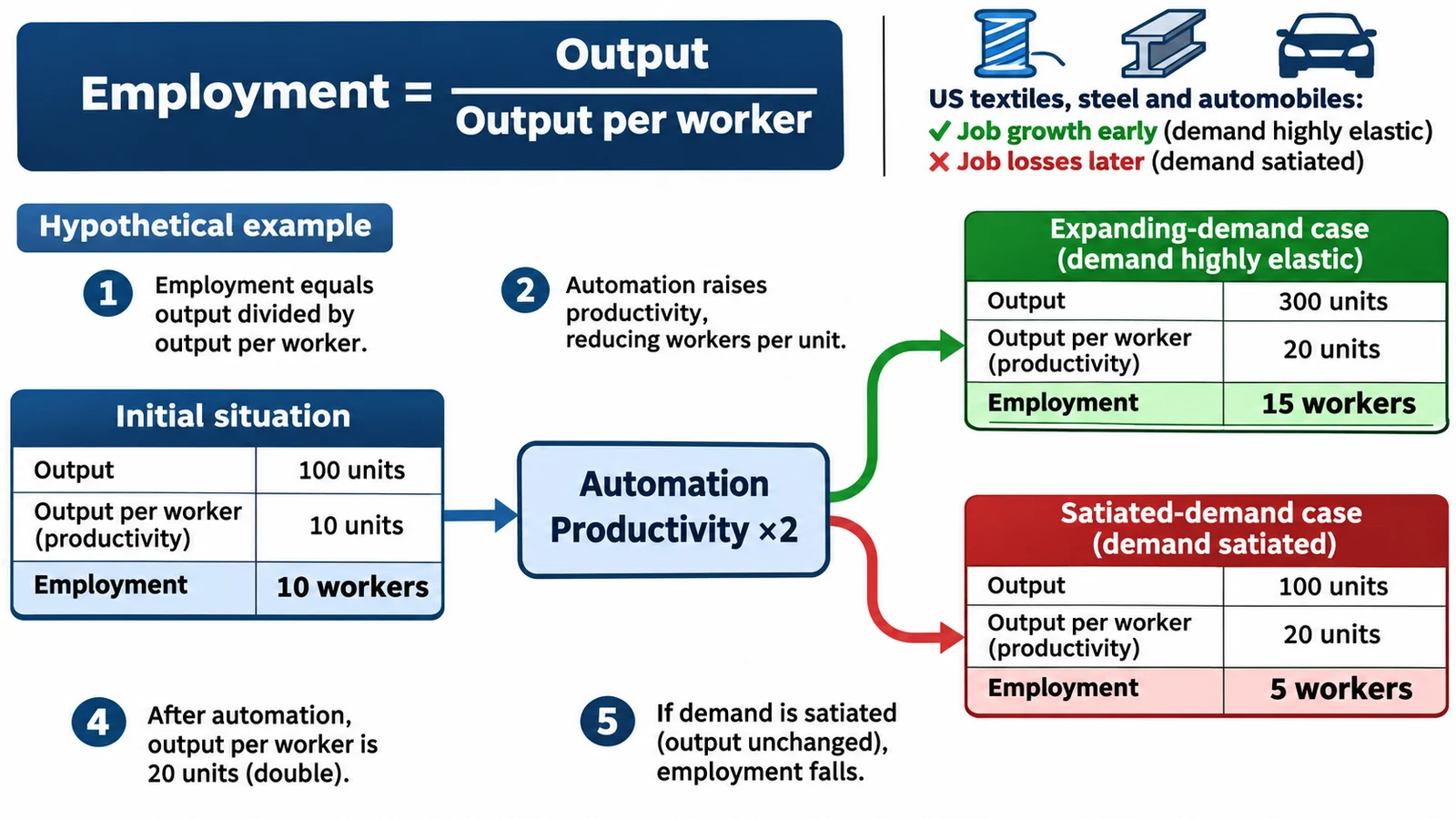
Industry histories show that the same technology can raise employment at one stage and cut it at another. Using two centuries of data on United States textiles, steel and automobiles, a 2019 study found that automation first spurred job growth because demand was highly elastic. Once demand became satiated, further productivity gains brought job losses. The study concludes that automation may not cause mass unemployment, but it may require workers to make disruptive moves to new industries and occupations.[22] A panel study of 14 Mexican states from 2013 to 2022 found that adopting industrial robots correlated positively with employment and salaries in the automotive sector.[20]
Using four decades of harmonized data, one study measured automation as industry-level movements in total factor productivity that are common across countries. Automation displaced employment in the industries where it originated, but indirect gains in customer industries and higher aggregate demand reversed those losses. Labor's share of value added fell in the originating industries, and those losses were not recouped elsewhere.[23]
Models that include this task displacement explain much of the change in education wage differentials between 1980 and 2016. The negative link between wage changes and task displacement held when controls were added for market power, deunionization and other forms of capital deepening. The same analysis finds that large changes in wage inequality can go together with modest productivity gains.[7]
Job polarization appears in sector studies. A 2026 study reports a sharp decline in middle-skilled, routine jobs in the solar power industry of Karnataka, India. Respondents said automation had raised productivity but also raised concerns about job displacement. Mid-skilled workers who lacked technical adaptability were described as facing the greatest difficulties.[24]
Forecasts and short-run studies measure different things. A 2020 study predicts future replacement, while a 2024 study observes freelancer outcomes after generative AI models appeared.[6][25] One estimate puts the number of Chinese workers replaced by artificial intelligence at 278 million by 2049. That is 35.8% of current employment, with a range of 201 to 333 million under different adoption rates. The same study found larger substitution effects on female workers and on older, less educated and lower-income workers.[6]
Evidence from United States online vacancies from 2010 onward shows rapid growth in artificial intelligence-related postings. Establishments that adopted the technology cut hiring in non-AI positions and changed the skills they asked for in remaining postings. At the level of whole occupations and industries, however, these effects on employment and wage growth were too small to be detected.[26] Freelancers on a large online platform in highly affected occupations saw both employment and earnings fall after generative AI models were released. Past service quality did not soften these losses, and top freelancers showed suggestive evidence of being disproportionately affected.[25]
How firms adopt and reorganize work
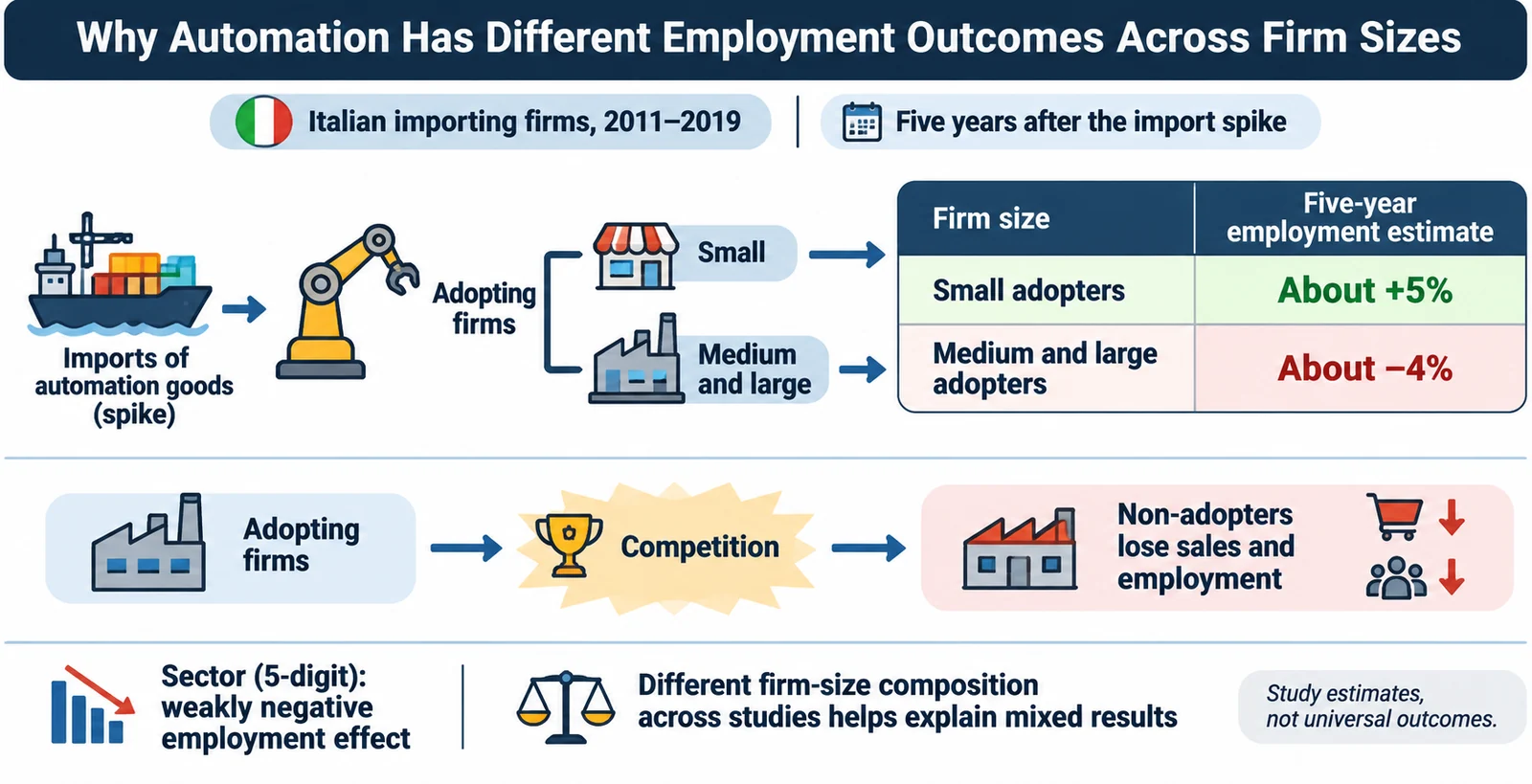
Firms that buy the same automation equipment can end up with different employment outcomes, and firm size is one reason. A study of Italian importing firms from 2011 to 2019 found that adopters of automation goods were on average around 3% larger in employment after a spike in such imports. The effect split by size: small firms were around 5% larger five years after the spike. Medium and large firms instead showed a negative displacement effect, with employment about 4% lower at five years. The study suggests this split may help explain why earlier studies reached mixed results, since those samples had different size distributions. At the level of 5-digit sectors, adopting automation had an overall weak negative effect on aggregate employment. Firms that did not adopt lost sales and employment, a competition effect of other firms' automation.[27]
An earlier study of small and medium Italian firms examined flexible integrated automation, a way of linking machines and software so production can change quickly. The evidence largely confirmed the expected patterns for the first three issues. The evidence on technological unemployment was quite discordant with expectations.[28]
In China since the early 2010s, local states made substituting robots for human workers the center of a development strategy and set statistical targets. Manufacturers saw limits to this substitution, yet most kept overstating what robots could do. Local states rewarded that claim with material and symbolic benefits. Most low-skilled workers backed the state's vision and saw automation as good for national progress, though state policy excluded them most. The result was close cooperation between state and capital that pushed low-skilled workers to the margins.[29]
A 2023 review of the research literature on workers and AI sharing workplaces sorted the evidence into four themes. Workers' distrust of workplace AI stems from seeing it as a threat to their jobs. Workplace AI draws workers into interaction by offering to augment their abilities, meaning to add to what they can do. Coexistence requires technical, human and conceptual skills, and technical skills cannot outweigh the human and conceptual ones. Workers need ongoing reskilling and upskilling, the teaching of new skills and the raising of existing ones, to build a working relationship with AI.[30]
A 2024 ethnographic study, which observes people in their own settings, looked at AI adoption in information technology, education and scientific research. It concluded that knowledge and skill requirements should be studied from several angles, including how a profession changes, not only from the technology side. The study defined a level of upskilling and reskilling importance, and firms can use that level to set strategies and actions.[31] A 2026 qualitative library study, which analyzes published journal sources rather than collecting new data, reported that AI creates new job categories and supports human-AI collaboration. The same study reported job displacement, skill mismatch, inequality and psychosocial pressure alongside those gains. It called for continuous upskilling and reskilling systems supported by organizations and policymakers.[1]
Country and regional labor market patterns
Several national studies combine occupational labor market micro data with measures of exposure to AI and of complementarity with it.[32][33][34] Applied to Denmark, the method suggests most Danes stand to gain from AI adoption. About one fifth of the workforce, however, faces a risk of job displacement. The vulnerable groups named for Denmark include private sector employees, women, and tertiary-educated workers, while men, low-educated people, and immigrants face lower risk because their jobs have low exposure.[32]
Finland shows a similar headline figure, with one-fifth of the workforce at risk of displacement. The groups differ, though: women, highly educated workers and non-immigrants stand to gain the most. In Finland, men, low-educated people, and immigrants may gain less, again mainly because they hold jobs with low exposure.[34] Malta looks somewhat less exposed to AI job displacement than other advanced economies. Women, young people and people whose highest qualification is a high school degree face greater risk.[35]
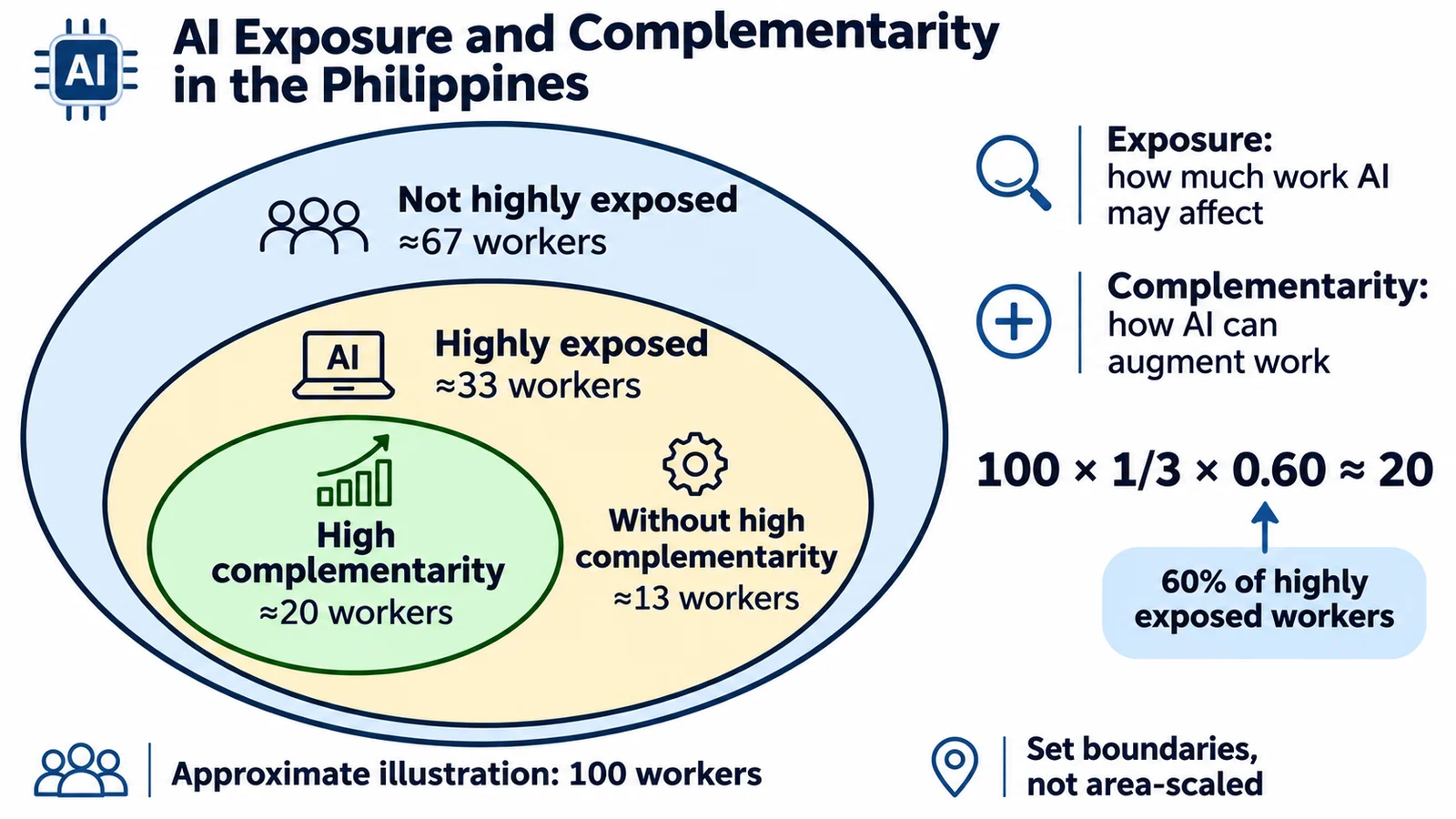
Sweden expects larger potential gains for its workforce than the European Union on average, but the displacement costs are likely to fall unevenly. In Sweden the greatest threat falls on information and communication technology professionals, on less-educated workers, on young people and on immigrants.[36] In the Philippines, about one third of workers are highly exposed to AI. Of those, around sixty percent also score high on complementarity, which points to possible productivity gains. The most exposed workers there are college-educated, young, urban, female and well paid, and they work in services. Business process outsourcing has the highest share of jobs at risk of displacement.[33]
Chilean employers advertising AI-related vacancies seek mainly technical skills, with soft skills such as teamwork playing a supporting role across job types. That demand clusters in high-skilled occupations and specialized professional profiles. The study reads the pattern as consistent with skill-biased and routine-biased technological change.[37]
A separate Chilean study of automation estimated that jobs lost to automation currently match the jobs being created, giving a negligible overall effect on the labor force. The occupations being created there require more highly educated workers, and low-skilled, low-income workers face the highest risk of losing their jobs.[38] Russian evidence comes from 3.5 million vacancies posted by about 35 thousand firms up to the spring of 2022. Where tasks could be done with AI, the data show higher AI-related employment, which implies a substitution effect, but the same tasks also go with higher non-AI employment, which supports productivity effects. The overall employment effect in that Russian sample is positive.[39]
Work on China describes a duality: AI can raise production efficiency and create new jobs, while the spread of intelligent technology also affects some traditional positions.[40] Uzbekistan's labor market in 2024 and 2025 shows a similar duality, with rising demand for IT specialists and digitally skilled workers alongside a shortage of qualified personnel.[41] A review of international evidence read against India argues that the fear of large-scale technological unemployment is exaggerated, and that online work will not by itself create a new era of prosperity. The review adds that new opportunities from digital platforms should be carefully supported through regulation that improves wages and working conditions for online workers.[42]
Skills, well-being and inequality at work
A systematic review of 639 papers published from March 2020 to March 2023 kept 103 articles on workers' professional skills and 35 on their personal well-being. That review found evidence of the ongoing need for upskilling or reskilling as an adaptive response to technological change. It also found that digital skills are widely agreed to matter, yet research on them remains underdeveloped.[43] A 2026 scoping review reports projections that about 60% of workers will need reskilling by 2027. That review names technical skills such as programming alongside soft skills such as adaptability as the growing demands.[44]
A questionnaire study of 482 professionals in information technology, healthcare and finance asked how AI and automation affect employment. About half of those respondents judged existing employment policies inadequate for rapid technological change. Most respondents saw AI and automation as creating new jobs and raising productivity in digitally advanced sectors.[45] Shengelia (2025) describes a gap between what traditional education systems teach and the skills the AI-driven economy needs.[46]
A 2023 review also examined the personal dimension, finding that efforts to counterbalance skill mismatch affected employees' well-being during the pandemic.[43] One review notes that AI can raise organizational efficiency while requiring cultural adjustments to address concerns about displacement. The same review lists skill obsolescence, digital disparities and ethical concerns about AI-driven behavioral modeling as key challenges.[44]
A 2025 review covers four perspectives on AI and workplace inequality: normative, cognitive, structural and relational.[47] A 2024 overview concludes that generative AI can boost productivity and create jobs, but that the benefits will likely be distributed unevenly.[48] A 2025 paper reports that the employment effects are uneven. High-skilled workers gain more than those in low-to-medium-skilled roles, and the gap adds to economic inequality.[46] A 2023 paper adds that most of the progress AI has made relates to highly educated and skilled occupations.[49]
A 2019 paper identifies barriers to measuring AI's effects on work, including poor data on the changing requirements of occupations. It also cites weak models of skill substitution and of how humans and machines work together. The paper calls for better data on workplace skills and for decision frameworks built around resilience to unexpected scenarios.[2]
Evidence on Job Displacement and Creation
The effects of AI on employment are not uniform across all workers.[50][51] A 2026 study on Israel's labor market found that about one-fifth of workers are at high risk of job displacement due to AI, particularly those in roles with low complementarity. In contrast, the same study found that most Israeli workers are expected to benefit from AI adoption through increased productivity and new job opportunities. The study recommended a lifelong learning strategy to help vulnerable workers reskill and adapt to changing job requirements.[50]
AI also has a gendered impact on employment. The 2024 study on China found that AI increased the job share of women and workers in labor-intensive industries. Shen and Zhang (2024) report that the positive effect of AI on employment varies across groups, and that it relatively improves the job share of women and of workers in labour-intensive industries.[51]
AI can also create new roles that did not exist before.[17][52] However, the paper also warned that AI can lead to job displacement and economic inequality if not managed carefully.[52]
Changes in Wages and Inequality
In some cases, AI has increased income for workers in management and skilled technical roles by improving productivity and creating new job opportunities. However, AI can also reduce job stability in lower-skill roles, leading to concerns about long-term employment and emotional exhaustion among affected workers. This emotional strain is linked to resource conservation theory, which explains how job insecurity can drain mental and emotional energy.[53]
AI adoption in China has shown mixed effects on employment, with some studies finding that it increases job numbers rather than reducing them. A study using data from 30 Chinese provinces found that AI technologies like industrial robots led to higher productivity and more specialized job roles. These effects were especially noticeable in labor-intensive industries, where AI helped refine the division of work and improve efficiency.[51]
Chandramohan (2025) examines how AI applications in hospital human resource management can affect workplace diversity along demographic, professional and cognitive lines, and how that in turn bears on the inclusion climate, team functioning and quality of care. The framework proposed by K and Chandramohan (2025) links AI-enabled HR practices to diversity-related processes such as fair hiring and unbiased promotion, and then to the inclusion climate, team functioning and quality of care.[54]
In practice
Firm-Level Adoption and Work Reorganization
Companies are integrating artificial intelligence into their operations, leading to reorganization of tasks, roles, and management structures. In manufacturing, healthcare, and logistics, AI-driven automation is displacing some jobs while creating new roles that require different skills. AI is also changing how managers make decisions, with predictive analytics and data-driven tools becoming central to strategic planning. For example, AI can automate routine tasks like scheduling or inventory tracking, allowing employees to focus on more complex or creative work.[16] However, this shift can cause uncertainty among workers who face unclear roles or fear being replaced by machines.[55]
AI adoption also influences how companies allocate training resources, with a growing emphasis on upskilling high-skilled employees.[56] A 2026 study showed that AI can either boost or reduce employee engagement, depending on how transparent and human-centered its implementation is.[55]
Regional and Country-Specific Labor Market Patterns
In Denmark, AI use is linked to changes in skill requirements, with high-skill jobs often benefiting from AI tools while lower-skill jobs face greater disruption.[57] Portugal’s automotive sector is adopting AI in ways that affect productivity and employment, with automation influencing both the types of jobs available and the skills required.[15] In Israel, the government is considering lifelong learning strategies to help workers at risk of displacement due to AI, emphasizing reskilling and mid-career training.[50] In Iraq, participants in a study noted the need for stronger regulations and ethical guidelines to prevent misuse of AI in corporate governance.[58] Bangladesh’s survey found that AI is already influencing education, healthcare, and production, with future impacts expected to grow as AI becomes more integrated into daily life.[59]
Skills Development and Employee Well-Being
Artificial intelligence is changing the skills required in many jobs, especially those involving tasks that AI can automate or support. Organizations must create training programs that help employees build these skills to stay relevant in the changing job market.[60]
Research suggests that these concerns can lead to emotional exhaustion and reduced well-being, particularly in high-pressure environments. However, when workers perceive AI as an opportunity rather than a threat, they are more likely to adopt a problem-solving approach to manage stress. This positive mindset can improve workplace well-being by encouraging learning and adaptation rather than fear and resistance.[53]
García-Madurga, Gil-Lacruz, Saz-Gil and Gil-Lacruz (2024) list mental health monitoring, emotional support and personalized well-being programs among the workplace well-being applications of AI found in the 31 reviewed articles. These tools can help identify psychosocial risk factors early and provide targeted support to prevent burnout or other mental health issues.[61]
Despite these benefits, AI can also create challenges, such as reducing the need for certain jobs or increasing pressure to keep up with rapid technological change. Workers who feel their jobs are at risk may experience anxiety or job insecurity, which can lower morale and productivity.[62]
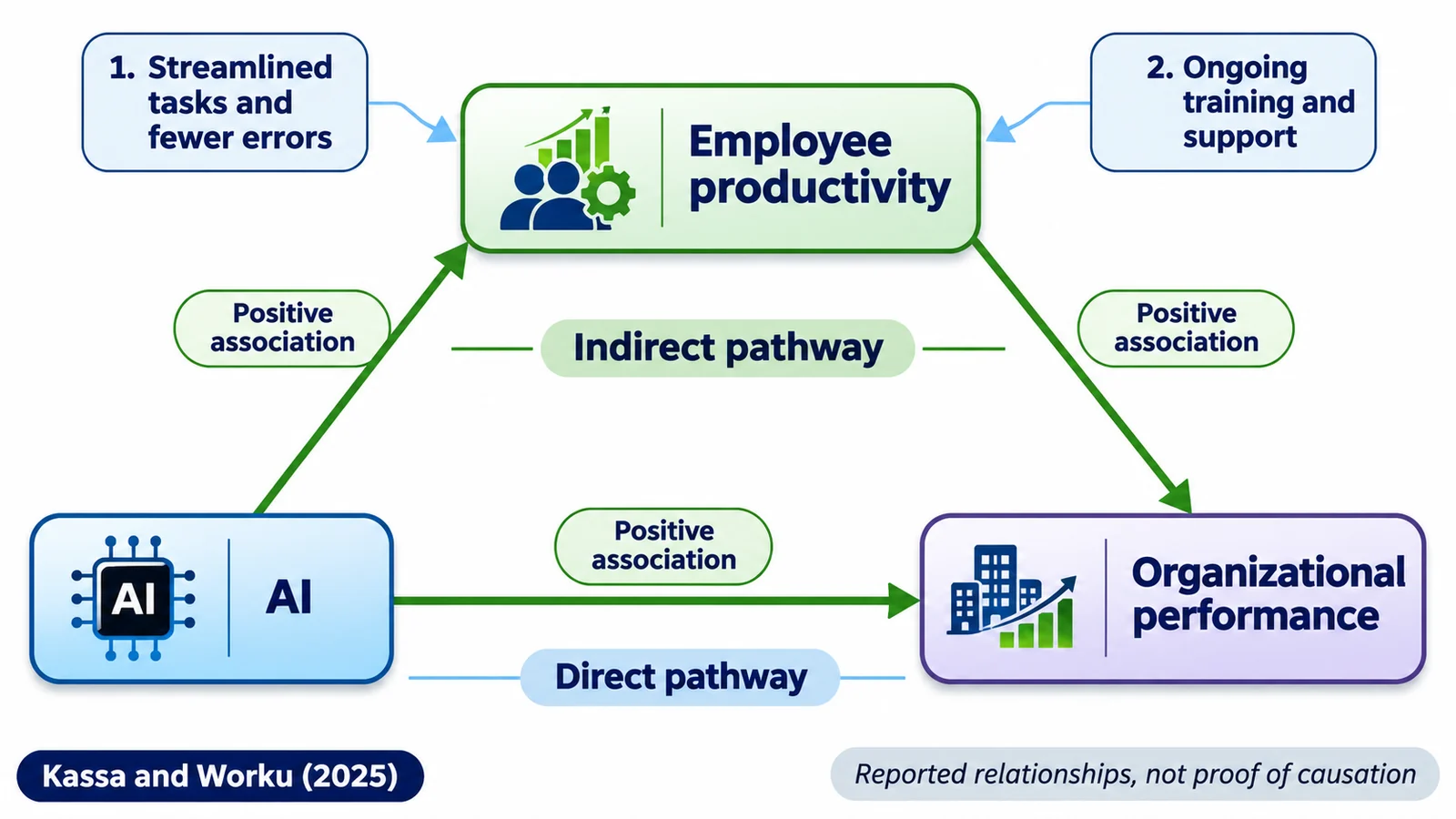
Research also highlights the importance of employee productivity as a key factor in how AI affects organizational performance. Studies show that when AI is implemented effectively, it can boost productivity by streamlining tasks and reducing errors. Kassa and Worku (2025) report positive and significant relationships between AI and employee productivity, between AI and organizational performance, and between employee productivity and organizational performance, with employee productivity acting as a partial mediator. However, the success of AI depends on how well employees can use it, which requires ongoing training and support.[63]
Future research is needed to better understand how AI affects different types of skills and how best to support workers through the transition.[60] Studies should also explore how AI can be used to enhance mental health and well-being while minimizing negative effects like job displacement.[61] By focusing on both skill development and employee well-being, organizations can help workers thrive in an AI-driven world.[60]
What this looks like in practice
An instrumental variables strategy used innovations developed independently of U.S. labor market trends, and automation technology raised local employment, driven by service-sector job growth.[3] A panel of 30 Chinese provinces from 2006 to 2020 used a two-way fixed-effect model and two-stage least squares. Installing industrial robots raised the number of jobs, and the gain was relatively larger for women and for workers in labour-intensive industries.[51]
A survey of 496 employees in AI-vulnerable industries tested how perceived technological threat relates to knowledge hiding. Threat perception was positively associated with hiding knowledge, with workplace anxiety and obsessive passion increasing it and harmonious passion reducing it. Organizational AI readiness strengthened the link between threat and anxiety. If you manage such a team, the authors recommend designing interventions that reduce technological anxiety and build work passion.[64]
A review of 102 publications found the employment effect of automation evaluated at many levels, from global to work activities, with inconsistent and inconclusive results.[4] A review of 31 articles published between 2018 and 2023 catalogued AI uses in workplace well-being, including mental health monitoring, emotional support and personalized well-being programs.[61]
Criticism
Criticisms and open questions
The evidence on automation and employment is often inconsistent and inconclusive, and only a few clear results emerge. A structured review of 102 publications found that studies measure the impact at different levels, from global to the work activity. They also use alternative methods, such as estimating the probability of automation or the net impact on employment. For many of these levels of analysis, the impact of automation technologies remains unclear.[4] A 2018 review reported that increasing automation and robot adoption do not seem to cause job loss in the aggregate. That review also noted that very few studies had detailed data on robot use and employment across sectors.[65]
A 2024 paper notes that findings about ChatGPT's effect on occupations represent potential implications rather than realized labor market effects. One text-mining study estimated that 32.8% of occupations could be fully affected by ChatGPT, 36.5% partly affected and 30.7% unaffected.[5]
A 2018 study finds that mankind faces ordinary structural change rather than the end of work, while a 2023 paper expects AI to replace old jobs with new ones.[66][67] One modeling study joined an economic model of structural change across sectors with labor economics.[66] A separate literature analysis argues that AI will not bring the leisure era described by Keynes.[67] Another paper argues the opposite, that AI has the potential to realize that leisure age.[68]
One study recommends national strategies that join technology with social justice and reskill the workforce, citing technological unemployment, the skills gap and digital inequality as challenges.[69] Another calls for aggressive government policies to address the possible trade-off between automation and unemployment.[68] A qualitative study concludes that investment in education and digital skills, within a broad policy framework, matters for a fair transition.[70] A 2023 paper calls for investment in education and training programs because of the skill changes AI causes.[68]
Ethical and Legal Concerns in AI Use
Artificial intelligence (AI) systems can introduce ethical issues like bias, especially in hiring and workplace monitoring. Algorithmic bias in AI recruitment often results from limited or unrepresentative training data and biased design choices by developers. Such bias can lead to discriminatory outcomes based on factors like gender, race, and personality traits in hiring decisions. To reduce bias, technical solutions such as unbiased dataset frameworks and increased algorithmic transparency are recommended. Organizations are also encouraged to adopt internal ethical governance and external oversight to manage AI-related discrimination risks.[71]
AI systems used in the workplace can also raise privacy concerns, particularly when monitoring employee behavior or performance. Real-time risk monitoring tools powered by AI can improve workplace safety but may also lead to distrust if employees feel their privacy is violated. Lack of transparency in how AI processes data can create ethical dilemmas and reduce employee morale. Transparent implementation practices are necessary to prevent unintended negative effects on workplace cohesion and trust.[72] Legal frameworks must also evolve to address the risks of AI in employment, including discrimination, data protection, and liability for harm.[73]
Current legal protections in some countries, such as Slovenia, do not fully cover the unique challenges of AI in the workplace. Lešnik (2025) finds that none of the legal sources analysed regulate AI use in employment relationships in full, and argues for amending current laws or adopting dedicated legislation so that workers are effectively protected.[73]
Organizations must balance the efficiency gains of AI with the need to maintain employee dignity, psychological well-being, and inclusive workplace cultures. AI can help create safer and more inclusive workplaces when integrated with ethical governance and clear communication about its use.[72]
Criticisms and Open Questions
Criticisms of artificial intelligence (AI) in the workplace include concerns about dehumanization, where AI systems may reduce human interactions to data points, weakening emotional connections and fairness. Practical recommendations include hybrid AI-human models and ethical oversight to prevent AI from eroding employee dignity and psychological well-being.[74]
Workplace surveillance through AI has also raised concerns, with new technologies enabling more intrusive monitoring of employees, including tracking of bodily data and private behaviors. A 2024 study found that connected workplace surveillance extends beyond performance tracking, often blurring the lines between professional and private life. This surveillance can lead to subtle forms of manipulation and coercion, raising ethical issues about consent and autonomy in the workplace. The study proposed a research agenda to explore the behavioral, design, and critical implications of AI surveillance, emphasizing an employee-centered perspective.[75]
AI systems can also provoke anxiety and negative emotional responses among employees, especially when they perceive AI as a threat to their job security or competence. A 2026 study of 496 employees in AI-vulnerable industries found that perceived technological threats increased knowledge hiding behaviors, mediated by workplace anxiety and work passion. Organizational readiness for AI was found to moderate the relationship between technological threats and anxiety, suggesting that preparedness can reduce negative emotional impacts.[64]
Work health and safety (WHS) risks associated with AI include psychosocial stress, privacy violations, and changes in workplace relationships during AI implementation. A 2023 study identified these risks through interviews with 30 experts and 12 organizational representatives, mapping them onto AI ethics principles and implementation stages. The study proposed a matrix of risk-minimization strategies, including systematic risk assessments and ethical oversight, to address WHS concerns at each stage of AI deployment.[76]
Generative AI (GAI) is also reshaping the workplace, with potential to automate tasks traditionally done by white-collar workers, such as writing and data analysis. However, the study warned against concentrating GAI power in the hands of a few large corporations, which could limit innovation and create new forms of inequality. The impact of GAI on higher education and the global workforce is mixed, with students embracing it for reducing rote learning, while educators remain cautious about its long-term effects.[77]
Common misconceptions
A common belief holds that robots crowd out labour jobs, yet a study of 30 Chinese provinces from 2006 to 2020 found that installing industrial robots increased the number of jobs. Higher labour productivity, deeper capital and a finer division of labour offset the damaging effect.[51]
It is often assumed that AI adoption shows up quickly in aggregate employment and wages, but establishment-level vacancy data from 2010 onward found the aggregate effect too small to detect. The visible changes were reduced hiring in non-AI positions and altered skill requirements at AI-exposed establishments.[26]
Key studies
| Year | Study | Sample | Design | Finding |
|---|---|---|---|---|
| 2020 | Zhou et al.[6] | occupations across China | substitution probability estimate | China will have 278 million labors (201 to 333 million under different adoption rates) replaced by AI by 2049, 35.8% of current employment. |
| 2022 | Acemoglu et al.[26] | near universe of U.S. online vacancies from 2010 onward | establishment-level vacancy analysis | AI-exposed establishments cut non-AI hiring and changed skill requirements, but aggregate effects were too small to detect. |
| 2022 | Acemoglu & Restrepo[7] | U.S. wage structure over four decades | task displacement regression analysis | Between 50% and 70% of wage structure changes are accounted for by relative wage declines of routine-task groups. |
| 2023 | Mann & Püttmann[3] | all U.S. patents granted between 1976 and 2014 | instrumental variables study | Automation technology had a positive effect on local employment, driven by service-sector job growth. |
| 2023 | Filippi et al.[4] | structured systematic review of 102 publications on automation and employment | Results are often inconsistent and inconclusive, and the impact is unclear for many levels of analysis. | |
| 2024 | Shen & Zhang[51] | 30 Chinese provinces, 2006 to 2020 | two-way fixed-effect and two-stage least squares panel study | Industrial robots increased the number of jobs, with relatively larger gains for women and labour-intensive industries. |
| 2024 | Hui et al.[25] | freelancers on a large online platform | analysis of outcomes after generative AI releases | Freelancers in highly affected occupations saw reductions in employment and earnings, with top freelancers suggestively hit hardest. |
| 2024 | Huang[21] | U.S. commuting zones, 2010 to 2021 | shift-share analysis | Commuting zones with higher AI adoption saw a stronger decline in the employment-to-population ratio. |
| 2024 | García-Madurga et al.[61] | 31 articles published 2018 to 2023 | systematic review | AI is used in workplace well-being for mental health monitoring, emotional support, personalized programs, risk identification and training. |
| 2024 | Zarifhonarvar[5] | text-mining of the International Standard Occupation Classification | ChatGPT could fully affect 32.8% of occupations and partly affect 36.5%. The remaining 30.7% are likely to remain unaffected. | |
| 2025 | Bisio et al.[27] | the population of Italian importing firms, 2011 to 2019 | difference-in-differences with import data | Adopters were about 3% larger on average; small firms were around 5% larger five years later, while medium and large firms shrank by around 4%. |
| 2025 | Renault[32] | Danish workforce microdata | occupational exposure mapping | Renault (2025) estimates that AI adoption will benefit most Danish workers, while roughly one fifth of the workforce faces a risk of displacement from their jobs. |
| 2025 | Cucio & Hennig[33] | Philippine labor force survey microdata | occupational exposure and complementarity mapping | Cucio and Hennig (2025) estimate that about one third of Philippine workers have high exposure to AI, and about sixty percent of that group also score high on complementarity, which points to possible productivity gains. |
| 2026 | Lin et al.[64] | 496 employees in AI-vulnerable industries | survey with mediation and moderation analysis | Perceived technological threat was positively associated with knowledge hiding, mediated by anxiety and passion. |
See also
References
- Fikri, M., & Eriska, M. (2026). The impact of artificial intelligence in the workplace: Opportunities, challenges, and the redefinition of professional skills. MSJ : Majority Science Journal, 4(1), 82-90. doi:10.61942/msj.v4i1.541
- Frank, M. R., Autor, D., Bessen, J. E., Brynjolfsson, E., Cebrian, M., Deming, D. J., Feldman, M., Groh, M., Lobo, J., Moro, E., Wang, D., Youn, H., & Rahwan, I. (2019). Toward understanding the impact of artificial intelligence on labor. Proceedings of the National Academy of Sciences, 116(14), 6531-6539. doi:10.1073/pnas.1900949116
- Mann, K., & Püttmann, L. (2023). Benign Effects of Automation: New Evidence from Patent Texts. Review of Economics and Statistics, 105(3), 562-579. doi:10.1162/rest_a_01083
- Filippi, E., Bannò, M., & Trento, S. (2023). Automation technologies and their impact on employment: A review, synthesis and future research agenda. Technological Forecasting and Social Change, 191, 122448. doi:10.1016/j.techfore.2023.122448
- Zarifhonarvar, A. (2024). Economics of ChatGPT: a labor market view on the occupational impact of artificial intelligence. Journal of Electronic Business & Digital Economics, 3(2), 100-116. doi:10.1108/jebde-10-2023-0021
- Zhou, G., Chu, G., Li, L., & Meng, L. (2020). The effect of artificial intelligence on China’s labor market. China Economic Journal, 13(1), 24-41. doi:10.1080/17538963.2019.1681201
- Acemoglu, D., & Restrepo, P. (2022). Tasks, Automation, and the Rise in U.S. Wage Inequality. Econometrica, 90(5), 1973-2016. doi:10.3982/ecta19815
- Agrawal, A., Gans, J. S., & Goldfarb, A. (2019). Artificial Intelligence: The Ambiguous Labor Market Impact of Automating Prediction. Journal of Economic Perspectives, 33(2), 31-50. doi:10.1257/jep.33.2.31
- Acemoglu, D., & Restrepo, P. (2019). Automation and New Tasks: How Technology Displaces and Reinstates Labor. Journal of Economic Perspectives, 33(2), 3-30. doi:10.1257/jep.33.2.3
- Restrepo, P. (2024). Automation: Theory, Evidence, and Outlook. Annual Review of Economics, 16(1), 1-25. doi:10.1146/annurev-economics-090523-113355
- Acemoglu, D., & Restrepo, P. (2018). The Race between Man and Machine: Implications of Technology for Growth, Factor Shares, and Employment. American Economic Review, 108(6), 1488-1542. doi:10.1257/aer.20160696
- Acemoglu, D., & Restrepo, P. (2018). Low-Skill and High-Skill Automation. Journal of Human Capital, 12(2), 204-232. doi:10.1086/697242
- Porter, A. L. (1987). A two‐factor model of the effects of office automation on employment. Office Technology and People, 3(1), 57-76. doi:10.1108/eb022642
- Wajcman, J. (2017). Automation: is it really different this time? The British Journal of Sociology, 68(1), 119-127. doi:10.1111/1468-4446.12239
- Boavida, N., & Candeias, M. (2021). Recent Automation Trends in Portugal: Implications on Industrial Productivity and Employment in Automotive Sector. Societies, 11(3), 101. doi:10.3390/soc11030101
- Kumar, S., Das, S., Agrawal, A., & Shaw, D. (2025). AI and Automation: Effects on Employment and Management. International Conference on AI Research, 5(1), 200-207. doi:10.34190/icair.5.1.4387
- Kao, W. (2024). Impaction of Artificial Intelligence on the Labor Market. Advances in Economics, Management and Political Sciences, 84(1), 24-29. doi:10.54254/2754-1169/84/20240772
- Tyson, L. D., & Zysman, J. (2022). Automation, AI & Work. Daedalus, 151(2), 256-271. doi:10.1162/daed_a_01914
- Yu, X., Xu, S., & Ashton, M. (2023). Antecedents and outcomes of artificial intelligence adoption and application in the workplace: the socio-technical system theory perspective. Information Technology & People, 36(1), 454-474. doi:10.1108/itp-04-2021-0254
- Márquez Stone, V., & Sandoval Cabrera, S. V. (2024). Effects of Automation on Mexican Automotive Employment: 2013–2022. The Indian Journal of Labour Economics, 67(3), 661-680. doi:10.1007/s41027-024-00505-5
- Huang, Y. (2024). The Labor Market Impact of Artificial Intelligence: Evidence from US Regions. IMF Working Papers, 2024(199), 1. doi:10.5089/9798400288555.001
- Bessen, J. (2019). Automation and jobs: when technology boosts employment*. Economic Policy, 34(100), 589-626. doi:10.1093/epolic/eiaa001
- Autor, D., Autor, D., Salomons, A., & Salomons, A. (2018). Is Automation Labor Share-Displacing? Productivity Growth, Employment, and the Labor Share. Brookings Papers on Economic Activity, 2018(1), 1-87. doi:10.1353/eca.2018.0000
- Srividya, U., & Gopal Krishna, U. M. (2026). Evaluation of job polarization in the solar power plant sector and automation effects on employment. Discover Sustainability, 7(1). doi:10.1007/s43621-026-03801-w
- Hui, X., Reshef, O., & Zhou, L. (2024). The Short-Term Effects of Generative Artificial Intelligence on Employment: Evidence from an Online Labor Market. Organization Science, 35(6), 1977-1989. doi:10.1287/orsc.2023.18441
- Acemoglu, D., Autor, D., Hazell, J., & Restrepo, P. (2022). Artificial Intelligence and Jobs: Evidence from Online Vacancies. Journal of Labor Economics, 40(S1), S293-S340. doi:10.1086/718327
- Bisio, L., Cuzzola, A., Grazzi, M., & Moschella, D. (2025). The dynamics of automation adoption: Firm-level heterogeneity and aggregate employment effects. European Economic Review, 173, 104943. doi:10.1016/j.euroecorev.2024.104943
- Calabrese, G. (1995). The employment effects of flexible integrated automation in small and medium firms: evidence from the Italian case. Integrated Manufacturing Systems, 6(2), 35-41. doi:10.1108/09576069510082138
- Lei, Y. W. (2022). Upgrading China through Automation: Manufacturers, Workers and the Techno-Developmental State. Work, Employment and Society, 36(6), 1078-1096. doi:10.1177/0950017021999198
- Zirar, A., Ali, S. I., & Islam, N. (2023). Worker and workplace Artificial Intelligence (AI) coexistence: Emerging themes and research agenda. Technovation, 124, 102747. doi:10.1016/j.technovation.2023.102747
- Bucharest University of Economic Studies, Romania and National Institute for Economic Research, Romanian Academy, Bucharest, Romania, Bodea, C. N., Paparic, M., Alma Mater Europaea ECM, Maribor, Slovenia and Calor Gas Ireland, Dublin, Ireland, Mogos, R. I., Bucharest University of Economic Studies, Romania, Dascalu, M. I., & National University of Science and Technology Politehnica Bucharest, Romania (2024). Artificial Intelligence Adoption in the Workplace and Its Impact on the Upskilling and Reskilling Strategies. Amfiteatru Economic, 26(65), 126. doi:10.24818/ea/2024/65/126
- Renault, T. (2025). The Impact of Artificial Intelligence on Denmark’s Labor Market. Selected Issues Papers, 2025(119), 1. doi:10.5089/9798229021647.018
- Cucio, M., & Hennig, T. (2025). Artificial Intelligence and the Philippine Labor Market: Mapping Occupational Exposure and Complementarity. IMF Working Papers, 2025(043), 1. doi:10.5089/9798229001977.001
- Renault, T. (2026). The Impact of Artificial Intelligence on Finland’s Labor Market: Finland. Selected Issues Papers, 2026(003), 1. doi:10.5089/9798229036528.018
- Gade, T. (2025). The Impact of Artificial Intelligence on Malta’s Labor Market. Selected Issues Papers, 2025(008), 1. doi:10.5089/9798229001304.018
- Tang, X. (2026). Labor Market Implications of Artificial Intelligence: Sweden. Selected Issues Papers, 2026(077), 1. doi:10.5089/9798229055857.018
- Guevara-Ramirez, W., Martinez-de-Alegria, I., Caballero-Zepeda, C. G., & Salinas-Astudillo, C. I. (2026). Characterization of the artificial intelligence labor market in Chile: An approach based on unstructured data and the ESCO taxonomy. International Journal of Information Management Data Insights, 6(1), 100401. doi:10.1016/j.jjimei.2026.100401
- Katz, R., Callorda, F., & Jung, J. (2023). The impact of automation on employment and its social implications: evidence from Chile. Economics of Innovation and New Technology, 32(5), 646-662. doi:10.1080/10438599.2021.1991798
- Skorobogatov, A. S., & Sviridov, O. I. (2025). The artificial intelligence impact on Russian labor market. Voprosy Ekonomiki(1), 71-91. doi:10.32609/0042-8736-2025-1-71-91
- Yan, R. (2024). The Impact of Artificial Intelligence on the Labor Market. International Journal of Global Economics and Management, 2(1), 233-238. doi:10.62051/ijgem.v2n1.29
- Rajabovna, A. N. (2026). The Impact of Artificial Intelligence During the Transformation of The Labor Market in Uzbekistan. The American Journal of Management and Economics Innovations, 8(4), 8-13. doi:10.37547/tajmei/volume08issue04-02
- Islam, I. (2018). Automation and the Future of Employment: Implications for India. South Asian Journal of Human Resources Management, 5(2), 234-243. doi:10.1177/2322093718802972
- Cramarenco, R. E., Burcă-Voicu, M. I., & Dabija, D. C. (2023). The impact of artificial intelligence (AI) on employees’ skills and well-being in global labor markets: A systematic review. Oeconomia Copernicana, 14(3), 731-767. doi:10.24136/oc.2023.022
- Bangura, S., & Lourens, M. E. (2026). A Scoping Review of the Future of Work: Effects of Artificial Intelligence Automation and Remote Work on Employment Patterns, Skill Demands, and Organizational Dynamics. International Journal of Management and Data Analytics (IJMADA), 6(1), 46-55. doi:10.68485/ijmada.20266112
- Olaniyi, O. O., Ezeugwa, F. A., Okatta, C. G., Arigbabu, A. S., & Joeaneke, P. C. (2024). Dynamics of the Digital Workforce: Assessing the Interplay and Impact of AI, Automation, and Employment Policies. Archives of Current Research International, 24(5), 124-139. doi:10.9734/acri/2024/v24i5690
- Revaz Shengelia, R. S. (2025). Artificial intelligence and labor market dynamics: Employment problems and development trends. Economics, 107(3-5), 07-13. doi:10.36962/ecs107/3-5/2025-07
- Karunakaran, A., Lebovitz, S., Narayanan, D., & Rahman, H. A. (2025). Artificial Intelligence at Work: An Integrative Perspective on the Impact of AI on Workplace Inequality. Academy of Management Annals, 19(2), 693-735. doi:10.5465/annals.2023.0230
- Capraro, V., Lentsch, A., Acemoglu, D., Akgun, S., Akhmedova, A., Bilancini, E., Bonnefon, J. F., Brañas-Garza, P., Butera, L., Douglas, K. M., Everett, J. A. C., Gigerenzer, G., Greenhow, C., Hashimoto, D. A., Holt-Lunstad, J., Jetten, J., Johnson, S., Kunz, W. H., Longoni, C., & ... Viale, R. (2024). The impact of generative artificial intelligence on socioeconomic inequalities and policy making. PNAS Nexus, 3(6). doi:10.1093/pnasnexus/pgae191
- Lyapin, И. А. (2023). The Impact of Artificial Intelligence on the Workplace: Current State and Future Perspectives. Journal of Digital Economy Research, 1(1), 137-176. doi:10.24833/14511791-2023-1-137-176
- Emeksiz, E. O. (2026). The Impact of Artificial Intelligence on Israel’s Labor Market. Selected Issues Papers, 2026(061), 1. doi:10.5089/9798229052931.018
- Shen, Y., & Zhang, X. (2024). The impact of artificial intelligence on employment: the role of virtual agglomeration. Humanities and Social Sciences Communications, 11(1). doi:10.1057/s41599-024-02647-9
- Bian, Z. (2024). Research on the Impact of Artificial Intelligence on the Labor Market. Highlights in Business, Economics and Management, 24, 1036-1041. doi:10.54097/48ra4c10
- Farzana, R., & Liu, X. (2024). The Impact of Artificial Intelligence Opportunities and the Perceived Risk of Unemployment on Employee Workplace Well-Being. American Journal of Management, 24(4). doi:10.33423/ajm.v24i4.7442
- K, D., & Dr.S.Chandramohan, D. S. C. (2025). The impact of artificial intelligence on workplace diversity in the hospital environment: A conceptual study. JOURNAL OF ADVANCE AND FUTURE RESEARCH, 3(12). doi:10.56975/jaafr.v3i12.502101
- Khan, S., Yadav, K., & Chandravanshi, V. (2026). The Impact of Artificial Intelligence on Employee Engagement and Workplace Productivity. International Journal of Research in Engineering, Science and Management, 9(7), 74-83. doi:10.65138/ijresm.v9i7.3487
- Muehlemann, S. (2025). Artificial intelligence adoption and workplace training. Journal of Economic Behavior & Organization, 238, 107206. doi:10.1016/j.jebo.2025.107206
- Holm, J. R., & Lorenz, E. (2022). The impact of artificial intelligence on skills at work in Denmark. New Technology, Work and Employment, 37(1), 79-101. doi:10.1111/ntwe.12215
- Al-Khafaji, D. A. M. K. (2026). Artificial Intelligence and Its Impact in Iraq. Journal of Economic, Finance Research and Review. doi:10.65150/ep-jefrr/v2e6/2026-05
- Department of Natural Science, Port City International University, Bangladesh., Islam, M. A., Ithmam, S. R., Department of Business Administration, Port City International University, Bangladesh., Islam, M. T., & Department of Business Administration, Port City International University, Bangladesh. (2023). The Impact of Artificial Intelligence on Daily Life and the Workplace: A Qualitative Statistical Survey in Bangladesh. International Journal of Science and Business, 29(1), 140-151. doi:10.58970/ijsb.2239
- Morandini, S., Fraboni, F., De Angelis, M., Puzzo, G., Giusino, D., & Pietrantoni, L. (2023). The Impact of Artificial Intelligence on Workers’ Skills: Upskilling and Reskilling in Organisations. Informing Science: The International Journal of an Emerging Transdiscipline, 26, 039-068. doi:10.28945/5078
- García-Madurga, M. Á., Gil-Lacruz, A. I., Saz-Gil, I., & Gil-Lacruz, M. (2024). The Role of Artificial Intelligence in Improving Workplace Well-Being: A Systematic Review. Businesses, 4(3), 389-410. doi:10.3390/businesses4030024
- El-Helaly, M., El-Sayed Awaad, A., & Elhelaly, A. M. (2026). Artificial intelligence and mental health in the workplace: positive and negative impacts. Archives of Environmental & Occupational Health, 81(3-4), 57-65. doi:10.1080/19338244.2026.2623267
- Kassa, B. Y., & Worku, E. K. (2025). The impact of artificial intelligence on organizational performance: The mediating role of employee productivity. Journal of Open Innovation: Technology, Market, and Complexity, 11(1), 100474. doi:10.1016/j.joitmc.2025.100474
- Lin, L., Lin, K., Chen, Q. Q., & Liu, M. (2026). When artificial intelligence is perceived as a threat: unraveling its paradoxical impact on knowledge hiding in the workplace. Journal of Knowledge Management, 1-18. doi:10.1108/jkm-02-2025-0164
- Ramaswamy, K. V. (2018). Technological Change, Automation and Employment: A Short Review of Theory and Evidence. International Review of Business and Economics, 2(2), 1-27. doi:10.56902/irbe.2018.2.2.1
- Vermeulen, B., Kesselhut, J., Pyka, A., & Saviotti, P. P. (2018). The Impact of Automation on Employment: Just the Usual Structural Change? Sustainability, 10(5), 1661. doi:10.3390/su10051661
- Zhang, X. (2023). Research on the impact of artificial intelligence on the labor market. Advances in Economics and Management Research, 8(1), 252. doi:10.56028/aemr.8.1.252.2023
- Zhou, Q. (2023). Research progress on the impact of artificial intelligence on the labor market. Advances in Economics and Management Research, 8(1), 241. doi:10.56028/aemr.8.1.241.2023
- University of Tikrit / Department of Administrative and Financial Affairs, & Sarhan, W. M. (2025). Artificial Intelligence and Labor Market Transformations. Journal of Economics, Finance And Management Studies, 08(12). doi:10.47191/jefms/v8-i12-12
- COMSATS University Islamabad, Abbottabad Campus, & Qazi, H. (2025). The Impact of Artificial Intelligence on the Labor Market. Advance Social Science Archive Journal, 4(1), 1560-1567. doi:10.55966/assaj.2025.4.1.088
- Chen, Z. (2023). Ethics and discrimination in artificial intelligence-enabled recruitment practices. Humanities and Social Sciences Communications, 10(1). doi:10.1057/s41599-023-02079-x
- Gandía, J. A. G., Ancillo, A. d. L., & del Val Núñez, M. T. (2025). Knowledge and artificial intelligence on employee behaviour advancing safe and respectful workplace. Journal of Innovation & Knowledge, 10(4), 100750. doi:10.1016/j.jik.2025.100750
- Lešnik, A. (2025). Protection of Workers in Relation to the Use of Artificial Intelligence in the Workplace. Lexonomica, 17(1), 79. doi:10.18690/lexonomica.17.1.79-120.2025
- Turkkan Zencirli, B., & Altin, M. (2025). The impact of artificial intelligence on workplace dehumanization: a critical review. Journal of Hospitality and Tourism Horizons, 1(2), 128-149. doi:10.1108/jhth-01-2025-0014
- Mettler, T. (2024). The connected workplace: Characteristics and social consequences of work surveillance in the age of datification, sensorization, and artificial intelligence. Journal of Information Technology, 39(3), 547-567. doi:10.1177/02683962231202535
- Cebulla, A., Szpak, Z., & Knight, G. (2023). Preparing to work with artificial intelligence: assessing WHS when using AI in the workplace. International Journal of Workplace Health Management, 16(4), 294-312. doi:10.1108/ijwhm-09-2022-0141
- Wong, W. K. O. (2024). The sudden disruptive rise of generative artificial intelligence? An evaluation of their impact on higher education and the global workplace. Journal of Open Innovation: Technology, Market, and Complexity, 10(2), 100278. doi:10.1016/j.joitmc.2024.100278
Cite this page: Atlas Nova editors. (2026). Workplace impact of artificial intelligence. Atlas Nova. https://velocer.io/atlas/ai-and-jobs/