

Theory · Learning strategies
Multimedia learning
Multimedia learning theory
Multimedia learning means learning academic material from words and graphics together, not from words alone.[1]
People learn better from words and pictures than from words alone.[2] Students given words and pictures produced over 75% more creative solutions than students given words alone.[3] Adding on-screen text that repeats narration can overload the visual channel and lower test scores.[4] Mayer and Moreno offered theory-based suggestions for reducing cognitive load in five overload scenarios.[5]
Key facts
| d = 1.67 | Median effect size for words plus graphics over words alone, from Mayer (2017).[2] |
|---|---|
| over 75% | More creative solutions from multimedia groups than verbal-only groups, from Mayer (1997).[3] |
| d = 0.47 and 0.70 | Retention advantage for short redundant phrases in diagrams, from Mayer and Johnson (2008).[6] |
| 57 | Independent studies in the verbal redundancy meta-analysis by Adesope and Nesbit (2012).[7] |
Overview
What multimedia learning means
The theory rests on separate channels for verbal and visual information, severely limited processing capacity, and active processing. Active processing means the learner picks out relevant material. The learner then organizes it into clear verbal and visual structures. The learner then links those structures to each other. The learner also links them to knowledge already in long-term memory.[1]
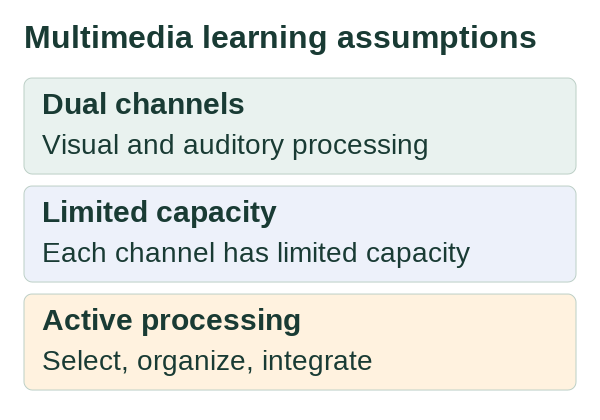
The multimedia principle is one of twelve research-based principles for designing computer-based instructional materials. It holds that people learn better from instruction containing words and graphics rather than words alone. A 2017 review reported a median effect size of d = 1.67 for this principle. It was based on five experimental comparisons.[2] Mayer's 2024 review lists 15 principles of multimedia design. Each is based on evidence.[1]
The multimedia principle sits inside a wider body of research on how people learn from words and pictures. A 2015 commentary on a handbook of multimedia learning judged that the major theories and models guiding this research are well accepted. They rest on classic research on memory. The same commentary said these theories need extending to the affective domain. Researchers note a need to extend learning theories to the affective domain. A 2015 commentary also judged that researchers have found most of the conditions that limit effective learning from basic multimedia materials. Examples are words and pictures that explain an idea. Ayres judged that researchers know far less about complex settings. Examples are games and computer-based tutors. More work is needed to sort out the factors that change results there. Ayres also asked for research that pairs particular instructional strategies with multimedia materials. One example is self-explanations, and the aim is to find which pairing works best.[8]
History
Where the theory came from
Mayer asked how students can be helped to understand cause-and-effect systems. Examples are a pump or a forming lightning storm. One promising answer was to give explanations in both visual and verbal form. One example is an animation with matching narration.[3]
In 2 experiments, students studied an animation of a bicycle tire pump. Others studied an animation of an automobile braking system. Some students saw the animation while a spoken narration of the steps played at the same time. Other students got the two parts one after the other. Some got one part alone, and some got no instruction. On retention tests, every instructed group did better than the control group. The instructed groups did not differ from one another. On problem-solving tests, the concurrent group beat every other group. Pictures and words worked best when they were close together in time or space, the study concluded. Pictures and words are most effective when they occur contiguously in time or space.[9]
A 1997 review of 8 studies found steady evidence for a multimedia effect. On problem-solving transfer tests, students who got explanations in both verbal and visual form produced a median of over 75% more creative solutions. A review of 10 studies found a contiguity effect.[3]
The theory rests on ideas about how memory handles pictures and words. The dual-channel assumption holds that people process pictures and words in separate systems. The limited-capacity assumption holds that each channel can process only a limited amount of material at one time. A learner may plan more mental work than the mind can handle. The result is cognitive overload.[5]
The theory has relatives among other descriptions of memory and thinking. The overview also reported a gap in the models. They leave underspecified how learners integrate multiple codes. In other words, they do not fully say how that joining happens.[10]
Main ideas
Words in the ear or on the screen
The modality principle says learners with little experience understand information better when it is narrated. The same information as on-screen text works less well. The usual explanation is that on-screen text can overload the learner when other visual elements are present at the same time.[11]
In a 1998 study, students watched a computer animation. It showed lightning forming or a car's braking system. It came with either concurrent narration or concurrent on-screen text. Both used the same words and timing. Across both experiments, the narration group did better at recalling the steps, at finding named elements in an illustration and at generating correct solutions to problems.[12]
A 1999 study used an animation of lightning. It tested where on-screen text sits and how it is delivered. Students saw on-screen text near the animation, or on-screen text far from it. A third group heard a narration instead. Students learned better when the visual and verbal materials were physically close. This is the spatial-contiguity effect. Both experiments in that study also found a modality effect: speech beat on-screen text. A second experiment changed when things appeared. Text or narration appeared after or before the animation.[13]
Eye-tracking studies have recorded where learners look. The learners viewed a single slide about how car brakes work. Some participants saw each group of words placed near its matching area of the diagram. Others saw the words as a paragraph or a legend below the diagrams. The integrated groups made significantly more eye movements. They looked back and forth between text and diagram. The effect sizes were d = 1.65, d = 0.85 and d = 1.44 in the three experiments. The effect size was d = 2.02 for corresponding transitions in Experiment 1. It was d = 1.35 in Experiment 3. The integrated groups scored better on transfer tests. It was d = .73 in Experiment 2. Experiment 3 found no such benefit. The researchers concluded that placing words near pictures encourages attempts to connect the two. That can support meaningful learning.[14]
The modality effect has been explained in more than one way. A 2011 paper added a third explanation. One account blames overload of visuospatial working memory. The overload occurs in the visual text condition. A second account holds that only spoken text and pictures can be attended to at the same moment. So it applies only when both are shown at the same time. In it, part of the effect comes from early sensory processes. It does not come from a working memory bottleneck. Two experiments found an advantage for auditory texts. It was limited to the most recent text information. It appeared under all presentation conditions. For picture recognition, the modality effect appeared only in one case. Text and pictures had to be shown at the same time.[15]
For them, the modality principle was not an effective strategy. Students who saw only on-screen text showed better retention and transfer. They did better than students who viewed the narrated presentation.[11]
When extra words and sounds hurt
In 4 experiments, college students watched an animation about lightning. A voice explained it at the same time. Some students also saw on-screen text that summed up or copied the narration. These students scored worse on tests of retention and transfer. Students who saw no on-screen text did better. Learners must divide their visual attention between the animation and the text, which can overload the visual channel.[4]
A meta-analysis by Adesope and Nesbit pooled data from 57 independent studies. Most of the students were in postsecondary education. It compared spoken-only, written-only and spoken-written presentations. Some students learned from spoken and written presentations. They did better than students who learned from spoken-only presentations. That advantage appeared for learners with low prior knowledge. It also appeared for materials the system paced. It appeared for materials without pictures too. Some presentations showed key terms taken from the narration. These led to better learning than presentations that showed the spoken words word for word.[7] A 2008 study found that short printed phrases next to the matching part of a diagram raised retention scores. The effect sizes were d = 0.47 and 0.70 in two experiments, and transfer scores did not rise.[6]
A 2013 study tested how closely on-screen text should match the narration. College students watched an animated lesson with narration. It was about the life cycle of a star. Each student saw a different degree of match between text and speech. Text that matched the narration word for word hurt learning in both experiments. A small amount of difference between the text and the narration helped. But too much difference hurt as much as an exact copy. Students liked the identical text better. Yet the slightly different wording led to better recall and transfer.[16]
A 2023 review looked at 63 studies. It sorted redundancy into two types. Content redundancy means the same information appears twice. Processing it twice strains limited mental capacity. Working memory channel redundancy means the visual and verbal channels are combined badly. This then overloads the limited capacity of working memory. The review found positive effects of content redundancy. Learners' prior knowledge shaped those effects. Working memory channel redundancy had negative effects regarding visualizations and written text. This happened when written text was added to visualizations.[17]
Interesting but irrelevant material can also lower learning. This result is called the coherence effect. In the 2001 lightning experiments, the narration added interesting but irrelevant details. This lowered transfer performance. Some presentations added interesting but unrelated video clips. These clips, within or before the presentation, also lowered transfer. The seductive details hypothesis explains this result. The added material primes inappropriate prior knowledge as the schema, or organizing framework, for the lesson.[4]
In one experiment, 78 middle school students in China were randomly assigned to study material. The material was about the economy of a U.S. state. One condition involved learning materials with no seductive details. Other conditions included seductive details at the beginning or at the end. One test measured free recall. The group without seductive details recalled significantly more main ideas than either other group. The beginning group and the end group did not differ significantly from each other. Wang and Adesope read the results as showing that interesting extras distract the reader. The distraction then gets in the way of learning.[18]
In 2 studies, students watched an animation with narration explaining lightning formation or hydraulic braking systems. For some students, the researchers added background music or sounds to the same lesson.[19] A 2007 set of experiments extended this idea to extra explanations rather than extra sounds. Students who studied a hydraulic brake lesson along with lessons on caliper brakes and air brakes did worse on retention and transfer tests about hydraulic brakes. Across the combined experiments, the drops were d = 0.37 for retention and d = 0.30 for transfer. The effect was statistically significant in Experiment 1 (d = 0.57 and 0.53) but not in Experiment 2 (d = 0.23 and 0.17).[20]
In 3 studies, students received a narrated explanation of lightning formation, sometimes with matching on-screen text. Students understood the explanation better when the words came both as speech and as text, but only when no other visual material appeared at the same time.[21] A later study compared a redundant presentation, with narration plus word-for-word on-screen text, against two leaner versions. The leaner presentations, narration with images and minimal text or narration with minimal text, produced the highest scores on a final comprehension test. The redundant presentation still earned the highest ratings for perceived understanding and engagement. Learners misjudge the benefits of redundant text, even after seeing a leaner presentation that worked better.[22]
The redundancy results depended on whether other visual material was on screen at the same time.[21] The interference from related examples was significant in one experiment and not the other. Students also performed similarly whether the lesson used narrated animation or annotated illustrations.[20]
Guiding attention with signals and cues
Cues in a single channel do not always improve learning. This holds for visual cues and for auditory cues. Coordinated dual cues spoke key elements with deeper intonation while the element turned red in the graphic. In Experiment 1, coordinated cues also beat a visual cue alone. They beat an auditory cue alone too. They also beat cues that were not synchronized in Experiment 3.[23]
In Experiments 1 and 2, students with a gesturing agent added to the screen scored higher on transfer. The effect sizes were ds = 0.77 and 0.80. They also scored higher on retention (ds = 1.16 and 1.00). In Experiments 2 and 3, a gesturing agent beat a still agent on transfer tests (ds = 0.72 and 1.02). It also beat it on retention (ds = 0.96 and 0.93). Adding a still agent to the screen did not improve performance in Experiment 2.[24]
Some gestures guide attention better than others. College students learned about neural transmission from an online lesson. Its agent displayed one of four kinds of gesture. These were specific pointing, general pointing, nonpointing, or no gestures. Specific pointing means pointing to the exact diagram part that the narration mentions. The specific pointing group also did better than the other groups. This held on retention tests and on transfer tests.[25]
One study put 77 participants into one of three presentations at random. They had no guiding gestures. Gestures that pointed to the elements being discussed improved retention. So did gestures made close to those elements. These findings provide partial support for applying the spatial contiguity principle to virtual humans.[26]
Some versions added signals: a preview paragraph summarizing the 3 main steps in lift, headings for each section, and cue words such as because or as a result. The signals added no new content about lift and only clarified the structure of the passage. Students who received the signals produced significantly more solutions on a transfer test, which asked them to solve 5 new problems such as designing a plane that lifts more rapidly. This held when the explanation was printed text, spoken text, and spoken text with a matching animation.[27]
A classroom study tested this with 111 second-year education students in Belgium, aged 19 to 25, who studied a web-based lesson on instructional design for about one hour. Adding visual cues to the pictures raised retention scores, but the cueing effect was weak overall. The same study found that replacing visual text with spoken text lowered both retention and transfer scores, a reverse of the usual modality effect. One proposed explanation is that the lesson was paced by the learner rather than by the system, unlike earlier laboratory studies.[28]
Integrated formats were more effective than separated formats for retaining textual information. In one study, 3 groups of students viewed illustrated texts on how the heart works and how the AIDS virus replicates. The pop-up group also did better than the plain integrated groups at remembering the pictured information and at finding correct solutions to problems.[29]
Pointing can be done by the learner's own hand. A 2025 study asked 84 native Chinese-speaking adults to learn how the human heart is built and how it works, using paper materials. Those randomly assigned to trace and point with the index finger scored higher on a comprehension test than those who did not. Participants who traced and pointed reported lower extraneous load. The result repeats earlier findings with Western samples and extends them to instruction given in Chinese.[30]
Pacing, segments and working memory
A 2015 experiment had 212 undergraduate students study a 9-minute multimedia tutorial on historical inquiry. It was split into 1, 7, 14 or 28 segments, each begun with a Continue button. More segments improved recall and application. This held whatever the learner's attitude toward the segmentation. Students still rated the finest version, at 28 segments, more negatively than the others.[31]
A 2020 attempt to repeat the segmentation advantage failed. It used health materials about kidney function. That study found no gain in transfer of information for segmented over continuous presentation. It also found no drop in perceived cognitive load.[32]
A 2009 study took 66 students with low working memory capacity and 67 with high capacity. Each was randomly assigned to a segmented or a non-segmented multimedia tutorial on historical inquiry. Capacity had a significant positive effect on recall scores. Segmentation helped explain that effect. Learners with lower capacity recalled and applied as much as those with higher capacity.[33]
Most reviewed studies did not include clear conceptualization or measurement of working memory. Most studies measured working memory poorly. Some did not measure it at all. Most used only general self-report measures. These had one item or very few items. Their results did not match the expected link between cognitive load and learning.[34]
Two pilot experiments used dual-task methods. They found that text and pictures shown as sound and image produced less cognitive load. The same material shown as images only produced more.[35] A 2023 study recorded eye movements and multichannel electroencephalography from 20 university students. The students worked in multimedia environments. Retention performance was also negatively related to self-reported measurements.[36]
In a 2024 experiment, teenage students at two language schools in Zhengzhou were randomly assigned to six groups. The study used a 2 × 3 design that crossed segmentation with textual augmentation. High segmentation lowered cognitive load and improved vocabulary learning, retention and reading comprehension.[37]
A 2022 meta-analysis searched 12 academic databases and found 7 qualifying manuscripts, giving 18 independent effect size comparisons. At playback speeds of 1.4 to 1.5 times normal, the overall effect was small and significant at g = −0.212, with a 95% confidence interval from −0.378 to −0.045. At 1.8 to 2.0 times normal, the effect was small and non-significant at g = −0.362, with a 95% confidence interval from −0.743 to 0.019. The analysis framed these results as an accelerated playback hypothesis: outcomes hold up until a threshold is reached.[38]
Learners who need different designs
Students with learning disabilities often take in information differently. They also hold it in working memory differently. Their ways can differ from those of typically developing students. A 2013 review argued that design rules built on typical learners may not fit these students. The review looked at five design principles. They came from cognitive load theory and from a model of working memory. They included the redundancy effect and the modality effect.[44]
A 2018 study compared 26 children with dyslexia, aged 11, with 38 typical readers. Both groups used multimedia lessons at their own pace. Lessons appeared in three forms. These were pictures with written text, pictures with audio, and pictures with both text and audio. Children with dyslexia spent more study time with written text. They spent less time with audio or with text and audio combined. Knowledge gain showed no effects of modality or redundancy. Working memory did not change the pattern. The study concluded that audio support is the more efficient format for these children.[45]
The multimedia format was an animation with narration. In both age groups it produced less cognitive load. Performance was equal or better than with the other formats.[46] A 2022 analysis of the evidence for video design for the elderly recommended including only material tied to the key learning goal, highlighting important information, and breaking longer videos into meaningful parts. That analysis also called for more study of redundancy in videos for the elderly. Such study should keep their specific needs in mind.[47]
Non-native English speakers learned from computer-based lessons presented in English. One 2014 experiment used a slow 16-minute narration about Antarctica. A video of the scenes and animals described was added. It improved comprehension for non-native English speakers (d = 0.63). In a second experiment, on-screen captions did not improve comprehension. Experiment 2 used a fast-paced 9-minute narrated video about chemical reactions. The researchers suggested that learners had no spare capacity to use the captions.[48]
Two experiments examined international university students with a sample size of 61. Their mean age was 21.2 years. More images helped learning of content with audio and pictures. They did not help audio-only content. Lower English skill and weaker attention predicted poorer recall. This was especially true when visual load was higher.[49]
How the mind handles words and pictures
In one 2006 study, people learned assembly procedures. They did tasks that kept parts of working memory busy at the same time. Different instruction formats drew on different working memory subsystems. Brunyé, Taylor, Rapp and Spiro (2006) reported this. Even so, participants often misremembered multimedia presentations as picture-based ones.[50]
Brünken, Plass and Leutner (2003) note that cognitive load is usually measured with indirect methods. These methods are subjective, or both.[51] A 2022 meta-analysis looked at four common load questionnaires. It found their internal consistency satisfactory. Correlations among the three load types partly contradicted theory-based assumptions. Correlations with learning outcomes supported them.[52]
Yu, Tian, Wang and Nie (2024) describe event-related potentials as potential changes linked to specific events or stimuli. They are recorded from the electroencephalogram. A 2024 meta-analysis of 17 experimental studies found high effect sizes for two such components, P300 and P200.[53]
Van Genuchten, van Hooijdonk, Schüler and Scheiter (2014) suggest that pictures in learning-how tasks may reduce the mental effort needed to understand the material. A spatial dual task interfered more with learning from text alone. It interfered less with learning from multimedia. Pictures may help because they spare learners the work of forming mental images.[54] A 2003 paper described a dual-task method. It measures load directly and objectively rather than by indirect or subjective reports.[51]
At a single UK medical school, students were exposed to text-heavy slides, defined as more than 10 words, 84.4% of the time. The slide sets in that study had a median total of 1531 words, with a mean of 38.3 words on each slide. The researchers concluded that slide design consistently violated the theory's principles and that lecturers should receive training in them.[55]
Common misconceptions
A survey of 2,247 upper secondary teachers examined how far their multimedia materials matched established design principles. About one in three teachers followed every principle in full. A further third followed all of them except coherence. How often teachers created multimedia documents was predicted by their beliefs about technology and their self-reported skills. Of the multimedia principles, only the dual coding assumption also had a significant positive effect.[56]
Research
How large the picture advantage is
A 1994 study by Mayer and Sims tested this. Students saw a computer animation. It showed a bicycle tire pump or the human breathing system. They solved more creative transfer problems than students who heard it afterward. That timing advantage was strong for students with high spatial ability. It was not strong for students with low spatial ability. Learners with high spatial ability can spend more mental effort linking the two representations. Low-spatial learners must spend more effort just forming the visual one.[57]
A picture can help even when it is seen only briefly before the text. In a 2013 experiment, 114 participants learned how a pulley system is built and works. They were in one of six conditions. The conditions were text only. In others, a picture appeared for 150 milliseconds, 600 milliseconds or 2 seconds. They also included a self-paced picture before the text. Self-paced pictures improved recall and comprehension. This held whether they came before or alongside the text. They also sped up reading compared with text alone. Even 600 milliseconds or 2 seconds of looking at the picture improved understanding. It also made later text about the system's spatial structure faster to read.[58]
Prior knowledge is a learner characteristic that impacts cognitive processes in multimedia learning. A 2013 paper summed up three experiments run from 2006 to 2010. Their multimedia results differed from earlier findings. The paper named prior knowledge as a student trait. It may explain why learners gain differently from multimedia. It also named affection, metacognition and cognitive synergy.[59]
Teachers, videos and open questions
A review looked at 860 medical animations from 20 developers. It found that many did not follow the recommended multimedia learning principles.[60] A design review looked at 78 videos. Secondary school teachers used them in science and history classes. It found a mixed picture. Most multimedia design principles were present. Some were broken or missing. The principles fell into three groups by how they affect cognitive load. The groups were rarely all present in the same video.[61]
A survey asked 2247 upper secondary school teachers a question. What predicted how often they make digital multimedia documents? Teachers who believed in technology, knew technology and knew how to teach with digital tools made multimedia documents more often. All three beliefs predicted this significantly and positively. The researchers concluded that teachers now rely more on those beliefs and self-ratings. They rely less on multimedia design guidelines.[56]
A questionnaire went to 311 people: 176 teachers and 135 student teachers. It measured four common wrong ideas. Naïve summation is the belief that more sensory channels always make instruction work better.[62]
One experiment tested refutation texts with 96 student teachers. Prinz et al. (2022) used refutation texts to correct student teachers' misconceptions about multimedia learning. Texts that corrected false beliefs worked better than standard texts. Adding two-sided argumentation that conceded points to prior beliefs brought no extra benefit. Correcting the beliefs did not lead student teachers to choose more appropriate multimedia material.[63]
The multimedia principles rubric (MPR) rests on 16 principles. They come from Mayer's cognitive theory of multimedia learning. Raters score descriptive items on a 5-point Likert scale. The scores give one overall mean cognitive value score. Several raters tested it on 90 sample physics videos chosen by cluster sampling. The rubric is meant to help teachers filter videos by design. It does not rely on statistical indicators alone.[64]
One is whether harder-to-read text helps, an idea called disfluency. Across four experiments, 308 students learned from text and pictures. The text was either easy or hard to read. Hard-to-read text raised transfer test scores in Experiment 1. It also raised mental effort. The effect did not appear in Experiments 2, 3 and 4. The researchers left open how stable the disfluency effect is.[65]
What the reviews find across many studies
The largest summary of this research pooled 29 reviews. Together they covered 1,189 studies and 78,177 participants. That overview of reviews found 11 design principles with significant positive effects on learning. It found five that significantly improved the management of cognitive load. The largest benefits came from captioning second-language videos, temporal and spatial contiguity, and signaling. The same review found solid evidence for modality, animation, coherence, anthropomorphics, segmentation, personalization, pedagogical agents, and verbal redundancy effects. Good design mattered more for complex materials. It also mattered more in system-paced settings such as lectures than in self-paced ones such as websites.[66]
A second-order meta-analysis combines the results of earlier meta-analyses. Sun et al. (2025) found a small positive effect of multimedia-based education on learning outcomes. The review covered 14 first-order meta-analyses. Multimedia-based education showed a small positive significant effect on cognitive and affective learning outcomes. The teaching setting changed this effect. The estimate for P-12 settings was smaller than the estimate for higher education. The kinds of multimedia elements used, the subject taught, and the type of publication did not significantly moderate the effect.[67]
Çeken (2022) reports that studies of multimedia learning principles in augmented reality and virtual reality environments are limited.[68] Krüger and Bodemer (2022) reported few significant effects for spatial contiguity and coherence in augmented reality studies. The first had 80 participants and the second had 130.[69] A 2025 experiment with 383 university students found that augmented reality improved retention for cell structure. It had no notable effect for lightning formation.[70] A 2026 perspective article argues that these principles cannot be moved directly into extended reality, a term covering virtual and augmented settings, without reinterpretation.[71]
In practice
Testing yourself and explaining what you learned
Johnson and Mayer (2009) define a testing effect. Learners do better on a retention test after studying and taking a practice-retention test than after studying twice. The students then restudied the material. Others took a practice test on memory, or a practice test on transfer. The practice-retention group beat the restudy group on a delayed retention test. Each practice test helped most on the kind of test it looked like. Practice-retention won on retention, and practice-transfer won on transfer.[72]
Writing a summary helped students in one study, but drawing did not. They then summarized, drew, did both, or did neither. Summarizers scored higher than students with no activity. The effect was d = 0.48 when tested immediately and d = 0.54 after a one-week delay. Drawing made no significant difference from doing nothing. Drawing plus summarizing did no better than summarizing alone. The students in Lawson and Mayer (2024) had no prior training in summarizing or drawing.[73]
Making a teaching video worked better than several other ways of explaining. College students who made a video outperformed three other groups. Those groups restudied, explained aloud to themselves, or taught a student face-to-face or online. The quality of the teaching was also better in the video condition. The researchers suggest that video teaching prompts learners to build connections. It also keeps unrelated mental work low.[74]
Self-regulated learning means defining tasks, making plans, choosing and monitoring strategies, and reflecting on outcomes. It takes effort. Good computer-based lessons can free mental resources. Students can then use those resources to manage their own learning.[75]
Applying the principles in real courses
Issa and colleagues (2011) tested Mayer's design principles with Year 3 medical students. The students were in their surgery clerkship in 2009 and 2010. Students who saw a lecture on shock with slides revised to follow Mayer's principles (n = 91) improved more on short-term retention and total scores. Students who saw the same lecture with traditional slides (n = 39) improved less. Both groups started with similar knowledge before the lecture. Issa and colleagues (2011) call for more research on long-term learning.[76]
Slide design has drawn attention in psychology teaching as well, because slides built on software defaults often break multimedia principles.[77] A 2022 eye-tracking study compared presentation slides with teleprompter slides. It found more eye fixations on the teleprompter version. Slides that included images were rated as more pleasurable to learn from. Visually based slides were also linked to more reflective learning and more active information processing.[78]
Cavanagh and Kiersch (2023) showed how to use the principles in online lessons. Commonly available technologies can put them into practice. Slide-sharing programs can build short narrated animation segments. Survey programs can insert questions and prompts between segments. Video-sharing sites can give learners control over minor features of the lesson.[79] Artman (2020) offered a parallel guide for instructional video. It applies the ADDIE model, a step-by-step planning process that starts with learning objectives and then builds content.[80]
A survey of 524 students at two universities in Iran asked how well instructors applied seven of Mayer's principles in electronic courses during the COVID-19 pandemic. Keshavarz, Fallahnia and Hamdi (2022) found that the modality principle ranked first in importance. The coherence principle ranked last. The two universities differed significantly on multimedia, contiguity, modality, redundancy and personalization. They did not differ on coherence, segmenting and pretraining.[81] Garner and Alley (2011) note that common PowerPoint slides violate multimedia learning principles.[77]
What this looks like when you study
Johnson and Mayer (2009) had 282 people view a narrated animation on how lightning forms, after which each person was assigned to one of three conditions. One group watched the presentation a second time. A second group took a practice test on the facts, and a third took a practice test that asked them to use the ideas in new ways. On a later retention test, the group that had practiced the facts beat the group that had only watched again. On a later test of transfer, which asks learners to use the material in new situations, the group that had practiced transfer beat the restudy group.[72]
In another study, students watched four short animations about greenhouse gases, each with a short caption, and paused between them. During the pauses, some students wrote a summary, some made a drawing, some did both, and a control group did nothing. Students who wrote summaries scored higher on the posttest than the control group, with effect sizes of 0.48 and 0.54 in the two experiments. Students who drew pictures did not score significantly higher than the control group.[73]
In a study of learning by teaching, students received a multimedia lesson together with instructions to explain it in one of several ways. Making a video explanation worked better than restudying, better than explaining aloud to oneself, and better than teaching face to face or online. The authors suggest that making a video primes generative processing, the mental work of building connections, while keeping extra demands low.[74]
A rubric with 16 items based on the theory was tested on 90 physics videos and showed good agreement between raters. The rubric lets a teacher score a video on coherence, signaling, redundancy, segmenting and other principles rather than relying only on video ratings or number of views.[64] A review of 78 videos that secondary teachers screened in class found that teachers often added principles themselves. They introduced new words before screening, paused the video, and asked students to complete a task during or right after it.[61]
When a narrated animation pauses between segments, writing a short summary of the main idea in your own words can help.[73] After studying, taking a practice test that asks you to use the ideas in new ways can improve later transfer.[72] If you want to teach the material, making a short video explanation can work better than restudying or explaining to yourself.[74] An instructional video can be checked against a short list of design principles, such as whether key parts are signaled and whether on-screen text repeats the narration.[64]
Key studies
| Year | Study | Sample | Design | Finding |
|---|---|---|---|---|
| 1997 | Mayer[3] | review of experiments | Students given coordinated verbal and visual explanations generated a median of over 75% more creative solutions on transfer tests than students given words alone. | |
| 1999 | Moreno & Mayer[13] | experiment with animation and narration or on-screen text | Students learned better when verbal input was spoken as narration rather than shown as on-screen text, and better when visual and verbal materials were physically close. | |
| 2001 | Mayer et al.[4] | college students in four experiments | experiment with narrated animation about lightning | Adding on-screen text that summarized or duplicated the narration lowered retention and transfer scores, and adding interesting but irrelevant details also lowered transfer. |
| 2001 | Mautone & Mayer[27] | 3 experiments with students viewing a lesson on airplane lift, with and without signals. | Signaling (preview summary, headings, pointer words) led to significantly more transfer solutions when text was printed, spoken, or spoken with animation. | |
| 2008 | Mayer & Johnson[6] | College students | 2 experiments with college students viewing 16 or 8 narrated slides on lightning or car brakes. | Short redundant phrases within the diagram improved retention (d = 0.47 and 0.70) but not transfer. |
| 2009 | Johnson & Mayer[72] | 282 participants | experiment with restudy, practice-retention test, or practice-transfer test | The practice-retention group beat the restudy group on delayed retention, and the practice-transfer group beat the restudy group on delayed transfer. |
| 2011 | Issa et al.[76] | Year 3 medical students (n = 91 in modified-design group; n = 39 in traditional-design group) | pre-test/post-test control group study | Students taught with slides modified according to multimedia design principles showed greater improvements in retention and total scores than students taught with traditional slides. |
| 2012 | Johnson & Mayer[14] | eye-movement study of a slide about car brakes | Integrated presentations produced more eye movements between text and diagram (d = 1.65 in Experiment 1, d = 0.85 in Experiment 2, d = 1.44 in Experiment 3). The same groups also scored higher on transfer tests in Experiments 1 and 2 (d = .80 and d = .73). | |
| 2014 | Wang & Adesope[18] | 78 middle school students in China | experiment with seductive details at the beginning, at the end, or absent | The no-seductive-details group recalled more main ideas (mean 4.48) than the seductive-details-first group (1.20) or the seductive-details-after group (1.31). |
| 2018 | Wang et al.[24] | college students | eye-tracking experiment with animated pedagogical agents | In Experiments 1 and 2, students with a gesturing agent scored higher on transfer (ds = 0.77 and 0.80) and retention (ds = 1.16 and 1.00) than students without one. In Experiments 2 and 3, they outperformed students with a static agent on transfer (ds = 0.72 and 1.02) and retention (ds = 0.96 and 0.93). |
| 2019 | Xie et al.[23] | eye-tracking experiment with cueing conditions | Coordinated visual and auditory cues led to more time on the relevant part of the graphic and better posttest scores than single or mismatched cues. | |
| 2022 | Noetel et al.[66] | 29 reviews including 1,189 studies and 78,177 participants | overview of reviews with meta-meta-analysis | Eleven design principles had significant positive effects on learning, with the largest benefits for captioning second-language videos, contiguity, and signaling. |
| 2023 | Cheng et al.[74] | college students | experiment comparing forms of learning by teaching | Making a video explanation worked better than restudying, self-explaining, or teaching face to face or online. |
| 2024 | Lawson & Mayer[73] | experiment with summaries, drawings, or both during pauses | Students who wrote summaries scored higher on the posttest than controls (d = 0.48 and 0.54), while students who drew pictures did not. |
See also
References
- Mayer, R. E. (2024). The Past, Present, and Future of the Cognitive Theory of Multimedia Learning. Educational Psychology Review, 36(1). doi:10.1007/s10648-023-09842-1
- Mayer, R. E. (2017). Using multimedia for e‐learning. Journal of Computer Assisted Learning, 33(5), 403-423. doi:10.1111/jcal.12197
- Mayer, R. E. (1997). Multimedia learning: Are we asking the right questions? Educational Psychologist, 32(1), 1-19. doi:10.1207/s15326985ep3201_1
- Mayer, R. E., Heiser, J., & Lonn, S. (2001). Cognitive constraints on multimedia learning: When presenting more material results in less understanding. Journal of Educational Psychology, 93(1), 187-198. doi:10.1037/0022-0663.93.1.187
- Mayer, R. E., & Moreno, R. (2003). Nine Ways to Reduce Cognitive Load in Multimedia Learning. Educational Psychologist, 38(1), 43-52. doi:10.1207/s15326985ep3801_6
- Mayer, R. E., & Johnson, C. I. (2008). Revising the redundancy principle in multimedia learning. Journal of Educational Psychology, 100(2), 380-386. doi:10.1037/0022-0663.100.2.380
- Adesope, O. O., & Nesbit, J. C. (2012). Verbal redundancy in multimedia learning environments: A meta-analysis. Journal of Educational Psychology, 104(1), 250-263. doi:10.1037/a0026147
- Ayres, P. (2015). State‐of‐the‐Art Research into Multimedia Learning: A Commentary on Mayer's Handbook of Multimedia Learning. Applied Cognitive Psychology, 29(4), 631-636. doi:10.1002/acp.3142
- Mayer, R. E., & Anderson, R. B. (1992). The instructive animation: Helping students build connections between words and pictures in multimedia learning. Journal of Educational Psychology, 84(4), 444-452. doi:10.1037/0022-0663.84.4.444
- Reed, S. K. (2006). Cognitive Architectures for Multimedia Learning. Educational Psychologist, 41(2), 87-98. doi:10.1207/s15326985ep4102_2
- Oberfoell, A., & Correia, A. (2016). Understanding the role of the modality principle in multimedia learning environments. Journal of Computer Assisted Learning, 32(6), 607-617. doi:10.1111/jcal.12157
- Mayer, R. E., & Moreno, R. (1998). A split-attention effect in multimedia learning: Evidence for dual processing systems in working memory. Journal of Educational Psychology, 90(2), 312-320. doi:10.1037/0022-0663.90.2.312
- Moreno, R., & Mayer, R. E. (1999). Cognitive principles of multimedia learning: The role of modality and contiguity. Journal of Educational Psychology, 91(2), 358-368. doi:10.1037/0022-0663.91.2.358
- Johnson, C. I., & Mayer, R. E. (2012). An eye movement analysis of the spatial contiguity effect in multimedia learning. Journal of Experimental Psychology: Applied, 18(2), 178-191. doi:10.1037/a0026923
- Rummer, R., Schweppe, J., Fürstenberg, A., Scheiter, K., & Zindler, A. (2011). The perceptual basis of the modality effect in multimedia learning. Journal of Experimental Psychology: Applied, 17(2), 159-173. doi:10.1037/a0023588
- Yue, C. L., Bjork, E. L., & Bjork, R. A. (2013). Reducing verbal redundancy in multimedia learning: An undesired desirable difficulty? Journal of Educational Psychology, 105(2), 266-277. doi:10.1037/a0031971
- Trypke, M., Stebner, F., & Wirth, J. (2023). Two types of redundancy in multimedia learning: a literature review. Frontiers in Psychology, 14. doi:10.3389/fpsyg.2023.1148035
- Wang, Z., & Adesope, O. (2014). Effects of Seductive Details on Multimedia Learning. Journal of Studies in Education, 4(3), 32. doi:10.5296/jse.v4i3.6024
- Moreno, R., & Mayer, R. E. (2000). A coherence effect in multimedia learning: The case for minimizing irrelevant sounds in the design of multimedia instructional messages. Journal of Educational Psychology, 92(1), 117-125. doi:10.1037/0022-0663.92.1.117
- Mayer, R. E., DeLeeuw, K. E., & Ayres, P. (2007). Creating retroactive and proactive interference in multimedia learning. Applied Cognitive Psychology, 21(6), 795-809. doi:10.1002/acp.1350
- Moreno, R., & Mayer, R. E. (2002). Verbal redundancy in multimedia learning: When reading helps listening. Journal of Educational Psychology, 94(1), 156-163. doi:10.1037/0022-0663.94.1.156
- Fenesi, B., & Kim, J. A. (2014). Learners misperceive the benefits of redundant text in multimedia learning. Frontiers in Psychology, 5. doi:10.3389/fpsyg.2014.00710
- Xie, H., Mayer, R. E., Wang, F., & Zhou, Z. (2019). Coordinating visual and auditory cueing in multimedia learning. Journal of Educational Psychology, 111(2), 235-255. doi:10.1037/edu0000285
- Wang, F., Li, W., Mayer, R. E., & Liu, H. (2018). Animated pedagogical agents as aids in multimedia learning: Effects on eye-fixations during learning and learning outcomes. Journal of Educational Psychology, 110(2), 250-268. doi:10.1037/edu0000221
- Li, W., Wang, F., Mayer, R. E., & Liu, H. (2019). Getting the point: Which kinds of gestures by pedagogical agents improve multimedia learning? Journal of Educational Psychology, 111(8), 1382-1395. doi:10.1037/edu0000352
- Craig, S. D., Twyford, J., Irigoyen, N., & Zipp, S. A. (2015). A Test of Spatial Contiguity for Virtual Human’s Gestures in Multimedia Learning Environments. Journal of Educational Computing Research, 53(1), 3-14. doi:10.1177/0735633115585927
- Mautone, P. D., & Mayer, R. E. (2001). Signaling as a cognitive guide in multimedia learning. Journal of Educational Psychology, 93(2), 377-389. doi:10.1037/0022-0663.93.2.377
- Tabbers, H. K., Martens, R. L., & Van Merriënboer, J. J. G. (2004). Multimedia instructions and cognitive load theory: Effects of modality and cueing. British Journal of Educational Psychology, 74(1), 71-81. doi:10.1348/000709904322848824
- Erhel, S., & Jamet, E. (2006). Using pop‐up windows to improve multimedia learning. Journal of Computer Assisted Learning, 22(2), 137-147. doi:10.1111/j.1365-2729.2006.00165.x
- Wang, Y., Han, K., & Ginns, P. (2025). Tracing and Pointing Support Multimedia Learning: A Cross-Cultural Replication. Educational Psychology Review, 37(2). doi:10.1007/s10648-025-10005-7
- Doolittle, P. E., Bryant, L. H., & Chittum, J. R. (2015). Effects of degree of segmentation and learner disposition on multimedia learning. British Journal of Educational Technology, 46(6), 1333-1343. doi:10.1111/bjet.12203
- Soicher, R. N., & Becker‐Blease, K. A. (2020). Testing the segmentation effect of multimedia learning in a biological system. Journal of Computer Assisted Learning, 36(6), 825-837. doi:10.1111/jcal.12485
- Lusk, D. L., Evans, A. D., Jeffrey, T. R., Palmer, K. R., Wikstrom, C. S., & Doolittle, P. E. (2009). Multimedia learning and individual differences: Mediating the effects of working memory capacity with segmentation. British Journal of Educational Technology, 40(4), 636-651. doi:10.1111/j.1467-8535.2008.00848.x
- Anmarkrud, Ø., Andresen, A., & Bråten, I. (2019). Cognitive Load and Working Memory in Multimedia Learning: Conceptual and Measurement Issues. Educational Psychologist, 54(2), 61-83. doi:10.1080/00461520.2018.1554484
- Brünken, R., Steinbacher, S., Plass, J. L., & Leutner, D. (2002). Assessment of Cognitive Load in Multimedia Learning Using Dual-Task Methodology. Experimental Psychology, 49(2), 109-119. doi:10.1027//1618-3169.49.2.109
- Mutlu-Bayraktar, D., Ozel, P., Altindis, F., & Yilmaz, B. (2023). Relationship between objective and subjective cognitive load measurements in multimedia learning. Interactive Learning Environments, 31(3), 1322-1334. doi:10.1080/10494820.2020.1833042
- Liu, D. (2024). The effects of segmentation on cognitive load, vocabulary learning and retention, and reading comprehension in a multimedia learning environment. BMC Psychology, 12(1). doi:10.1186/s40359-023-01489-5
- Cheng, L., Pastore, R., & Ritzhaupt, A. D. (2022). Examining the Accelerated Playback Hypothesis of Time-Compression in Multimedia Learning Environments: A Meta-Analysis Study. Journal of Educational Computing Research, 60(3), 579-598. doi:10.1177/07356331211043535
- Mayer, R. E., Sobko, K., & Mautone, P. D. (2003). Social cues in multimedia learning: Role of speaker's voice. Journal of Educational Psychology, 95(2), 419-425. doi:10.1037/0022-0663.95.2.419
- Kartal, G. (2010). Does language matter in multimedia learning? Personalization principle revisited. Journal of Educational Psychology, 102(3), 615-624. doi:10.1037/a0019345
- Zander, S., Wetzel, S., Kühl, T., & Bertel, S. (2017). Underlying Processes of an Inverted Personalization Effect in Multimedia Learning – An Eye-Tracking Study. Frontiers in Psychology, 8. doi:10.3389/fpsyg.2017.02202
- Um, E. “., Plass, J. L., Hayward, E. O., & Homer, B. D. (2012). Emotional design in multimedia learning. Journal of Educational Psychology, 104(2), 485-498. doi:10.1037/a0026609
- Désiron, J. C., & Schneider, S. (2024). Exploring the interplay of information relevance and colorfulness in multimedia learning. Frontiers in Psychology, 15. doi:10.3389/fpsyg.2024.1393113
- Greer, D. L., Crutchfield, S. A., & Woods, K. L. (2013). Cognitive Theory of Multimedia Learning, Instructional Design Principles, and Students with Learning Disabilities in Computer-based and Online Learning Environments. Journal of Education, 193(2), 41-50. doi:10.1177/002205741319300205
- Knoop‐van Campen, C. A. N., Segers, E., & Verhoeven, L. (2018). The modality and redundancy effects in multimedia learning in children with dyslexia. Dyslexia, 24(2), 140-155. doi:10.1002/dys.1585
- Van Gerven, P. W. M., Paas, F., Van Merriënboer, J. J. G., Hendriks, M., & Schmidt, H. G. (2003). The efficiency of multimedia learning into old age. British Journal of Educational Psychology, 73(4), 489-505. doi:10.1348/000709903322591208
- Muñoz, J. H. O. d., & Letouze, P. (2022). Some considerations on the principles of the Cognitive Theory of Multimedia Learning for instructional video design for the elderly. Research, Society and Development, 11(10), e499111032333. doi:10.33448/rsd-v11i10.32333
- Mayer, R. E., Lee, H., & Peebles, A. (2014). Multimedia Learning in a Second Language: A Cognitive Load Perspective. Applied Cognitive Psychology, 28(5), 653-660. doi:10.1002/acp.3050
- Bali, C., Tasdelen, B., Bandi, S., & Zsidó, A. (2026). Understanding the cognitive cost of multimedia learning: effects of visual load and language proficiency. Cognitive Research: Principles and Implications, 11(1). doi:10.1186/s41235-025-00699-2
- Brunyé, T. T., Taylor, H. A., Rapp, D. N., & Spiro, A. B. (2006). Learning procedures: the role of working memory in multimedia learning experiences. Applied Cognitive Psychology, 20(7), 917-940. doi:10.1002/acp.1236
- Brunken, R., Plass, J. L., & Leutner, D. (2003). Direct Measurement of Cognitive Load in Multimedia Learning. Educational Psychologist, 38(1), 53-61. doi:10.1207/s15326985ep3801_7
- Krieglstein, F., Beege, M., Rey, G. D., Ginns, P., Krell, M., & Schneider, S. (2022). A Systematic Meta-analysis of the Reliability and Validity of Subjective Cognitive Load Questionnaires in Experimental Multimedia Learning Research. Educational Psychology Review, 34(4), 2485-2541. doi:10.1007/s10648-022-09683-4
- Yu, S., Tian, L., Wang, G., & Nie, S. (2024). Which ERP components are effective in measuring cognitive load in multimedia learning? A meta-analysis based on relevant studies. Frontiers in Psychology, 15. doi:10.3389/fpsyg.2024.1401005
- van Genuchten, E., van Hooijdonk, C., Schüler, A., & Scheiter, K. (2014). The Role of Working Memory when ‘Learning How’ with Multimedia Learning Material. Applied Cognitive Psychology, 28(3), 327-335. doi:10.1002/acp.2998
- Le Blanc, R., & Cooper, N. (2026). Investigating Death by PowerPoint: Do Medical School Lecturers Adhere to the Cognitive Theory of Multimedia Learning in Their Slide Design? The Clinical Teacher, 23(1). doi:10.1111/tct.70315
- Désiron, J. C., Schmitz, M. L., & Petko, D. (2025). Teachers as Creators of Digital Multimedia Learning Materials: Are they Aligned with Multimedia Learning Principles. Technology, Knowledge and Learning, 30(2), 637-653. doi:10.1007/s10758-024-09770-1
- Mayer, R. E., & Sims, V. K. (1994). For whom is a picture worth a thousand words? Extensions of a dual-coding theory of multimedia learning. Journal of Educational Psychology, 86(3), 389-401. doi:10.1037/0022-0663.86.3.389
- Eitel, A., Scheiter, K., & Schüler, A. (2013). How Inspecting a Picture Affects Processing of Text in Multimedia Learning. Applied Cognitive Psychology, 27(4), 451-461. doi:10.1002/acp.2922
- Kim, D., Kim, D. J., & Whang, W. H. (2013). Cognitive Synergy in Multimedia Learning. International Education Studies, 6(4). doi:10.5539/ies.v6n4p76
- Yue, C., Kim, J., Ogawa, R., Stark, E., & Kim, S. (2013). Applying the cognitive theory of multimedia learning: an analysis of medical animations. Medical Education, 47(4), 375-387. doi:10.1111/medu.12090
- La Torre, S., & Désiron, J. C. (2024). From Research to Practice: Are Multimedia Principles Present in Instructional Videos Used by Teachers in Science and History? Technology, Knowledge and Learning, 29(4), 1993-2016. doi:10.1007/s10758-024-09753-2
- Eitel, A., Prinz, A., Kollmer, J., Niessen, L., Russow, J., Ludäscher, M., Renkl, A., & Lindner, M. A. (2021). The Misconceptions About Multimedia Learning Questionnaire: An Empirical Evaluation Study With Teachers and Student Teachers. Psychology Learning & Teaching, 20(3), 420-444. doi:10.1177/14757257211028723
- Prinz, A., Kollmer, J., Flick, L., Renkl, A., & Eitel, A. (2022). Refuting student teachers’ misconceptions about multimedia learning. Instructional Science, 50(1), 89-110. doi:10.1007/s11251-021-09568-z
- Mohamed Taher, F., Öncü, S., & Samur, Y. (2025). Multimedia Principles Rubric: A New Instrument to Filter Instructional Science Videos Based on the Cognitive Theory of Multimedia Learning. Necatibey Eğitim Fakültesi Elektronik Fen ve Matematik Eğitimi Dergisi, 19(1), 1-29. doi:10.17522/balikesirnef.1566204
- Eitel, A., Kühl, T., Scheiter, K., & Gerjets, P. (2014). Disfluency Meets Cognitive Load in Multimedia Learning: Does Harder‐to‐Read Mean Better‐to‐Understand? Applied Cognitive Psychology, 28(4), 488-501. doi:10.1002/acp.3004
- Noetel, M., Griffith, S., Delaney, O., Harris, N. R., Sanders, T., Parker, P., del Pozo Cruz, B., & Lonsdale, C. (2022). Multimedia Design for Learning: An Overview of Reviews With Meta-Meta-Analysis. Review of Educational Research, 92(3), 413-454. doi:10.3102/00346543211052329
- Sun, T., Wu, T., Martin, F., & Westine, C. (2025). Effects of Multimedia-based Education on Learning Outcomes: An Evidence Gap Map Analysis and A Second Order Meta-analysis. Journal of Educational Multimedia and Hypermedia, 32(1), 57-95. doi:10.70725/798356qwfmej
- Çeken, B., & Taşkın, N. (2022). Multimedia learning principles in different learning environments: a systematic review. Smart Learning Environments, 9(1). doi:10.1186/s40561-022-00200-2
- Krüger, J. M., & Bodemer, D. (2022). Application and Investigation of Multimedia Design Principles in Augmented Reality Learning Environments. Information, 13(2), 74. doi:10.3390/info13020074
- Çeken, B., & Taşkın, N. (2025). Examination of Multimedia Learning Principles in Augmented Reality and Virtual Reality Learning Environments. Journal of Computer Assisted Learning, 41(1). doi:10.1111/jcal.13097
- Acevedo, P., Magana, A. J., Benes, B., & Mousas, C. (2026). Reinterpreting multimedia learning principles for extended reality: a perspective on XR learning design. Frontiers in Education, 11. doi:10.3389/feduc.2026.1868028
- Johnson, C. I., & Mayer, R. E. (2009). A testing effect with multimedia learning. Journal of Educational Psychology, 101(3), 621-629. doi:10.1037/a0015183
- Lawson, A. P., & Mayer, R. E. (2024). Generative learning activities for online multimedia learning: when summarizing is effective but drawing is not. Frontiers in Psychology, 15. doi:10.3389/fpsyg.2024.1452385
- Cheng, M., Wang, F., & Mayer, R. E. (2023). Benefits of asking students to make an instructional video of a multimedia lesson: Clarifying the learning‐by‐teaching hypothesis. Journal of Computer Assisted Learning, 39(5), 1636-1651. doi:10.1111/jcal.12823
- Kuhlmann, S. L., Bernacki, M. L., & Greene, J. A. (2023). A multimedia learning theory‐informed perspective on self‐regulated learning. New Directions for Teaching and Learning, 2023(174), 17-23. doi:10.1002/tl.20544
- Issa, N., Schuller, M., Santacaterina, S., Shapiro, M., Wang, E., Mayer, R. E., & DaRosa, D. A. (2011). Applying multimedia design principles enhances learning in medical education. Medical Education, 45(8), 818-826. doi:10.1111/j.1365-2923.2011.03988.x
- Garner, J. K., & Alley, M. (2011). PowerPoint in the Psychology Classroom: Lessons from Multimedia Learning Research. Psychology Learning & Teaching, 10(2), 95-106. doi:10.2304/plat.2011.10.2.95
- LeFebvre, L., Parsons, M., Entwistle, C., Boyd, R., & Allen, M. (2022). Rethinking PowerPoint Slide Design for Multimedia Learning. Journal of Educational Technology Systems, 50(4), 503-520. doi:10.1177/00472395221077628
- Cavanagh, T. M., & Kiersch, C. (2023). Using commonly-available technologies to create online multimedia lessons through the application of the Cognitive Theory of Multimedia Learning. Educational technology research and development, 71(3), 1033-1053. doi:10.1007/s11423-022-10181-1
- Artman, N. (2020). Applying the cognitive theory of multimedia learning: Using the ADDIE model to enhance instructional video. Explorations in Media Ecology, 19(3), 371-380. doi:10.1386/eme_00054_1
- Keshavarz, H., Fallahnia, S., & Hamdi, F. (2022). How university instructors apply the design principles for electronic courses: a comparative study based on Richard Mayer's model on multimedia learning. The International Journal of Information and Learning Technology, 39(4), 319-339. doi:10.1108/ijilt-11-2021-0173
Cite this page: Atlas Nova editors. (2026). Multimedia learning. Atlas Nova. https://velocer.io/atlas/multimedia-learning/
Social and emotional design choices
Social agency theory says social cues in a multimedia message can lead learners to treat a computer lesson more like a talk between people. A voice effect also appeared when the voice was human, not made by a machine. Results on the retention test, which asks learners to remember what was presented, were mixed.[39]
The personalization principle states that learning increases when the language style is informal and conversational. A 2010 study tested this principle in a setting unlike the one where it was first tested. It had 89 college students read a short text on stellar death with pictures and animation.[40]
An eye-tracking study had 37 German university students as subjects. They learned the symptoms and causes of cerebral haemorrhages. This health topic can be upsetting. Students saw either a formal or a personalized version. The personalized version produced an inverted personalization effect. Students made fewer fixations on the images. Their average fixation duration was also shorter.[41]
One experiment put 118 college students into 4 groups. These studies combined positive or neutral mood induction with positive or neutral emotional design. The lesson was about immunization and ran on a computer. Positive emotions caused by the design of the materials increased comprehension. They also increased transfer. A positive mood caused from outside raised transfer but not comprehension.[42]
Color may help or hurt. It depends on whether it marks information that matters. A 2024 experiment tested 128 university students and 140 secondary school students on how hurricanes form. It varied how colorful the useful information was and how colorful the irrelevant pictures were. How relevant the information was and how colorful the pictures were affected each other. This affected learners' cognitive processes. It also affected their metacognitive and affective perceptions.[43]