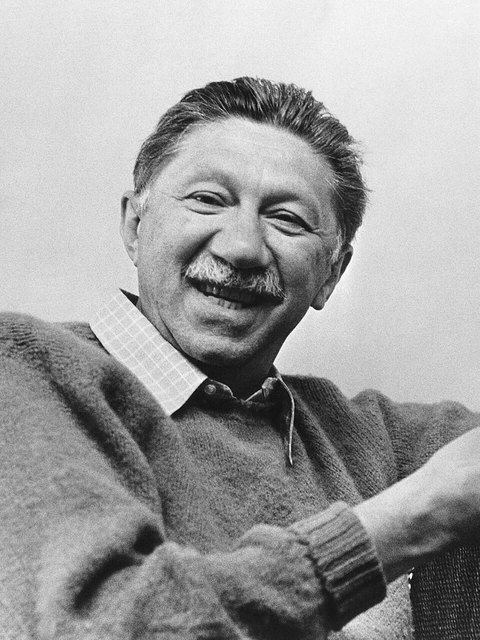

Theory · Motivation and self-regulation
Maslow's hierarchy of needs
Psychological theory of motivation
Maslow's hierarchy of needs is a theory of motivation that arranges five classes of needs in order: physiological, safety, belongingness, esteem, and self-actualization. Each level is prepotent to the next higher level, so lower needs must receive sufficient satisfaction before higher needs emerge.[1]
The theory arranges five classes of human needs in a fixed order from basic to highest.[1] In 386 adults, satisfaction of each need predicted satisfaction of the next higher need.[2] Two scales for college students did not correlate significantly except for physiological needs.[3] Students' views of college service quality fit the hierarchy and add employability and safety.[4]
Key facts
| 386 | adult respondents in the general population tested Taormina and Gao's five need scales[2] |
|---|---|
| 51 | college students whose scores on two need scales were compared by Lester[3] |
| 43 | students from 3 Turkish private institutions interviewed by Abbas about service quality[4] |
| 202 | users of social networking services in China surveyed by Cao and colleagues[5] |
Overview
What the hierarchy of needs is
Maslow's hierarchy of needs is a theory of human motivation that sorts human needs into five classes and arranges them in order from the most basic to the most advanced.[6][1] Physiological needs sit at the bottom of the hierarchy, followed in turn by security, belongingness, esteem and self-actualization.[1] The theory belongs to humanistic psychology, which came third among the schools of psychology, behind psychoanalysis first and behaviorism second.[7] The theory is associated with Abraham Maslow, and one account dates his version of it to 1970.[1][7]
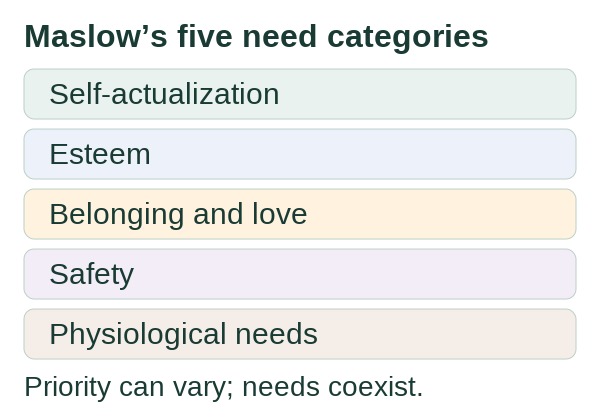
The needs are usually drawn as a pyramid, a triangular figure that shows a movement upward from meeting basic needs toward the aim of self-actualization. The pyramid is an illustration of the order of the needs rather than a measuring instrument, and the theory has been described as a foundational theory in humanistic psychology.[8] Maslow built the theory from observation of normal humans rather than from people with neurotic symptoms or from monkeys, the objects used by the earlier schools.[7]
The ordering rests on the idea of prepotency: each level of need is prepotent to the next higher level, meaning that it takes priority while it is unmet. Physiological needs must be met well enough before security needs appear, and security needs before belongingness needs, with the same relation at each step above.[1] Three principles underlie the hierarchy: an unmet lower need takes priority, higher needs appear in more advanced species, and needs unfold as a person develops.[6]
If the theory is accurate, it can guide living: early in life a person should establish a basis for survival and safety, then seek friends, then achievements, and finally self-actualization.[1] Maslow's hierarchy simplified earlier long lists of human motives into the five core needs.[6] The theory has been widely influential in psychology and education, and it has also been criticized for oversimplification and limited empirical support. The framework has been applied in cross-cultural studies, where its global applicability raises challenges. Accounts of self-actualization within the theory stress harmony within the self, good relationships with other people and a realistic view of life.[8]
History
Where the theory came from
Maslow set out the theory in a paper of 1943 and in a fuller book of 1954.[9] The needs hierarchy rested on Maslow's own research into dominance among monkeys and among humans. Later research in primatology, the study of monkeys and apes, found serious flaws in how Maslow understood dominance in those animals. The theory therefore rests on research that the discipline in which it was done no longer considers valid.[10]
A second source was a six-week stay at the Siksika reserve in 1938. He may not have interpreted what he saw and heard as fully as a Blackfoot community member would have, but the experience stayed with him. That experience can be read as the ground from which he later built the hierarchy of needs and the idea of self-actualization.[11]
How management texts present the theory over time is itself a subject of study. When management theory, and the choice and work of management theorists, are steadily filtered, the result is a narrow, managerialist and functionalist view. Left-wing ideas have been left out of management accounts, and so has the rich complexity of mainstream ideas. The conclusion drawn is that management theory, mainstream or critical, does the field a disservice when it oversimplifies until a theory or theorist is misread for lack of context, history and reflection.[12]
Main ideas
Self-actualization and the later addition
Self-actualization is the stage in which a person is described as tending to devote himself or herself mostly to causes of collective interest rather than individual interests, and as valuing the environment in itself. The description comes from Maslow's theory of needs, in which the self-actualizing individual is said to hold more developed B-values, a term for the values Maslow associated with being rather than with deficiency. A study of 134 participants adapted and used an instrument called the Environmental Motivation Profile Test. It found a significant correlation between the self-actualization stage and a globalizing representation of the environment, meaning a view of the environment as a whole rather than as separate parts.[13] Maslow's treatment of spirituality places it on subjective human experience, with life satisfaction reached by making the most of one's potential; in that reading God is set apart from the human mind and religion becomes a secondary component.[14]
The familiar pyramid does not match Maslow's later thought, according to a 2006 review. Maslow revised his model in 1969 so that self-transcendence became a motivational step beyond self-actualization.[9]
A 2026 article in the Athens Journal of Psychology rejects the pyramid of needs. The article calls it an ideologically rooted, sanitized and stripped-down version of a theory of human development that Maslow was still building at his death. The article calls that larger project a Eupsychian theory of human flourishing, with the theory of needs at its center, and notes that Maslow began it after presenting his theory of human motivation in 1943.[15]
The five needs in plain terms
The hierarchy places human needs at five levels, running from the most basic to the most developed: physiological needs first, then safety and security, love and belonging, self-esteem, and finally self-actualisation.[16] Physiological needs are the body's survival requirements, such as food and sleep, and they sit at the base of the model.[17][16] Safety and security come next, covering the conditions a person needs in order to feel protected rather than exposed to harm. Love and belonging describe the need for acceptance by other people and for a place within a group.[16] Self-esteem concerns a person's sense of worth and standing, and self-actualisation, the top level, refers to the effort to explore and realise one's fullest potential.[18][16]
The ordering logic rests on the idea that the lower needs are prepotent: under equal deprivation, the basic survival needs press more urgently than the others. Until those prepotent needs are relatively satisfied, the higher needs do not emerge as consistent motivators of behaviour.[19] In the original argument, a person could not move from one level of need until the level below had been satisfied.[16] The word relative matters here, because the claim is about needs being met well enough for the next level to take over, not about complete satisfaction.[19]
Maslow himself allowed for many exceptions to the sequence, among them people with a strong thirst for truth who will make life-altering sacrifices for it. When the model is used as a basic theory for understanding human nature, the frequency of such exceptions can impede its practical application.[18] Later theorising has proposed other basic needs that do not line up with the five levels, among them acceptance, optimal predictability and competence, which are said to lead to four further needs: trust, control, status or self-esteem, and self-coherence.[16] A 2026 essay argues that the pyramid may in practice work in reverse, with distress growing as a person climbs toward the higher levels. It reports that many people describe more anxiety, depression and other distress once they have security, success and social belonging.[20]
Next came community, family and peers, along with a shift in how healthcare workers approached care and provided information and education. This let people learn to use insulin, its delivery and control with flexibility. Experience and personality then helped people adapt and be open about their diabetes, allowing acceptance and a view of diabetes as something positive. That mapping keeps a plain distinction between needs required for survival and needs that serve well-being, and between needs that can be directly provided and those that cannot.[21]
How the levels are said to work
The hierarchy is usually described as a system of prepotency, a term meaning that a need lower in the order tends to dominate attention until it is reasonably satisfied. In this account, a person who has passed a given level of need is no longer driven by the motivation belonging to the levels below it. The claim is therefore about the order in which needs take charge of behavior, not about a fixed timetable for reaching each one. A manager or other motivator is advised to work out which class of need currently matters to a particular person, because a daily production worker and a member of managerial staff are said to need different things.[22]
Empirical work on the ordering has mostly tested it by measuring how strongly each level is felt within the same person. One self-report inventory used a modified paired-comparison format, in which items from each need level were compared with items from every other level and the intensity of each item was also rated. With 59 participants, items intended to measure the same need correlated between .52 and .65, and an analysis of variance found that the mean potencies of the levels differed in the predicted direction.[23]
A separate instrument built around the four most basic levels (physiological, physical safety and security, affection, and self-esteem) was administered to 200 delinquent adolescents from lower socio-economic backgrounds. Every subscale and the total schedule proved stable (p < .041). Internal consistency ran relatively higher for the upper levels and for the total schedule, and convergent validity was established (p < .005).[24] Internal consistency is the extent to which all the items in a scale or test measure the same concept.[25]
What happens when a level is met is described in two ways in the literature.[22][26] The first is the shift of motivation upward: once a need is satisfied, the level below it stops supplying the motive, and attention moves to the next level.[22] That account notes that Maslow described the needs required before self-actualization could be realized but left little recommendation for how the state could be enacted.[26] A replication study found positive and significant correlations between scores on a measure of self-actualization and endorsement of the qualities Maslow called metavalues, such as truth, goodness, beauty, justice and love, which supported his conclusions. The same study found nonsignificant correlations between self-actualization and measures of creativity.[27]
When a level is blocked rather than met, the claimed effect is a delay that can spread to the levels above. One paper argues that a starved need for security can bring a psychological delay, and neurosis if that delay lasts. Deprivation of security can also slow a person's passage through the higher needs as they emerge. Puri also treats obsessive compulsive disorder as one way an individual's safety-seeking mechanism finds expression.[28]
Tests of the ordering have not always supported it.[29][30] Brown and Cullen correlated scores on a questionnaire about motivation for religious behavior with scores on a measure of Maslow's hierarchy. Against their expectations, the two measures showed no significant association.[29] Male and female respondents showed no significant differences in the structure of their needs and motives. That study concluded that applying the concept to the management of motivation requires field research to establish the relevance of each class of needs in the particular group being studied.[30]
Research
How researchers measure the needs
Taormina and Gao built operational definitions of each of Maslow's five needs from his theory of motivation. From those definitions the pair built new questionnaire scales with three jobs. The scales assess how far each need is satisfied and check the expected correlations with the other needs and with four social and personality measures: family support, traditional values, anxiety and worry, and life satisfaction. Psychometric tests, meaning checks on whether a scale measures consistently and measures what it claims, were run on questionnaire results from 386 adult respondents drawn from the general population. Those tests gave strong backing for the validity and the reliability of all 5 measures of needs.[2]
Comparing and testing the scales
Two questionnaires have been put forward to measure Maslow's five needs in college students: one published by Lester in 1990 and one by Strong and Fiebert in 1987. A later study set the two side by side in a sample of 51 college students, scoring each student on the matching scale from each questionnaire for physiological, safety, belongingness, esteem and self-actualization needs. Across the five needs, scores on the corresponding scales did not correlate significantly and positively, with one exception: the measures of physiological needs.[3]
What the evidence shows
Maslow's hierarchy of needs is widely taught, yet the empirical record on the hierarchy itself is thin. A 2025 review states plainly that the model, as typically drawn as a pyramid, has no relevant empirical support.[31] A 2015 study of 81 nurses tested prepotency, the claim that lower needs must be met before higher ones can direct behavior, and found little empirical support for it. The same study reported that social needs and self-esteem needs had a positive relationship with job performance, while security, autonomy and self-actualization showed no significant relationship with performance. Performance, in turn, had a positive relationship with job satisfaction in that sample.[32]
A 2022 paper on the hierarchy and subjective wellbeing (a person's own assessment of how well life is going) notes that people do not have to fully satisfy one need before the next need rises in the hierarchy. That paper also argues that subjective wellbeing depends less on which needs are judged significant in general than on which factors respondents themselves rate as most significant in their own cognitive assessments. Using Mann Whitney U-Tests to compare median satisfaction with life across 24 human needs, the study found that wellbeing rose with how convenient most of those needs were to satisfy.[33]
A 2023 mixed-methods study asked 240 randomly chosen people to compare the satisfaction priority of needs in pairs, then interviewed 12 participants of different ages, genders and income levels to explain the variation. The results indicated that the ordering people report depends on gender, age and income level, which undercuts the idea of a single sequence that holds for everyone.[34]
Motivation and incentives in learning
Studies that connect Maslow's hierarchy to learning treat the lower needs as conditions that make study possible and the higher needs as conditions that make it attractive.[35][36] A qualitative study of Arabic speaking lessons at a state Islamic middle school in Batu, Indonesia, described how the teacher met physiological needs through a comfortable place, rest, drink and air. The same study reported that safety was met through preventive efforts by the teacher and through the absence of mockery, while social needs were met through empathy, feedback and encouragement. Esteem appeared as respect for students' opinions and as recognition given in the form of letters and gifts, and self-actualization appeared as vocabulary learning and dialogue made interesting and interactive through a contextual approach.[35] A descriptive qualitative study of Fiqh lessons at a secondary Islamic school in Sungguminasa, Indonesia, reported that meeting needs from the basic level up to esteem let students arrive at self-actualization during learning. That study attributed low motivation in the subject to rigid teaching that overlooked psychological aspects and individual needs.[36]
Incentives to learn have been modeled as a function of which needs a student is trying to meet. A survey of college students found a linear relationship between the students' hierarchy of needs and their incentives to learn. The same paper reported that several factors influence the order of students' needs, and that a change in that order changes the variety of incentives to learn. From these results it developed a model for qualitative analysis, illustrated with numerical examples, so that incentive methods could be selected according to a student's type of need hierarchy.[37] A study of differentiated mid-semester assessment in Islamic religious education at a state middle school in Demak, Indonesia, drew on Maslow's needs theory and on a learning style theory. It reported a significant relationship between psychological needs and learning styles on one side and students' learning achievement on the other.[38]
Not every test of the link has found one. A study of 450 engineering students at the University of Cartagena in Colombia, drawn from the years 2018 to 2020, measured Maslow's safety and protection needs with a survey scored on a scale of 0 and 1. It measured academic performance in conceptual, procedural and global dimensions and meaningful learning in representational, conceptual and propositional types. Crossing the safety and protection variable with academic performance and with meaningful learning, the study found no statistical significance at a 95% confidence level in the sample analyzed.[39]
Surveys of what students value bear on the incentives side of the question.[40][41] A survey of 150 college students asked which of Maslow's levels of need counted most for happiness. Falling or staying in love drew significantly more choices than the other options, from undergraduates of both genders.[40] A 1977 study of business college seniors compared 58 black students with 249 white students and found that the black students placed greater importance on most of the needs studied, regardless of sex. That study read its data as support for Maslow's postulate that the needs he proposed are more universal across cultures than superficial behaviors or desires, with cultural differences appearing in the magnitude of individual needs.[41]
In practice
Needs in classrooms and student motivation
A 2024 survey of first-semester students at Universitas Negeri Yogyakarta, in the Sociology Education Program for the 2023/2024 academic year, drew a random sample of 34 students from a population of 100 new students, or 34 percent, and analyzed the answers with descriptive percentages. Most of those students, 70.6 percent, were driven by the need for self-actualization, the top level of the hierarchy, while 29.4 percent were motivated by the need for esteem. Intrinsic motivation, meaning interest in the work itself, dominated at 82.4 percent against 17.6 percent for extrinsic motivation, meaning rewards or pressures from outside.[42]
A 2024 study of junior high school students in Indonesia examined whether motivation, read through the hierarchy, influences enthusiasm for learning. Data came from a survey using a Likert scale questionnaire, in which respondents rate statements on an ordered scale, distributed online through a messaging service. The analysis showed a positive relationship: learning motivation had a significant influence on students' enthusiasm for learning. The study argues that the finding matters for learning strategies at the lower secondary level, which should give more weight to students' psychological state.[43]
A 2024 analysis sorts the factors that shape learning motivation into external ones, namely schools and families, and internal ones, namely interest and satisfaction. Reading these factors through the hierarchy, the analysis makes a set of recommendations, each tied to a level of need. The first is a safe and stable campus environment, which addresses students' safety. The second is a sense of collective belonging, supported by good family relationships maintained by parents. The third is respect for students' ideas and encouragement to express them, which helps sustain interest in learning. The fourth is guidance toward personal value realized through study, with satisfaction taken from it, which the analysis expects to raise interest further.[44]
Teaching practice and curriculum design
Teachers who run simulation-based learning, in which trainees practice real tasks with trained actors or in staged settings, have needs of their own that the hierarchy can describe. A qualitative case study of 68 four-hour workshops at a teacher-education simulation center drew on 211 open-ended instructor reflections, two focus groups and 98 interpersonal communication documents. Thematic analysis produced 11 themes spread across all five levels of the hierarchy, from basic needs through self-actualization.[45]
In special education, a literature review argues that children with special needs often struggle to meet physiological and safety needs first, and that this struggle can hold back their progress in class. The review reports that when basic needs such as nutrition, safety and emotional support are met, children with special needs show gains in motivation, focus and academic achievement. Its recommendation is a holistic approach in which children's emotional and physical needs receive the same attention as academic ones.[46]
Differentiated learning, the practice of varying what students study, how they work and what they produce, has been read through Maslow's humanistic philosophy in a literature study. That study concludes the philosophy is relevant to differentiated learning because student needs largely determine how needs are met in a lesson. It names routes for meeting those needs: differentiation of content, of process, of product, and of a comfortable learning environment. On this account, differentiated learning humanizes students by applying the hierarchy of needs to the design of instruction.[47]
A textbook for spoken Arabic in rural Islamic schools was built on a humanistic approach that attends to students' psychological needs for security, social connection and self-esteem. The developers targeted weak speaking proficiency that they attributed to traditional methods centered on rote memorization and grammar, with few chances for meaningful, contextual communication. The work followed a research and development design using the ADDIE model, whose stages are analysis, design, development, implementation and evaluation. Expert validation scores came in above 85 percent, and students reported greater motivation, participation and confidence in speaking.[48]
Ghana's senior high school core mathematics curriculum has been mapped onto the hierarchy through its action verbs, the words such as identify or apply that state what students should do. All 217 identified action verbs were arranged in a matrix against the syllabus headings and against the levels of the hierarchy, and their frequencies and percentages were tallied in spreadsheet software.[49]
Higher education, advising and student services
Colleges have adapted the hierarchy to several tasks, among them advising medical students, judging the quality of student services, and managing staff in universities.[50][4][51] A 2026 article in Academic Medicine describes one such adaptation, in which the hierarchy helps medical students see the many tasks they must complete from a career perspective.[50]
A 2020 study by Abbas asked what service quality means to students themselves, a question the paper says earlier work had treated mainly from a management or general perspective, or had answered with dated evidence. The data came from 43 students at 3 private higher education institutions based in Turkey, gathered through 26 individual interviews and 3 focus group sessions. The findings were reported to comply strongly with Maslow's hierarchy, and the study treats employability and safety and security as new emerging indicators in the literature on service quality in higher education.[4]
A 2023 paper by Cui applies the five stages (physiological needs, safety, love and social belonging, respect, and self-actualization) to students at Chinese universities. The paper argues that these students are shaped by Confucianism and by a collectivist national culture. It holds that attention to their needs at each of the five stages helps them succeed in life. Its recommendation is organizational: university leaders should establish policies and provide efficient counseling services to address the psychological issues students may have.[52]
A 2024 study by Nguyen, Diep and Duong examines how the hierarchy can inform human resource management at higher education institutions in Vietnam. The paper states that good management of human resources in these institutions, particularly in teaching and scientific research, bears directly on whether all university objectives and responsibilities are achieved. It proposes that fulfilling employees' physiological needs is the foundational requirement for ensuring their motivation, with the aspiration for self-realization and personal growth at the apex of the needs. The study presents the hierarchy as a tool for managers seeking to use human resources efficiently, and it describes the theory as a cornerstone of psychology with influence on economic growth, the ordering of development initiatives, and the formulation of policies and social programs.[51]
Leadership, work and professional settings
A 2003 paper in the Journal of Nursing Management applied the model to a health care industry facing reorganization, mergers, acquisitions, rising learning demands and a growing role for technology in training. The paper argued that the model helps leaders read these pressures as expressions of universal individual needs: security and freedom from stress, social belongingness, self-esteem and self-actualization.[53]
A 2024 survey of 99 elementary school teachers in Cirebon City, Indonesia, examined how the fulfillment of each level of needs related to teacher performance. The study used a quantitative descriptive approach and analyzed the data with correlation and regression methods. Physiological and safety needs had the most significant impact on job performance, and teachers whose basic needs were met were more focused on their professional responsibilities. Social and esteem needs also had a positive influence on performance, though to a lesser degree, which the study read as room for improvement in workplace recognition and social dynamics. The authors stated that the focus on a single city may limit how far the results generalize and called for research in other regions.[54]
A qualitative study of medical records and health information staff at one hospital, published in 2026, interviewed employees in depth about what shapes their work motivation. The results indicated that needs at every level are linked to one another in shaping work motivation, rather than acting one at a time. Safety needs were met through clear work procedures and guidance from senior staff, which created a sense of security in the workplace. Social needs and safety needs came out as the strongest factors in daily work motivation. The study concluded that meeting needs across the board matters for sustaining motivation and performance.[55]
A 2025 mixed-method study assessed how well the hierarchy explains employee behavior in multinational corporations, combining a substantial literature survey with surveys and interviews of employees across several sectors. It concluded that the hierarchy works as a flexible model in that setting but requires major adaptations, because employees in multinational corporations are shaped by many cultural, economic and organizational factors at once. In certain cultures, the study found, self-actualization or self-esteem matters less. Across a range of mixed cultures and organizations, the study reported evidence that attention to social and esteem needs goes together with a shrinking need to satisfy physiological needs. Its recommendation was that human resource policies be adjusted to the culture and context of a global workforce, and that the flexible model be combined with modern theories of motivation.[56]
Health, community and everyday life
Burnout among doctors in training is widespread and harms career satisfaction, personal well-being and patient outcomes, and programs that address it have often targeted single causes in isolation. Hale and colleagues proposed in 2019 that Maslow's five levels (physiologic, safety, love and belonging, esteem, and self-actualization) could organize wellness efforts for resident physicians, on the argument that the causes of burnout are numerous and the remedies must be equally varied. Their framework treats the trainee's personal and professional needs together and sorts existing interventions into a scaffold that a residency program can use as a complete plan.[57]
Hospice care in the United States has advanced greatly, yet no widely accepted psychological theory has guided needs assessment and intervention design for patients and families, and Maslow's work has appeared only sparsely in the palliative care literature. Zalenski and Raspa adapted the hierarchy in 2006 into five palliative care levels. The first is distressing symptoms such as pain or dyspnea (shortness of breath); the second is fears for physical safety, of dying or of abandonment. The adapted hierarchy is meant to support assessment of patients' needs and the design of interventions whose goals begin with comfort and may extend to the experience of transcendence.[58]
A descriptive study of 50 patients receiving maintenance haemodialysis, a treatment that filters the blood when the kidneys cannot, took place in the dialysis unit of Suez Canal University Hospitals and used the hierarchy to identify patients' needs. The highest reported need was for self-esteem, at 92.0%, and the lowest was for love and belonging, at 38.0%. The author concluded that nurses should be aware of these findings so they can supply the support that helps a patient regain a sense of self.[59]
A mixed-methods study followed 63 newly enrolled clients of Housing First and of traditional programs for adults with serious mental illness who had experienced homelessness, using the hierarchy as a theoretical lens. The quantitative results suggested that naming self-actualization goals went with basic needs not being met, rather than with those needs being fulfilled. Henwood, Derejko, Couture and Padgett argued that making mental health care a recovery-oriented system will require more attention to person-centered care planning and to the effect of limited resources, especially for people living in poverty.[60]
A 2024 survey of 372 residents of Wuxi, China, examined what people want from neighborhood outdoor spaces at each level of the hierarchy. At the physiological level, residents valued access to clean, green spaces for relaxation and exercise; at the safety level, they considered well-lit, secure and well-maintained settings essential. For love and belonging, settings that encourage neighborhood interaction and social bonds, such as playgrounds and community gardens, were highly valued, and for esteem, spaces that are aesthetically appealing and strengthen local identity and pride mattered. For self-actualization, residents wanted places that offer personal development and contact with the environment, such as educational workshops and neighborhood vegetable gardens. The study argued for urban planning that accounts for needs at every level and reported that meeting these varied needs is central to residents' well-being and satisfaction with community outdoor spaces.[61]
Needs in school leadership and indigenous outcomes
One line of research asks whether a principal who manages students' needs in an organised way is associated with better results for Indigenous students. A 2026 correlational study examined this question in 93 national primary schools in Orang Asli settlement areas of Peninsular Malaysia. Multi-stage sampling gathered data from 342 teachers. Yahaya, Alias and Nordin measured Student Needs Management Practices, or SNMP: principal-led practices built on five dimensions drawn from Maslow, covering physiological, safety, belongingness, esteem and self-actualisation needs. Student outcomes covered academic achievement, co-curricular participation and character development.[62]
In multiple regression, the five SNMP dimensions together explained 18.8% of the variance in student outcomes (R squared = .188, adjusted R squared = .176), F(5, 336) = 15.559, p < .001. Belongingness needs were the only statistically significant predictor (beta = .298, p < .001), while safety needs approached significance (beta = .124, p = .061). The physiological, esteem and self-actualisation dimensions did not predict student outcomes significantly. Yahaya, Alias and Nordin read the pattern as evidence that the emotional and relational side of leadership practice is tied more directly to Indigenous student outcomes than the material or recognition-based side. Yahaya, Alias and Nordin add that a modest direct association fits leadership-influence models. In such models principals reach student outcomes largely through intermediate mechanisms, teacher commitment among them.[62]
A qualitative descriptive study of a modern pesantren (Islamic boarding school), Al Amin in Prenduan, Sumenep, Indonesia, described teaching organised around the hierarchy, drawing on teachers who had taught there for over 10 years. The practices identified included providing a physical environment and learning books as basic needs. They also included a psychological environment of advocacy, encouragement and role models, where students could ask questions, express opinions and offer criticism; the study links this to satisfying the need for safety when learning. Active learning and the development of talent and potential were framed as expressions of self-actualisation.[63]
A library-based analysis of digital transformation in Islamic education reported that students' physiological and safety needs gain support from easier access to learning, flexible time and space, and more structured digital learning systems. The same analysis found that digitalisation supports self-actualisation through creativity, digital literacy, critical thinking and independent learning.[64]
Applications in higher education and e-learning
In higher education, the hierarchy has been used as a planning checklist for student welfare as much as for instruction. A 2024 discussion of Indian higher education argues that physiological needs come first, so adequate nutrition, housing and health care must be secured before academic success is realistic for students facing significant socio-economic challenges. The same discussion places physical safety and emotional security inside institutions at the safety level, and treats supportive communities, peer relationships and mentorship as the belongingness level. Esteem needs are met, in this account, by recognizing and celebrating student achievements, while self-actualization requires opportunities for creativity, critical thinking and personal growth. The proposal concludes that applying the hierarchy in this setting calls for policy reforms, infrastructure improvements and attention to the diverse needs of students rather than a single classroom technique.[65]
Designers of online platforms have drawn on the hierarchy in a different way, treating each level as a requirement the software itself should satisfy. A 2011 paper on e-learning architecture reasoned that Web 2.0 platforms were not yet fit for users' needs and predicted a further shift toward web-based virtual reality that gives priority to people. The work simulated a web virtual reality system built with Java and Java3D for human-computer interaction and proposed technical improvements in virtual scene construction, learning history records, file compression and security. Its authors presented the result as a reference for developers building similar systems later.[66]
The hierarchy has also been mapped onto the design of digital games, which overlaps with educational technology when games are used for learning. A 2025 conceptual analysis assigned each level a design element: functional interfaces for physiological needs, save systems for safety, multiplayer modes for belonging, reward structures for esteem, and user-generated content or AI-driven narratives for self-actualization. From this mapping the study built a comparative model separating low-level from high-level design features and a layered format for judging games as strong or weak by how fully they address player needs. It reported that games with greater experiential, aesthetic and creative depth tend to align with the upper levels and to give a richer player experience.[67]
Two limits follow from what these sources actually show. The higher education discussion is an argument for applying the theory in one national context, and the e-learning and game design papers are conceptual mappings and simulations rather than tests of whether meeting lower needs improves learning outcomes.[65][66][67] Related work on social media adoption surveyed 287 respondents, used exploratory factor analysis to map questionnaire items to each level and confirmatory factor analysis to check fit, and found that adoption followed the hierarchy's order. That study concerns consumer behavior rather than classrooms, and its author suggests the model could later support scale development for measuring reasons for social media use.[68]
The hierarchy has likewise served as a metaphor outside teaching, which marks how loosely it travels.[69][70] A 2008 article proposed an IT Value Hierarchy that uses Maslow's levels to describe stages of information technology maturity in competitive organizations, so that executives can discuss the value of more sophisticated systems.[69] A 2018 paper compared trends in research on online consumer trust, meaning how people judge a website's trustworthiness, with the hierarchy's progression toward self-actualisation and recommended a spiral cycle of research for managing online relationships.[70]
Work, pay and employee motivation
A historical study of that period traced how a group of management experts turned the hierarchy into practice. Lussier examined job redesign programs at Texas Instruments and management training at the marketing firm Young & Rubicam. The hierarchy appealed to managers because it appeared to offer a concrete guide for designing work structures and training, together with a broader social theory that claimed to explain changing values and economic conditions in America. For the theorists who invoked it, the corporation was both the prime site for people to meet their higher psychological needs and the ideal place to study and cultivate motivation.[71] A separate historical analysis argues that Maslow's ideas and their place in the management canon are best understood within the culture and institutions of Cold War America.[72]
Later writers paired the hierarchy with Frederick Herzberg's two-factor motivation theory, which separates factors that prevent dissatisfaction from factors that produce satisfaction. A comparative review of the two theories, based on qualitative analysis of scholarly articles using a case study approach, reported a correlation between them and described them as overlapping models of the structure of needs that represent both intrinsic and extrinsic motivation. That review concluded that individual needs differ and that the two kinds of motivation factor cannot be isolated from each other, since regular application of both would produce employees energized for higher performance. It also concluded that organizational success depends not only on a manager's capacity to organize and coordinate material resources but also on recognizing how individuals' needs diverge and developing approaches to satisfy them.[73] An earlier article drew on the hierarchy and on Herzberg's theory to discuss turnover among correctional officers, applying both to the work situation in one southern U.S. state's correctional agency.[74]
Survey evidence from employees gives a mixed picture of which levels matter most. A survey of 824 employees of Romanian health organizations tested a model in which work satisfaction mediates the link between each need level and professional performance, using seven latent constructs measured by several observed indicators each. The results indicated that these employees were mostly motivated by meeting higher level needs, especially self-actualization, and to a lesser extent by meeting lower level ones. The researchers presented the findings as useful for health system policy makers and for managers designing motivational strategies intended to raise professional performance.[75] A much smaller questionnaire study of 31 operational construction workers on one site in São Paulo city, Brazil, built on the hierarchy found that security, collaboration, consideration for work performed and greater respect from superiors were the workers' main requirements.[76]
The hierarchy has also been proposed for workers who sit outside an organization's direct payroll. One paper describes third-party contractual workers, hired through contractors by principal employers seeking to cut labor costs with minimal responsibilities toward such workers, and argues that the hierarchy can be used to design a motivational program for them. The argument rests on the point that these workers ultimately work toward the principal employers' organizational objectives and so need to be kept motivated.[77]
Some management writing treats the hierarchy as one model among several that managers must choose between and combine. A 2025 paper compares Maslow's levels with a seven-step model of its author's own design, called Model C, and asks how far each contributes to management literature and to empowerment of human resources in organizational behavior.[78] A case study of a successful Swedish partnering project, a way of working in which organizations collaborate closely on a shared project, described components that sit on different levels and act as building blocks toward a truly collaborative climate. That study located trust, openness and mutual understanding at the interpersonal level and suggested that partnering efforts are won or lost there, while noting the limitations common to case study research.[79]
Health, religion and community settings
Health researchers have adapted the hierarchy to describe what patients need, sometimes rebuilding the pyramid around a single condition. In the resulting diabetes hierarchy, the base holds policies, the organization of the health system, insulin, its delivery, control, healthcare workers, and information and education, all needed for survival. Community, family and peers come next, together with a changed role for healthcare workers in how care is delivered and information is shared. Only after those conditions are met can a person use insulin and control flexibly, draw on experience and personality to adapt, and reach acceptance, including viewing diabetes as something positive. The study distinguishes needs that are tangible, which a health system can provide directly, from intangible ones it cannot, and suggests the list could guide policy and targeted interventions.[21]
A cross-sectional study of 159 patients at a hospital haemodialysis unit in Taiwan asked patients to rate their needs on a structured questionnaire. Mean scores were 4.0 ± 0.8 for physical needs, 3.2 ± 0.8 for mental needs, 2.7 ± 1.0 for spiritual needs, 3.1 ± 0.9 for other needs, and 4.1 ± 0.7 for needs related to medical staff care. Care from medical staff scored highest, followed by physical needs. Patients who remained employed during treatment reported higher mental, spiritual and other needs, and patients supported financially by family reported higher physical needs. Patients cared for by paid caregivers, and patients who were religious rather than nonreligious, reported lower spiritual and other needs, while patients with tertiary education reported higher other needs than those with primary or secondary education only. The authors conclude that providers should look beyond physiological needs and address needs in other areas to improve dialysis care.[80]
A study of 442 middle-aged women in Korea built a model of happiness on the hierarchy, with health status, financial distress and social support as basic inputs, self-esteem and positive thinking as psychological needs, and happiness as self-fulfilment. The model explained 82% of the variation in happiness, and the authors argue that interventions meeting basic needs such as health status, financial distress and social support are required to raise it.[81]
Two studies examined religion from different angles: one tested whether motivation for religious behavior correlates with scores on a measure of Maslow's hierarchy, and the other read verses of the Qur'an on the pillars of Islam through the hierarchy.[29][82] A 2006 study developed a Motivation for Religious Behaviour Questionnaire, reported that its reliability and social validity were confirmed, and then correlated its scores with a measure of the hierarchy.[29] A 2024 literature study took a textual route, reading Qur'anic verses on the pillars of Islam through the hierarchy and arguing that self-actualization through those pillars can shape a better Muslim personality in physical and mental terms.[82]
In nutrition and community health, the hierarchy has served as a simple graphic for linking food security and nutritional education to successive levels of need. A 2023 descriptive and exploratory review from Cuba related food sovereignty and nutritional education to the levels of the pyramid. It ran from physiological needs through safety, belonging and social needs, self-esteem and recognition, to self-actualization. The authors present the pyramid as an easy visual tool for understanding how human needs might be met at each level and basic deficits compensated.[83]
Stunting, a common form of child malnutrition that hampers growth through poor nutrition, infections and limited psychosocial stimulation, is another setting where the hierarchy has been used. A 2023 mixed-methods study in Belu Regency, on the border between Indonesia and Timor-Leste, surveyed 150 community health volunteers and interviewed 10 informants about their motivation to tackle stunting. Social needs dominated, at 99.3%, and the qualitative theme of humanitarian harmony divided into volunteering, dedication and caring, all treated as ways of meeting social needs without expecting immediate reward.[84]
Culture, migration and economic context
A 2022 survey of 81 mothers in Jordan who were starting new businesses, called nascent mumpreneurs, found that the hierarchy's needs together explained 54% of the variation in their intention to start a venture, with a correlation of r = 0.74. Within that sample, the need for self-actualization was the strongest predictor (β = 0.80) and esteem followed (β = 0.43), while physiological needs, security needs and belonging did not predict entrepreneurial intention (significance of 0.74, 0.09 and 0.09). Marital status and level of education did not change the relationship between the needs and intention, since both had significance above 0.05.[85] A study of 110 litchi farmers in Kapasia, Bangladesh, reported the opposite emphasis: farmers were driven mainly by physiological and safety needs, such as food for the family and shelter and clothing for its members. Those farmers showed less interest in parts of self-actualization, including teaching or motivating other farmers, and named flower drop, irrigation problems and weak support from extension officers among their main obstacles.[86]
A qualitative field study of lower-level workers in Mexico's maquiladora factories, plants that assemble imported parts for export, concluded that the hierarchy did not explain their needs at all. That study used semi-structured interviews with open-ended questions and content analysis, and it set out the needs the workers actually described instead. The hierarchy still stands as the needs theory with the most research and the most citations, even though needs researchers have questioned whether it applies.[87] A 2025 comparison with the Pancha Kosha theory of the Taittiriya Upanishad, which describes five sheaths of human existence (physical, energetic, mental, intellectual and blissful), contrasted the linear progression of Western psychological models with the nested interdependence of Vedic thought. That paper treated the older framework as a supplement to modern models rather than a rival, and illustrated its use with cases from yoga therapy, mental health and integrative medicine.[88]
Migration research has used the hierarchy to sort the motives of professionals who leave low-resource countries, and it finds more than pay at work. A 2019 review of the literature on physician migration found that financial safety needs were major drivers of emigration from low-resource to high-resource settings. Self-actualization factors also drove emigration in a major way, among them the wish for professional development through training opportunities and research. The review described physician motives as multifactorial and proposed the theory as a guide for future studies and for efforts to retain doctors in low-income countries.[89]
Economists have borrowed the hierarchy as a model of how spending changes with income, and critics have attacked that use on social grounds. Post Keynesian theorists treat income and demand, rather than prices and substitution, as the centre of consumption. They used the hierarchy to give a theoretical foundation to the Engel curve, the pattern in which the share of income spent on food falls as income rises. In that account, people satisfy physiological needs first and move toward safety, social and finally self-actualization needs as incomes grow, becoming satiated at each level. A 2004 critique argued that the main problem with the approach is that individual needs are treated as innate, so questions of social interaction and culture are seriously downgraded. The critique offered the social theory of Pierre Bourdieu as an alternative, in which the structure of the social hierarchy constrains what lower strata consume and produces less conspicuous consumption at the top.[90]
One study applied the hierarchy to China's state-owned enterprises and small and medium enterprises, examining whether higher disposable income, often a product of state firms' control over vital industries and utility prices, raises public support for economic decentralisation. Using several analytical techniques on secondary data, it reported patterns suggesting a mutually supportive relationship between the two kinds of enterprise in advancing growth and decentralisation.[91] A 2024 study of 134 participants, using an adapted environmental motivation profile test, found a significant correlation between the self-actualization stage and a broad, global view of the environment.[92] The hierarchy has also been used to frame data on gender equality across world regions since 2000, in health, education and work, with the analysis pointing to fields where progress has stalled for historical and cultural reasons.[93]
The strongest challenge comes from a qualitative field study of lower-level workers in Mexico's maquiladora export factories, the assembly plants that operate along the country's northern border. The researcher used semi-structured interviews with open-ended questions and analyzed the answers by content analysis, a method that sorts spoken or written material into categories and counts what falls in each. On those results, the hierarchy did not explain the needs of the workers interviewed, and the study set out the needs that the interviews actually revealed. The same paper notes that the hierarchy remains the needs theory with the most research behind it and the most citations, so a failure to fit one sample sits against a large record of use.[94]
A 2023 mixed-methods study asked whether the hierarchy is still universal. It drew on social role theory, on Mannheim's theory of generations and on an income inequality approach. In its first sub-study, 240 randomly chosen people compared the satisfaction priority of needs two at a time, a pairwise format that forces a choice between two items. The ordering of needs depended on gender, age and income level, which the authors read as evidence that the hierarchy is not fixed across groups. A second sub-study interviewed 12 people chosen by purposive sampling, meaning selected on purpose for variety, from different ages, genders and income levels within the same sample, to understand why the ordering varied.[34]
Money attitudes have also been examined against the hierarchy in a university-age cohort. Every one of Maslow's needs appeared strongly tied to the money attitudes of evaluation and anxiety. Men's and women's needs were highly correlated with obsession, budget, anxiety and, in particular, evaluation.[95]
In consumer research, a 2025 discussion paper gives the hierarchy a significant place in the field. It credits the theory with a positive role in explaining why people consume, in predicting consumption trends and in guiding marketing strategies. The same paper argues that the theory meets difficulties in the complex and changeable consumption environment of the present, naming the blurring of the levels, the growing influence of individual differences and interference from social and cultural factors. Its suggestions are to refine the classification of needs, to take multicultural backgrounds into account and to combine the hierarchy with other related theories.[96]
One test of the hierarchy in a digital service surveyed 202 users of social networking services in China, applying the needs to an expectation-confirmation model of information systems continuance, which predicts whether people keep using a system from how far it met their expectations. Fulfillment of self-actualization needs had a significant impact on the intention to continue using the services. Fulfillment of social needs had no significant direct effect on continuance intention, but satisfaction fully mediated it. Cao, Jiang, Oh, Li, Liao and Chen list limits to their study: the sample was made up of undergraduates, the survey data were cross-sectional, and the survey was conducted in a single country. Their practical advice for managers of such services was to strengthen instant communication functions, build a platform convenient for users to express themselves, add entertainment functions, and adjust or update website functions in line with users' expectations and experiences.[5]
The hierarchy in fiction, film and games
A body of literary and film criticism uses Maslow's five needs as a reading frame for fictional characters, asking which needs a story shows being met and which are left unmet.[97][98][99] These studies are interpretive rather than experimental: they treat a novel or film as a source of dialogue, scenes and gestures that can be sorted into the five levels.[97][100] One analysis of the film Colette found all five levels depicted in the main character, with the evidence drawn through dialogue, appearance, external actions and internal actions, four of the eight types of characterization in the framework the study applied.[97] A study of the film Bolehkah Sekali Saja Kumenangis counted 12 steps by which the main character moves toward self-actualization, shaped by internal factors, external factors, or both together.[98]
Positive outcomes, including feeling safe, loved and accepted, self-confidence and self-acceptance, appear more often at the fifth stage, once self-actualization has been reached.[98] An analysis of the film Miracle in Cell Number 7, about a father with intellectual disabilities facing legal injustice, found love and belonging the most dominant force in his behavior and resilience, even though safety stays incomplete under legal pressure and social stigma. That study concludes the hierarchy is flexible and contextual, since personality traits and intellectual limits on one side and social support and surroundings on the other both shape how needs are met.[100]
Lestari and Attas found six basic needs in the main character of Tere Liye's Hujan, who reaches self-actualization with only some of them met. Ghozali found physiological, safety, love and belonging, and esteem needs met in sequence by Elinor in Austen's Sense and Sensibility, with self-actualization not reflected in the novel.[101][102] A content analysis of Tere Liye's novel Hujan reports six basic needs in the main character and finds that the character can self-actualize even though only some of those needs are fulfilled.[101] An analysis of Caleb in the 2008 film Fireproof centers on self-esteem, describing a character with strong esteem who works to repair his household problem and keep his marriage.[103] A reading of Blake Crouch's novel Dark Matter treats the characters' choices as driven by psychological needs that differ across environments, and argues that the book turns Maslow's hierarchy on its head through a literary lens.[104]
An article on the 2024 Indian film Lucky Baskhar, whose bank cashier turns to fraud under financial pressure, argues that films can make the five needs, listed in ascending order from physiological needs to self-actualization, easier for students to grasp. The article holds that the ideas fit non-Western settings such as India and Nepal, which share values such as duty to family, and that the film helps students learn motivation in a way suited to those settings.[105] A study of Syed Waliullah's 1967 novel Tree Without Roots pairs Maslow's hierarchy with Charles Sanders Peirce's semiotics, the study of signs, to connect the book's symbols and its characters' actions with human desire in a post-colonial setting.[106]
One study moves from invented characters to children's own words, collecting writing samples from kindergarten through sixth grade in response to the prompt "My dreams for the world". Two researchers rated each sample separately and then discussed them until they agreed, and the study tested whether gender, income, ethnicity and grade influenced the scores.[107]
Training, professional development and critique
Training for police trainers in Britain has long rested on a specific and prescriptive set of adult learning theories. Those theories draw broadly on the principles of humanistic education and psychology. One analysis of such a programme identifies a contradiction between its stated aim to promote diversity and its promotion of learning theories that are questionable from a diversity perspective. Heslop's title refers to trainers doing a Maslow, and the article examines the training programme's use of humanistic learning theories alongside its stated aim of promoting diversity.[108]
The place of the hierarchy in professional education has a longer history than police training alone, and critics now treat its continued citation as a question in its own right. Later theorists have offered refinements and alternatives, among them a unified model of motivation that treats acceptance, optimal predictability and competence as basic needs leading to four further emergent needs: trust, control, status or self-esteem, and self-coherence. That model is presented as evidence that many other needs may exist which do not align with Maslow's hierarchy.[16]
A separate line of critique addresses how the theory is taught rather than how it is applied. Yergensen calls for changes in the pedagogy of critical theory, so that instruction re-centres the field on the historical foundations that drove its origins: economic despair and dangerous oppression. That argument places Maslow alongside Adorno and Auschwitz in a discussion of teaching practice. Yergensen holds that integrating historically grounded examinations of suffering more fully gives students a reflexive lens for addressing challenges across different ages. The proposal is framed as a way to improve instruction in critical theory through principles that focus on prudent student application.[109]
What this looks like when you study
In one study, 386 adults from the general population filled in new questionnaires built from Maslow's definitions of the 5 needs. Each lower need's satisfaction correlated positively with the next higher need's satisfaction. A regression analysis, a method for predicting one score from others, showed each higher need was predicted by the need just below it.[2]
Teachers at a modern Islamic boarding school in Indonesia, all with more than 10 years of service, were interviewed about their practice. They provided a physical environment and learning books as basic needs, and gave encouragement and role models for safety. They used collaborative learning and helped students with learning problems to meet affection needs. They gave rewards for excellent achievement and for student criticism to support self-esteem.[63]
In a Malaysian study, 342 teachers rated principal-led needs management and student outcomes in 93 national primary schools in Orang Asli settlement areas. Both needs management (mean 4.63) and outcomes (mean 4.26) were rated very high. The correlation between them was moderate and positive (r = .411). Belongingness was the only significant predictor (β = .298), and the five dimensions together explained 18.8% of the variance in outcomes.[62]
A textbook for rural Islamic school students was built with the ADDIE model, whose stages are Analysis, Design, Development, Implementation and Evaluation. Expert validation scores were above 85%, and the experimental group's average N-Gain, a measure of improvement from pretest to posttest, was 0.72.[48] If you want to apply this evidence, start by checking that your basic conditions are met: food, rest, a safe place and a stable routine. Next, build a sense of belonging by keeping good relationships with family and classmates. Then express your ideas and accept encouragement, so that interest in learning is maintained. Finally, look for personal value and satisfaction in the work itself.[44]
Criticism
Criticisms, misconceptions and open questions
The most common objection to Maslow's hierarchy of needs is that its empirical support is thin, and that the familiar pyramid shape misrepresents what Maslow actually claimed. A 2026 narrative review of the literature reports that the theory still draws substantial criticism on its empirical support, on its cultural assumptions, and on the pyramid image that is routinely used to describe it but is not accurate. The same review gives particular attention to the historical misrepresentation of the pyramid structure and to the theory's limited applicability in collectivist cultural contexts, meaning settings in which group and community goals carry more weight than individual ones.[110]
A separate line of criticism attacks self-actualization itself rather than the ordering of needs. The critique further holds that the logic of human development on which the whole theory rests is essentially reductionist, which in principle leaves Maslow unable to account for the origin and nature of the self and of human needs.[111]
A third objection concerns where the theory came from and what that origin implies. That basis, the analysis states, was Maslow's own study in the 1930s of how self-esteem related to sexual behavior in young college women. The analysis places that study within the sexological research of its time and contrasts it with a 1929 study by Katharine Davis, finding that the two present very divergent pictures of women's sexuality. It argues that Maslow's portrayal, later built into the needs hierarchy, carries implications for understanding dominance and subordination in organizations. Implicit in that portrayal, the authors say, is a claim that female submission is natural and that male dominance is eroticized.[112]
A fourth line of criticism asks whether an upward ladder describes motivation at all in societies marked by structural inequality, oppression and chronic deprivation. A 2026 paper argues that under such conditions deprivation does not merely obstruct human development but actively reverses it, producing a gradual erosion of psychological and social functioning. The paper introduces an alternative framework called the Hierarchy of Deprivation, an inverted pyramid that represents a downward human trajectory in oppressive environments.[113]
A related debate concerns the individual-society relationship that runs through Maslow's humanistic psychology. A 1999 analysis examines that relationship through Maslow's influence on adult education in the United States and through the points of contention between his key assumptions and recent critics, particularly Marxist and postmodernist scholars. The analysis closes with perspectives that keep humanistic possibilities alive while pinpointing their problems.[114]
Common misconceptions
Many people believe Maslow's hierarchy is still a current explanation of motivated behaviour. Motivational theorists have moved on to more complex explanations of the fundamental drivers of behaviour. Citing the hierarchy as the current explanation usually reflects limited knowledge of the field.[16]
Maslow's hierarchy of needs theory has been examined for whether it still holds across groups. In a mixed-methods study, Yurdakul and Arar (2023) found that the order in which needs are satisfied depended on gender, age, and income level. The priority people give to the needs depended on gender, age and income level in a study of 240 people.[34] Among 591 Russian university students, social needs were significantly less relevant than security, self-affirmation and self-actualization.[30]
Many assume the hierarchy explains the needs of workers everywhere. Interviews with lower-level maquiladora workers in Mexico found that the hierarchy did not explain their needs.[94]
It is often assumed that religious motivation follows the hierarchy. Scores on a new Motivation for Religious Behaviour Questionnaire showed no significant association with a measure of Maslow's hierarchy.[29]
Key studies
| Year | Study | Sample | Design | Finding |
|---|---|---|---|---|
| 2006 | Brown & Cullen[29] | Respondents completing a new Motivation for Religious Behaviour Questionnaire | Psychometric validation and correlation study | No significant association was found between religious motivation and a measure of Maslow's hierarchy. |
| 2011 | N. Gonzalez[94] | Lower-level maquiladora workers in Mexico | Qualitative field study with semi-structured interviews and content analysis | Maslow's hierarchy did not explain the needs of these workers. |
| 2012 | Bayoumi[59] | Descriptive study of 50 patients attending a dialysis unit at Suez Canal University Hospitals | The highest need was for self-esteem (92.0%) and the lowest for love and belonging (38.0%); total needs scores were lower with longer dialysis duration (59.6 ± 7.3) than under 24 months (65.7 ± 8.1), p = 0.02. | |
| 2013 | Taormina & Gao[2] | 386 adult respondents from the general population | Questionnaire study with psychometric tests and multiple regression | All 5 needs measures were valid and reliable, and each higher need was predicted by the need immediately below it. |
| 2013 | Cao et al.[5] | 202 users of social networking services in China | Survey testing an extended expectation-confirmation model | Fulfillment of self-actualization needs had a significant impact on continuance intention, while social needs acted fully through satisfaction. |
| 2014 | Beran[21] | 101 people from 13 countries with Type 1 diabetes | Qualitative study using semi-structured interviews and grounded theory | Sixteen needs were identified and arranged in a diabetes-specific hierarchy, from survival needs at the base to acceptance at the top. |
| 2015 | Henwood et al.[60] | Mixed-methods study of 63 newly enrolled clients of Housing First and of traditional programs for adults with serious mental illness who had experienced homelessness | Naming self-actualization goals went with basic needs not being met, rather than with those needs being fulfilled. | |
| 2019 | Shih et al.[80] | 159 patients at a hospital haemodialysis unit in Taiwan | Small-scale cross-sectional observational study | The highest need was medical staff care (mean 4.1), followed by physical needs (mean 4.0). |
| 2020 | Abbas[4] | 43 students from 3 Turkey-based private higher education institutions | Qualitative interviews and focus groups with open coding | Six themes described service quality, including safety and security and employability links, consistent with Maslow's hierarchy. |
| 2023 | Yurdakul & Arar[34] | 240 randomly chosen people, plus 12 interviewed | Mixed-methods study with pairwise comparisons of needs | The hierarchy depended on gender, age and income level. |
| 2024 | Sevostyanov et al.[30] | Survey using the Maslow pyramid test | Social needs were significantly less relevant than security, self-affirmation and self-actualization, with no significant differences between men and women. | |
| 2024 | Lia Eliana et al.[54] | 99 elementary school teachers in Cirebon City | Quantitative descriptive survey with correlation and regression | Physiological and safety needs had the most significant impact on teacher performance. |
| 2025 | Wazkia et al.[48] | Rural Islamic school students in a junior secondary setting | Research and development study using the ADDIE model with pretest and posttest | Expert validation scores were above 85%, and the experimental group's average N-Gain was 0.72. |
| 2026 | Yahaya et al.[62] | 342 teachers in 93 national primary schools in Orang Asli settlement areas | Quantitative cross-sectional correlational study | Needs management correlated moderately with student outcomes (r = .411), and belongingness was the only significant predictor (β = .298). |
See also
References
- Mathes, E. W. (1981). Maslow's Hierarchy of Needs as a Guide for Living. Journal of Humanistic Psychology, 21(4), 69-72. doi:10.1177/002216788102100406
- Taormina, R. J., & Gao, J. H. (2013). Maslow and the Motivation Hierarchy: Measuring Satisfaction of the Needs. The American Journal of Psychology, 126(2), 155-177. doi:10.5406/amerjpsyc.126.2.0155
- Lester, D. (2013). Measuring Maslow's Hierarchy of Needs. Psychological Reports, 113(1), 15-17. doi:10.2466/02.20.pr0.113x16z1
- Abbas, J. (2020). Service quality in higher education institutions: qualitative evidence from the students’ perspectives using Maslow hierarchy of needs. International Journal of Quality and Service Sciences, 12(3), 371-384. doi:10.1108/ijqss-02-2020-0016
- Cao, H., Jiang, J., Oh, L., Li, H., Liao, X., & Chen, Z. (2013). A Maslow's hierarchy of needs analysis of social networking services continuance. Journal of Service Management, 24(2), 170-190. doi:10.1108/09564231311323953
- Lester, D. (2025). Measuring Abraham Maslow’s hierarchy of needs. Assessment and Development Matters, 17(4), 18-23. doi:10.53841/bpsadm.2025.17.4.18
- Mustofa, A. Z. (2022). Hierarchy of Human Needs: A Humanistic Psychology Approach of Abraham Maslow. Kawanua International Journal of Multicultural Studies, 3(2), 30-35. doi:10.30984/kijms.v3i2.282
- Huang, W. (2024). An Exploration of Needs within Maslows Hierarchy of Motivation. Advances in Social Behavior Research, 14(1), 41-44. doi:10.54254/2753-7102/2024.19284
- Koltko-Rivera, M. E. (2006). Rediscovering the Later Version of Maslow's Hierarchy of Needs: Self-Transcendence and Opportunities for Theory, Research, and Unification. Review of General Psychology, 10(4), 302-317. doi:10.1037/1089-2680.10.4.302
- Cullen, D. (1997). Maslow, Monkeys and Motivation Theory. Organization, 4(3), 355-373. doi:10.1177/135050849743004
- Lawrence, A. (2025). Blackfoot Education: What Abraham Maslow Glimpsed in 1938. History of Education Quarterly, 65(2), 153-168. doi:10.1017/heq.2025.11
- Dye, K., Mills, A. J., & Weatherbee, T. (2005). Maslow: man interrupted: reading management theory in context. Management Decision, 43(10), 1375-1395. doi:10.1108/00251740510634921
- Pimentel, A. K. O., Farias, L. A., Nakayama, C. R., Leite, C. B. B., Duarte, C. G., & Leite, L. O. d. C. (2024). Maslow and the Environment: Integrating the Social Representation and the Theory of Needs. Ambiente & Sociedade, 27. doi:10.1590/1809-4422asoc0147r1vu27l2oa
- Ihsan, N. H., Rahmadi, M. A., & Jamal, J. (2022). Spirituality as The Foundation of The Hierarchy of Needs in The Humanistic Psychology of Abraham Maslow and Sufi Psychology of Said Nursi. Afkaruna: Indonesian Interdisciplinary Journal of Islamic Studies, 18(1). doi:10.18196/afkaruna.v18i1.14495
- Sosteric, M. (2026). Eupsychian Theory I: Reclaiming Maslow and Rejecting the Pyramid — The Circle of Seven Essential Needs. Athens Journal of Psychology, 2(1), 9-34. doi:10.30958/ajpsy.2-1-1
- Remedios, R. (2025). Why are you still talking about Maslow? Spotting the academic charlatans in the Psychology of Education. Psychology of Education Review, 49(1), 5-15. doi:10.53841/bpsper.2025.49.1.5
- Burleson, S. E., & Thoron, A. C. (2014). Maslow’s Hierarchy of Needs and Its Relation to Learning and Achievement: AEC495/WC159, 4/2014. EDIS, 2014(4). doi:10.32473/edis-wc159-2014
- Shanghai Jiaotong University, & Chen, Z. (2024). Chaos and Reconstruction of the Three Desires in Education: A Dialogue with Maslow’s Hierarchy of Needs. Philosophy of Education, 80(4), 34-47. doi:10.47925/80.4.034
- Sullivan, D. R. (1972). Maslow's hierarchy of needs in relation to employment. Journal of Employment Counseling, 9(2), 94-95. doi:10.1002/j.2161-1920.1972.tb00609.x
- O’Kane, M. (2026). Reversing the Pyramid: Is Maslow’s Hierarchy of Needs ‘Upside Down’? Clinical Psychology Forum, 1(398), 33-38. doi:10.53841/bpscpf.2026.1.398.33
- Beran, D. (2014). Developing a hierarchy of needs for Type 1 diabetes. Diabetic Medicine, 31(1), 61-67. doi:10.1111/dme.12284
- Suyono, J., & Mudjanarko, S. W. (2017). Motivation Engineering to Employee by Employees Abraham Maslow Theory. JETL (Journal Of Education, Teaching and Learning), 2(1), 86. doi:10.26737/jetl.v2i1.141
- Strong, L. L., & Fiebert, M. S. (1987). Using Paired Comparisons to Assess Maslow's Hierarchy of Needs. Perceptual and Motor Skills, 64(2), 492-494. doi:10.2466/pms.1987.64.2.492
- Lollar, D. (1974). An Operationalization and Validation of the Maslow Need Hierarchy. Educational and Psychological Measurement, 34(3), 639-651. doi:10.1177/001316447403400316
- NCI Thesaurus (n.d.). Internal Consistency. NCI Thesaurus. https://evsexplore.semantics.cancer.gov/evsexplore/concept/ncit/C78687
- Dickinson, S. (2020). Grit and Flow as Prescriptions for Self-Actualization. Journal of Wellness, 2(2). doi:10.55504/2578-9333.1039
- Mathes, E. W. (1978). Self-Actualization, Meta Values, and Creativity. Psychological Reports, 43(1), 215-222. doi:10.2466/pr0.1978.43.1.215
- Puri, T. (2021). An Inquiry Into the Concept of ‘Late Bloomers’ with Reference to the Theory of Human Motivation of Abraham H. Maslow. International Journal of Academic Research & Development, 7(1). doi:10.70381/23951737.v7.n1.2021.8
- Brown, K., & Cullen, C. (2006). Maslow's hierarchy of needs used to measure motivation for religious behaviour. Mental Health, Religion & Culture, 9(1), 99-108. doi:10.1080/13694670500071695
- Sevostyanov, D. A., Gainanova, A. R., & Auman, E. A. (2024). Hierarchical system of needs according to A. Maslow and motivation of modern students. Professional education in the modern world, 14(1), 103-108. doi:10.20913/2618-7515-2024-1-12
- Strelicz, A., & Berényi, L. (2025). The significance of Maslow’s hierarchy of needs. Gradus, 12(2). doi:10.47833/2025.2.eco.020
- Setiawan, I. A. (2015). Prinsip prepotent needs hierarchy maslow dan hubungannnya dengan kinerja serta kepuasan kerja. Journal of Management and Business, 12(1). doi:10.24123/jmb.v12i1.9
- Abu Bakar, A. (2022). Hierarchy of needs and subjective wellbeing. PLANNING MALAYSIA, 20. doi:10.21837/pm.v20i24.1213
- Yurdakul, G., & Arar, T. (2023). Revisiting Maslow’s hierarchy of needs: Is it still universal content? Journal of Human Behavior in the Social Environment, 33(8), 1103-1130. doi:10.1080/10911359.2023.2177227
- Wafa, M. A. S., Mustofa, S., & Rusuly, U. (2025). Increasing Student Motivation in Learning Arabic Speaking Skills Based on Abraham Maslow's Hierarchy of Needs Theory. Arabia, 17(1), 65. doi:10.21043/arabia.v17i1.29879
- Ruhaya, B., Muhaimin, M., Qadri, M., & Darussalam, A. B. (2026). Teori Humanistik Abraham Maslow dalam Meningkatkan Motivasi Belajar Peserta Didik pada Pembelajaran Fikih. Al asma : Journal of Islamic Education, 8(1), 1-10. doi:10.24252/asma.v8i1.64584
- Wu, W. (2012). The Relationship between Incentives to Learn and Maslow's Hierarchy of Needs. Physics Procedia, 24, 1335-1342. doi:10.1016/j.phpro.2012.02.199
- Husni, M. W., Aula, I. A., Hakim, L., Muhibbin, N. A., & Muttaqin, M. R. (2026). Strategi ASTS PAI Berbasis Diferensiasi Perspektif Maslow dan Dunn & Dunn. ILUMINASI: Journal of Research in Education, 4(1), 95. doi:10.54168/iluminasi.v4i1.568
- Fong-Silva, W., Fong-Amaris, W., & Pérez-Mendoza, J. (2022). Necesidades de seguridad y protección de Maslow, rendimiento académico y aprendizaje significativo en estudiantes de ingeniería. IPSA Scientia, revista científica multidisciplinaria, 7(4), 10-23. doi:10.25214/27114406.1542
- Pettijohn, T. F., & Pettijohn, T. F. (1996). Perceived Happiness of College Students Measured by Maslow's Hierarchy of Needs. Psychological Reports, 79(3), 759-762. doi:10.2466/pr0.1996.79.3.759
- Shapiro, H. J., & Stern, L. W. (1977). Importance of Maslow-Type Needs to Business College Seniors: Blacks, Whites, Males, Females. Psychological Reports, 40(3_suppl), 1227-1235. doi:10.2466/pr0.1977.40.3c.1227
- Zachari, A. '. Z., & Murdianto, M. (2024). Hierarchy of Needs and Motivation of New Students' Study at University. Scaffolding: Jurnal Pendidikan Islam dan Multikulturalisme, 6(3). doi:10.37680/scaffolding.v6i3.6398
- Alpian Wahyudi, M. (2024). Seeing the Influence of Motivation on Junior High School Students’ Learning Enthusiasm Based on Abraham Maslow’s Hierarchy of Needs Theory. Journal of Educational Studies, 1(2). doi:10.58218/jes.v1i2.770
- Ma, Y. (2024). Analysis Learning Motivation from Internal and External Perspectives: Recommendations Based on Maslow's Hierarchy of Needs Theory. Lecture Notes in Education Psychology and Public Media, 39(1), 119-125. doi:10.54254/2753-7048/39/20240688
- Frei-Landau, R., & Levin, O. (2023). Simulation-based learning in teacher education: Using Maslow’s Hierarchy of needs to conceptualize instructors’ needs. Frontiers in Psychology, 14. doi:10.3389/fpsyg.2023.1149576
- Shahrul Azri Bin Mohamed, & Mohd Norazmi Nordin (2025). Teaching strategies of abraham maslow's hierarchy of needs theory in special education. Special Education [SE], 3(1), e0040. doi:10.59055/se.v3i1.40
- Wiyoko, T. (2024). Filsafat humanisme abraham maslow dalam persepektif pembelajaran berdiferensiasi. Jurnal Muara Pendidikan, 9(2), 337-343. doi:10.52060/mp.v9i2.2484
- Wazkia, H., Rasyidi, A. W., & Mufidah, N. (2025). Designing a Humanistic Arabic Speaking Textbook for Rural Islamic School Students: A Maslow-Based Approach. Abjadia : International Journal of Education, 10(3), 638-649. doi:10.18860/abj.v10i3.33643
- Oppong-Gyebi, E., Belbase, S., & Kwadwo Amo-Asante (2024). The Identification and Utilization of Maslow's Hierarchy of Needs in Ghana's Senior High Mathematics Curriculum. Journal of Mathematics Instruction, Social Research and Opinion, 3(2), 171-188. doi:10.58421/misro.v3i2.235
- Greminger, A., Bauer-Erickson, M., Hendrick, B., & Holmgren, A. (2026). Adapting Maslow’s Hierarchy of Needs to a student advising framework. Academic Medicine, 101(10), 1315-1316. doi:10.1093/acamed/wvag201
- Nguyen, A. Q., Diep, N. N., & Duong, L. T. T. (2024). Application of maslow’s hierarchy of needs theory in human resource management at higher education institutions in vietnam. Educational Research and Human Development, 1(1), 10-21. doi:10.61784/erhd3002
- Cui, X. (2023). Unraveling University Students’ Socio-Psychological Needs in Chinese Cultural Context: Grounded in Maslow’s Hierarchy of Needs. The Eastasouth Journal of Learning and Educations, 1(03), 116-122. doi:10.58812/esle.v1i03.172
- Benson, S. G., & Dundis, S. P. (2003). Understanding and motivating health care employees: integrating Maslow's hierarchy of needs, training and technology. Journal of Nursing Management, 11(5), 315-320. doi:10.1046/j.1365-2834.2003.00409.x
- Lia Eliana, Ela Rosilawati, Hana Zakiyyatul Muna, & Efrita Norman (2024). Implementation of Maslow's Motivation Theory through a Hierarchy of Needs Approach to Improve Teacher Performance in Cirebon City Elementary Schools. Jurnal Dirosah Islamiyah, 6(3). doi:10.47467/jdi.v6i3.5317
- Sari, S. R., Ansyori, A., & Suhariyono, U. S. (2026). Work Motivation of Medical Records Personnel Based on Maslow’s Hierarchy of Needs. Journal of International Public Health, 4(4), 185-192. doi:10.37676/jiph.v4i4.12160
- Belal Batiha (2025). A Critical Analysis of the Maslow Hierarchy of Needs in Shaping Organizational Behavior in Multinational Corporations. International Academic Journal of Organizational Behavior and Human Resource Management, 21. doi:10.71086/iajobhrm/v12i1/iajobhrm1204
- Hale, A. J., Ricotta, D. N., Freed, J., Smith, C. C., & Huang, G. C. (2019). Adapting Maslow's Hierarchy of Needs as a Framework for Resident Wellness. Teaching and Learning in Medicine, 31(1), 109-118. doi:10.1080/10401334.2018.1456928
- Zalenski, R. J., & Raspa, R. (2006). Maslow's Hierarchy of Needs: A Framework for Achieving Human Potential in Hospice. Journal of Palliative Medicine, 9(5), 1120-1127. doi:10.1089/jpm.2006.9.1120
- Bayoumi, M. (2012). Identification of the needs of haemodialysis patients using the concept of maslow's hierarchy of needs. Journal of Renal Care, 38(1), 43-49. doi:10.1111/j.1755-6686.2011.00237.x
- Henwood, B. F., Derejko, K. S., Couture, J., & Padgett, D. K. (2015). Maslow and Mental Health Recovery: A Comparative Study of Homeless Programs for Adults with Serious Mental Illness. Administration and Policy in Mental Health and Mental Health Services Research, 42(2), 220-228. doi:10.1007/s10488-014-0542-8
- (2024). Occupant Needs for Neighborhood Outdoor Spaces Based on Maslow's Hierarchy of Needs: Evidence from Wuxi, China. International Journal of Business and Technology Management. doi:10.55057/ijbtm.2024.6.1.56
- Yahaya, Y., Alias, B. S., & Nordin, M. N. (2026). School leadership and indigenous student outcomes: A correlational study of Student Needs Management Practices based on Maslow’s Hierarchy of Needs. PLOS One, 21(7), e0350479. doi:10.1371/journal.pone.0350479
- Mohammad Muchlis Solichin, & Habibur Rahman (2022). Humanization of Pesantren Education: The Abraham Maslow Perspective. TADRIS: Jurnal Pendidikan Islam, 17(1), 143-155. doi:10.19105/tjpi.v17i1.5946
- Muhammad Zainal Abiin, Zarkoni, & Hasan Baharun (2026). The Digital Transformation Of Islamic Education In The Perspective Of Abraham Maslow's Hierarchy Of Needs. Walada: Journal of Primary Education, 5(2), 1751-1762. doi:10.61798/wjpe.v5i2.737
- -, J. A. A. (2024). How to Use Maslow’s Hierarchy of Needs in Higher Education in Indian Scenario. International Journal For Multidisciplinary Research, 6(4). doi:10.36948/ijfmr.2024.v06i04.26888
- -, K. S., & -, C. W. (2011). Architecture of an E-learning Platform Deriving from Maslow's Hierarchy of Needs and Technologic Ideas. INTERNATIONAL JOURNAL ON Advances in Information Sciences and Service Sciences, 3(5), 236-242. doi:10.4156/aiss.vol3.issue5.27
- Mengi, V. D. (2025). Reimagining Game Design Through Maslow’s Hierarchy of Needs. MANAS Sosyal Araştırmalar Dergisi, 14(Eğitim Bilimleri Ek Sayısı), 98-112. doi:10.33206/mjss.1669819
- Ghatak, S., & Singh, S. (2019). Examining Maslow’s Hierarchy Need Theory in the Social Media Adoption. FIIB Business Review, 8(4), 292-302. doi:10.1177/2319714519882830
- Urwiler, R., & Frolick, M. N. (2008). The IT Value Hierarchy : Using Maslow's Hierarchy of Needs as a Metaphor for Gauging the Maturity Level of Information Technology Use within Competitive Organizations. Information Systems Management, 25(1), 83-88. doi:10.1080/10580530701777206
- Bauman, A. A. (2018). Online consumer trust research and Maslow's hierarchy of needs. International Journal of Electronic Customer Relationship Management, 11(4), 315. doi:10.1504/ijecrm.2018.096238
- Lussier, K. (2019). Of Maslow, motives, and managers: The hierarchy of needs in American business, 1960–1985. Journal of the History of the Behavioral Sciences, 55(4), 319-341. doi:10.1002/jhbs.21992
- Cooke, B., Mills, A. J., & Kelley, E. S. (2005). Situating Maslow in Cold War America: A Recontextualization of Management Theory. Group & Organization Management, 30(2), 129-152. doi:10.1177/1059601104273062
- Ihensekien, O. A., & Joel, A. C. (2023). Abraham Maslow’s Hierarchy of Needs and Frederick Herzberg’s Two-Factor Motivation Theories: Implications for Organizational Performance. The Romanian Economic Journal(85). doi:10.24818/rej/2023/85/04
- Udechukwu, I. I. (2009). Correctional Officer Turnover: Of Maslow's Needs Hierarchy and Herzberg's Motivation Theory. Public Personnel Management, 38(2), 69-82. doi:10.1177/009102600903800205
- ", Ștefan, S. C., Lecturer, PhD, Management Department, Faculty of Management, Bucharest University of Economic Studies, Bucharest, Romania E-mail: simona.stefan@man.ase.ro", Popa, Ș. C., "Teaching Assistant, PhD Student, Management Department, Faculty of Management, Bucharest University of Economic Studies, Bucharest, Romania E-mail: popacatalinstefan@yahoo.com", Albu, C. F., & "Teaching Assistant, PhD Student, Management Department, Faculty of Management, Bucharest University of Economic Studies, Bucharest, Romania E-mail: albucatalinaflorentina@yahoo.com" (2020). Implications of Maslow’s Hierarchy of Needs Theory on Healthcare Employees’ Performance. Transylvanian Review of Administrative Sciences(59 E), 124-143. doi:10.24193/tras.59e.7
- Pereira, V. M., de Campos, G. C., & Camarini, G. (2012). Maslow’s Theory of Motivation - Hierarchy of Needs: Results from Construction Operational Workers in São Paulo City, Brazil. Applied Mechanics and Materials, 174-177, 2339-2342. doi:10.4028/www.scientific.net/amm.174-177.2339
- Verma, D., Banerjee, R., & Jaiswal, B. (2019). Practical Model of Motivation and Welfare of Third Party Contractual Workers through Application of Maslow’s Need Hierarchy. COMMERCE TODAY, 13(01). doi:10.29320/jnpgct.13.1.5
- Associate Professor., & Almekrad, F. (2025). Comparative studies:the maslow theory hierarchy of needs and almekrad theory of MODEL c mechanism in management at work environment. International Journal of Advanced Research, 13(10), 594-610. doi:10.21474/ijar01/21946
- Jacobsson, M., & L. Wilson, T. (2014). Partnering hierarchy of needs. Management Decision, 52(10), 1907-1927. doi:10.1108/md-02-2014-0075
- Shih, C., Huang, C., Huang, M., Chen, C., Lin, C., & Tang, F. (2019). The association of sociodemographic factors and needs of haemodialysis patients according to Maslow's hierarchy of needs. Journal of Clinical Nursing, 28(1-2), 270-278. doi:10.1111/jocn.14532
- Kim, S. J., & Hur, M. H. (2019). Understanding of Factors Influencing Happiness of Middle-Aged Women in Korea Based on Maslow’s Hierarchy of Needs. Psychiatry Investigation, 16(7), 539-546. doi:10.30773/pi.2019.04.25.2
- Nurrahim, H., & Zamimah, I. (2024). The Qur'an and Self-Actualization: Thematic Verses on the Pillars of Islam from Abraham Maslow's Perspective: Al-Qur’an dan Aktualisasi Diri: Ayat-ayat Tematik tentang Rukun Islam Perspektif Abraham Maslow. Takwil: Journal of Quran and Hadith Studies, 2(2), 21-40. doi:10.32939/twl.v2i2.3086
- Rodríguez Borroto, E., López Rosa, W., & Mendoza del Toro, I. R. (2023). Seguridad Alimentaria y Educación Nutricional: Relación con la Pirámide de Maslow: Food Safety and Nutritional Education: Relationship with the Maslow Pyramid. REVISTA CIENTÍFICA ECOCIENCIA, 10(4), 110-124. doi:10.21855/ecociencia.104.808
- Naibili, M. J. E., Rua, Y. M., & Seuk Asa, S. M. (2023). Analyzing Posyandu Cadres' Motivation in Combating Stunting through the Lens of Maslow's Hierarchy of Needs. JURNAL PENDIDIKAN KEPERAWATAN INDONESIA, 9(2), 123-140. doi:10.17509/jpki.v9i2.64226
- Abdelsalam, R., Al-Haddad, S., & Ahmad Sharabati, A. A. (2022). Relationship between Maslow’s hierarchy of needs and mumpreneurial intentions. Problems and Perspectives in Management, 20(3), 387-399. doi:10.21511/ppm.20(3).2022.31
- Badhan, A., & Sikdar, M. M. H. (2025). Determinants of Farmers’ Motivation for Litchi Cultivation in Kapasia, Bangladesh: An Analysis Based on Maslow’s Hierarchy of Needs. Asian Journal of Agricultural Extension, Economics & Sociology, 43(5), 133-142. doi:10.9734/ajaees/2025/v43i52744
- N. Gonzalez, M. (2011). Revisiting Classic Needs Theory: Does Maslow Explain Mexico’s Maquiladora Workers’ Needs? International Journal of Management Studies, 18(1), 49-70. doi:10.32890/ijms2011.18.1.3
- Babu, D. R., & Tiwari, M. R. (2025). Bridging ancient wisdom and modern motivation: A study of pancha kosha and maslow’s hierarchy of needs. Towards Excellence, 136. doi:10.37867/te170212
- Dohlman, L., DiMeglio, M., Hajj, J., & Laudanski, K. (2019). Global Brain Drain: How Can the Maslow Theory of Motivation Improve Our Understanding of Physician Migration? International Journal of Environmental Research and Public Health, 16(7), 1182. doi:10.3390/ijerph16071182
- Trigg, A. B. (2004). Deriving the Engel Curve: Pierre Bourdieu and the Social Critique of Maslow's Hierarchy of Needs. Review of Social Economy, 62(3), 393-406. doi:10.1080/0034676042000253987
- Lee, B. T. F., & Sims, J. P. (2023). Maslow’s Hierarchy of Needs: A Framework for Understanding China’s SOEs, SMEs and Decentralisation. China Report, 59(4), 402-421. doi:10.1177/00094455231187692
- Pimentel, A. K. O., Farias, L. A., Nakayama, C. R., Leite, C. B. B., Duarte, C. G., & Leite, L. O. d. C. (2024). Maslow e o Meio Ambiente: Integrando Representação Social e Teoria das Necessidades e Motivações. Ambiente & Sociedade, 27. doi:10.1590/1809-4422asoc0147r1vu27l2ao
- Zhang, C. (2023). Gender Equality and Progress Analysis in Representative Regions Based on Maslow's Hierarchy of Needs. Lecture Notes in Education Psychology and Public Media, 9(1), 190-199. doi:10.54254/2753-7048/9/20230146
- N. Gonzalez, M. (2011). Revisiting Classic Needs Theory: Does Maslow Explain Mexico’s Maquiladora Workers’ Needs? International Journal of Management Studies, 18. doi:10.32890/ijms.18.1.2011.10197
- Oleson, M. (2004). Exploring the relationship between money attitudes and Maslow's hierarchy of needs. International Journal of Consumer Studies, 28(1), 83-92. doi:10.1111/j.1470-6431.2004.00338.x
- Li, S. (2025). The Value and Challenges of Maslow Hierarchy of Needs in Contemporary Consumer Behavior Analysis. Journal of Education, Humanities and Social Sciences, 60, 224-230. doi:10.54097/zfm1g851
- Suryani, S. (2022). Maslow hierarchy of needs in colette movie. Ilmu Budaya: Jurnal Bahasa, Sastra, Seni, dan Budaya, 6(3), 1267. doi:10.30872/jbssb.v6i4.6542
- Wahyuningtyas, C., & Sodiq, S. (2025). Journey of Self-Actualization of the Main Character in the Film Bolehkah Sekali Saja Kumenangis: A Humanistic Psychology Perspective by Abraham Maslow. Jurnal Pembelajaran Bahasa dan Sastra, 4(6), 1887-1904. doi:10.55909/jpbs.v4i6.1015
- A, G. S., & S, R. (2023). Maslow’s Hierarchy of Needs in Ponnagaram. Indian Journal of Multilingual Research and Development, 18-25. doi:10.54392/ijmrd2323
- Budiati, R. N., Sucipto, S., & Imayah, I. (2026). Hierarki Kebutuhan Tokoh dalam Film Miracle in Cell Nomor 7 Perspektif Psikologis Humanistik Abraham Maslow: Hierarchy of Needs of Characters in the Film Miracle In Cell Number 7 Humanistic Psychological Perspective of Abraham Maslow. JBSI: Jurnal Bahasa dan Sastra Indonesia, 6(01), 19-29. doi:10.47709/jbsi.v6i01.8139
- Lestari, C. B., & Attas, S. G. (2018). Self-actualization of The Main Character Hujan Novel by Tere Liye A Review of Psychology Abraham Maslow. BAHTERA : Jurnal Pendidikan Bahasa dan Sastra, 17(1), 74-89. doi:10.21009/bahtera.171.6
- Ghozali, I. (2020). The Fulfillment of Hierarchy of Needs of Elinor in The "Sense And Sensibility" Novel by Jane Austen: A Study of Humanism Psychology of Abraham Maslow. Pancaran Pendidikan, 9(1). doi:10.25037/pancaran.v9i1.261
- Kusuma, I. V., & Rahman, I. A. (2022). CALEB’S CHARACTERIZATION ON THE MOVIE OF FIREPROOF DIRECTED BY ALEX KENIDRICK AND STEVEN KEDNDRICK: Hierarchy Needs Study by Maslow. e-LinguaTera, 2(2), 1-7. doi:10.31253/lt.v2i2.1806
- Dai, Y. (2025). Study of Characters’ Behaviors in Dark Matter based on Maslow’s Need Hierarchy Theory. International Journal of Education and Humanities, 19(1), 66-71. doi:10.54097/v9pmna74
- Bhattarai, J. R. (2026). Learning Through Movies: How Lucky Baskhar Helps Understand Maslow's Hierarchy of Needs. The Management Review, 2(1), 167-178. doi:10.3126/tmr.v2i1.96914
- Nazneen, S., & Rion, R. A. (2026). Ingrained Symbols and Hierarchy of Needs: Interpreting Syed Waliullah's Tree Without Roots through the Lens of Peirce and Maslow. Asian Journal of Education and Social Studies, 52(2), 822-832. doi:10.9734/ajess/2026/v52i22882
- Medcalf, N. A., Hoffman, T. J., & Boatwright, C. (2013). Children's dreams viewed through the prism of Maslow's hierarchy of needs. Early Child Development and Care, 183(9), 1324-1338. doi:10.1080/03004430.2012.728211
- Heslop, R. (2006). ‘Doing a Maslow’: Humanistic Education and Diversity in Police Training. The Police Journal: Theory, Practice and Principles, 79(4), 331-341. doi:10.1350/pojo.2006.79.4.331
- Yergensen, B. (2026). Reconnecting Critical Theory with Its Suffering Origins: Adorno, Auschwitz, and Maslow in Pedagogical Practice. Journal of Higher Education Theory and Practice, 26(2). doi:10.33423/dx7xxc80
- Bangura, F. A. M., & Jalloh, M. (2026). Maslow's Need Hierarchy: Unveiling Praises, Criticisms, Misconceptions, and Gaps of Maslow's Need Hierarchy 1943. Journal of market research, 2(1), 122-132. doi:10.58970/jmr.5018
- Geller, L. (1982). The Failure of Self-Actualization Theory: A Critique of Carl Rogers and Abraham Maslow. Journal of Humanistic Psychology, 22(2), 56-73. doi:10.1177/0022167882222004
- Cullen, D., & Gotell, L. (2002). From Orgasms to Organizations: Maslow, Women’s Sexuality and the Gendered Foundations of the Needs Hierarchy. Gender, Work & Organization, 9(5), 537-555. doi:10.1111/1468-0432.00174
- Soufyane, K. (2026). Reframing Human Needs in the Context of Negative Societies: From Maslow’s Hierarchy to the Hierarchy of Deprivation. Journal of Social Studies, 32(2). doi:10.20428/jss.v32i2.3278
- Pearson, E. M., & Podeschi, R. L. (1999). Humanism and Individualism: Maslow and his Critics. Adult Education Quarterly, 50(1), 41-55. doi:10.1177/07417139922086902
Cite this page: Atlas Nova editors. (2026). Maslow's hierarchy of needs. Atlas Nova. https://velocer.io/atlas/maslows-hierarchy-of-needs/