Theory · Memory
Encoding specificity principle
Memory retrieval principle
The encoding specificity principle links cues used while learning to cues that help later recall. Matching cues can help, but new cues can also aid recall in some studies.[1][2]
In Badham's studies, closer cue matches helped only when the cue set the target apart from rival items.[3] A brain study found that different patterns at learning predicted later memory for object concepts or exact images.[4] In a word-pair study, both adults and children recalled more words when the same cues appeared at learning and test.[5]
Overview
Definition and historical scope
The encoding specificity hypothesis was stated in 1970 by Thomson and Tulving. It holds that only cues present at encoding will be effective retrieval cues. This early definition set a strict limit on which hints help recall.[1]
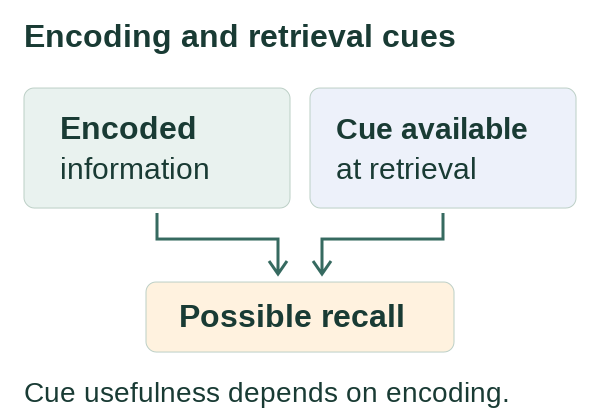
Newman and colleagues tested this idea in eight experiments published in 1982. Recall was generally strongest if the context at test matched the context during learning. These results provided general support for the original hypothesis across many trials. Several tests produced counterexamples to the early hypothesis.[1]
Tulving and Thomson updated their account with a principle stated in 1973. This later principle accommodated the unexpected results from the strong cue conditions. It relied on the assumption that strong cues were also present at encoding. The data showed recall facilitation was independent of semantic integration degree. The findings also went against the semantic integration account put forward by Baker and Santa.[1]
In 1982, Lee replied to Crocker's concerns about using encoding specificity to explain the study's results. Crocker had questioned whether ideas from outside movement research could guide studies of motor behavior. Lee argued that those concerns rested on flawed reasoning about theory and methods. Lee treated the concerns about theory and methods separately from the broader issue of how theory should guide research. Lee warned that Crocker's broader view might hold back progress in memory research.[6]
Main ideas
Prospective memory and competing explanations
McBride and Abney tested three ways that an ongoing task and a prospective-memory task could match or differ. Two matched on perceptual processing; the third paired a conceptual ongoing task with a perceptual planned task. One matching condition made the planned task focal; the remaining matched and mismatched conditions made it non-focal. People completed the planned task more accurately in the focal condition than in either non-focal condition.[7]
That result for correct answers fits what the multi-process view predicts for prospective memory. After accounting for practice, the time cost of the planned task did not differ across the conditions. The timing results thus went against the cost predictions of this view, even though correct-answer rates fit it.[7]
Janiszewski and Chandon studied how asking about a plan can change the chance that someone will carry it out. Earlier accounts linked this mere measurement effect to making an attitude about the act easier to bring to mind. They proposed that answering the question and making the choice may share processes, which makes the later thought feel more fluent. A person may read that fluent feeling as support for the act they are leaning toward. Across eight studies, the authors found that processing fluency also plays a part in the mere measurement effect.[8]
Cue distinctiveness and competition
The memory-as-discrimination view asks how well a cue sets the target apart from other things a person might retrieve. On this view, matching study and test cues may help only when the match makes the target easier to distinguish. Badham and colleagues tested this view in two studies, varying cue overlap and how well cues set targets apart. In Experiment 1, training minimized age differences in memory for cue-target pairs. The researchers then used response times to measure how efficiently people retrieved what they had learned.[3]
Experiment 2 left the age-group gap in learning associations free to vary. That experiment used correct-answer rates, instead of response times, to measure how well people retrieved the items. Both studies fit memory-as-discrimination in young adults and older adults. A closer match between study and test cues did not help unless it also made the target easier to distinguish.[3]
In Experiment 1, prior knowledge helped older adults form links between the items. In Experiment 2, a closer match between study and test helped older adults more than young adults. The authors proposed that older adults' weaker memory links left fewer rival items to compete at recall. They proposed a joint benefit: a cue was more likely to reach the target while fewer other candidates competed with it.[3]
In the second learning phase, people studied the items again, then chose a target using one or two cues. The four conditions used one unique cue, one shared cue, a unique-plus-shared pair, or two unique cues. Each condition had four trials, giving 16 trials in that test phase. The cues appeared in randomly chosen positions on each trial. For one-unique-cue tests, cues came from study triplets with two unique cues or with a unique-plus-shared pair. When just one cue was shown, a small black square filled the other space on the screen.[3]
Three possible targets appeared at the bottom, with the digits 1, 2 and 3 beneath them. People pressed key 1, 2 or 3 to choose the target that had been paired with the cue. Target order was set at random for each person, then stayed fixed for that person. Across people, the target with two unique cues occupied the first, second and third positions equally often. For each person, that target kept its place whether or not the items fit the schema. In shared-cue tests, one possible answer was removed so that people would not favor one response.[3]
A shared cue was tested equally often with each of its two targets. Training stopped at six blocks or after two successive attempts reached at least 75 percent correct in each of the four cue conditions. The main test then used 48 trials, with 12 trials for each cue condition. The longer test added a speed instruction to the accuracy instruction: people should answer as quickly as possible. The order of the main-test trials was randomized separately for each person. The procedure was repeated at the other level of schema consistency; people could rest as long as they wished between conditions.[3]
Research
Encoding versus retrieval
Transfer-appropriate processing links learning with recall, so a change at either stage should have much the same effect. Mulligan and Lozito tested this view with word anagrams, which people solved either while learning or during a later test. While learning, people either solved a scrambled word or read that word in its normal form. At test, they again solved or read words, then judged whether each word had appeared before.[9]
Solving anagrams while learning led to more accurate old-word judgments later than reading words in their normal form. The effect went the other way at test: solving anagrams led to less accurate judgments than reading the words. In Experiment 1, people gave an old-or-new judgment for each word. Experiment 2 used confidence ratings and showed the same reversal.[9]
Tajika tested whether the cue-match account held across different tasks. Three experiments paired free-associate and nonverbal tasks, varying how many associates were used and how long people studied them. Recall beat recognition only in free-associate tasks; only those tasks also showed differences in both scores across the experiments. Tajika questioned cue matching, suggesting that tasks interfere partly through features of the words used in the recognition test.[10]
Wohl and Izawa tested cued recall in 128 college students, varying how closely the words and cues were related. Their design varied cue congruity at study and test, with a delay of either zero or 30 minutes. People recalled more when the cues stayed the same from study to test than when those cues changed. When cues changed, scores were higher with congruous test cues than with incongruous ones. Cues being more closely related to the target had significant effects at study and test, with a significant interaction between stages.[11]
The results fit encoding specificity more often when answers were scored leniently than when they were scored strictly. People forgot more over the 30-minute delay; the loss was statistically significant. The authors concluded that encoding specificity on its own could not explain every part of their findings.[11]
Tajika also asked whether test context changes how well people recall words and recognize them. After a practice list, people studied word pairs and did either a free-associate task or a nonverbal task. They then took a forced-choice recognition test, followed by a test in which cues prompted recall. With a changed context and a free-associate task, people failed to recognize some words that they could still recall. That pattern, along with recall beating recognition, was weaker in the other conditions. Tajika explained the results as tasks disrupting each other, instead of support for the cue-match account.[12]
Tajika tested the cue-match account by changing the recognition task and how often cue words brought out their associates. In Condition I, people made their own free associations in response to 30 cue words from outside the study list. Condition II used associates supplied by the researcher; Condition III used words that people in Condition I had made themselves. Only Condition I fit the cue-match account, with people recalling more words than they recognized. In the other conditions, recognition beat recall; the author explained this as one task disrupting another.[13]
O'Neill, Sutcliffe, and Tulving reported a 1976 study that repeated and extended an experiment from 1972. They argued that Wickens' shift effect may miss some of the features primed over a series of Brown-Peterson trials. In their account, people encode those primed features as a required process, not one they can choose to omit. They also argued that the shift effect reflects both storage and recall, in line with encoding specificity.[14]
Krane varied sensory features of targets and distractors across and within senses, with the targets' meaning-related features kept relatively controlled. Two Brown-Peterson tasks used 40 people and 22 undergraduates, in that order. The first experiment also included a recognition test after a delay. The results fit an episodic account of memory based on how much the sensed features overlapped. Scores fit the overlap of test context with a memory trace, and how much that trace resembled others formed nearby in time. Krane argued that an account based only on meaning cannot explain all such encoding specificity effects.[15]
Weist and Crawford used four conditions to test two views: dependent storage and independent storage. The lists held either words linked by association or words that were not related to one another. People recalled these words either with cues to help them or in a free-recall test without cues. The pattern favored dependent storage when the task gave people cues that helped them retrieve the words. When cues failed to help, the results instead favored the view that items are stored independently.[16]
For the practice list, mean recall scores in Conditions I, II and III were 16.80, 18.80 and 18.50. The difference among those scores was not significant; the F value was below 1. Recognition failure here is the chance of not recognizing a word that a person can recall. In Condition I, people recalled and recognized more target words with low-frequency associate cues than with high-frequency associate cues. The effect of associate frequency was significant: F(1,19) was 8.87, with p below .01.[13]
The type of memory test also had a significant effect: F(1,19) was 25.27, with p below .01. Under high-frequency associate cues, people recalled 35 percent of the target words; under low-frequency cues, they recalled 37 percent. People recognized 17 percent of generated high-frequency targets and 24 percent of generated low-frequency targets. For high-frequency associates, people failed to recognize 74 percent of the generated targets that they could recall. For low-frequency associates, that failure rate was 59 percent among targets that people could recall.[13]
The interaction of frequency with the type of memory test was not significant; F(1,19) was 2.30. For 15 high-frequency cue words, people produced a mean of 47.9 associates. That total amounts to a mean of 3.2 response words for each high-frequency cue. For the set of 15 low-frequency cues, people produced a mean of 50.4 associates. That total amounts to a mean of 3.4 response words for each low-frequency cue.[13]
Processing and retrieval demands
Bramão and Johansson recorded brain waves to test how the match between learning and test tasks relates to memory. People learned links between words and pictures of faces, landmarks or objects. Later tests asked them to retrieve either visual details or names for the pictured items. Early in learning, brain-wave patterns could distinguish the kinds of pictures people saw. Those visual patterns predicted later memory scores, but the direction of the link differed between the two tasks.[17]
Visual category patterns during learning predicted later memory, with a benefit when the test asked for visual details. Those learning patterns predicted a memory cost when the later task asked for verbal information. When those visual patterns reappeared during the test, their link with scores again depended on what the task asked. When visual patterns reappeared, scores were better on the visual task but worse on the name task; these were associations. The authors suggest that processing one aspect of an event can hinder later memory when a test asks for another aspect.[17]
Huang and colleagues studied links between the hippocampus and cortex while people learned about objects. Nineteen people viewed pictures of real objects as researchers recorded their brain activity with fMRI. Later tests asked about both the concepts of the objects and the exact pictures people had seen. The cortex showed strong patterns for visual details and meaning in the regions linked to each kind of information. The hippocampus did not show the same strong patterns for those visual details and meanings.[4]
The authors linked activity in the hippocampus to how well patterns in the cortex predicted later memory. Visual patterns in occipital cortex, linked with the hippocampus, gave the best prediction of memory for picture details. Patterns for meaning, linked with hippocampal function, gave the best prediction of memory for object concepts. The reverse pairings lacked support through links to the hippocampus: visual patterns with concept memory, and meaning patterns with picture memory. The findings suggest that different hippocampal functions work with cortical patterns in ways suited to what a later test needs.[4]
In the visual task, correct category choices earned category hits; choosing the original picture as well earned exact-picture hits. Category answers were correct on 69 percent of trials on average, with a standard deviation (SD) of 13 percentage points. Within correct category trials, exact-picture hits had a mean of 74 percent and an SD of 6 percentage points. The rate of correct exact-picture choices was significantly above the chance level of 50 percent. That above-chance result gave t = 16.7 with 17 degrees of freedom and p below 0.001. On the verbal test, a name or rich details that identified the target counted as an exact-item hit.[17]
A category hit meant showing knowledge of the pictured item's category, even without identifying the item. People recalled names on a mean of 53 percent of trials, with an SD of 16 percentage points. Category knowledge was shown on a mean of 62 percent of trials, with an SD of 18 percentage points. Exact-item hit rates were higher on the visual test than on the verbal test. That difference was significant, with t = 5.35 and p below 0.001. Category-hit rates, by contrast, did not differ significantly between the visual and verbal tests.[17]
The comparison of category-hit rates gave t = 1.33 and p = 0.194. On the visual test, people were less accurate for faces than for either landmarks or objects. The comparison gave t = -5.1 for landmarks and t = -7.7 for objects. On the verbal test, recalling landmark names was harder than recalling names for faces or objects. Here, t was -3.2 in the comparison with faces and -3.1 in the comparison with objects.[17]
The object study included 19 people: seven female and twelve male. Its later tests assessed both memory for object concepts and memory for the exact images. Visual patterns in ventromedial occipital cortex were linked to later memory for picture details. Their strength worked with activity and pattern information from the hippocampus, recorded while people learned. Patterns for meaning in the left inferior frontal gyrus helped predict later memory for object concepts.[4]
The strength of patterns for meaning in angular gyrus also helped predict memory for object concepts. Cortical meaning patterns predicted memory with either activity or meaning-pattern strength in the hippocampus during learning. The account treats the hippocampus as an index linking pieces of information stored across the cortex; that role is a theory. Visual patterns in the cortex did not support concept memory through links with the hippocampus. Nor did patterns for meaning in the cortex support picture-detail memory through links to the hippocampus.[4]
Materials and experimental design
Glover and colleagues ran four studies to compare the levels-of-processing and transfer-appropriate-processing views of memory. Experiment 1 varied the type and placement of questions within groups, then tested which sentences people recognized. The findings seemed to favor transfer-appropriate processing, but the study design left a confound. Experiment 2 tested the same questions with separate groups, addressing the design problem in the first experiment.[18]
Experiment 3 repeated that approach, but tested free recall in place of recognition. Experiments 2 and 3 seemed to favor the transfer-appropriate-processing view, and to go against the levels-of-processing view. Experiment 4 moved from single sentences to memory for whole paragraphs. This time, the findings seemed to favor levels of processing and did not follow the earlier pattern.[18]
Tozios and Fukuda asked whether a change in test context would limit long-term memory for pictures, as encoding specificity might predict. People learned pictures of real objects, each placed on one of three nature scenes. In the consistent condition, an object appeared three times against the same scene. In the variable condition, an object also appeared three times, but against a different scene each time.[19]
The recognition test used either the scene seen during learning or a new, fourth scene. After consistent study, scores were much the same with the old scene and with the new one. Neither study method was better or worse at supporting recognition in a new context.[19]
Liu and colleagues asked whether familiar spatial layouts help people combine objects while holding them in visual working memory. Across five experiments, they varied the layout of real-object pairs and whether people saw them together or one after the other. A regular layout improved scores when people saw the objects at the same time. It did not improve scores when the objects appeared one after the other. The study checked load, verbal suppression, masking and display duration, yet still found no benefit from regular layouts in sequence. The authors favored encoding specificity over the perception-alike view to explain how well people held the objects in mind.[20]
In Experiment 1, showing objects together or in sequence had a significant main effect, with p below 0.001. The interaction of that timing with pair layout was also significant, with p = 0.024. Pair layout on its own did not have a significant main effect; p was 0.077. Planned tests found greater sensitivity for regular pairs shown together, with p = 0.038. For that advantage, effect size d was 0.67 and the Bayes factor BF10 was 2.82. For pairs shown in sequence, the regular and irregular layouts did not differ significantly; p was 0.838.[20]
That sequential comparison gave d = 0.06 and a Bayes factor, BF10, of 0.22. In their Figure 2, bars were dark gray for regular layouts and light gray for irregular ones. Its error bars showed 95 percent confidence intervals around the sensitivity scores. The authors offered a possible explanation: regular layouts may make a stronger sensory impression during simultaneous presentation. They proposed that these stronger impressions help at encoding and may improve visual working-memory scores. The lack of a sequential benefit suggests regular layouts do not help people combine these objects online in working memory.[20]
They favored a benefit while objects are first encoded, rather than help combining them online while they are held in memory. This finding conflicts with earlier work by Gao and colleagues, who found a benefit from regular layouts in sequential trials. The kind of items studied may explain why those two studies produced different results. Gao used simple disks; Liu and colleagues used complex objects from the real world. People might hold some details of complex objects as concepts, not just as visual representations.[20]
The computational view says people judge whether a trait describes them by recalling trait-linked events from their own lives. They then work out how similar the trait is to what they recalled. The trait summary view instead says people rely directly on abstract summary knowledge of their personal traits.[21]
Earlier work used a priming method and supported the trait summary view. The study used a new method that avoided a possible limit of the earlier priming method. Its findings agreed with earlier studies about how people decide whether traits describe them. People can judge whether a trait describes them without recalling trait-linked events from their own lives.[21]
The study tested 24 female undergraduates using active and passive criterion movements. Movements were presented under preselected or constrained conditions during the experiment. Subjects underwent 36 trials combining immediate, 20-sec unfilled, and 20-sec filled retention conditions. These trials also involved active and passive reproduction methods for the subjects. For absolute error under constrained presentations, accuracy was greater when modes matched. Accuracy was lower when presentation and reproduction modes differed from each other.[22]
The study included 40 third graders and 40 sixth graders as participants. These students learned items presented with highly related picture cues during the task. Cued recall produced higher recall than free recall under specific initial instructions. This benefit occurred when subjects were told retrieval would occur with cues.[23]
The difference between cued and free recall was not statistically reliable otherwise. This null result applied when subjects were initially instructed merely to memorize items. It appears subjects used storage cues without specific instruction in certain conditions. This usage happened if they knew these cues would be present during retrieval.[23]
Cue categories and counterexamples
Epstein and Dupree used category headings as recall cues in two tests of encoding specificity. Each experiment involved 20 college students: 10 male and 10 female. Students sorted 32 words into eight named categories and placed 16 words in an uncategorized group. At recall, category headings cued half of the words in each group, including half of those left uncategorized.[2]
On the free-recall test, people recalled more words that they had sorted into categories while learning. With category cues at test, recall was nearly equal for words sorted at study and words left uncategorized. The authors treated this as a counterexample: category cues helped recall even for words that had not been sorted at study.[2]
Dietze and colleagues asked whether matching study and test cues helps children as it helps adults. Four groups took part: adults, plus children aged 11, 7 and 9 years. People studied pairs of cue and target words whose links were either strong or weak. Recall was tested right away, with cues used at study and new cues from outside the list. Both children and adults recalled more targets when the cue at test was the one used at study. That advantage held for both strong and weak links between the cue and target words.[5]
Song and Oh studied retrieval cues in a university course where students learned a second language. Their quasi-experiment used a series of tests as a teaching method for learning new words. They examined the link between cue type and how well students retained words and transferred what they had learned.[24]
Friestad and Thorson studied how people remember television ads with and without emotional content. Within the television program, viewers saw five ads with emotional content and another five that were neutral. Some people were told to judge each product; others were told simply to watch. At recall, the cue was either an ad's first scene or the category of product it showed.[25]
Recall was faster when product judgments were paired with category cues, or simple watching was paired with opening-scene cues. After just watching emotional ads, people retrieved them faster when cued by the opening scene than by the product category. After judging neutral ads' products, people recalled more and were faster with product-category cues than with opening-scene cues. Cueing the opening scene first, then the product category, raised recall for both emotional and neutral ads. Reversing that cue order lowered recall for neutral ads.[25]
Age and attention boundaries
Puglisi and colleagues tested cued recall in young and older adults in two experiments. One experiment used full attention; the other used divided attention. The targets and cues were pictures or matching words, with strong or weak links in meaning. At recall, people received either the cue used while learning or a different one. For the most part, both age groups recalled more when the cue stayed the same from study to test. With word cues and attention split, older adults were an exception: their results fit general encoding.[26]
Park and colleagues used pictures to ask whether cue-match effects change with age. Young and older adults studied pictures with or without picture cues; cue presence was varied at both study and recognition testing. The results gave no evidence that age interacted with the cue variables. Under control conditions, both age groups showed encoding specificity effects of much the same size. To divide attention, the researchers also asked people to monitor digits while studying the pictures. That added task did not interact with age; both groups again showed effects of much the same size.[27]
Buschke and colleagues tested category-cued recall after people learned with either category cues or item cues. Recall after learning with category cues was about twice that after learning with item cues. In both conditions, older adults recalled fewer items than young adults. Older adults gained less from the closer cue match and deeper processing that the category cues gave them.[28]
For young adults, the regression linking the two recall scores followed a straight line. For older adults, the plot had different straight-line segments, so the relation did not follow a single line. Some older adults without clinical dementia had lower category-cued recall than expected; the authors suggested this may signal preclinical dementia. The two scores were correlated: recall after learning with item cues predicted expected recall after learning with category cues.[28]
Quantitative example and its limits
A study of 24 college students used a 3 by 3 design to test repetition and cues in recall. It combined three repetition conditions with three cue conditions. The repetition conditions were after the 3rd trial, after the 6th trial, and a control condition. At test, cues were reinstated, came from outside the list, or were absent. With repetition after the 3rd trial, mean recall was 183.25, significantly higher than with repetition after the 6th. The mean was 162.38 for repetition after the 6th trial and 147.00 in the control condition.[29]
For the cue comparison, the reported mean recall score with reinstated cues was 165.75. The mean with extra-list cues was 163.50, and the mean without cues was 163.38. The authors described the advantage of reinstated cues over the other cue conditions as marginal. Repetition and cue type did not show a significant interaction in the test. The authors concluded that the two factors independently improved recall in their sample.[29]
In practice
Applications and external validity
Parker and colleagues studied context-dependent memory in a virtual world that looked like the real one. They compared study and test in matching settings with study and test in different settings. People who learned semantic information in virtual reality did well at recognizing it in the real world. People who learned that information in the real world also did well on recognition in virtual reality. The findings support transfer of semantic knowledge between those virtual and real-world settings. They partly repeated Godden and Baddeley's 1980 recognition study, replacing its underwater setting with a virtual one that looked real.[30]
Readence and Moore gave a theoretical case for using related activities before and after classroom reading. They proposed that similar tasks before and after reading could help students understand the text. They suggested encoding specificity as a way to prepare students for what they would read. They also proposed using it to help students recall information from the text. The available abstract gives a case for the teaching ideas, but reports no measured effect in a classroom.[31]
Sun proposed reading lessons for Chinese high-school students based on transfer-appropriate processing. The account links memory to depth of processing and to how well activities and settings match at learning and test. Sun suggested having learners form questions that require close thought about what they read. Sun proposed initial tests and matching physical tasks at learning and test to help students keep new words in mind.[32]
Hashizaki studied 68 Japanese learners of English, using a separate list for each learning method. People learned verb-noun idioms by listening, repeating, or pairing reading with one of those methods. On written tests, form recognition was higher after repeating aloud and after reading while repeating. On spoken tests of form recall, the largest gains followed reading the idioms while also repeating them. The author discussed these differences between spoken and written tests in terms of transfer-appropriate processing and the strong-trace account.[33]
Dando and colleagues compared ways to interview witnesses who had watched a mock robbery. The interview took place 48 hours after people had seen the event. People using their own sketches recalled 26% more correct information than people whose interviewer guided them to mentally reinstate the context. People using their own verbal cues recalled 11% more correct information than those using the interviewer-guided method. Mean combined errors were 34% lower with people's own sketches than when the interviewer guided them to mentally reinstate the context. With self-generated verbal cues, mean combined errors were 22% lower than with that interviewer-guided method.[34]
The study combined different levels of attention and encoding specificity in live-photo and photo-photo conditions. People recognized more faces correctly with greater attention and higher encoding specificity. There was a borderline trend toward better recognition in photo-photo trials than in live-photo trials. The authors discussed what the findings imply for using these eyewitness-study results outside the lab.[35]
Researchers tested implicit voice learning with more similar training and test tasks to see whether familiar talkers would help. People improved more at recognizing sentences in noise for familiar voices than for new voices; the difference was significant. The findings suggest that short-term implicit learning can produce a familiar-talker advantage. The authors explored how the match between training and test conditions might shape that advantage.[36]
Thirty-six trainee interpreters interpreted a speech as they heard it, then reported their decisions right afterward. Group A used a transcript of the source speech; group B used a recording of their interpreted output. The groups did not differ significantly in how informative, accurate or verbose their reports were. People nevertheless differed in how they viewed the cues they had used. The findings suggest that personal reporting styles may matter more than cue type for these reports.[37]
Rats learned fear extinction in a context different from the one used for the original learning. They were then exposed to the training context right away, or after 30 or 60 minutes. With immediate exposure, fear did not renew when the rats were tested in the original context. With longer delays, that reduction in fear renewal became weaker or disappeared. The authors suggested that an active memory of extinction at the time of context exposure matters for cue transfer.[38]
In another experiment, rats were exposed to contextual cues from a new setting right after learning a punishment task. When tested in that new setting, the rats treated it as though it were the training context. Rats tested in the original setting behaved similarly, showing that the old context still worked as a cue. The authors suggested that cues had gained a link to the new context while retaining their link to the old one.[39]
The witness study set alpha at .017 for tests of whole-interview scores and scores from each phase. One planned test pooled the sketch and verbal-cue groups, then compared them with the group guided to mentally reinstate context. A second planned comparison tested the sketch group against the self-generated verbal-cue group. Whole-interview scores did not differ significantly by interviewer across the groups. The later models therefore did not include a covariate for who gave the interview. Cue condition had a significant effect on correct recall across the interview, with p below .001.[34]
The effect of cue condition on errors was also significant, with p = .001. Cue condition had a significant effect on confabulations, with p below .001. The linear trend for confabulations was not significant: F(1, 146) = 0.416 and p = 0.520. Mean correct counts were 25.40 with sketches, 22.40 with verbal cues and 20.20 with mental reinstatement. Mean error counts were 1.71 for sketches, 1.56 for verbal cues and 2.29 for mental reinstatement. Mean confabulation counts were .80 with sketches, 1.38 with verbal cues and 1.50 with mental reinstatement.[34]
During free recall, mean correct counts were 15.75 for sketches, 12.18 for verbal cues and 10.98 for mental reinstatement. During probing questions, mean correct counts were 9.69 for sketches, 10.18 for verbal cues and 9.25 for mental reinstatement. Accuracy was 91.16% for sketches, 88.79% for verbal cues and 84.12% for mental reinstatement. Completeness was 41.08% for sketches, 36.00% for verbal cues and 32.63% for mental reinstatement. People using their own cues recalled more correct information than the mental-reinstatement group; this test gave t(146) = 7.789. That difference was significant, with p below .001 and an effect size d of 2.68.[34]
Earlier idiom studies used mixed lists, applying more than one learning method to items in a single list. Hashizaki instead used a pure-list design, giving each learner four lists. All items within a list were learned through the same method. Earlier studies had relied almost entirely on written tests of recognition. Hashizaki also tested recall and included spoken tests, which earlier work had largely left out.[33]
People learned 64 verb-noun idioms across the four active learning conditions. Those conditions were listening, repeating, reading while listening, and reading while repeating. A fifth, unexposed control condition contained 16 items that people had not studied. Tests assessed recall of forms, recognition of forms and recognition of meanings. Each of those test types was given in both a written and a spoken form.[33]
Asked what might help, some group A members suggested hearing their output recording in place of reading the source transcript. 4 members of group A named that switch as a possible aid to reporting their decisions. 3 said they would like the recording alongside the source transcript, rather than in its place. 2 thought that focusing better while interpreting might help them report their decisions afterward. 1 wanted a transcript of their own interpreted output to use when reporting. 1 wanted to know before interpreting that they would later be asked to report their decisions.[37]
Members of group B, who had used output recordings, also suggested possible aids to reporting. 3 said reading a transcript of the source speech might help them. 2 wanted to listen to the output recording while reading the source transcript. 2 thought a slower pace from the speaker could help with the task. 2 wanted advance notice that they would need to report their decisions afterward. 2 also mentioned being able to listen again to their interpreted output.[37]
Both groups viewed the cue they had actually used as helpful. Most people in group A thought hearing their own output recording would help to some degree. Group B was less united in its views about reading the source-text transcript. 3 people in group B thought access to that transcript would make no difference. 4 people in group B judged that proposed cue to be of no use.[37]
Gumul suggested that views about the cues differed slightly more than the objective report measures did. Those subjective differences concerned how useful the cues seemed and how hard it felt to recall decisions. The report measures compared the amount of speech, its accuracy and how much information it gave.[37]
What this looks like when you study
Readence and Moore propose similar tasks before and after reading to help students recall the text. The abstract sets out why this match might help students get ready for reading and later recall what they read.[31] After repeating idioms aloud, the Japanese learners of English in Hashizaki's study scored higher on written tests of form recognition. In that study, reading while repeating gave the largest gains when learners had to recall the forms in spoken tests. The reported benefits were for different skills: written form recognition and spoken form recall.[33]
In Badham and colleagues' studies, matching cues helped only if they set the target apart from the items competing with it. The authors proposed that fewer rival items partly explain older adults' larger gain in Experiment 2, along with a closer cue match.[3] Song and Oh discuss why cues may differ in how well they support second-language word learning. They suggest choosing suitable cues to help learners engage more deeply with the study material.[24]
Criticism
Limits, criticisms and open questions
When people divide their attention while learning, the usual cue-match effect can have limits. In Puglisi and colleagues' study with full attention, older adults showed the usual benefit from matching cues. When attention was split and cues were words, older adults showed evidence of general encoding. Apart from that older-adult verbal-cue exception, the study found strong cue-match effects in both age groups.[26] Study design also shapes which account of memory the results appear to support. Glover and colleagues' first three sentence studies seemed to favor transfer-appropriate processing, though the first had a design confound.[18]
Their fourth study used whole paragraphs and instead seemed to favor the levels-of-processing view. They discussed how choices of design, study material and measured outcome work together to shape the results.[18] In rats, cue transfer to a new context need not remove the ability of the old context to cue the memory. Tests in the original context showed that those old cues remained effective as well.[39] A separate rat study linked the timing of context exposure to whether fear renewed after extinction.[38]
The hypothesis was not supported in several experiments under wide ranging conditions. Recall was better with strong extralist retrieval cues than with no cues. This pattern occurred in Experiments 2 through 7 of the reported series. Strong cues also outperformed weak extralist cues present at retrieval in Experiment 8.[1]
Common misconceptions
Methods and concepts used to explain word memory may not fit the study of movement memory. Lee and Hirota said their 1980 study showed that encoding specificity applies to memory for movements. Crocker argued that their account mixed effects of the methods with issues about the theory. Crocker suggested that generation-recognition models also fit the results.[40]
Such models describe producing possible answers and then recognizing which of those answers meets the test criteria.[13] Crocker argued that the study did not test well enough how encoding is related to retrieval. The critique also discussed risks in taking concepts from word-memory research and applying them to movement. The critique targeted using concepts from word memory for movement tasks without checking their fit.[40]
Key studies
| Year | Study | Sample | Design | Finding |
|---|---|---|---|---|
| 1977 | Epstein & Dupree[2] | 20 college students in each experiment: 10 male and 10 female | Two experiments varied how words were grouped at study and whether category cues appeared at recall. | Category cues brought recall to nearly equal levels for words grouped and not grouped during learning. |
| 2021 | Gumul[37] | 36 trainee interpreters | After interpreting a speech, trainees recalled their decisions using either a source transcript or recordings of their interpreted speech. | The cue groups did not differ significantly in report length, informativeness or accuracy, although their views of the cues differed. |
| 2024 | Huang et al.[4] | 19 participants: 7 female and 12 male | Brain imaging during object learning was related to later memory for object concepts and particular images. | Visual and semantic brain patterns predicted different later memory outcomes in coordination with hippocampal measures. |
| 2026 | Hashizaki[33] | 68 Japanese learners of English | Each participant studied four idiom lists, with one learning method per list; tests covered written and spoken forms. | Vocal practice had benefits that varied with test format; reading while repeating gave the strongest gains in spoken form recall. |
| 2026 | Grace O. Anderson et al.[29] | 24 undergraduate participants | A factorial experiment varied repetition timing and the cues given at recall. | Recall means were 183.25, 162.38 and 147.00 for third-trial, sixth-trial and control conditions; the interaction was not significant. |
| 2026 | Dando et al.[34] | People who had watched a mock robbery | Witnesses used their own sketches, their own verbal cues, or interviewer-guided mental reinstatement at a later interview. | Self-generated cues yielded more correct recall, with lower combined errors, than the interviewer-guided method in this mock-witness study. |
See also
References
- Newman, S. E., Cooper, M. H., Parker, K. O., Sidden, J. A., Gonder-Frederick, L. A., Moorefield, K. M., & Nelson, P. A. (1982). Some Tests of the Encoding Specificity and Semantic Integration Hypotheses. The American Journal of Psychology, 95(1), 103. doi:10.2307/1422662
- Epstein, M. L., & Dupree, D. A. (1977). Category Headings as Recall Cues: A Test of the Principle of Encoding Specificity. The Journal of General Psychology, 97(1), 101-108. doi:10.1080/00221309.1977.9918506
- Badham, S. P., Poirier, M., Gandhi, N., Hadjivassiliou, A., & Maylor, E. A. (2016). Aging and memory as discrimination: Influences of encoding specificity, cue overload, and prior knowledge. Psychology and Aging, 31(7), 758-770. doi:10.1037/pag0000126
- Huang, S., Howard, C. M., Hovhannisyan, M., Ritchey, M., Cabeza, R., & Davis, S. W. (2024). Hippocampal Functions Modulate Transfer-Appropriate Cortical Representations Supporting Subsequent Memory. The Journal of Neuroscience, 44(1), e1135232023. doi:10.1523/jneurosci.1135-23.2023
- Dietze, P. M., Sharman, S. J., Powell, M. B., & Thomson, D. M. (2011). Context Reinstatement Effects in Children's Cued Recall of Strongly and Weakly Associated Word Pairs. The Australian Educational and Developmental Psychologist, 28(2), 91-100. doi:10.1375/aedp.28.2.91
- Lee, T. D. (1982). Encoding Specificity: A Reply to Crocker (1981). Journal of Motor Behavior, 14(1), 86-90. doi:10.1080/00222895.1982.10735265
- McBride, D. M., & Abney, D. H. (2012). A Comparison of Transfer-Appropriate Processing and Multi-Process Frameworks for Prospective Memory Performance. Experimental Psychology, 59(4), 190-198. doi:10.1027/1618-3169/a000143
- Janiszewski, C., & Chandon, E. (2007). Transfer-Appropriate Processing, Response Fluency, and the Mere Measurement Effect. Journal of Marketing Research, 44(2), 309-323. doi:10.1509/jmkr.44.2.309
- Mulligan, N. W., & Lozito, J. P. (2006). An Asymmetry Between Memory Encoding and Retrieval: Revelation, Generation, and Transfer-Appropriate Processing. Psychological Science, 17(1), 7-11. doi:10.1111/j.1467-9280.2005.01657.x
- TAJIKA, H. (1978). Features of recognition tasks in encoding specificity. The Japanese journal of psychology, 48(6), 344-347. doi:10.4992/jjpsy.48.344
- Wohl, M. K., & Izawa, C. (1980). Congruency, Scoring Method, and Encoding Specificity in Cued Recall. The Journal of General Psychology, 102(1), 13-26. doi:10.1080/00221309.1980.9920959
- TAJIKA, H. (1978). Features of recognition tasks in encoding specificity: The function of context in recognition tasks. Japanese Psychological Research, 20(2), 93-100. doi:10.4992/psycholres1954.20.93
- TAJIKA, H. (1977). Features of recognition tasks in encoding specificity: Types of frequency associates in extralist cue words and types of recognition tasks. PSYCHOLOGIA, 20(3), 151-158. doi:10.2117/psysoc.1977.151
- O'Neill, M. E., Sutcliffe, J. A., & Tulving, E. (1976). Retrieval Cues and Release from Proactive Inhibition. The American Journal of Psychology, 89(3), 535. doi:10.2307/1421625
- Krane, A. R. (1979). The Role of Sensory Attributes as Retrieval Cues Or as Interference in Retrieval of Information from Episodic Memory. The Journal of General Psychology, 101(2), 227-247. doi:10.1080/00221309.1979.9920077
- Weist, R. M., & Crawford, C. (1972). Effectiveness of Retrieval Cues and the Issue of Independent vs Dependent Storage. Psychological Reports, 31(2), 501-502. doi:10.2466/pr0.1972.31.2.501
- Bramão, I., & Johansson, M. (2018). Neural Pattern Classification Tracks Transfer-Appropriate Processing in Episodic Memory. eneuro, 5(4), ENEURO.0251-18.2018. doi:10.1523/eneuro.0251-18.2018
- Glover, J. A., Rankin, J., Langner, N., Todero, C., & Dinnel, D. (1985). Memory for Sentences and Prose: Levels-of-Processing or Transfer-Appropriate-Processing? Journal of Reading Behavior, 17(3), 215-234. doi:10.1080/10862968509547541
- Tozios, C. J. I., & Fukuda, K. (2022). The multiple encoding benefit: encoding specificity does not hinder the retrieval generalizability of visual long-term memory. Journal of Vision, 22(14), 4047. doi:10.1167/jov.22.14.4047
- Liu, X., Liu, R., Guo, L., Astikainen, P., & Ye, C. (2022). Encoding specificity instead of online integration of real-world spatial regularities for objects in working memory. Journal of Vision, 22(9), 8. doi:10.1167/jov.22.9.8
- Klein, S. B., Loftus, J., & Plog, A. E. (1992). Trait Judgments about the Self: Evidence from the Encoding Specificity Paradigm. Personality and Social Psychology Bulletin, 18(6), 730-735. doi:10.1177/0146167292186009
- Lee, T. D., & Hirota, T. T. (1980). Encoding Specificity Principle in Motor Short-Term Memory for Movement Extent. Journal of Motor Behavior, 12(1), 63-67. doi:10.1080/00222895.1980.10735206
- Kobasigawa, A. (1975). Effects of Retrieval Cues on Children's Recall following Free- or Cued-Recall Instructions. Perceptual and Motor Skills, 40(1), 187-191. doi:10.2466/pms.1975.40.1.187
- Song, D., & Oh, E. Y. (2017). The Effects of Retrieval with Different Cues on Second Language Vocabulary Learning. Journal of Language Teaching and Learning, 7(1), 30-42. doi:10.66887/jltl.v7i1.35
- Friestad, M., & Thorson, E. (1993). Remembering ads: The effects of encoding strategies, retrieval cues, and emotional response. Journal of Consumer Psychology, 2(1), 1-23. doi:10.1016/s1057-7408(08)80072-1
- Puglisi, J. T., Park, D. C., Smith, A. D., & Dudley, W. N. (1988). Age Differences in Encoding Specificity. Journal of Gerontology, 43(6), P145-P150. doi:10.1093/geronj/43.6.p145
- Park, D. C., Puglisi, J. T., Smith, A. D., & Dudley, W. N. (1987). Cue Utilization and Encoding Specificity in Picture Recognition by Older Adults. Journal of Gerontology, 42(4), 423-425. doi:10.1093/geronj/42.4.423
- Buschke, H., Sliwinski, M., Kuslansky, G., & Lipton, R. B. (1995). Aging, encoding specificity, and memory change in the Double Memory Test. Journal of the International Neuropsychological Society, 1(5), 483-493. doi:10.1017/s1355617700000576
- Grace O. Anderson, Nyitor A. Shenge, & Emmanuel E.Uye (2026). Hebb Repetition Effect and Encoding Specificity on Memory Recall Among Undergraduates. Jurnal Ilmu Pendidikan dan Sosial, 5(2), 736-747. doi:10.58540/jipsi.v5i2.2172
- Parker, J. A., Kaplan, A. D., Volante, W. G., Abich, J., & Sims, V. K. (2020). Exploring the Encoding Specificity Principle and Context-Dependent Recognition in Virtual Reality. Proceedings of the Human Factors and Ergonomics Society Annual Meeting, 64(1), 1481-1485. doi:10.1177/1071181320641353
- Readence, J. E., & Moore, D. (1979). Strategies for enhancing readiness and recall in content areas: The encoding specificity principle. Reading Psychology, 1(1), 47-54. doi:10.1080/0270271790010107
- Sun, S. (2024). The Application of Transfer-Appropriate Processing for Enhancing Reading Comprehension of Chinese High Schoolers. Arts, Culture and Language, 2(4), 1722. doi:10.61173/ckpx0780
- Hashizaki, R. (2026). The Production Effect in Second Language Verb–Noun Idiom Learning: Evidence From Pure-List Designs and Transfer-Appropriate Processing. Language Teaching Research. doi:10.1177/13621688261454077
- Dando, C. J., Dando, R. V., Richardson, H., Osorio Rojas, A., & Taylor, D. A. (2026). Supporting Witnesses and Victims to Invoke Episodic Retrieval Mode: Own-Generated Verbal- and Sketch-Reinstatement-of-Context Retrieval Cues Improves Recall Versus Interviewer-Generated Mental Reinstatement of Context Cues. Behavioral Sciences, 16(2), 245. doi:10.3390/bs16020245
- Maass, A., & Brigham, J. C. (1982). Eyewitness Identifications: The Role of Attention and Encoding Specificity. Personality and Social Psychology Bulletin, 8(1), 54-59. doi:10.1177/014616728281009
- Case, J., Seyfarth, S., & Levi, S. V. (2018). Short-term implicit voice-learning leads to a Familiar Talker Advantage: The role of encoding specificity. The Journal of the Acoustical Society of America, 144(6), EL497-EL502. doi:10.1121/1.5081469
- Gumul, E. (2021). Retrospective protocols in simultaneous interpreting: Testing the effect of retrieval cues. Linguistica Antverpiensia, New Series – Themes in Translation Studies, 19. doi:10.52034/lanstts.v19i0.547
- F. Briggs, J., & C. Riccio, D. (2009). Transfer of Extinction Retrieval Cues Attenuates the Renewal Effect in Rats. The Open Psychology Journal, 2(1), 71-76. doi:10.2174/1874350100902010071
- Briggs, J. F., & Riccio, D. C. (2008). Fate of the Original Retrieval Cues Following the Transfer of Memory in Rats. The Open Psychology Journal, 1(1), 51-54. doi:10.2174/1874350100801010051
- Crocker, P. R. E. (1982). Encoding Specificity in Short-Term Memory for Movement Information: A Comment on Lee and Hirota (1980). Journal of Motor Behavior, 14(1), 81-85. doi:10.1080/00222895.1982.10735264
Cite this page: Atlas Nova editors. (2026). Encoding specificity principle. Atlas Nova. https://velocer.io/atlas/encoding-specificity/