Method · Reading
SQ3R
Reading study method
Overview
What SQ3R is and where it came from
A 2004 experiment in Indonesia compared the method with conventional reading for first-year students at a junior secondary school in Kutoarjo. Students taught with SQ3R read at 62,60 words per minute on average, against 54,61 words per minute for the conventional class. The difference between the two methods was significant, with t = 7,35 and P < 0,001.[8]
One 2021 study at a junior secondary school in Indonesia used 60 eighth-grade students and a 25-item multiple-choice test. The experimental group's post-test scores ran from 32 to 72, while the control group's post-test scores stayed between 28 and 60.[9] Smaller qualitative studies have described how the steps are carried out in class, with 4 students in one case and 17 students in another.[10][11]
Main ideas
The five steps in published lesson plans
A descriptive qualitative study of reading instruction at a university set out the sequence in detail. In the survey stage the lecturer supplied reading material and students examined the text before reading it closely. In the question stage the lecturer guided students to close the text and write questions from what they had found in the survey. During reading, students read carefully with their own questions in view. The recite stage tested recall: students stated each question and answered it without looking at their notes. In review, students went over their important notes and summarized how the main points connected.[3]
A descriptive qualitative study of a seventh-grade class at a madrasah in Ponorogo recorded a shorter version of the routine in the teacher's lesson plan. The SQ3R steps observed there were survey, read, recite and review, with no separate question stage recorded. The same teacher also used choral reading, in which the teacher gave an example of correct reading, the students repeated after the teacher, and the teacher moved around the room checking for mistakes. Two problems arose in that class: students were not enthusiastic about the lesson, and they often came without dictionaries. The teacher announced that an assignment would have to be submitted, kept using the methods across several meetings, and told students to get a dictionary from a classmate in another class or from the library.[12]
An action research study with 38 eleventh-grade students and an English teacher as observer ran two cycles, the second built on revisions from the first, and stopped after the second cycle.[13] A study of grade VII students also ran two cycles and gathered quantitative data from formative tests in each cycle, alongside qualitative observation data.[14] A study of tenth-grade students at one senior high school drew on interviews, observation, tests, a questionnaire and English scores across two cycles.[15] A study of tenth-grade students majoring in electrical power installation engineering at a vocational high school collected data through observation sheets and reading comprehension tests over two cycles.[16]
One implementation took place entirely online, which changed the materials a teacher needed. That qualitative study followed 25 eighth-grade students and gathered student interview questionnaires, transcripts of teacher interviews and photographs of the online lessons. Its conclusion was that the method can be applied online when teachers create media that help students understand the steps. The study also noted a problem that motivated the work: many students were not learning effectively and tended to rely on smartphones rather than on their own ideas.[17]
A true experimental design compared a control class and an experimental class, one taught with SQ3R and one without, on narrative texts.[18] A quasi-experiment with a non-equivalent control group design assigned one class to the experiment and one to the control by random sampling.[19] A mixed-method study with a quantitative and qualitative model split 24 eighth-grade students into a control group of 12 and an experimental group of 12 and used a reading test and a questionnaire.[20] A comparison of two fourth-grade classes reported pre-test and post-test averages for an experimental class and a control class.[21]
Other studies used a single class and no control group.[22][23] A pre-experimental design with a pre-test and a post-test drew one class of 30 students from a population of 60 eleventh-grade students.[23] A pre-experimental study took one class by quota sampling from a population of 90 students in South Sulawesi.[22]
A 2025 study in Indonesia examined whether the SQ3R study method could raise higher order thinking skills in sociology lessons, where students had trouble analysing the meaning of texts in depth. Higher order thinking skills, often shortened to HOTS, are the mental operations that go beyond recalling facts: analysing, evaluating and creating. The study took place at SMAN 1 Padang Ganting, a senior secondary school, with students in phase F, the final stage of that school system. The researcher chose SQ3R because its five steps (Survey, Question, Read, Recite and Review) push students to engage actively with material in a systematic way, which was expected to develop the analysing, evaluating and creating skills.[24]
The design was a quasi-experiment of the nonequivalent control group type, in which two intact classes are compared without random assignment of individual students. The population was 65 students, split into an experimental class of 32 and a control class of 33, and total sampling was used, meaning the whole population became the sample. The measuring instrument was a set of 25 HOTS questions that had been tested for validity and reliability.[24]
The researcher concluded that SQ3R was effective for raising students' higher order thinking skills, with students performing better at analysing (C4) and evaluating (C5), two categories of a widely used classification of thinking objectives. The recommendation was for teachers to use the method to build analytical and evaluative skills and to support literacy-based teaching in sociology. The study drew on 65 students in one school, with 32 in the experimental class and 33 in the control class, and measured outcomes with 25 HOTS questions.[24]
Why the method may work
A 2023 review describes reading comprehension as a skill that shapes success in school and in social life. That review places SQ3R among strategies that can be used across the whole reading process, before, during and after reading.[25]
In a 1985 study, three intermediate-grade students with learning disabilities were taught a modified SQ3R procedure. The study found a functional relationship between use of the procedure and better oral retelling of expository material. The researcher's directions and help were gradually removed, and the students then used the procedure quickly and scored their highest retelling marks.[26]
Short-term retention reached 78.125% with SQ3R and 62.5% with direct instruction. Long-term retention, tested 3 weeks after the first test, was 68.75% with SQ3R and 56.25% with direct instruction. Both methods were rated very good, and the study concluded that retention rose more with SQ3R.[27]
SQ3R with metacognition was one of the two most effective learning activities in the study. The conventional method was the least effective way of improving achievement in that sample.[28] A 2014 college biology study measured metacognitive awareness and reading comprehension before and after lessons on active reading. Both the online group of 154 students and the face-to-face group of 152 students improved significantly on both measures. The study suggests that instructors can add effective lessons on metacognitive awareness and active reading to a course in either format.[29]
A 2025 experiment with 96 fourth grade students compared SQ3R with a speed reading method. The two methods differed significantly in their effect on learning motivation, with a significance value of 0.001. They also differed significantly in their effect on reading comprehension, again with a significance value of 0.001. The study concluded that SQ3R was more effective for increasing learning motivation.[30]
Research
The evidence from controlled comparisons
In one quasi-experimental study, 68 Year Three pupils in a Chinese-language primary school in Tangkak district were split into an experimental group and a control group.[31] A quasi-experimental design is a kind of experiment that does not rely on randomly assigning participants to conditions.[32] On the post test, the SQ3R group averaged 73.18 (SP=14.988) and the control group averaged 63.21 (SP=17.952), a significant difference, t(66)=2.486, p<0.05.[31]
A second quasi-experimental study tested the same question in Tamil with 63 Year Three pupils from two primary schools in the Sepang district. The treatment group's mean score rose significantly from pre-test to post-test (p=0.000, p<0.05).[33]
One study took 2 classes of 30 students each at SMA Nasrani 2 Medan, taught one with SQ3R and the other conventionally, and tested both with multiple choice items before and after. Its t-test value was higher than the t-table value (4,23>2,00) at the 0,05 level with 58 degrees of freedom.[34] A study at MTS AMIN DARUSSALAM MEDAN used 2 classes of 32 students each and the same multiple choice pre-test and post-test design.[35][36]
A larger experiment in Gaza divided 119 female eighth graders into three equivalent groups and tested reading comprehension before and after. The SQ3R group's post-test average was significantly higher than the control group's at (α ≤ 0.01).[37]
Both methods raised scores significantly from pretest to posttest. The independent sample t-test gave t-hitung 0,242 against a t-table value of 2,042 at the 5% level and 2,75 at the 1% level.[38] A t-test is a statistical test used to find out whether there is a real difference between the means, or averages, of two different groups.[39] A quasi-experimental study of 68 seventh-grade students at SMPN 2 Ngadiluwih compared KWL with SQ3R on a 20-item multiple-choice test. Both methods produced significant improvements in reading comprehension, but no statistical difference was found between them (p-value = 0.914).[40] A p-value is the probability of observing a difference between groups, or an association between two variables, as large as or larger than the one found if only chance were at work.[41]
Students using SAVI averaged 84.14 and students using SQ3R averaged 72.22.[42] A quasi-experimental study of 58 fourth-grade pupils in Gowa compared SQ3R with CIRC, a cooperative reading method. An independent sample t-test gave a significance value of 0,045, below 0,05, and a second test gave 0,000. The report concludes that CIRC was superior to SQ3R on reading comprehension.[4]
A comparison of SQ3R with SOAR, a study method built on selecting, organizing, associating and regulating, surveyed 100 upper-secondary students from three branches. Students applying either method during reading obtained good comprehension results, and SOAR was the more highly rated technique, especially in science.[2]
Effect sizes reported in quasi-experiments
The clearest two-group comparison comes from a study of fourth-grade students at a school in Gowa Regency, Indonesia, which assigned 26 students to an SQ3R class and 26 to a control class. Before treatment the experimental class averaged 48.15 on the reading comprehension test and the control class averaged 52.88, both in the low category. After treatment the experimental class averaged 85.46, described as a very high category with 100% mastery, while the control class averaged 72.50 with a mastery level of 42.3%. The normalized gain, a score that scales the improvement against the room left for improvement, was 0.71 in the experimental class (high category) and 0.41 in the control class (medium category). An independent-samples t-test gave a t value of 5.364 with a two-tailed significance value of 0.001, below the 0.05 threshold the study set.[1]
A second two-group study compared tenth-grade students at a senior high school in Pajar Bulan, Indonesia, on descriptive texts in English, with one class taught by SQ3R and one by conventional methods. The SQ3R group reached a mean of 67.13 against a mean of 44.55 for the control group, and the difference held under paired and independent t-tests. The report describes the gain as an improvement in summarizing text content, locating specific information and understanding vocabulary.[43] A seventh-grade study at a junior high school in Bululawang, Indonesia, used a quasi-experimental design with two intact classes, teaching one by SQ3R and the other by skimming and scanning. The reading test was given twice, as a pretest and a post-test, and the hypothesis test returned a significance value of 0.000, which the report reads as a significant effect of SQ3R on comprehension of descriptive texts.[44]
A study of 40 sixth-grade students with learning disabilities, randomly divided into two groups of 20 with equal numbers of boys and girls, built an achievement test covering literal, deductive, applied and creative comprehension. The experimental group outperformed the control group on the total score and on the literal, deductive and applied levels at a significance level of 0.05 or less. No significant difference appeared on the creative comprehension level, and no significant differences were attributed to gender.[45]
Other studies measured one group before and after SQ3R instruction, including a class of 24 students at SMPN 1 Mila and a sample of 25 students in class IV (A) at Pondok Darul Ulum Al-Ashri.[46][47] A true-experimental pretest and post-test study of grade VIII students at a school in Gresik, Indonesia, reported an average rise from 61.90 to 78.81, with a significance value of 0.000. The same report describes a true-experimental design in which pretest and posttest scores of an experimental group were compared, with the average rising from 61.90 to 78.81 and a sign value of 0.000, below 0.05.[48] A study of 24 first-year students at a junior high school in Mila, Indonesia, used a set of multiple-choice tests as pretest and post-test and found the post-test higher, analyzed with a t-test formula.[46] A mixed-methods study of 20 third-year Bachelor of Elementary Education students at a Philippine institute found a significant difference after the intervention in literal, inferential and evaluative comprehension.[49]
Test formats also differ: multiple-choice items in one study, an achievement test with named comprehension levels in another, and descriptive texts in English in a third.[43][46][45] One further study of third-year students at a junior high school in Kampar Kiri reports that SQ3R significantly improved comprehension and retention, but its abstract gives no scores, sample size or test statistic.[50] A one-group quasi-experiment with Grade 9 and 10 students at a private school in Kathmandu likewise reports substantial improvement over traditional instruction without reporting the size of the sample or the scores.[51]
Speed of reading and long-term retention
One classroom study of class IX B students measured reading speed in kpm, an Indonesian abbreviation for words per minute, and reported an average of 140 kpm with 54% comprehension in Cycle I and 175 kpm with 90% comprehension in Cycle II. One such study followed students in class IX B across two teaching cycles and recorded an average reading speed of 140 kpm in the first cycle. By the second cycle the average had risen to 175 kpm, and the average share of the reading content that students understood rose from 54% to 90% over the same period. The study concluded that SQ3R improved the students' reading ability, but it reports no comparison group, so the gains cannot be separated from ordinary practice or from repeated testing on similar texts.[52]
A study of a different study method, differential-associative processing, which asks students to compare related concepts pairwise, tested how long the knowledge lasted and whether a short review before the test helped. Knowledge from that method declined as the delay between learning and testing grew, and the decline was about the same as the decline seen in two conditions where students chose their own learning strategy. A 10-minute pre-testing review added to the method's advantage rather than replacing it.[53]
What the mixed-method and survey studies add
Some studies asked students what they thought of SQ3R rather than measuring test scores, including interviews with students at one Indonesian university and a qualitative account of undergraduate EFL students who found the strategy effective for academic texts despite implementation challenges.[54][55] A descriptive qualitative study in Indonesian higher education collected data through observation and interviews with students learning English as a foreign language, a term for students who study English in a country where it is not the main language of daily life. Most students in that study said the method affected their learning process, and the reported benefits were improved reading comprehension, greater curiosity and an easier experience of understanding discourse, meaning connected stretches of text rather than isolated sentences.[54]
A systematic literature review screened empirical work on SQ3R published between 2020 and 2025 and analyzed 20 studies that met predefined inclusion and exclusion criteria, following the PRISMA 2020 reporting guidelines for such reviews. The reviewed studies reported positive effects beyond comprehension itself, including on students' motivation, their engagement in class, their critical reading and their self-regulated learning, meaning the planning and monitoring a learner applies to their own study. The same review found that the research base is narrow: most studies were conducted in Indonesian English-as-a-foreign-language settings and most used quasi-experimental designs, in which whole classes rather than randomly assigned individuals receive the method. Widiawati Kusumah, Fitriyani and Farihah concluded that later work should test SQ3R in a wider range of educational contexts, learner groups and instructional settings, so that the existing evidence can be generalized further.[55]
One study at a vocational secondary school in Indonesia ran two cycles over 16 weeks in the odd semester of the 2022/2023 academic year and recorded a mean reading score of 65 on the first ability test, with 45% of students reaching the required standard. On the second ability test the mean was 85, with 87% of the class reaching the standard, a stated progress figure of 31%. The same study reported an increase in student activity while absorbing teaching materials under the method.[56]
Reading gains in Islamic religious education
A 2025 study by Aprilian and colleagues tested whether the SQ3R learning model raised cognitive learning outcomes in Islamic religious education among seventh-grade students at SMP Negeri 1 Bandar Lampung, a school in Indonesia. Cognitive learning outcomes here means measured performance on a written test of thinking skills rather than on recitation or conduct. The design was a quasi-experiment, a comparison of intact classes rather than of students assigned at random as individuals, with a posttest-only control group: both groups were tested once, after the lessons, and neither was pretested. Two classes were selected at random from the school's classes, one with 32 students taught through the SQ3R model and one with 32 students taught by conventional methods.[57]
The posttest was a multiple-choice test that had been checked for validity and reliability, and it sampled three cognitive levels: understanding (C2), analyzing (C4) and evaluating (C6) in the C-numbered scale used to classify test items by the kind of thinking they demand. The analysis checked the data for normality with the Kolmogorov-Smirnov test and for equal variances with Levene's test. It then compared the groups with an independent samples t-test and computed an effect size (Cohen's d), a standardized measure of how far apart two group means sit in units of spread. The difference between the groups was statistically significant (t(62) = 2.71, p = 0.009). The SQ3R group averaged 79.15 points (SD = 6.10) against 73.20 points (SD = 7.30) for the conventional group.[57]
In practice
How the five steps are carried out
In a study of fourth-grade students, reading mastery rose from 61.90 percent in the first cycle to 90.48 percent in the second, and average scores rose from 71.41 to 87.14.[5] A classroom action research study at SMP Negeri 1 Lemola reported that more than 80% of students reached the achievement indicators after SQ3R was used to teach descriptive texts.[58]
Classroom action research and repeated cycles
At SDN 13 Gresik, 19 fourth-grade students averaged 69.78 in the first cycle and 76.51 in the second, while mastery rose from 52.63% to 84.21%.[59] At SDN 70 Libukang, 12 fifth-grade students moved from 41.67% mastery before the study to 66.67% in Cycle I and 83.33% in Cycle II.[60] At SDN Cideng 13 in Central Jakarta, 16 fourth-grade students rose from a pre-test mean of 71.25 to 75.60 in Cycle I and 78.75 in Cycle II.[61] A study of 17 fourth-grade students at SD Negeri 07 Padang reported learning outcomes of 65% in the first cycle and 82% in the second.[62]
At a senior high school in Surakarta, the mean score was 70.76 on the pre-test, 77.33 in cycle I and 85.33 in cycle II. Each cycle moved through five stages, from spotting the problem and planning the change to teaching, watching and reviewing it.[6] In a class of 21 Grade VII students at MTs Ma'arif NU 1 Ajibarang, the mean was 59.48 before the study, 70.62 after the first post-test and 86.05 after the second.[63] Grade VII students at SMP 9 Tarakan scored 79.09 in Cycle I and 85.04 in Cycle II on the evaluation test.[64] At SMA Negeri 1 Jember, the two cycles each lasted four meetings, and the survey and question steps were placed before reading.[65]
At SMK Al Ikhlash Rambipuji, after SQ3R was used in two meetings, 70% of students were active in the second meeting and 80% scored 70 or higher on the reading test.[66] Among 20 first-semester students of the Economic Department at STIS Nuruddhalam Sumenep, 10 students (50%) gained 10 points over their pre-test in cycle I, and in cycle II, 15 students (75%) did so.[67]
Several of these reports also describe changes in the class itself, not only in scores.[6][68][60][63] Students were said to be more focused on the task, more willing to ask when they did not understand, and more active in class.[6] One report lists five reading aspects that improved: finding the main idea, explicit and implicit information, pronoun reference, and word meaning.[68] Teacher and student activities at SDN 70 Libukang moved from fair to good and very good across the cycles.[60] In the Ajibarang class, students asked about unknown terms, discussed vocabulary and summarized the content of the text.[63]
What students and teachers say
A classroom action research study of 6 elementary teachers, run over 2 cycles, reported that students said they were interested in the method and felt motivated to learn.[69] A qualitative study of 9 fourth graders described the method as effective at capturing students' attention, which the researcher linked to better understanding of the text.[70] A study of 31 fourth graders found that students responded very positively and that lessons ran smoothly and pleasantly.[71]
A study of 80 ninth graders found no significant interaction between the SQ3R method and reading interest, and concluded the method suited students at all interest levels.[72] A study at a Palembang senior high school reported that SQ3R contributed to better reading comprehension achievement.[73]
A quasi-experimental study of grade IV elementary students found that reading comprehension lessons with both CIRC (Cooperative Integrated Reading and Composition) and SQ3R met the criteria for effectiveness. The CIRC and SQ3R comparison still found CIRC more effective, with a mean of 83,33 against 82,70 for SQ3R.[74]
Training teachers to run the five steps
One published account of teacher training in SQ3R comes from a community service program at SMK Muhammadiyah 4 Kalisat, a vocational secondary school in Jember, Indonesia, reported in 2026. The program set out to improve teachers' pedagogical knowledge, meaning their understanding of how to teach, and their instructional skills in applying the SQ3R technique, whose steps are Survey, Question, Read, Recite and Review. It used a participatory approach, in which participants took an active part rather than listening to lectures alone, and combined training workshops, mentoring, classroom simulations and guided field practice.[75]
Effectiveness was judged from pre-test and post-test questionnaires given before and after the training, from classroom observations, and from reflective feedback supplied by the participating teachers. The reported results describe a significant improvement in teachers' understanding of SQ3R and in their ability to carry it out, reflected in higher instructional competence and in more structured reading instruction in the classroom. The report also notes that students showed improved reading comprehension and engagement after the method was applied.[75]
The program's conclusion is that structured, participatory interventions organized through community service can strengthen teacher capacity and support lasting improvement in literacy in vocational secondary education. The report gives no counts of teachers or students, no size for the improvement, and no comparison group, so its claims rest on before-and-after measures and on the observers' and participants' own accounts.[75]
Picture stories and Arabic reading mastery
Picture-story media are illustrated narratives used as teaching material, and one study paired them with the SQ3R reading method to improve reading mastery of Arabic texts. SQ3R stands for Survey, Question, Read, Recall or Recite, and Review, and the study describes the method as well suited to reading more deeply and logically because its steps are structured and practical. The stated aim of the method is to help students remember material better, so that they not only memorize the content but also understand the meaning and concepts within a reading. The study began from observations that students lacked qiraah, or reading comprehension, skills, and that little innovation in teaching methods or materials had left students less interested in learning Arabic.[76]
The classroom action research reported success in the second cycle, when 30 of 37 students (81.5%) completed the task and 7 students (18.5%) did not. The study reports that this result represents an increase of 49% after the SQ3R method was used with picture-story media, and it concludes that the combination can improve students' qiraah skills.[76]
A separate qualitative descriptive study examined the same pairing of SQ3R with picture stories in reading comprehension lessons for a class of 31 students at a primary school in Ponorogo, Indonesia. That study found the syllabus, lesson plans and media were well organized, and that lessons ran smoothly in an effective and enjoyable atmosphere, with students responding very positively. It also recorded constraints: time allocation was less than optimal, and 2 to 3 students had difficulty following the stages of the method because they were still confused and did not pay attention to the teacher.[77]
What this looks like when you study
In a study of 52 fourth-grade students, class IV-A (26 students) learned reading with SQ3R while class IV-B (26 students) used the usual method. The SQ3R class moved from a pre-test average of 48.15 to a post-test average of 85.46, and the control class moved from 52.88 to 72.50. The average N-Gain, a measure of improvement from pre-test to post-test, was 0.71 in the SQ3R class and 0.41 in the control class.[1] In a study of 68 Year Three pupils in Tangkak district, the SQ3R group scored a mean of 73.18 on the post-test and the conventional group scored 63.21.[31]
In a study of 63 Year Three students in the Sepang district, the SQ3R group's pre-test and post-test means differed significantly (p = 0.000), and its post-test mean was higher than the control group's (p = 0.04).[33] A study of 62 class VIII students found that an argument-based SQ3R method had a positive effect on critical reading skills, with Asymp. sig. of 0.00. In that study students were grouped and given several reading sources, and the teacher directed them to argue with each other in their groups.[78]
A study of 32 seventh-grade students in Islamic Religious Education found the SQ3R group's mean was 79.15 and the control group's mean was 73.20, with an effect size (Cohen's d) of 0.88.[57] Cohen's d is a measure of effect size based on the difference between two means, where a value near 0.5 counts as a medium effect and a value near 0.8 as a large one.[79] A study of 37 students using SQ3R with picture story media found that 30 students (81.5%) completed the task in the second cycle, an increase of 49%.[76]
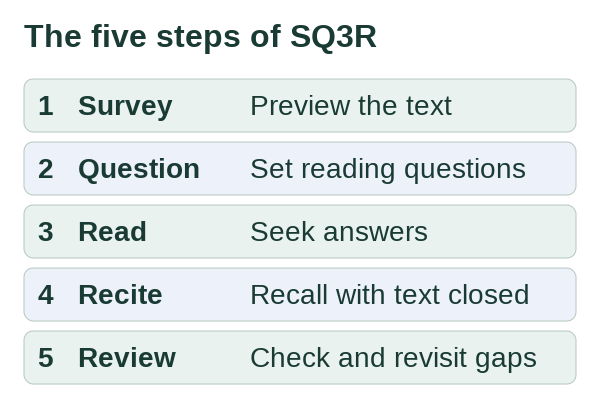
A source recommends that you survey the text first, then turn headings into questions, read to answer them, recite the answers without looking at your notes, and review your notes and summarize the main points. The same source recommends that you review the material regularly to prevent forgetting, and that you explain the material to friends to reinforce understanding. A source recommends that you highlight key terms in your notes and formulate questions with their answers to check your comprehension.[3]
Later developments
Reading in a second language and other subjects
At Jakarta State University, a two-cycle action research project with fourth-semester German language students raised average learning outcomes from 65.85 in cycle I to 87.15 in cycle II. The share of students meeting the minimum mastery standard rose from 56% in the first cycle to 96% in the second.[80] A pre-experimental study of 33 first-semester management informatics students at LP3I Polytechnic found average reading scores rising from 65.45 on the pretest to 77.87 on the posttest. That study computed a t value of 8.37 against a critical value of 2.03, and it also looked at students with a visual learning style.[7]
A 2008 article in the Journal of Marketing Education proposed SQ3R as a partial remedy for marketing students who struggle with assigned textbook reading.[81] In an English as a foreign language class in Indonesia, 24 third-semester students read Islamic texts through one cycle of three meetings. On the achievement test, 19 students, or 75%, scored above 80, and 6 did not reach that score.[82]
Fitriyah and Arfani (2022) report a classroom action research study in two cycles with 34 students at an Islamic college in Jakarta in the academic year 2020/2021, who read O. Henry's short story "The Gift of the Magi" in a literature class. Henry's short story "The Gift of the Magi" with the SQ3R method over two cycles of classroom action research. Henry's short story "The Gift of the Magi" across two cycles, and the study reported improved reading comprehension.[83]
Researchers surveyed 340 junior high school students in the Philippines about how often their teachers used SQ3R and compared that with their performance in Filipino. Reported teacher use was high and Filipino performance sat at a Very Satisfactory level, with a low to moderate positive correlation between the two.[84] A quasi-experimental study in rural Karanganyar, Indonesia, compared seventh graders taught with a local culture based SQ3R against a control group taught by the direct method. The SQ3R group scored better on reading comprehension of ecological wisdom themes, with an effect size of 33.6%, described as a large effect.[85] An effect size is a statistical calculation of how large a measurable effect is, for example the difference between the averages of two groups divided by the standard deviation.[86]
Adaptations for Arabic, economics and science texts
Several studies have carried SQ3R (Survey, Question, Read, Recite, Review) into classrooms where the reading material is not English, including Arabic text instruction at a Malang middle school and at Pondok Darul Ulum Al-Ashri, and social studies economics at SMPN 2 Kota Jambi.[87][47][88] A classroom action research study at a Muhammadiyah middle school in Malang, Indonesia, ran SQ3R over two cycles with a Class VIII C group that struggled to comprehend Arabic texts. The percentage increases on the study's reading indicators reached 68.4% and 74.45% in Cycle I and 88.85% and 90.1% in Cycle II. Because the design was a single class followed across two cycles, the figures describe change within that class and are not compared with a group taught another way.[87]
In social studies and economics, one study compared SQ3R with expository teaching, in which the teacher prepares the material in advance and presents it while students receive the information. The study examined creativity and learning outcomes in the economics portion of the social studies subject at a state middle school in Jambi, Indonesia. Its abstract defines creativity as the ability to produce a composition, product or idea that is new and previously unknown to its author. The abstract describes the SQ3R steps and the contrast with expository teaching but reports no scores, sample size or test result, so the comparison's outcome is not stated in the available record.[88]
Science reading has been approached through an argument-based version of SQ3R, in which students build and weigh arguments as they read. A quasi-experiment with a randomized pretest-posttest control group design drew 62 Class VIII students from two classes and measured critical reading with essay questions and reading interest with a questionnaire. The t-test gave an asymptotic significance of 0.00, below 0.05, and the Mann Whitney U-test on reading interest gave 0.018, also below 0.05, which the researchers read as a positive effect of the method on critical reading. The reported values are significance levels, not effect sizes, so the magnitude of the difference between groups is not given.[78]
A research and development project produced a reading comprehension module for biographical texts about authors of the yellow book, a body of classical Islamic writing, for grade X students, drawing data from three schools. Small-scale product testing scored 83.63, broad-scale testing scored 87.30 and teachers' assessment scored 89.25, and the module was judged suitable for high school (SMA/MA) students.[89] A separate development study tested a student worksheet built on SQ3R and on higher-order thinking skills, meaning tasks that ask for analysis and evaluation rather than recall. Expert review gave the worksheet 87 from a subject-matter expert and 89 from a media expert, both meeting the suitable criterion with minor revision, and the authors called for further testing on limited and wide scales.[90] These two studies report judgments about teaching materials, not gains in students' reading, and neither supplies a comparison group.[89][90]
A quasi-experiment in a grade three class at SD Negeri 03 Sukamaju divided 21 students into an experimental group and a control group. The group taught with SQ3R reached a normalized gain of 0,63, described as a medium to high category, against 0,30 for the control group.[91] A classroom action research study with 23 grade three pupils at SDN 144/VI Bangko reported observation scores that rose from an average of 58.91 in Cycle I to 83.15 in Cycle II.[92]
A quasi-experiment with a non-equivalent control group compared 35 fifth graders taught with SQ3R assisted by comic media with 32 fifth graders taught conventionally. The calculated t value was 2.700 against a table value of 1.997 at the 5% significance level, so the difference in reading comprehension was significant.[93] A classroom action research project with 23 students in class V at SDN 4 Karangrowo used SQ3R with KOMUNANG media over two cycles. Close reading ability rose from 74% in cycle 1 to 84% in cycle 2.[94]
The experimental class rose from a mean of 5,80 to 8,00, and the control class from 5,37 to 7,11. The t test gave 3,25 against a table value of 2,00, so the difference between the classes was significant.[95] A true experiment with 54 class X high school students, plus interviews with four of them, reported score gains in English reading and positive attitudes toward the method.[96]
With 23 second semester students at Universitas Bhinneka PGRI, the mean rose from 59.13 on the pretest to 87.17 on the posttest, a difference of 28.04, with a significance value below 0.001.[97] Second semester English education students at Universitas Muhammadiyah Surabaya averaged 59.67 before and 80.89 after.[98] A qualitative study of 25 fourth semester teacher education students reading scientific articles found the survey and question stages built a focused reading orientation. The same study reported obstacles at the read, recite and review stages, where students struggled to absorb and then state information aloud.[99]
Combining SQ3R with other techniques and tools
One quasi-experiment in a senior high school in Indonesia taught descriptive text through SQ3R combined with Directed Reading Thinking Activity (DRTA), a procedure in which students predict what a text will say and then check those predictions as they read. The 30 students in the sample averaged 54.33 on the reading test before the integrated treatment and 72.53 after it, and a paired samples t-test gave a significance value (2-tailed) of 0.000, below the 0.05 threshold the study set.[100] A paired t-test is a method used to test whether the mean difference between pairs of related measurements is significant.[101] The design had one group and no separate SQ3R-only class, so the gain cannot be split between the two methods.[100]
Two primary school studies paired SQ3R with a visual aid.[102][103] In the first, fourth-grade students at SD Muhammadiyah 1 Krembung worked with pop-up books, books with parts that stand up from the page when it opens, inside an SQ3R lesson. A one-group pretest-posttest design produced a paired sample t-test significance value (2-tailed) of 0.000, below 0.05, which the study read as a significant improvement in reading comprehension.[102] Average scores rose from 71.11% at the first meeting of the first cycle to 74.81% at the second meeting, which the researchers judged short of the success indicators, and then reached 82.96% and 93.33% at the two meetings of the second cycle.[103]
A controlled trial during the pandemic tested SQ3R delivered through the WhatsApp messaging platform. Ninth graders at MTsN 6 Cianjur were assigned at random to an experimental class and a control class, and both groups took a reading comprehension test and a reading interest questionnaire covering situational, individual and topic dimensions before and after the lessons. The significance value (2-tailed) for the post-test reading comprehension scores was reported as 0%, below the 5% level, and the experimental class scored higher than the control class. The same pattern held on all three dimensions of the interest questionnaire, where the significance value was again 0% and the experimental class scored higher. The researchers noted that schools would need to provide free internet access for the approach to work and called for qualitative follow-up research.[104]
A different pairing appears in a 2025 methodological article on extensive reading, the practice of reading large amounts of easy material for fluency, in heterogeneous English classes at a non-linguistic university faculty. The article describes SQ3R and proposes folding selected elements of it into extensive reading lessons for undergraduate and graduate students whose English proficiency ranges from B1 to C1 on the Common European Framework of Reference for Languages. The proposal rests on an argument about the fit between the two approaches rather than on measured outcomes, so it offers no evidence yet that the combination improves communicative competence.[105]
Criticism
Limits, mixed results and open questions
The Palompon trial measured reading comprehension before and after the lessons and reported a significant difference between the two groups at the end.[106] The Banjarmasin study rated the method only as quite effective, a middle category rather than a strong one.[107] The Medan study found a difference between SQ3R with feedback and SQ3R without feedback, with a t value of 1,25 against a table value of 0,67 at a confidence level of 0,05. That comparison tests two versions of SQ3R against each other, not SQ3R against an unrelated method.[108]
A 2 x 2 factorial experiment in Cilegon City set SQ3R against a scramble method and multiple-choice tests against cloze tests, which are passages with words removed.[109] A study of fourth graders compared SQ3R and Cooperative Integrated Reading and Composition, a group reading method, with a control class. The results showed an influence of both methods on reading comprehension skill, so SQ3R was not tested alone against the control.[110]
Key studies
| Year | Study | Sample | Design | Finding |
|---|---|---|---|---|
| 2018 | Larasati et al.[6] | senior high school students in Surakarta | classroom action research, two cycles over two months | The mean score rose from 70.76 to 77.33 in cycle I and to 85.33 in cycle II. |
| 2019 | Almakahleh & Alramamneh[45] | 40 sixth-grade students with learning disabilities | randomly selected control and experimental groups | The SQ3R group scored significantly higher on literal, deductive and applied comprehension, but not on creative comprehension. |
| 2020 | Dewi & Ganing[93] | quasi-experiment with 35 fifth graders in the experimental group and 32 in the control group | The SQ3R group with comic media differed significantly from the conventional group (t count 2.700 against t table 1.997). | |
| 2021 | Fong & Hoon[31] | 68 Year Three pupils in Tangkak district | quasi-experiment | The SQ3R group's post-test mean was 73.18 and the control group's was 63.21, a significant difference (t(66)=2.486, p<0.05). |
| 2023 | Heriana et al.[78] | 62 class VIII students | quasi-experiment with randomized pretest-posttest control group | The argument-based SQ3R method had a positive effect on critical reading skills (Asymp. sig. 0.00). |
| 2024 | Kamila et al.[63] | 21 Grade VII C students at MTs Ma'arif NU 1 Ajibarang | classroom action research, two cycles | The mean rose from 59.48 to 70.62 and then to 86.05, a 21.85% increase from the first to the second post-test. |
| 2024 | Muriawati et al.[76] | 37 students | classroom action research with picture story media | In the second cycle, 30 students (81.5%) completed the task, an increase of 49%. |
| 2025 | Yuda & Mustadi[30] | 96 fourth-grade students | nonequivalent control group pretest-posttest experiment | SQ3R and speed reading differed significantly in reading comprehension (Sig. 0.001), and SQ3R was more effective for learning motivation. |
| 2025 | Mariyapan & Ponniah[33] | 63 Year Three students from two primary schools in Sepang district | quasi-experiment | The treatment group's pre-test and post-test means differed significantly (p=0.000), and its post-test mean was higher than the control group's (p=0.04). |
| 2025 | Aprilian et al.[57] | quasi-experiment with posttest-only control group | The SQ3R group's mean was 79.15 versus 73.20 for the control group, with Cohen's d = 0.88. | |
| 2025 | Safitri[14] | two-cycle action research with 23 grade VII students | Classical completeness rose from 42.30 percent before the action to 69.23 percent and then 88.46 percent. | |
| 2026 | Azmi et al.[1] | 52 fourth-grade students (26 in the experimental class, 26 in the control class) | quasi-experiment with nonequivalent control group | The SQ3R class rose from a mean of 48.15 to 85.46, and the control class from 52.88 to 72.50; N-Gain was 0.71 versus 0.41. |
| 2026 | Rahmi et al.[60] | 12 fifth-grade students at SDN 70 Libukang | classroom action research, two cycles | Learning mastery rose from 41.67% to 66.67% in Cycle I and 83.33% in Cycle II. |
| 2026 | Putri & Wachidah[5] | classroom action research over two cycles with 21 students | Reading mastery rose from 61.90 percent to 90.48 percent, and average scores from 71.41 to 87.14. |
See also
References
- Azmi, M., Khaltsum, U., & Asnidar, A. (2026). THE EFFECT OF SQ3R READING LEARNING METHOD ON READING COMPREHENSION ABILITY OF FOURTH-GRADE STUDENTS AT SD INPRES PAKATTO CADDI GOWA REGENCY: SQ3R Method, Reading Comprehension, Elementary Education, Reading Literacy. KLASIKAL : JOURNAL OF EDUCATION, LANGUAGE TEACHING AND SCIENCE, 8(2), 928-934. doi:10.52208/klasikal.v8i2.1842
- Dionisio Murakami, M. N. (2024). Comparación de dos métodos de estudio SQ3R y SOAR para una mejor comprensión lectora. European Public & Social Innovation Review, 9, 1-19. doi:10.31637/epsir-2024-408
- Anggraini, D. (2024). Implementation of SQ3R in Teaching Reading at University. EDUKASIA Jurnal Pendidikan dan Pembelajaran, 5(1), 1899-1904. doi:10.62775/edukasia.v5i1.1128
- Ilham, I., Munirah, M., & Akhir, M. (2023). Perbandingan Metode SQ3R Metode CIRC terhadap Kemampuan Membaca Pemahaman Siswa. Jurnal Basicedu, 7(2), 1332-1338. doi:10.31004/basicedu.v7i2.5060
- Putri, J. R., & Wachidah, K. (2026). SQ3R Method Optimizes Reading Comprehension Outcomes In Elementary Language Education: Metode SQ3R Mengoptimalkan Hasil Membaca Pemahaman Pada Pendidikan Bahasa Dasar. Indonesian Journal of Education Methods Development, 21(4). doi:10.21070/ijemd.v21i4.1137
- Larasati, S. V., Rais, A. D., & Elyono, D. (2018). Improving Students’ Reading Comprehension By Using Survey, Question, Read, Recite, And Review (SQ3R) Method. English Education, 6(2), 239. doi:10.20961/eed.v6i2.35952
- Fitriani, R. L., & Komala, S. (2024). Use of SQ3R on students’ achievement in reading comprehension with their learning style at LP3I polytechnic. Wiralodra English Journal, 8(2), 14-27. doi:10.31943/wej.v8i2.285
- Santosa, W. H. (2004). Penggunaan Metode Membaca SQ3R pada Siswa Kelas I SLTP di Kutoarjo. Jurnal Penelitian dan Evaluasi Pendidikan, 1(1). doi:10.21831/pep.v1i1.2117
- Widiani, L. (2021). SQ3R strategy in teaching reading. Journal Of Responsible Tourism, 1(2), 165-174. doi:10.47492/jrt.v1i2.1351
- Kusumayanthi, S., & Maulidi, S. M. (2019). The implementation of SQ3R technique in teaching reading comprehension. JELA (Journal of English Language Teaching, Literature and Applied Linguistics), 1(2), 74-80. doi:10.37742/jela.v1i2.14
- Andini, D. (2022). Implementation SQ3R strategy in teaching reading comprehension in MA al-khairiyah walantaka serang-banten. Journal of English Language Teaching and Literature (JELTL), 5(2), 117-128. doi:10.47080/jeltl.v5i2.1751
- Untari, S., & Sri Agung, W. K. (2024). Choral reading and SQ3R methods in teaching reading at the seventh grade students at mtsn 1 ponorogo. Journal of Language, Literature, and Teaching, 5(3), 1-15. doi:10.35529/jllte.v5i3.1-15
- BAKHTIAR, A. (2018). Improving Students' Reading Comprehension by Using SQ3R Method. Scope : Journal of English Language Teaching, 2(02), 99. doi:10.30998/scope.v2i02.2405
- Safitri, L. A. D. (2025). Application of the Survey Question Read Recite and Review (SQ3R) Method to Students' Reading Comprehension Skills. YASIN, 5(2), 1320-1330. doi:10.58578/yasin.v5i2.5213
- Prasetyo, W. (2022). SQ3R Method in Teaching Reading: How It Improves Students’ Comprehension of Narrative Texts at SMAN 2 Trenggalek. FOSTER: Journal of English Language Teaching, 3(1), 44-54. doi:10.24256/foster-jelt.v3i1.83
- Prayoga, Y., Sudarmaji, I., & Forsia, L. (2026). Improving Students’ Reading Comprehension of Procedural Texts through the SQ3R Strategy. English Education:Journal of English Teaching and Research, 11(1). doi:10.29407/jetar.v11i1.28115
- Pribadi, T. R., & Sujatmiko, S. (2022). The Implementation of SQ3R Method for Teaching English Reading Text. JEdu: Journal of English Education, 2(2), 101-107. doi:10.30998/jedu.v2i2.6560
- Mujidah, A. (2021). SQ3R Method for Teaching Reading Narrative Text of the Tenth Grades at MA IslamiyahTanggulangin. Proceedings of The ICECRS, 9. doi:10.21070/icecrs2021883
- Mulyanah, E. Y., & Ishak, I. (2023). Teaching method: Survey, question, read, recite, review (SQ3R) to improve students’ reading comprehension. Globish: An English-Indonesian Journal for English, Education, and Culture, 12(2), 145. doi:10.31000/globish.v12i2.8787
- Biringkanae, A. (2018). The Use Of SQ3r Technique in Improving Students` Reading Comprehension. ELS Journal on Interdisciplinary Studies in Humanities, 1(2), 218-225. doi:10.34050/els-jish.v1i2.4316
- Frasandy, R. N., Fitri, E., Hasnah, H., Aulia, A., & Nisa Septiana, Y. (2025). Penerapan Metode Survey, Questions, Read, Recite, Review (SQ3R) Untuk Meningkatkan Kemampuan Membaca Pemahaman Peserta Didik. Jurnal Pendidikan: Riset dan Konseptual, 9(4), 994-1004. doi:10.28926/riset_konseptual.v9i4.1391
- Kasmawati, K., & Sakkir, G. (2020). Improving students reading comprehension through “survey, question, reading, recite, review (SQ3R)” strategy. Interference: Journal of Language, Literature, and Linguistics, 1(2), 92. doi:10.26858/interference.v1i2.14695
- Anjuni, G. R., & Cahyadi, R. (2019). Improving students’ reading comprehension through SQ3R (survey, question, read, recite and review) technique. PROJECT (Professional Journal of English Education), 2(1), 1. doi:10.22460/project.v2i1.p1-6
- Khairo, L. U., & Nurlizawati, N. (2025). Efektivitas Metode SQ3R dalam Meningkatkan Higher Order Thinking Skill pada Mata Pelajaran Sosiologi. Naradidik: Journal of Education and Pedagogy, 4(4), 580-590. doi:10.24036/nara.v4i4.411
- Kaya, H., & Yılmaz, M. (2023). Sq3r Strategy Importance in Developing Reading Comprehension Skills. The Journal of Academic Social Resources, 8(Cilt 8 Sayı 52), 3257-3263. doi:10.29228/asrjournal.70963
- Alexander, D. F. (1985). The effect of study skill training on learning disabled students' retelling of expository material. Journal of Applied Behavior Analysis, 18(3), 263-267. doi:10.1901/jaba.1985.18-263
- Agustianda, S., Meilinda, M., Nazip, K., Genisa, M. U., Sumah, A. S., & Ismail, G. (2024). Pengaruh Direct Instruction Dan SQ3R Terhadap Retensi Siswa Dalam Pembelajaran Biologi: (The Effects of Direct Instruction and SQ3R on Student Retention In Biology Learning). BIODIK, 10(3), 449-456. doi:10.22437/biodik.v10i3.32679
- Herbst, P. S., & Fritzer, P. (1997). Student Performance in High School Social Studies Using SQ3R and SQ3R with Metacognition. The Journal of Social Studies Research, 21(1), 44-48. doi:10.1177/235227981997021001007
- Hill, K. M., Brözel, V. S., & Heiberger, G. A. (2014). Examining the Delivery Modes of Metacognitive Awareness and Active Reading Lessons in a College Nonmajors Introductory Biology Course. Journal of Microbiology & Biology Education, 15(1), 5-12. doi:10.1128/jmbe.v15i1.629
- Yuda, L. S., & Mustadi, A. (2025). The Efficacy of SQ3R and Speed Reading Method in Improving Students’ Motivation to Learn and Reading Comprehension. Journal of Languages and Language Teaching, 13(2), 888. doi:10.33394/jollt.v13i2.14088
- Fong, C. M., & Hoon, N. M. (2021). The effect of SQ3R on Chinese reading comprehension for Year 3 pupils. EDUCATUM Journal of Social Sciences, 7(2), 11-22. doi:10.37134/ejoss.vol7.2.2.2021
- Noba textbook series: Psychology (n.d.). Quasi-experimental design. Noba textbook series: Psychology. https://nobaproject.com/modules/research-designs
- Mariyapan, R., & Ponniah, K. (2025). The effectiveness of SQ3R technique in tamil reading comprehension for year three students. International Journal of Education, Psychology and Counseling, 10(57), 142-153. doi:10.35631/ijepc.1057010
- Masitowarni Siregar, P. R. S. A. (2013). The effect of applying SQ3R method on students’ achievement in reading comprehension. REGISTER Journal of English Language Teaching of FBS-Unimed, 2(2). doi:10.24114/reg.v2i2.642
- Hutasuhut, A., & Gintings, E. M. (2014). The effect of SQ3R method on the students™ ability in reading comprehension. TRANSFORM: Journal of English Language Teaching and Learning, 3(2). doi:10.24114/tj.v3i2.1834
- Elia Masa Gintings, A. H. A. (2015). The effect of SQ3R method on the students’ ability in reading comprehension. REGISTER Journal of English Language Teaching of FBS-Unimed, 4(1). doi:10.24114/reg.v4i1.2088
- (2021). The Effect of KWL and SQ3R Strategies on Developing Reading Comprehension Skills Among Eighth Graders in Gaza. مجلة الجامعة الإسلامية للدراسات التربوية والنفسية, 29(4). doi:10.33976/iugjeps.29.4/2021/38
- Sunarti, S., Chairunnisa, N. M., Irwan, M., & Rizal, A. (2021). Comparing Students' Learning Result on Reading Comprehension Through SQ3R and Reciprocal. Jurnal Imiah Pendidikan dan Pembelajaran, 5(3), 455. doi:10.23887/jipp.v5i3.39974
- NCI Dictionary of Cancer Terms (n.d.). t test. NCI Dictionary of Cancer Terms. https://www.cancer.gov/publications/dictionaries/cancer-terms/def/t-test
- Thaharnunu, M. M., Sulistyanto, I., & Muchyidin, M. S. (2025). Comparing KWL and SQ3R models on enhance junior highschool studentns’ reading comprehension. Premise: Journal of English Education, 14(2), 462. doi:10.24127/pj.v14i2.12080
- Principles of Epidemiology in Public Health Practice, glossary (n.d.). P value. Principles of Epidemiology in Public Health Practice, glossary. https://archive.cdc.gov/www_cdc_gov/csels/dsepd/ss1978/glossary.html#Pvalue
- Ningrum, S., & Asih, S. S. (2025). Effectiveness of the Application of SAVI Compared SQ3R Learning Models on Science Learning Outcomes in Elementary School. Jurnal Penelitian Pendidikan IPA, 11(8), 415-422. doi:10.29303/jppipa.v11i8.11299
- Saputra, J. A., Febianti, K., & Rohani, T. (2025). Survey, Question, Read, Recite, Review (SQ3R) Method Improves Reading Comprehension of Descriptive Texts for Tenth Grade Students. Academia Open, 10(1). doi:10.21070/acopen.10.2025.11379
- Yunensia Ovi Adila, D. N. (2019). The effect of SQ3R strategy on students’ reading comprehension. JURNAL ILMIAH BAHASA DAN SASTRA, 5(1), 48-57. doi:10.21067/jibs.v5i1.3175
- Almakahleh, A., & Alramamneh, A. (2019). The Impact of A Program Based on SQ3R Strategy to Improving Reading Comprehension Skills among Students with Learning Disabilities in the Sixth Grade. An-Najah University Journal for Research - B (Humanities), 33(2), 275-304. doi:10.35552/0247-033-002-005
- Sagita, M. (2019). THE IMPLEMENTATION OF SURVEY, QUESTION, READ, RECITED, AND REVIEW (SQ3R) METHOD TO INCREASE STUDENTS’ READING COMPREHENSION (An Experimental Study at the First Year Students of SMP Negeri 1 Mila). Jurnal Sains Riset, 8(1), 13-17. doi:10.47647/jsr.v8i1.26
- Zulhendra, D., Syahminan, S., Hidayatil Muslimah, & Ali, B. (2023). SQ3R في تعليم القراءة (Survey, Question, Read, Recite, Review) SQ3R استخدام أسلوب. 'ARABIYYA: JURNAL STUDI BAHASA ARAB, 12(01), 89-108. doi:10.47498/arabiyya.v12i01.1848
- Nabilla, A., & Hadi Asmara, C. (2022). The Effect of SQ3R Method On Improving Students’ Reading Skill. English Education Journal, 12(4), 510-525. doi:10.15294/eej.v12i4.66593
- Cataraja, G. D. (2025). Explanatory Sequential Mixed Methods Study of SQ3R: A Theory. Journal of Educational Analytics, 4(3), 775-792. doi:10.55927/jeda.v4i3.237
- Pratama, E., & Raputri, E. (2025). Improving Students' Reading Comprehension through SQ3R Method: A Study at SMPN 2 Kampar Kiri. ENGLISH JOURNAL OF INDRAGIRI, 9(1), 149-156. doi:10.61672/eji.v9i1.2883
- Gurung, S. (2025). The Impact of SQ3R on Reading Comprehension in High School Students. Journal of NELTA, 30(1), 128-136. doi:10.3126/nelta.v30i1.87838
- Purwaningsih, S. (2020). Penggunaan SQ3R dalam Meningkatkan Kemampuan Membaca Cepat. Dinamika, 3(2), 74. doi:10.35194/jd.v3i2.1002
- Hannon, B. (2013). The Influences of Pre-testing Reviews and Delays on Differential-associative Processing versus Conditions in which Students chose their Learning Strategy. Journal of Education and Training Studies, 1(2). doi:10.11114/jets.v1i2.225
- Wahyuningsih, S., Nafisah, P., Mulyono, N., & Hidayat, Y. (2023). Utilization of SQ3R Method to Enhance English Reading Skills: Students’ Voices in The Indonesian Higher Education Context. International Journal Corner of Educational Research, 2(1), 17-22. doi:10.54012/ijcer.v2i1.175
- Widiawati Kusumah, Nurul Fitriyani, & Nurul Farihah (2026). Enhancing Reading Skills: SQ3R Method for Reading Comprehension. Chalim Journal of Teaching and Learning, 6(2), 197-211. doi:10.31538/cjotl.v6i2.2963
- Sinulingga, S., Saragih, E., & Purba, C. A. (2023). Improving students' reading comprehension skills through the survey, question, read, recite, review (SQ3R) method. Jurnal EDUCATIO: Jurnal Pendidikan Indonesia, 9(1), 492. doi:10.29210/1202322940
- Aprilian, L. Y., Baharudin, B., Azizah, N., Zulaikhah, S., & Yusnita, E. (2025). Evaluating the Effectiveness of the SQ3R Learning Model on Students’ Islamic Religious Education Outcomes. Journal of Innovation and Research in Primary Education, 4(3), 380-389. doi:10.56916/jirpe.v4i3.1286
- Taluku, M. K., & Sasabone, C. (2024). Improving Descriptive Text Reading Comprehension Using the SQ3R (Survey, Question, Read, Recite, Review) Method for Class VII-A Students at SMP Negeri 1 Lemola. Mirlam: Jurnal Pendidikan Bahasa dan Sastra Indonesia, 5(2), 81-87. doi:10.30598/mirlamvol5no2hlm81-87
- Yunita, N. (2026). Penerapan Metode SQ3R untuk Meningkatkan Kemampuan Pemahaman Teks Bacaan Siswa Kelas IV SDN 13 Gresik. DIDAKTIKA : Jurnal Pemikiran Pendidikan, 32(1), 130-142. doi:10.30587/didaktika.v32i1.11220
- Rahmi, S., Ikhsan, M., & Febriany, D. (2026). Implementing the SQ3R Method to Improve Reading Comprehension of Fifth-Grade Students at SDN 70 Libukang, Liliriaja District, Soppeng Regency. International Journal of Advance Social Sciences and Education (IJASSE), 4(3), 167-178. doi:10.59890/ijasse.v4i3.4
- Azizah, N., & Ninawati, M. (2026). Upaya Meningkatkan Kemampuan Membaca Pemahaman Melalui Metode SQ3R Pada Siswa Kelas IV. Jurnal Ilmiah Global Education, 7(3), 2637-2645. doi:10.55681/jige.v7i3.6904
- Vini Wela Septiana, Ambiyar, & Ishak Aziz (2021). Improving Learning Outcomes Reading Comprehension Using SQ3R Model. International Journal Of Humanities Education and Social Sciences (IJHESS), 1(3). doi:10.55227/ijhess.v1i3.51
- Kamila, N., Kariadi, M. T., & Cakrawati, L. M. (2024). Improving Students’ Reading Comprehension through SQ3R : A Classroom Action Research. Jurnal Vokasia, 4(2), 65. doi:10.20884/1.vokasia.2024.4.2.14301
- Asih Riyanti, & Nurul Hanna Fauziyyah (2025). Improving Reading Comprehension through SQ3R Strategy towards Junior High School Students in Tarakan. International Journal of Community Engagement Payungi, 5(1), 125-136. doi:10.58879/ijcep.v5i1.91
- Rojabi, A. R. (2013). Improving the First Year Students’ Reading Comprehension Achievement by Using SQ3R Technique at SMA Negeri 1 Jember. Fenomena, 12(1), 1-10. doi:10.35719/fenomena.v12i1.527
- Khafidhoh, D. L., Tasnim, Z., & Sukmaantara, I. P. (2023). The Use of SQ3R Strategy to Improve Reading Comprehension Achievement of Vocational High School Students. EFL Education Journal, 10(3), 287. doi:10.19184/eej.v10i3.40970
- Khasanah, S. (2019). Improving Reading Comprehension Of The Students Of Economic Department At STIS Nuruddhalam Sumenep Through SQ3R Strategy. Kariman: Jurnal Pendidikan Keislaman, 7(1), 129-140. doi:10.52185/kariman.v7i1.107
- Heriyanto, A., Siswantoro, S., & Sarosa, T. (2017). Improving The Students’ Reading Comprehension in Narrative Text by Using SQ3R. English Education, 6(1), 85. doi:10.20961/eed.v6i1.35935
- Hutapea, B. (2019). Observasi pengawas sekolah terhadap penerapan model pembelajaran SQ3R di SDN 094131 batu silangit. Jurnal Tematik, 9(3). doi:10.24114/jt.v9i3.16699
- Kultsum, U., & Salim, H. (2022). SQ3R: Cara Efektif Merebut Atensi Siswa pada Pembelajaran Keterampilan Membaca Pemahaman. Didaktika, 2(3), 431-440. doi:10.17509/didaktika.v2i3.38225
- Maruti, E. S., Budyartati, S., & Silviana, E. (2023). SQ3R Techniques with Let's Read Application for Improvement of Reading Comprehension in Low Class Elementary Students. kata, 25(00), 64-68. doi:10.9744/kata.25.00.64-68
- Afriani, V. (2019). The influence of survey, question, read, recite and review (SQ3R) method and reading interest towards reading comprehension of the ninth grade students of SMP n 13 of palembang. ELTE Journal (English Language Teaching and Education), 7(1), 84-98. doi:10.31851/elte.v7i1.3000
- Amiruddin, A. (2022). The Influence of SQ3R Technique and Students’ Reading Interest towards Students’ Reading Comprehension Achievement. Journal of Social Work and Science Education, 3(1), 60-66. doi:10.52690/jswse.v3i1.273
- Milasari, D., Subyantoro, & Suminar, T. (2023). Keefektifan keterampilan membaca pemahaman melalui metode CIRC dan metode SQ3R peserta didik. ELSE (Elementary School Education Journal): Jurnal Pendidikan dan Pembelajaran Sekolah Dasar, 8(1). doi:10.30651/else.v8i1.20224
- Eka Nova Ali Vardani, & Indri Astutik (2026). Strengthening Teachers' Teaching Capacity through SQ3R Reading Strategy Training: A Community Service Initiative at Muhammadiyah 4 Kalisat Vocational School, Jember. ABDIMAS: Jurnal Pengabdian Masyarakat, 9(1), 601-613. doi:10.35568/abdimas.v9i1.7640
- Muriawati, N., Zulliana, E., & Fauziah, A. (2024). Implementasi Metode SQ3R Berbantu Media Cerita Bergambar Untuk Meningkatkan Kemampuan Maharah Qira’ah. Qismul Arab: Journal of Arabic Education, 3(02), 99-105. doi:10.62730/qismularab.v3i02.96
- Sri Maruti, E., & Lailatul Karoma, D. (2022). Penerapan Metode SQ3R Disertai Media Cerita Bergambar pada Keterampilan Membaca Siswa SD. Journal of Nusantara Education, 1(2), 79-87. doi:10.57176/jn.v1i2.6
- Heriana, D. E., Hartono, H., & Isnaeni, W. (2023). Analysis of Students' Critical Reading Ability in Science Learning Using the Argument-Based SQ3R Method. Journal of Innovative Science Education, 12(1), 50-55. doi:10.15294/jise.v12i1.64356
- OpenStax Introductory Business Statistics 2e (n.d.). cohen’s d. OpenStax Introductory Business Statistics 2e. https://openstax.org/details/books/introductory-business-statistics-2e
- Adhima, F., Hutubessy, E. D., & Siregar, A. H. (2025). Improving German Reading Comprehension Skill Through Applying of SQ3R Teaching Strategy. Jurnal Pembelajaran Bahasa dan Sastra, 4(5), 1107-1112. doi:10.55909/jpbs.v4i5.888
- Artis, A. B. (2008). Improving Marketing Students' Reading Comprehension With the SQ3R Method. Journal of Marketing Education, 30(2), 130-137. doi:10.1177/0273475308318070
- Marzuki, A. G. (2019). The Implementation of SQ3R Method to Develop Students’ Reading Skill on Islamic Texts in EFL Class in Indonesia. Register Journal, 12(1), 49. doi:10.18326/rgt.v12i1.49-61
- Fitriyah, F., & Arfani, S. (2022). Using survey-question-read-recite-review (SQ3R) method for reading short story in teaching literature. Jurnal Ilmiah Bina Bahasa, 15(2), 127-137. doi:10.33557/binabahasa.v15i2.1994
- Southern de Oro Philippines College, Cagayan de Oro City, Philippines, & M. Kindom, E. (2025). SQ3R Method: Its Effect to Students’ Filipino Subject Performance. INTERNATIONAL JOURNAL OF MULTIDISCIPLINARY RESEARCH AND ANALYSIS, 08(11). doi:10.47191/ijmra/v8-i11-41
- Universitas Sebelas Maret, Insinyur Sutami Street Number 36, Kentingan, Jebres, Surakarta, Indonesia, Mukhibun, A., Andayani, A., Universitas Sebelas Maret, Insinyur Sutami Street Number 36, Kentingan, Jebres, Surakarta, Indonesia, Sumarwati, S., & Universitas Sebelas Maret, Insinyur Sutami Street Number 36, Kentingan, Jebres, Surakarta, Indonesia (2024). The Effects of Local Culture-Based SQ3R Method on Ecological Wisdom-Themed Reading Literacy Ability. International Journal of Social Science Humanity & Management Research, 03(12). doi:10.58806/ijsshmr.2024.v3i12n27
- ERIC Thesaurus (n.d.). Effect Size. ERIC Thesaurus. https://eric.ed.gov/?ti=Effect+Size
- Amirullah, D., & Anwar, N. (2024). Improving Maharah Qira'ah in Arabic Through SQ3R Method: Meningkatkan Maharah Qira'ah dalam Bahasa Arab Melalui Metode SQ3R. Journal of Islamic and Muhammadiyah Studies, 6(2). doi:10.21070/jims.v6i2.1609
- Sondarti, V. (2018). PENGARUH PENGGUNAAN METODE SQ3R (SURVEY, QUESTION, READ, RECITE, REVIEW) TERHADAP KREATIVITAS DAN HASIL BELAJAR SISWA MATA PELAJARAN IPS EKONOMI DI SMPN 2 KOTA JAMBI: Creativity, Learning Outcomes, SQ3R method. JURNAL AKADEMIKA, 11(1), 94-100. doi:10.53564/akademika.v11i1.312
- Universitas Lampung, Hayati, M., Samhati, S., Universitas Lampung, Suyanto, E., & Universitas Lampung (2019). Pengembangan Modul Membaca Pemahaman Teks Biografi Melalui SQ3R Siswa Kelas X. J-Simbol: Jurnal Magister Pendidikan Bahasa dan Sastra Indonesia, 7(3), 1-10. doi:10.23960/j-simbol/v7i3.2019.02
- Sugiarti, I. Y., & Khodari, R. (2022). Analisis kelayakan LKS dengan metode SQ3R berbasis HOTS pada dimensi pengetahuan di sdn kota cirebon. Jurnal Elementary, 5(1), 23. doi:10.31764/elementary.v5i1.6268
- Megasari, R. (2026). Pengaruh penggunaan metode SQ3R (survey, question, read, recite, review) terhadap membaca dan menulis siswa kelas III di SD negeri 03 sukamaju. Pena Kreatif : Jurnal Pendidikan, 15(1), 62-69. doi:10.29406/jpk.v15i1.8700
- Husni Maulana, R., & Aryastuti Hasanah, I. (2025). Peningkatan keterampilan membaca peserta didik menggunakan model survey, question, read, recite dan review (SQ3R) di kelas III SDN 144/VI bangko ix. Jurnal Tunas Pendidikan, 8(1), 68-79. doi:10.52060/pgsd.v8i1.3380
- Dewi, N. P. Y., & Ganing, N. N. (2020). Comic Media Assisted SQ3R Method Influence Students Comprehensive Reading Skills. Journal of Education Technology, 4(3), 331. doi:10.23887/jet.v4i3.27101
- Maulida, A. Z., Hidayati, N. A., & Masfuah, S. (2025). Peningkatan kemampuan membaca teliti menggunakan model pembelajaran SQ3R berbantuan media KOMUNANG. Jurnal Pendidikan Dasar, 16(1), 110-126. doi:10.21009/jpd.v16i1.48135
- Hutagaol, P. (2020). Perbandingan hasil belajar siswa dengan menggunakan metode SQ3R (survey, question, read, recite, review): Comparison of student learning results using the SQ3R method (survey, question, read, recite, review). Jurnal Metabio, 2(2), 49-56. doi:10.36985/jpbm.v8i2.389
- Firda Wulan Sudarsono, & Astutik, Y. (2024). Evaluating the Effectiveness of the SQ3R Method in Enhancing Students' Reading Proficiency. Script Journal: Journal of Linguistics and English Teaching, 9(1), 24-41. doi:10.24903/sj.v9i1.1598
- Winanti, E., & Kartikawati, D. (2025). Effectiveness of SQ3R Method to Teach Reading Comprehension at Second Semester in Universitas Bhinneka PGRI Academic year 2024/2025. EduCurio: Education Curiosity, 3(3), 776-784. doi:10.71456/ecu.v3i3.1387
- Silfani, R., Wijayadi, W., & Ro’ifah, R. (2024). The Effect of The SQ3R Method Using Beelinguapp on Student’s Literal Reading Comprehension. Journal of Educational Sciences, 8(1), 71. doi:10.31258/jes.8.1.p.71-82
- Wahyuningsih, I., Sabarudin, S., & Praheto, B. E. (2025). Application of The SQ3R Method to Improve The Effective Reading Skills Of PGSD Students in Understanding Scientific Articles. Abjad Journal of Humanities & Education, 3(2), 87. doi:10.62079/abjad.v3i2.77
- Student of Master of English Education, University of Lampung, Indonesia, Kusuma Ningtyas, N. O., Raja, P., Professor of English Education, University of Lampung, Indonesia, Flora, F., & Professor of English Education, University of Lampung, Indonesia (2024). Integrating The Directed Reading Thinking Activity (DRTA) and The Survey, Question, Read, Recite and Reviews (SQ3R) Strategy to Enhance Students’ Reading Comprehension of Descriptive Text in Senior High School. International Journal of Current Science Research and Review, 07(10). doi:10.47191/ijcsrr/v7-i10-58
- NCI Thesaurus (n.d.). Paired t-Test. NCI Thesaurus. https://evsexplore.semantics.cancer.gov/evsexplore/concept/ncit/C53232
- Khotimah, K., & Lansari, V. (2025). Study of the SQ3R Pop-Up Book Learning Method and Reading Ability of Elementary School Students: Studi Metode Pembelajaran SQ3R Pop-Up Book dan Kemampuan Membaca Siswa SD. Indonesian Journal of Education Methods Development, 20(4). doi:10.21070/ijemd.v20i4.911
- Faisy, R. A. N., & Hartatik, S. (2024). Learning transformation: Enhancing student reading comprehension through the SQ3R model supported by canva. Abuya: Jurnal Pendidikan Dasar, 2(2), 80-93. doi:10.52185/abuyavol2iss2y2024545
- Kohar, D. A., Saehu, A., & Ardiasih, L. S. (2022). Strengthening reading comprehension and interest through SQ3R strategy using whatsapp during pandemic. Indonesian EFL Journal, 8(2), 165-176. doi:10.25134/ieflj.v8i2.6440
- Ilyina, G. A., & Shmaraeva, A. A. (2025). A methodology for organizing and conducting extensive reading with elements of the SQ3R method as a way to develop foreign language communicative competence in heterogeneous English language groups at a non-linguistic faculty in a university. Philology. Theory & Practice, 18(9), 4056-4064. doi:10.30853/phil20250555
- Cataraja, G. (2022). Effect of SQ3R on Students’ Reading Comprehension. International Journal of Multidisciplinary: Applied Business and Education Research, 3(4). doi:10.11594/ijmaber.03.04.07
- Alhudari, M. A., Rusma Noortyani, & Faradina (2024). Efektivitas keterampilan membaca pemahaman teks cerita inspiratif menggunakan metode SQ3R pada siswa kelas IX SMP negeri 3 banjarmasin: Effectiveness of reading comprehension skills in inspiration story texts using the SQ3R method in class IX students of SMP negeri 3 banjarmasin. LOCANA, 7(2), 46-60. doi:10.20527/jlc.v7i2.187
- Hutabarat, N. S., & Fitriana, S. (2018). Perbedaan hasil belajar siswa yang diajar menggunakan metode SQ3R dengan umpan balik dan metode SQ3R tanpa umpan balik pada pokok bahasan sistem koloid di kelas XI SMA prayatna medan. PASCAL (Journal of Physics and Science Learning), 2(1), 35-43. doi:10.30743/pascal.v2i1.640
- Hilaliyah, T. (2019). 81 keterampilan pemahaman membaca siswa kelas vii sekolah menengah pertama melalui SQ3R dan tes pilihan ganda (7th grade junior high school students’ reading comprehension skill through SQ3R and multiple choice tests). Metalingua: Jurnal Penelitian Bahasa, 17(1), 81. doi:10.26499/metalingua.v17i1.436
- Pamungkas, S., & Suhardi, S. (2019). The Influence of Cooperative Intergerative Reading and Composition (CIRC) and Survey, Question, Read, Recite, Review (SQ3R) on Ability Reading Comprehension of Elementary School. KnE Social Sciences. doi:10.18502/kss.v3i17.4682
Cite this page: Atlas Nova editors. (2026). SQ3R. Atlas Nova. https://velocer.io/atlas/sq3r/